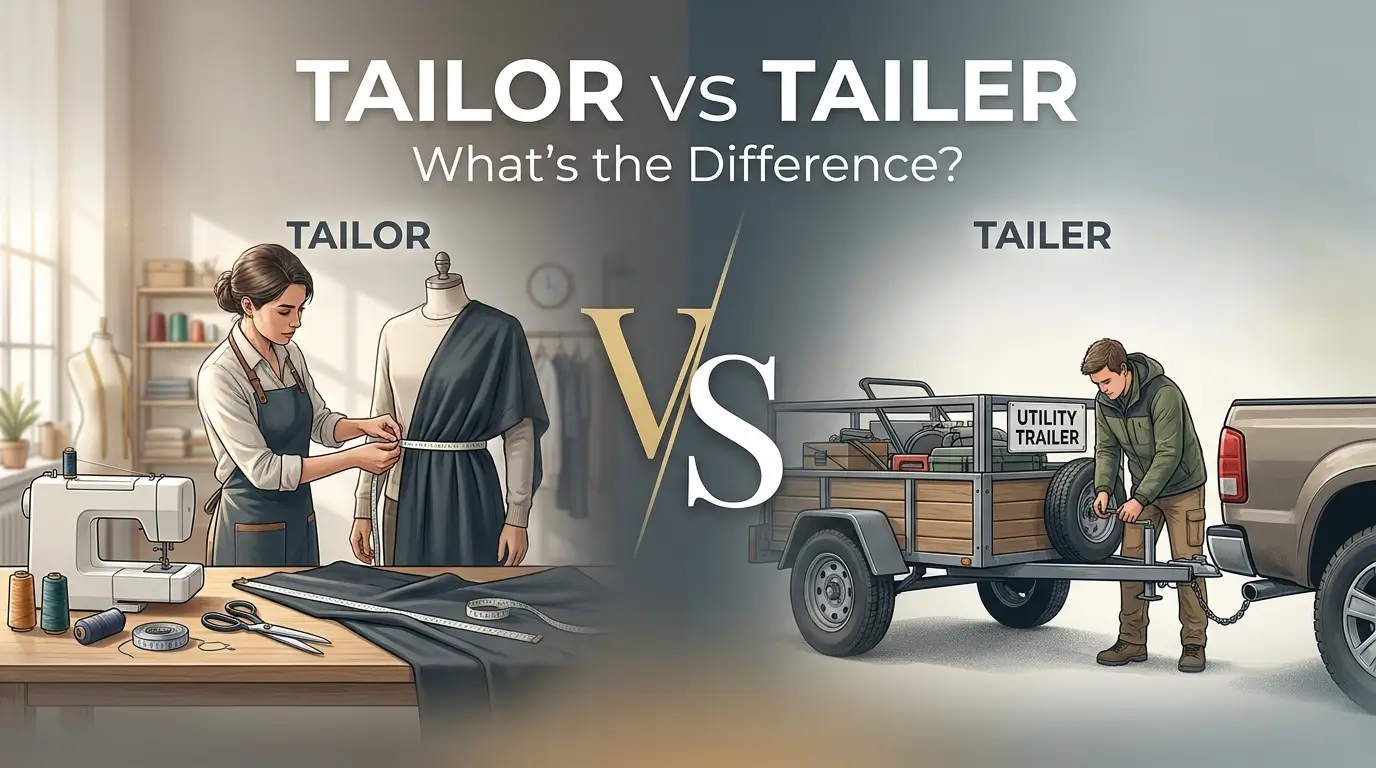
Choosing between tailor or tailer can be confusing because the two words look almost the same and are pronounced very similarly. However, they do not normally mean the same thing. Tailor is the common word for a person who makes, repairs, or alters clothes, while tailer has several specialized meanings linked to the verb tail and to fishing.
People often search for tailor or tailer when they are writing about clothing, jobs, fashion, fishing, or someone following another person. The extra e can completely change the meaning. In most everyday situations involving clothes, tailor is the word you want.
Understanding tailor or tailer also helps prevent spelling mistakes in emails, resumes, schoolwork, product descriptions, and everyday conversations. The difference is not mainly a British-versus-American spelling issue. Instead, these are separate words with different histories and meanings.
In this guide, we will explain tailor or tailer in simple terms, including pronunciation, word origins, parts of speech, regional usage, common mistakes, examples, and practical advice for choosing the right word.
Quick Answer
Tailor is the correct word when you mean a person who makes, repairs, or alters clothing. It is also a verb meaning to adapt something for a particular person, purpose, or need.
Tailer is a real English word, but it is much less common. Merriam-Webster defines tailer as someone or something that tails or follows. It can also refer to certain fishing-related meanings and a type of fish.
Examples:
- Correct: I took my suit to the tailor.
- Correct: She asked the tailor to shorten her trousers.
- Correct: We need to tailor the lesson to the students.
- Correct in a specialized context: The detective was the tailer following the suspect.
So, if you are talking about clothes or adapting something to suit a need, use “tailor.”
If you mean someone who follows or tails another person, tailer may be appropriate.
The Origin of Tailor or Tailer
The two words have different origins, even though their spellings are closely related.
The Origin of Tailor
Tailor comes from a long history connected with cutting cloth. The word was recorded in English in the late 13th century. It came through Anglo-French tailour and Old French tailleor, from taillier, meaning “to cut.” The deeper source is Late Latin tāliāre.
This history makes sense because the traditional work of a tailor involves measuring, cutting, shaping, and sewing fabric into clothing.
Over time, the noun tailor also produced a broader verb meaning to adapt something to particular needs or conditions.
For example:
The company tailored its service to small businesses.
Here, no clothing is involved. The verb developed a figurative sense based on the idea of making something fit a particular requirement.
The Origin of Tailer
Tailer has a different formation. Merriam-Webster traces one noun sense to tail + -er. In this construction, the suffix -er creates a noun for someone or something that performs an action. Thus, a tailer can be one that tails or follows.
Historical etymological records date the noun tailer meaning “one who follows” to the 19th century. It was formed from the verb tail.
There are also specialized fishing meanings. Collins lists tailer in British English as a fishing term for a fish that shows its tail at the surface or a pole with a loop used to land large fish.
Merriam-Webster also records another tailer noun referring to bluefish, with that sense described as an alteration of tailor.
So the spelling tailer is not simply a misspelling of tailor. It is a legitimate word with specialized meanings.
Pronunciation
The two words can sound very similar, and in some accents their pronunciation may be effectively identical.
Tailor is commonly pronounced with the vowel sound found in day, followed by the unstressed ending in -or. Dictionary.com gives the American pronunciation as /ˈteɪlər/ and the British form as /ˈteɪlə/.
Merriam-Webster gives tailer as /ˈtālə(r)/.
Because the words are so close in sound, context is often the best way to understand which word someone means.
Parts of Speech: Tailor vs Tailer
Understanding the grammar of each word makes the difference easier to remember.
Tailor as a Noun
As a noun, tailor means a person whose work involves making, repairing, or altering clothes.
Example:
The tailor measured my jacket.
Here, tailor names a person.
Tailor as a Verb
As a verb, tailor means to make, adjust, or adapt something for a particular purpose.
Examples:
We tailored the presentation for younger students.
She tailored her resume for the job.
This broader verb is extremely common in modern English.
Tailer as a Noun
Tailer is primarily used as a noun in the dictionary senses discussed above. It can mean someone who follows another person, especially for surveillance, or can have specialized fishing and occupational meanings.
Example:
The tailer followed the suspect without being noticed.
It is not the normal word for someone who makes clothing.
British English vs American English Spelling
There is no standard British-versus-American spelling difference between tailor and tailer.
Both British and American English use:
- tailor for the clothing profession and the related verb
- tailer for its specialized meanings
The important distinction is therefore meaning, not regional spelling.
| Word | British English | American English | Main meaning |
| tailor | Tailor | Tailor | Clothing worker; adapt |
| tailer | Tailer | Tailer | One who tails; specialized fishing meanings |
| Clothing professional | Tailor | Tailor | Makes or alters clothing |
| Adapt something | Tailor | Tailor | Make suitable for a need |
| Person who follows | Tailer | Tailer | Specialized noun |
You should not change tailor to tailer simply because your audience is American or British.
The same basic distinction applies in both varieties of English.
Which Spelling Should You Use?
For most readers, the answer is simple:
Use “Tailor” for Clothing
Use tailor when discussing:
- Suits
- Dresses
- Jackets
- Trousers
- Shirts
- Alterations
- Custom clothing
- Sewing and fitting
Example:
I need to visit the tailor before the wedding.
Use “Tailor” for Adaptation
Use tailor when you mean “adapt to suit.”
Examples:
Tailor your application to the job.
The teacher tailored the lesson to the class.
We tailored the package to meet the customer’s needs.
This use is very common in professional English.
Use “Tailer” Only When Its Meaning Fits
Use tailer when you genuinely mean one of its specialized senses.
For example, a dictionary may use tailer for someone who follows another person or for particular fishing-related meanings.
For general writing, however, tailer is much less common than tailor.
Common Mistakes with Tailor or Tailer
Mistake 1: Writing “Tailer” for a Clothing Worker
Incorrect:
I went to the tailer to fix my suit.
Correct:
I went to the tailor to fix my suit.
The clothing professional is a tailor.
Mistake 2: Assuming Tailer Is Always Wrong
It is not.
Tailer is a legitimate dictionary word. It simply has different and less common meanings. Merriam-Webster lists meanings involving following, fishing, and other specialized contexts.
Mistake 3: Confusing Tailor With Tailor-Made
Correct:
She bought a tailor-made suit.
Not:
She bought a tailer-made suit.
The expression comes from tailor, the clothing-related word.
Mistake 4: Using Tailer When You Mean “Adapt”
Incorrect:
We will tailer the course for beginners.
Correct:
We will tailor the course for beginners.
The verb meaning “adapt” is tailor.
Mistake 5: Choosing Based Only on Sound
Because the words can sound very similar, listening alone may not be enough.
Instead, look at the meaning.
If the sentence involves clothing or customization, choose tailor.
If it involves following someone or a specialized fishing context, tailer may be correct.
Everyday Examples
Seeing the words in realistic sentences is one of the fastest ways to learn them.
In an Email
Dear Mr. Ahmed,
I would like to ask whether your tailor can alter a suit before Friday.
Here, tailor refers to the clothing professional.
Another professional example:
We can tailor the proposal to match your company’s requirements.
Here, tailor is a verb meaning “adapt.”
In News Writing
A news report about fashion might say:
The tailor created a custom suit for the actor.
A report about surveillance could potentially use tailer:
Investigators identified the person acting as a tailer.
The second example uses the specialized noun sense of tailer.
On Social Media
My tailor did an amazing job on this jacket!
Or:
Always tailor your resume to the job you want.
Both uses of tailor are natural.
In Formal Writing
The training program was tailored to meet the needs of new employees.
This is a standard professional use of tailored. Dictionary examples also show the verb being used for adapting services, lessons, advertising, and other things to particular needs.
In Everyday Conversation
Do you know a good tailor?
Can you tailor this jacket?
We should tailor the plan to our budget.
These are all normal uses of tailor.
Comparison Table
| Feature | Tailor | Tailer |
| Common English word | Yes | Yes, but less common |
| Main everyday meaning | Person who makes or alters clothes | One who tails or follows |
| Can be a verb? | Yes | Generally used as a noun in the cited dictionary senses |
| Clothing meaning | Yes | No, not normally |
| Means “adapt” | Yes | No |
| Fishing meanings | Not the main use | Yes, in specialized terminology |
| Pronunciation | Very similar | Very similar |
| British spelling | Tailor | Tailer |
| American spelling | Tailor | Tailer |
| Common learner mistake | Confusing it with tailer | Using it instead of tailor |
| Example | “The tailor fixed my suit.” | “The tailer followed him.” |
The key lesson is simple: tailor is the everyday word you are likely to need, while tailer is a specialized word with separate meanings.
How to Remember the Difference
A simple memory trick can help.
Think:
TAILOR = CLOTHES
The word tailor is connected historically with cutting and shaping, which fits its clothing meaning.
You can also remember:
TAILER = ONE WHO TAILS
The spelling contains tail, and Merriam-Webster explains one major sense as someone or something that tails.
Try this mental picture:
Tailor → tape measure, fabric, suit
Tailer → following someone, fishing
This quick association can prevent most spelling errors.
Search Intent Behind “Tailor or Tailer”
People who search tailor or tailer are usually trying to solve one of three problems.
First, they may be unsure how to spell the word for someone who makes or alters clothes.
Second, they may have encountered tailer and want to know whether it is a real word.
Third, they may be checking a sentence where the words sound similar.
The most important distinction is therefore not British versus American English. It is meaning and context.
There is also no need to use unsupported search-volume claims to understand this query. Search interest can show that people are looking for clarification, but it does not prove how frequently either word is used in everyday English.
For normal communication, tailor will be the correct choice far more often when the topic is clothing, customization, or adaptation.
FAQs
1. Is “tailor” or “tailer” correct for someone who makes clothes?
Tailor is correct. A tailor is a person who makes, repairs, or alters clothing, especially garments such as suits and coats.
2. Is “tailer” a real word?
Yes. Tailer is a legitimate English word. It can mean someone who follows or tails another person, and it also has specialized fishing-related meanings.
3. Is tailor a noun or a verb?
It can be both. As a noun, it refers to a clothing professional. As a verb, it means to make or adapt something for a particular purpose or need.
4. Is tailer a British spelling of tailor?
No. Tailer is not the British spelling of tailor. Both British and American English use tailor for the clothing profession. Tailer is a separate word with specialized meanings.
5. Do tailor and tailer sound the same?
They can sound extremely similar, and in some accents they may be effectively homophonous. This is one reason the spelling can cause confusion.
6. Should I write “tailor your resume” or “tailer your resume”?
Write “tailor your resume.” Here, tailor is a verb meaning to adapt the resume to a particular job or audience.
7. What is the easiest way to remember tailor vs tailer?
Remember tailor = clothes or adapt. Think of tailer = one who tails, plus its specialized fishing meanings. That distinction covers most everyday cases.
Conclusion
The choice between tailor and tailer becomes easy once you focus on meaning. Tailor is the normal word for clothing work and for adapting something to fit a need.
Tailer is not simply a spelling error. It is a real but less common word used in specialized contexts, including following and fishing-related meanings.
When writing emails, essays, resumes, or daily messages, use tailor whenever you mean clothing or adaptation. Context will guide you to the right word.
Keep practicing these words in real sentences, and the difference will soon feel natural. Use them in your writing and conversations to build confidence.

Anton Reyes is a contributing writer at DiffNexx.com, where he explores meaningful differences in language, culture, and everyday concepts. With a background in creative nonfiction, Anton brings clarity and balance to complex comparisons. His writing helps readers understand subtle distinctions in words and ideas, making learning both insightful and engaging.








5 thoughts on “Tailor or Tailer: Key Differences You Need in 2026”