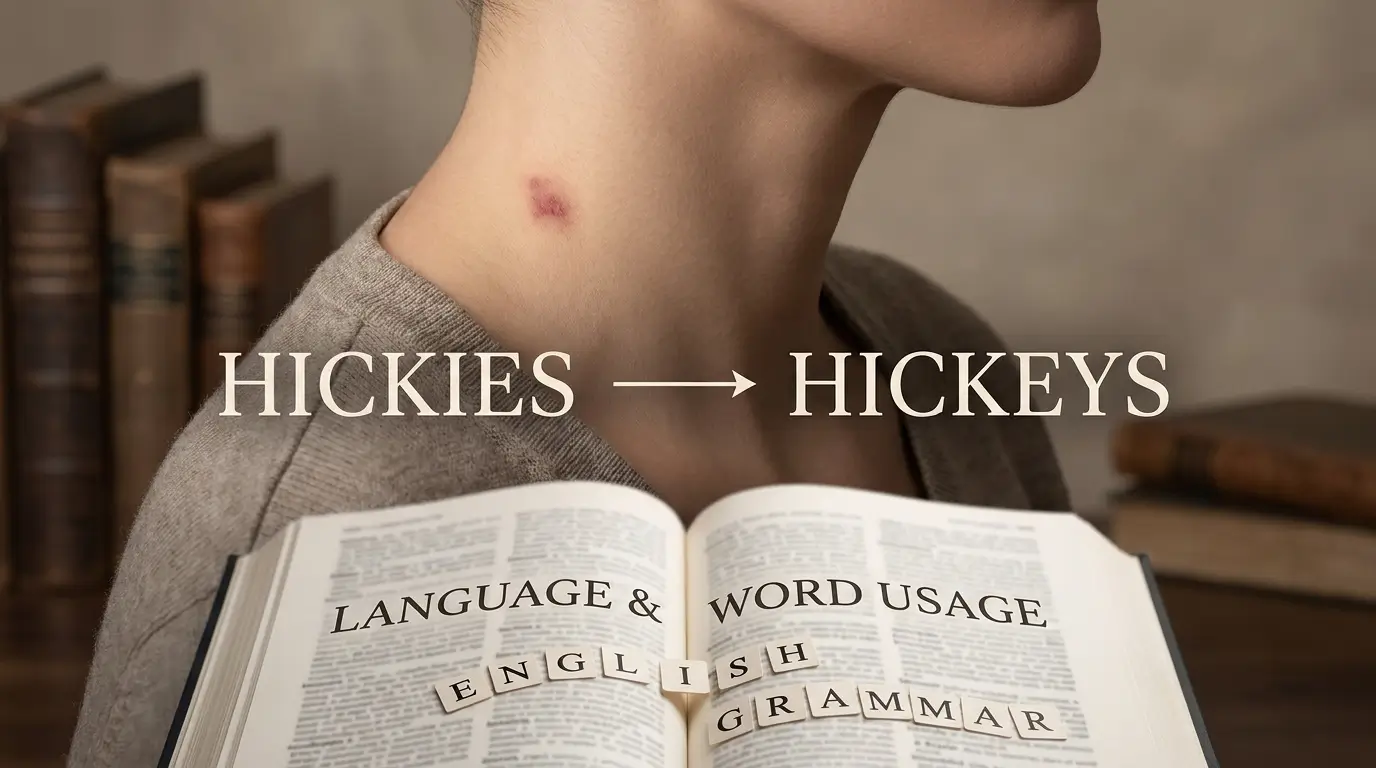
When writing the plural of hickey, many people stop and wonder: should it be hickies or hickeys? Both forms appear online, which makes the choice even more confusing. If you are writing a text, social media post, article, email, or school assignment, knowing which form is standard can help you avoid an unnecessary spelling mistake.
The confusion becomes stronger because hickey and hickie are both found in English. The spelling with -ey is the standard dictionary form, while hickie is recognized as an alternative spelling. This leads to the plural forms hickeys and hickies.
So, are hickies or hickeys both correct? In most ordinary writing, hickeys is the safer and more widely established plural of hickey. Hickies can occur when the singular form is written as hickie, and some dictionaries also record it for a particular printing sense.
This guide explains hickies or hickeys, their origins, pronunciation, British and American usage, common mistakes, and the best spelling to use in different situations.
Quick Answer
The short answer is:
Hickeys is the standard plural of hickey.
Hickies is also found, mainly as the plural of the alternative spelling hickie. It is less useful as the default choice when you are writing the standard form hickey.
For example:
- She noticed two hickeys on his neck. ✓
- The movie character tried to hide his hickeys. ✓
- She noticed two hickies on his neck. ✓ when using the alternative singular hickie
- The hickey was easy to notice. ✓
Merriam-Webster lists hickey as a noun with the plural hickeys. It also notes hickies as an alternative plural for a printing-related sense.
The word is a noun. In its common informal sense, it refers to a temporary reddish mark on the skin caused by biting or sucking. Dictionaries also record other meanings, including a small gadget or an imperfection in printing.
The simple rule
If your singular noun is:
hickey → hickeys
If you deliberately use the alternative spelling:
hickie → hickies
For most readers, hickeys is the clearest choice.
The Origin of Hickies or Hickeys
The history of hickey is not completely certain. Reliable dictionaries describe its origin as unknown or obscure, so it would be misleading to claim a definite source.
Merriam-Webster gives the first known use of hickey as 1913 for a gadget-related meaning and around 1918 for a skin-related meaning. It identifies the etymology as unknown.
Oxford also describes hickey as an early-20th-century word of unknown origin.
The hickie spelling has its own history. The Online Etymology Dictionary records hickie in the skin-mark sense from the early 20th century and describes it as a spelling variation connected with the earlier word hickey. It also records the skin-related sense from the 1930s.
Another dictionary source gives an alternative spelling hickie and notes that the origin of hickey is obscure.
Why are there two spellings?
English often develops spelling variants, especially with informal words. A word may appear in different spellings before one form becomes more common in dictionaries and general writing.
That appears to be the situation with hickey and hickie.
The important point is that there is no reliable basis for claiming that one spelling came from a specific country or that one spelling has a completely different historical origin. The safest explanation is that hickie is an established variant of hickey, while hickey is the standard form in major modern dictionaries.
What does hickey mean?
In its common informal use, a hickey is a temporary red or reddish mark on the skin, often on the neck, caused by sucking or biting during intimate contact. Cambridge and Oxford both give this meaning.
The word can have other meanings too. Merriam-Webster lists hickey as a term for a gadget or unspecified device and also records a printing sense involving a small imperfection.
So context matters.
How Do You Pronounce Hickey and Hickies?
Hickey is pronounced with two syllables.
Its dictionary pronunciation is approximately:
HICK-ee
The standard pronunciation is represented as /ˈhɪki/.
The plural hickeys adds a plural -z sound:
hickeys
Likewise, hickie and hickies follow the same basic vowel pattern.
This means the difference between hickeys and hickies is primarily a spelling difference, not a major pronunciation difference.
For learners, this is useful because hearing the word alone may not tell you which spelling the writer used.
British English vs American English Spelling
There is a real regional usage difference with hickey, but it is not a simple British-versus-American spelling rule like color/colour.
Cambridge labels the skin-mark meaning as US, while giving love bite as the UK term. Oxford similarly identifies hickey as North American English and gives love bite for British English.
Collins also describes the skin-mark sense as American usage and notes that British English uses hickey for other meanings, such as a gadget or a printing imperfection.
Comparison table
| Feature | American English | British English |
| Common term for a love bite | hickey | love bite |
| Standard spelling | hickey | hickey can occur, especially for other meanings |
| Alternative spelling | hickie | hickie may occur |
| Plural of hickey | hickeys | hickeys when hickey is used |
| Pronunciation | /ˈhɪki/ | /ˈhɪki/ |
| Main regional difference | hickey is common for the skin mark | love bite is more usual for that meaning |
The key lesson is that hickeys is not simply the “American spelling” while hickies is the “British spelling.” That would be an inaccurate rule.
The stronger regional difference concerns the word used for the concept, rather than a fixed spelling change from hickeys to hickies.
Which Spelling Should You Use?
For most readers, choose hickeys.
It is the natural plural when the singular word is hickey, which is the standard dictionary headword. Merriam-Webster explicitly gives hickeys as the plural.
Use hickies when you are intentionally using hickie as the singular form or when a source, style, or context specifically uses that variant.
For American readers
Hickeys is the best default choice.
Example:
The characters tried to hide their hickeys before the meeting.
For British readers
If you mean the skin mark, love bite is often the more natural term.
Example:
She noticed a love bite on his neck.
If you are discussing the spelling itself, however, hickey and hickeys remain useful forms to recognize.
For international audiences
Choose hickeys if you need the term and your audience understands American informal English.
If your article is aimed mainly at British readers, love bite may be clearer.
Common Mistakes with Hickies or Hickeys
1. Treating hickies as the only correct plural
Incorrect assumption:
Hickies is always the correct plural.
Not quite.
If the singular is hickey, the standard plural is hickeys. Hickies makes sense when the singular is hickie or in specific recorded usage.
2. Assuming the spelling changes by country
Some writers believe:
American = hickeys
British = hickies
This is too simple and does not reflect dictionary evidence.
The major British-American difference is that British English commonly uses love bite for the skin mark, while American English commonly uses hickey.
3. Writing hickey’s for the plural
This is a common English mistake.
Hickey’s is possessive, not plural.
- Two hickeys = two marks.
- The hickey’s color = the color belonging to the hickey.
Do not use an apostrophe simply to make hickey plural.
4. Confusing hickie with hickey
Hickie is an established variant, so it is not simply a random spelling error. However, hickey is the better default form for general writing.
5. Using a slang word in formal writing
Hickey is informal in the skin-mark sense. Cambridge and Collins identify this usage as informal.
In a formal medical or professional context, a more neutral description such as skin mark, bruise, or another medically appropriate term may be better, depending on what you actually mean.
Hickies or Hickeys in Everyday Examples
The best way to understand the difference is to see how each form works in real sentences.
Text messages
Informal communication often uses hickeys naturally:
“I hope no one notices those hickeys.”
This is casual language and fits a personal conversation.
Social media
A post might say:
“How can I cover up hickeys before work?”
Again, hickeys is the normal plural when the singular is hickey.
News writing
News writing generally avoids slang unless the subject or quotation requires it. If the word appears in a news story, the writer may use hickey when it is relevant to a person’s exact words or the topic.
Educational writing
A language article can discuss the spelling directly:
“Hickeys is the standard plural of hickey.”
This is appropriate because the word itself is the subject.
Formal writing
In a formal report, the slang term may not be the best choice:
“The patient had a temporary mark on the skin.”
The exact wording should depend on the purpose and audience.
Everyday conversation
A speaker might say:
“He had several hickeys after the weekend.”
Here, hickeys works naturally as the plural noun.
Hickies vs Hickeys: Side-by-Side Comparison
| Word | Status | Meaning | Example |
| hickey | Standard singular | A temporary skin mark; also other meanings | He had a hickey. |
| hickeys | Standard plural | More than one hickey | She noticed two hickeys. |
| hickie | Variant singular | Alternative spelling of hickey | He had a hickie. |
| hickies | Variant plural | Plural of hickie; also recorded in some dictionary senses | The text used the spelling hickies. |
Merriam-Webster explicitly lists hickeys as the plural of hickey and records hickies as an additional plural form for one of its meanings.
This distinction makes the answer much clearer: hickies or hickeys is not a case where both spellings are equally interchangeable in every sentence.
Is Hickeys More Common Than Hickies?
For the standard word hickey, hickeys is the natural default because dictionaries list it as the regular plural.
The alternative spelling hickie is also recognized. Dictionary.com lists hickie as an alternative form, while Merriam-Webster has a separate entry identifying hicky as a variant spelling of hickey.
This shows why both forms can appear in searches and informal writing.
However, search results alone should not be treated as proof that two spellings have equal status. Online usage can contain personal preferences, informal spellings, typos, quotations, and regional habits.
For polished writing, the safest approach is simple:
Use hickey → hickeys.
Is Hickie a Misspelling of Hickey?
Not necessarily.
Hickie is recorded as an alternative spelling, so it has legitimate dictionary support.
That said, the existence of a variant does not mean you should use it whenever you want. In general-purpose English writing, hickey is the clearer and more standard choice.
Think of it this way:
- hickey = standard headword
- hickeys = standard plural
- hickie = recognized variant
- hickies = plural associated with the variant
This gives you a reliable rule without claiming that the alternative form is completely wrong.
7 Quick Facts About Hickies or Hickeys
- Hickey is a noun.
- Hickeys is the standard plural of hickey.
- Hickie is an established alternative spelling.
- Hickies can be used as the plural of hickie.
- The words are pronounced with the same basic sound pattern.
- The origin of hickey is considered unknown or obscure.
- British English commonly uses love bite for the skin-mark meaning, while American English commonly uses hickey.
FAQs About Hickies or Hickeys
Is hickeys or hickies correct?
Hickeys is the standard plural of hickey. Hickies is also found as the plural associated with the alternative spelling hickie, and dictionaries record it in some contexts.
What is the plural of hickey?
The standard plural is hickeys.
For example:
She had two hickeys.
Merriam-Webster lists hickeys as the plural form.
Is hickie a real word?
Yes. Hickie is recognized as an alternative spelling of hickey. Dictionary.com and etymological sources record the variant.
Is hickies a correct spelling?
Yes, but context matters. Hickies can be the plural of the variant hickie, and Merriam-Webster also records hickies for a particular printing-related sense. For the standard singular hickey, use hickeys.
Do British people say hickey?
They can, but love bite is the more established British term for the skin mark. Cambridge and Oxford both distinguish the North American term hickey from British love bite.
Are hickey and hickie pronounced differently?
Generally, no. The two spellings represent essentially the same pronunciation. The main difference is written form rather than sound.
Is hickey a formal word?
The skin-mark sense is generally informal. In formal or professional writing, a neutral description may be more suitable.
Conclusion
When choosing between hickies or hickeys, the safest standard form is hickeys. It is the regular plural of the dictionary headword hickey and works well in general English writing.
Hickies is not simply an error. It can come from the recognized variant hickie, and dictionaries also record the form in specific contexts. The key is knowing which singular spelling you are using.
Regional usage matters too. American English commonly uses hickey, while British English often prefers love bite for the same skin mark. Neither spelling should be treated as a simple UK-versus-US rule.
Once you remember hickey → hickeys, the choice becomes easy. Practice the distinction in emails, essays, and daily conversations to make your English more natural and confident. English is full of similarly confusing word pairs — for another example, see our guide to tailor vs tailer.

Anton Reyes is a contributing writer at DiffNexx.com, where he explores meaningful differences in language, culture, and everyday concepts. With a background in creative nonfiction, Anton brings clarity and balance to complex comparisons. His writing helps readers understand subtle distinctions in words and ideas, making learning both insightful and engaging.







