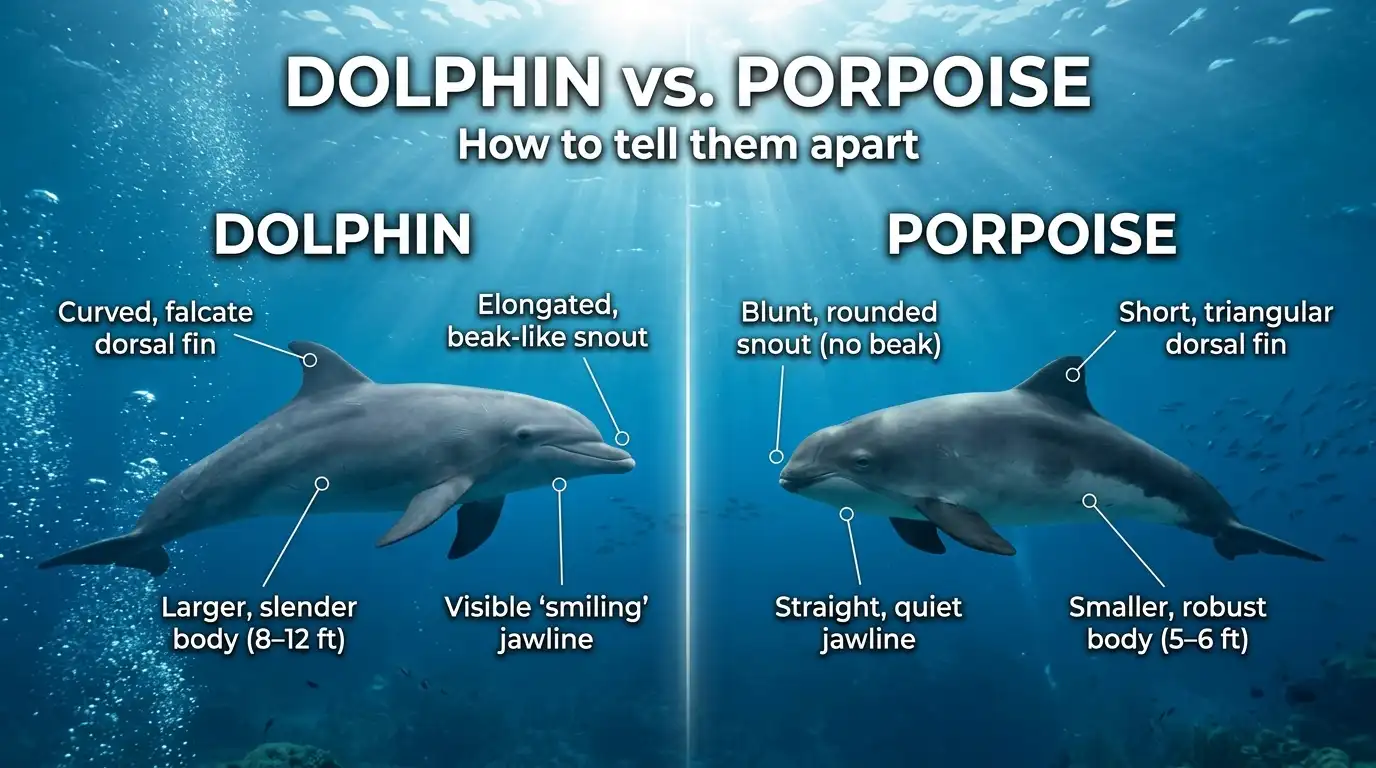
The difference between dolphin and porpoise is easiest to see in their faces, teeth, and dorsal fins. Dolphins often have a long, narrow snout called a beak, pointed cone-shaped teeth, and a curved fin on their backs. Porpoises usually have a shorter, rounder face, flat spade-shaped teeth, and a triangular dorsal fin.
Both are warm-blooded marine mammals. They breathe air, give birth to live young, feed their babies milk, and use sound to find food and navigate underwater. They may look alike from a distance, but they belong to different biological families.
Knowing the difference between dolphin and porpoise can help you identify these animals and understand how they live in the ocean.
Dolphin vs. Porpoise: Quick Comparison
| Feature | Dolphin | Porpoise |
|---|---|---|
| Scientific family | Delphinidae for oceanic dolphins | Phocoenidae |
| Face | Often has a long, visible beak | Usually has a short, blunt snout |
| Teeth | Usually cone-shaped | Usually flat and spade-shaped |
| Dorsal fin | Often curved or hooked | Usually triangular |
| Body shape | Often streamlined and slender | Often shorter and stockier |
| Typical size | Many species are medium to large | Many species are relatively small |
| Social behavior | Many species form active social groups | Many species are seen in smaller groups |
| Communication | Uses sounds, including clicks and whistles | Uses clicks and other sounds |
| Echolocation | Yes | Yes |
| Examples | Bottlenose dolphin, common dolphin, orca | Harbor porpoise, Dall’s porpoise |
These are general patterns, not rules for every species. Some dolphins have short snouts, and some have unusual dorsal fins. Body size and social behavior also vary.
What Is a Dolphin?
A dolphin is a marine mammal in the dolphin group. Oceanic dolphins belong to the family Delphinidae, which includes bottlenose dolphins, common dolphins, and orcas.
Dolphins have lungs, so they must come to the water’s surface to breathe. They use a blowhole on top of the head to take in air. They also use sound to communicate and locate prey.
Many dolphins have streamlined bodies that help them swim quickly. Their mouths often form a clear beak, and their teeth are usually pointed.
Common Types of Dolphins
- Bottlenose dolphin: Known for its rounded forehead and distinct snout.
- Common dolphin: Often recognized by its patterned sides and slender body.
- Spinner dolphin: Known for its spinning leaps out of the water.
- Orca: Also called the killer whale, it is the largest member of the dolphin family.
The orca is an important example because it shows why common names can be confusing. Despite having “whale” in its name, an orca is biologically a dolphin.
What Is a Porpoise?
A porpoise is a small toothed marine mammal in the family Phocoenidae. Porpoises are closely related to dolphins, but they have distinct physical features.
Most porpoises have compact bodies, short snouts, and small mouths. Their teeth are usually flattened and shaped like tiny spades rather than pointed cones.
Porpoises also use echolocation. They send out sound signals and listen for returning echoes. This helps them detect prey and understand their surroundings, even when the water is dark or cloudy.
Common Types of Porpoises
- Harbor porpoise: A small porpoise often found in coastal waters.
- Dall’s porpoise: A fast-swimming species known for its dark body and pale patches.
- Vaquita: A rare porpoise found only in the northern Gulf of California.
The vaquita is critically endangered. Its survival is threatened mainly by accidental capture in fishing gear. This makes the difference between identifying a porpoise and protecting its habitat especially important.
5 Ways to Tell a Dolphin From a Porpoise
1. Look at the Snout
The face is often the easiest feature to compare.
Many dolphins have a long, narrow beak that extends from the front of the head. A bottlenose dolphin is a familiar example.
Porpoises usually have a shorter, rounded snout without a clear beak. Their heads tend to blend more smoothly into the body.
However, not every dolphin has a long beak. Orcas and some other dolphin species have a more rounded face. Look for several features instead of relying on the snout alone.
2. Check the Dorsal Fin
The dorsal fin is the fin on the animal’s back.
Many dolphins have a curved or sickle-shaped dorsal fin. The rear edge bends back, giving the fin a crescent-like appearance.
Porpoises usually have a triangular dorsal fin. It often looks shorter and more pointed.
This is a useful clue when an animal surfaces far away. Still, some dolphins have triangular fins, and some species have no visible dorsal fin at all.
3. Compare Their Teeth
Teeth provide one of the clearest biological differences.
Dolphins usually have cone-shaped teeth. These pointed teeth help them grip fish and other prey.
Porpoises usually have flattened, spade-shaped teeth. Their shape is different from the narrow cones found in most dolphins.
You usually cannot see the teeth when an animal swims past a boat. Scientists use tooth shape, along with other physical traits, to identify and classify species.
4. Consider Body Shape and Size
Many dolphins have long, streamlined bodies. Some species grow much larger than most porpoises.
Porpoises often have shorter, stockier bodies. Many are small enough to be mistaken for young dolphins when seen briefly.
Size alone is not a reliable way to identify them. Dolphin species vary greatly, and some are quite small. The best approach is to compare body shape with the snout and dorsal fin.
5. Observe Their Behavior
Dolphins are often seen jumping, riding waves, or swimming in active groups. Some species interact with boats, and many live in complex social groups.
Porpoises are often more difficult to observe. They may surface quietly and spend less time making the dramatic leaps people associate with dolphins.
These differences are tendencies, not strict rules. Some dolphins remain quiet, and porpoises can also be social. Behavior alone cannot confirm an animal’s identity.
Are Dolphins and Porpoises the Same Kind of Animal?
They are closely related, but they are not the same group of animals.
Both belong to the order Cetacea, which includes whales, dolphins, and porpoises. Both dolphins and porpoises are toothed cetaceans, a group known as Odontoceti.
The main taxonomic difference is their family. Oceanic dolphins belong to Delphinidae, while porpoises belong to Phocoenidae.
This distinction matters because common names do not always match scientific classification. The orca is called a whale, for example, but it belongs to the dolphin family.
In short, dolphins and porpoises share a common evolutionary background, but their body features and family classifications set them apart.
What Do Dolphins and Porpoises Eat?
Both animals eat other aquatic animals, but their diets depend on their species and habitat.
Dolphins commonly eat fish and squid. Some species also eat crustaceans. Their pointed teeth help them catch and hold prey.
Porpoises also feed on fish and squid, along with other small marine animals. Their diet varies with the species and the food available in their environment.
Neither group chews food in the same way humans do. Toothed cetaceans generally grip prey and swallow it, often whole.
Where Do Dolphins and Porpoises Live?
Dolphins live in oceans around the world. Some prefer warm tropical waters, while others live in cooler seas. Certain dolphin species also inhabit rivers.
Porpoises are found mainly in marine waters, often in coastal regions or cooler seas, though their habitats vary by species. Harbor porpoises, for example, often live near coasts and in shallow bays.
Not every dolphin lives in the open ocean, and not every porpoise stays close to shore. Their range depends on the species, water conditions, food supply, and other habitat needs.
Are Dolphins More Intelligent Than Porpoises?
It is difficult to compare the intelligence of two entire animal groups with one simple ranking.
Dolphins have been studied for their social behavior, communication, learning, and problem-solving skills. Some species use tools and learn behaviors from other members of their groups.
Porpoises also have complex sensory systems and use echolocation to find food and navigate. However, scientists have studied some dolphin species more extensively than many porpoise species.
Differences in research, behavior, and the tests used make a simple comparison unreliable. It is more accurate to study the abilities of specific species than to claim that every dolphin is smarter than every porpoise.
Common Mistakes About Dolphins and Porpoises
Mistake 1: Calling every small cetacean a dolphin.
Some small animals that look like dolphins are actually porpoises. Their teeth, snout, and dorsal fin can help tell them apart.
Mistake 2: Assuming every dolphin has a long beak.
Many do, but orcas and several other dolphin species have shorter or less distinct snouts.
Mistake 3: Thinking porpoises are baby dolphins.
Porpoises are a separate group of animals. They are not young dolphins.
Mistake 4: Using size as the only clue.
Size varies among species. A proper identification should consider several physical features.
Mistake 5: Thinking the terms “whale” and “dolphin” always describe separate groups.
Common names can be confusing. Orcas, despite their name, are members of the dolphin family.
Frequently Asked Questions
1. What is the main difference between a dolphin and a porpoise?
Dolphins usually have longer beaks, cone-shaped teeth, and curved dorsal fins. Porpoises generally have short, rounded snouts, spade-shaped teeth, and triangular dorsal fins.
2. Which is bigger, a dolphin or a porpoise?
Many dolphin species are larger than porpoises, but size depends on the species. Some dolphins are small, while orcas are very large members of the dolphin family.
3. Do dolphins and porpoises both use echolocation?
Yes. Both use echolocation to detect prey and understand their surroundings. They send out sounds and use the returning echoes to gather information.
4. Can dolphins and porpoises live in the same waters?
Yes. Their habitats can overlap, depending on the species and region. Both may be found in coastal waters, although their preferred habitats vary.
5. Is an orca a dolphin or a whale?
An orca, also called a killer whale, belongs to the dolphin family. Its common name includes the word “whale,” but its scientific classification makes it the largest member of Delphinidae.
6. Are porpoises endangered?
Some porpoise species face serious threats. The vaquita is critically endangered, largely because of accidental capture in fishing gear. Conservation needs differ by species and location.
Test Your Knowledge: Dolphin vs. Porpoise
1. Which teeth do porpoises usually have?
A. Flat, spade-shaped teeth
B. Large grinding teeth
C. No teeth
D. Long tusks
Correct answer: A. Flat, spade-shaped teeth
2. Which dorsal fin shape is common in many dolphins?
A. Square
B. Curved or sickle-shaped
C. Completely flat
D. Always triangular
Correct answer: B. Curved or sickle-shaped
3. Which animal belongs to the dolphin family?
A. Harbor porpoise
B. Vaquita
C. Orca
D. Dall’s porpoise
Correct answer: C. Orca
4. What do dolphins and porpoises use echolocation for?
A. Breathing air
B. Finding prey and navigating
C. Producing milk
D. Keeping their bodies warm
Correct answer: B. Finding prey and navigating
5. Are porpoises baby dolphins?
A. Yes, always
B. Only in cold water
C. No, they are a separate group
D. Only near the coast
Correct answer: C. No, they are a separate group
6. Which feature is often useful for telling a dolphin from a porpoise?
A. Whether it lives in water
B. Whether it breathes air
C. Snout shape and tooth shape
D. Whether it has a tail
Correct answer: C. Snout shape and tooth shape
Conclusion
Dolphins and porpoises share many traits, but they belong to different families and have distinct physical features. Dolphins often have beaks, pointed teeth, and curved dorsal fins. Porpoises usually have rounded snouts, spade-shaped teeth, and triangular fins.
When identifying one in the wild, look at several features together rather than relying on size or behavior alone. This gives you a clearer idea of which animal you are seeing.
Sources

Aamer Shahzad is the founder of Diffnexx.com, a fast-growing educational platform focused on high-intent “difference between” topics. With over 8 years of experience in English language education and analytical writing, I specialize in breaking down complex “difference between” topics into clear, structured, and easy-to-understand explanations. Diffnexx.com is your go-to resource for enhancing English skills and writing with confidence.
I specializes in building search-optimized, research-driven comparison content designed for clarity, authority, and long-term digital asset value.







