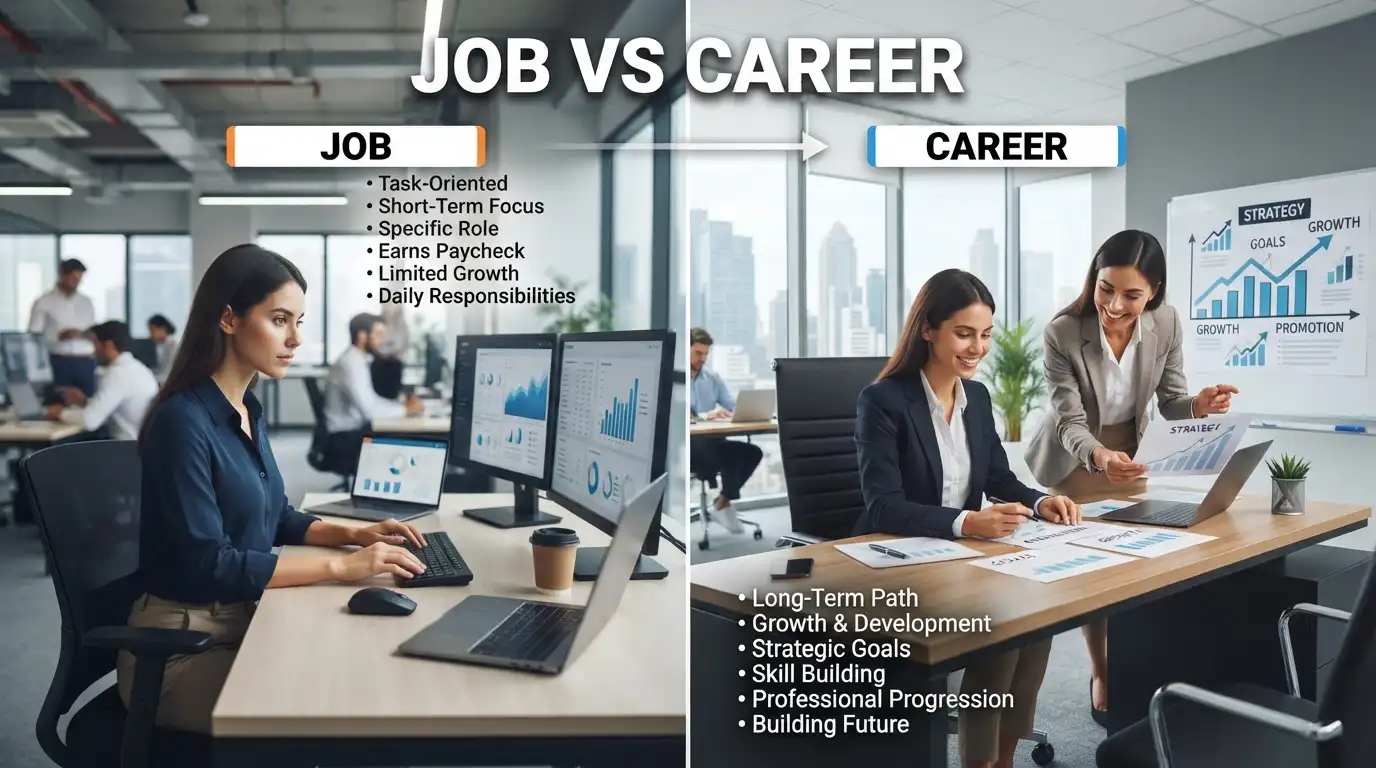
The difference between job and career is mainly about scope, purpose, and time. A job is a specific role or position you do in exchange for pay. A career is the broader path you build through your work, skills, experience, education, and professional goals. You can have several jobs during one career, and one job can sometimes become an important part of a long-term career.
The difference between job and career does not mean that one is always better than the other. A person may take a job for income, flexibility, experience, or a temporary need. A career usually involves a longer view of professional growth and direction.
Understanding the difference between job and career can also help you use these words correctly in English. You “get a job,” “apply for a job,” and “lose a job,” while you usually “build a career,” “start a career,” or “change careers.”
Job vs. Career at a Glance
| Feature | Job | Career |
|---|---|---|
| Meaning | A specific paid role or position | A person’s broader professional journey |
| Main focus | Current work and income | Long-term development and direction |
| Time | May be short-term or long-term | Usually develops over many years |
| Number | One job at a time, though people can have multiple jobs | Can include many jobs and roles |
| Skills | May build specific or transferable skills | Usually involves continued skill development |
| Goals | Often focused on immediate needs | Often connected to longer-term goals |
| Example | Working as a cashier | Building a career in retail management |
| Can it change? | Yes, you can change jobs | Yes, you can change or redirect your career |
The key point is that a job is a position; a career is the larger professional journey. This distinction is also reflected in career-development resources that treat individual jobs and occupations as parts of broader career planning.
What Is a Job?
A job is work that a person performs, usually in exchange for money.
It can be full-time, part-time, temporary, permanent, seasonal, contract-based, or casual. A job can also be related to your long-term goals—or completely separate from them.
For example:
- A student works at a coffee shop during college.
- Someone takes a delivery job while looking for work in their field.
- A graduate accepts an entry-level office position.
- A person takes a six-month contract to earn money between longer-term opportunities.
All of these are jobs.
A common mistake is thinking that every job must be part of a carefully planned career. It does not have to be.
You can have a job simply because you need income, want flexible hours, want experience, or need a temporary source of work.
What Is a Career?
A career is the broader course of a person’s working life.
It can include several jobs, promotions, changes in employers, additional education, new skills, and changes in professional direction.
For example, someone might begin as a junior graphic designer, become a graphic designer, move into art direction, and later work as a creative director.
Those positions are different jobs, but together they can form a career in design.
A career does not have to follow a straight line. Career paths can change as people gain new interests, skills, experience, or responsibilities. CareerOneStop, a U.S. Department of Labor resource, encourages people to explore their interests, skills, values, occupations, and training options when planning their careers.
The Main Difference Between a Job and a Career
The easiest way to understand the difference is to think about one position versus the bigger journey.
A job answers:
What work am I doing now?
A career answers:
Where is my professional life going?
Imagine someone who works as a receptionist at a medical clinic.
If she took the position mainly to earn money while studying, it is simply a job.
If she plans to become a healthcare administrator and uses the position to learn about medical offices, build skills, and gain experience, the same job may become part of her career.
The workplace and job title can be exactly the same. What changes is the broader professional path.
A Job Can Be Part of a Career
This is one of the most important points to understand.
A job and a career are not completely separate things.
A job can be:
- A temporary source of income
- A way to gain experience
- A stepping stone to another role
- A long-term position
- Part of a larger career path
For example, consider a person who wants a career in software development.
Their path might look like this:
Intern → Junior Developer → Software Developer → Senior Developer → Engineering Manager
Each position is a job.
Together, the experience, skills, and progression can form a career.
Indeed also notes that a career can develop through multiple roles and that an individual job can provide transferable skills such as communication, problem-solving, and time management.
Does a Career Mean You Must Stay in One Job?
No.
A career can involve many employers and many job titles.
For example, someone could work as:
Teacher → Curriculum Specialist → Academic Coordinator → Education Consultant
They changed jobs several times, but the roles still connect to a broader career in education.
Likewise, changing employers does not automatically mean changing careers.
A marketing professional could move from one company to another while continuing to work in marketing. That is usually a job change, not necessarily a career change.
A career change is broader. It usually means moving into a different professional direction.
For example:
Accountant → Software Developer
That may represent a career change because the person has moved from one professional field into another.
Job vs. Career Examples
Example 1: Student
A university student works as a waiter on weekends.
The student plans to become an engineer.
The waiting job provides income, but it is not necessarily the student’s career.
Job: Waiter
Career goal: Engineering
Example 2: Nursing
Someone starts as a nursing assistant, completes additional training, becomes a registered nurse, and later moves into a nursing leadership role.
The individual has held different positions, but they are connected by a broader career in healthcare.
Jobs: Nursing assistant, registered nurse, nurse manager
Career: Nursing/healthcare
Example 3: Retail
A person starts as a sales assistant and later becomes a store supervisor and retail manager.
These roles can represent progression within one career path.
Jobs: Sales assistant, supervisor, manager
Career: Retail management
Example 4: Career Change
Someone works in banking for several years and later becomes a teacher.
Their previous banking positions were jobs within one professional direction. Moving into teaching represents a much larger change in career direction.
Job vs. Career: Which One Should You Focus On?
The answer depends on your situation.
If you urgently need income, finding a suitable job may be the most important goal.
If you are thinking about your long-term professional direction, career planning becomes more important.
In practice, you often need both.
A job can pay your bills today while also helping you build skills for tomorrow.
For example, a customer-service job may help someone develop communication, problem-solving, and conflict-management skills. Those skills can later be useful in sales, management, human resources, or other fields.
So you do not need to reject a job simply because it does not look like your final career.
How to Tell Whether a Job Is Part of Your Career
Ask yourself a few simple questions:
1. Does this work build useful skills?
Skills that transfer to other roles can make a job valuable even when the position itself is temporary.
2. Does the experience support your future goals?
A job related to your desired field may give you useful experience and professional knowledge.
3. Can you see a possible next step?
There does not need to be a perfect promotion ladder. But if the job gives you experience that can support future roles, it may fit your career path.
4. Are you learning something useful?
Learning can come from formal training, daily work, projects, colleagues, or new responsibilities.
5. Does the role fit your interests and values?
Career planning is not only about salary. Career resources commonly encourage people to consider interests, skills, values, working conditions, education, and the nature of the work itself.
Common Confusion: Job, Work, Occupation, and Career
These four words are related, but they are not interchangeable.
Job
A job usually means a particular position or paid role.
Example:
“I applied for a new job.”
Work
Work is a broader word. It can refer to an activity, effort, or the general thing someone does to earn a living.
Example:
“I have a lot of work today.”
You normally do not say “I have a work” when you mean a job.
Occupation
An occupation is the type of work a person does, often as a profession or regular activity.
Example:
“Her occupation is nursing.”
Career
A career refers to the broader professional journey over time.
Example:
“He built a career in journalism.”
This distinction is especially useful for English learners because these words often appear together but have different uses.
Common English Expressions With Job and Career
Learning the common word combinations can make the difference much easier to remember.
Common expressions with “job”
- Get a job
- Find a job
- Apply for a job
- Start a job
- Lose a job
- Quit a job
- Change jobs
- Have a full-time job
- Have a part-time job
Example:
“She applied for a new job last week.”
Common expressions with “career”
- Start a career
- Build a career
- Pursue a career
- Develop a career
- Advance your career
- Change careers
- Career path
- Career goals
- Career development
- Career planning
Example:
“He wants to build a career in engineering.”
Is a Job Always Short-Term?
No.
This is an important correction to a common oversimplification.
A job can last for many years. Calling something a “job” does not automatically mean that it is temporary.
Likewise, a career does not automatically mean a permanent position.
For example, a person could stay with one employer for 20 years and still describe their position as a job.
At the same time, a person’s career could include many short-term contracts.
So duration alone does not determine whether something is a job or a career.
The broader purpose and context matter more.
Is a Career Always About Promotion?
No.
Career growth does not always mean moving into management.
A person may develop professionally by:
- Learning new skills
- Earning qualifications
- Becoming more specialized
- Taking on complex projects
- Changing professional fields
- Becoming self-employed
- Moving into a different type of role
For example, an experienced software developer may choose to remain a technical specialist rather than become a manager.
That can still be a career path.
Can You Have a Career Without a Traditional Job?
Yes.
A career does not have to follow the traditional pattern of working for one employer.
People may build careers through:
- Freelancing
- Self-employment
- Entrepreneurship
- Contract work
- Consulting
- Creative work
- Portfolio careers
The exact structure varies by person and field.
Career planning resources also recognize self-employment and different forms of work as possible professional paths.
How to Turn a Job Into a Career
A job can become part of a career when you start thinking beyond the current position.
Build useful skills
Pay attention to skills that can help you in future roles.
For example, customer service can develop communication and problem-solving skills.
Look for meaningful experience
Take on tasks that give you experience related to the direction you want to pursue.
Set realistic career goals
Your next goal does not need to be ten years away.
Start with a practical question:
What would I like to be able to do next?
Keep learning
Training, education, certifications, and hands-on experience can all contribute to professional development, depending on the field.
Review your direction
Your first career plan does not have to be your final plan.
Interests and goals can change. CareerOneStop notes that career planning can involve changing direction over time.
Job vs. Career: A Simple Way to Remember
Use this rule:
Job = the position you have.
Career = the professional path you build.
Think of a career as a road.
A job is one stop along that road.
You may stay at one stop for years. You may move to another company.
That does not make your earlier job meaningless. It simply means your career is broader than any single position.
Frequently Asked Questions
Is a job the same as a career?
No. A job is usually a specific position or type of work, while a career is the broader professional journey that can include many jobs over time.
Can one job be a career?
Yes. A person can stay in one long-term position and consider it part of their career. The terms describe different ideas, not necessarily different employment arrangements.
What is the difference between a job and a career in simple words?
A job is work you do now for pay. A career is the larger professional path you build over time.
Can you have multiple jobs in one career?
Yes. Someone can change employers, positions, or responsibilities while continuing along the same career path.
Is a career always better than a job?
No. A job may be exactly what someone needs at a particular point in life. It can provide income, flexibility, experience, or skills. A career is simply a broader way of looking at professional life.
Can you change your career?
Yes. People can change careers by moving into a different field, occupation, or professional direction. Career planning can also change as interests, skills, and circumstances change.
Test Your Knowledge
1. What is a job?
A. A person’s entire professional life
B. A specific role or paid position
C. A long-term career plan
D. A person’s education history
Correct answer: B
2. What does a career usually describe?
A. One short task
B. One interview
C. A broader professional journey
D. One paycheck
Correct answer: C
3. Which sentence uses “career” correctly?
A. “I applied for a career yesterday.”
B. “She wants to build a career in medicine.”
C. “I lost my career last week.”
D. “He has three careers at the same company today.”
Correct answer: B
4. Can several jobs form one career?
A. Yes
B. No
C. Only if they are at the same company
D. Only if they have the same job title
Correct answer: A
5. Does changing employers always mean changing careers?
A. Yes
B. No
C. Only for full-time workers
D. Only after five years
Correct answer: B
6. Which statement is most accurate?
A. Every job is temporary.
B. Every career requires management experience.
C. A job can become part of a person’s career.
D. A career always means working for one employer.
Correct answer: C
Final Takeaway
The difference between job and career is best understood as the difference between a specific work role and a broader professional journey.
A job can provide income, experience, flexibility, and useful skills. A career connects work experiences to a longer-term professional direction. One career can include several jobs, and one job can become an important step toward a larger goal.
Most importantly, there is no rule that says every job must fit a perfect career plan. Sometimes you need a job for today. Sometimes you are building a career for tomorrow. Both can have value.
External Sources
- Indeed — Differences Between a Job, Career and Calling
- SEEK — The Difference Between a Job and a Career
- U.S. Bureau of Labor Statistics — Occupational Information
- CareerOneStop — Research Industries and Career Planning
- Drexel University — What Is the Difference Between a Job and a Career?
SEO check: The article satisfies the primary informational intent, distinguishes job/career without the common “short-term vs. long-term” oversimplification, covers related job vs. work vs. occupation usage, gives practical examples, and includes genuine FAQs and an MCQ section useful for English learners and students.

Aamer Shahzad is the founder of Diffnexx.com, a fast-growing educational platform focused on high-intent “difference between” topics. With over 8 years of experience in English language education and analytical writing, I specialize in breaking down complex “difference between” topics into clear, structured, and easy-to-understand explanations. Diffnexx.com is your go-to resource for enhancing English skills and writing with confidence.
I specializes in building search-optimized, research-driven comparison content designed for clarity, authority, and long-term digital asset value.







