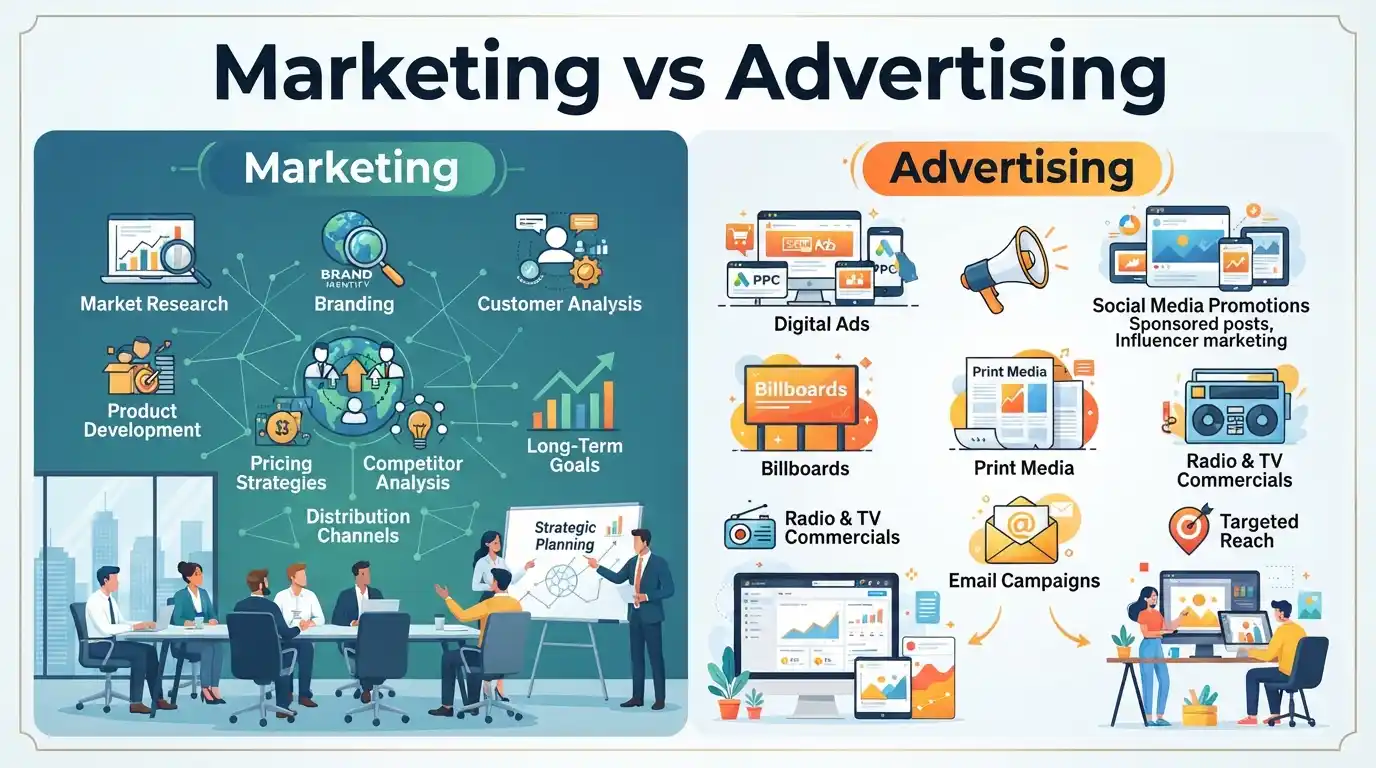
The difference between marketing and advertising is mainly about scope. Marketing is the broader process of understanding customers, creating value, positioning a product or service, and building relationships with buyers. Advertising is one part of marketing that uses paid communication to promote a product, service, or brand.
In simple terms, marketing is the bigger strategy, while advertising is one of the tools used to carry out that strategy. Marketing can include research, branding, pricing, content, SEO, public relations, customer relationships, and advertising.
Understanding the difference between marketing and advertising matters because a business can run ads without having a strong marketing strategy. A good ad may attract attention, but the wider marketing plan determines who the business wants to reach, what it offers, how it is positioned, and how it keeps customers.
Marketing vs. Advertising: Quick Comparison
| Feature | Marketing | Advertising |
|---|---|---|
| Meaning | Broad process of creating, communicating, and delivering customer value | Paid promotion of a product, service, or brand |
| Scope | Broad | Narrower |
| Main focus | Customer needs and the overall customer journey | Promotional messages and paid reach |
| Includes | Research, branding, pricing, distribution, content, PR, SEO, advertising, and more | Paid search, social ads, TV, radio, print, display, billboards, and other paid placements |
| Cost | May be paid or unpaid depending on the activity | Usually requires payment for media placement |
| Time frame | Often long-term and ongoing | Often campaign-based |
| Main goal | Attract, satisfy, and retain customers | Reach an audience and encourage awareness or action |
| Measurement | Can include brand awareness, customer retention, market share, leads, and revenue | Often includes impressions, clicks, conversions, cost per acquisition, and return on ad spend |
What Is Marketing?
Marketing is the broader business process used to understand customers and connect a company’s products or services with their needs.
It starts before a customer sees an advertisement.
A marketing team may first research what people want, study competitors, define the target audience, develop product positioning, set prices, choose distribution channels, and decide how the brand should communicate.
The American Marketing Association describes marketing as a business practice centered on identifying, predicting, and meeting customer needs.
Marketing can include:
- Market research
- Customer research
- Product development
- Pricing
- Branding
- Positioning
- Content marketing
- Search engine optimization (SEO)
- Email marketing
- Social media marketing
- Public relations
- Sales support
- Customer relationship management
- Advertising
This is why marketing is much bigger than simply creating advertisements.
What Is Advertising?
Advertising is a specific form of promotion in which a business pays to place a message or branding in front of an audience.
Examples include:
- Google search ads
- Social media ads
- YouTube ads
- Television commercials
- Radio commercials
- Newspaper ads
- Magazine ads
- Display ads
- Billboard advertising
- Sponsored digital placements
For example, when a company pays Google to show an ad when someone searches for a particular product, that activity is advertising.
The American Marketing Association defines advertising as a business practice in which a company pays to place its messaging or branding in a particular location.
Advertising therefore focuses on the paid communication side of promotion.
The Main Difference Between Marketing and Advertising
The clearest way to understand the difference is to think about scope.
Marketing asks questions such as:
- Who are our customers?
- What do they need?
- What should we offer?
- How should we price it?
- How should we position the brand?
- Where should customers find the product?
- How can we build trust?
- How can we keep customers?
Advertising asks questions such as:
- What message should this ad communicate?
- Who should see it?
- Where should the ad appear?
- When should it run?
- How much should we spend?
- How many people clicked or converted?
Marketing creates the broader direction. Advertising helps deliver a specific promotional message through paid media.
Is Advertising Part of Marketing?
Yes.
Advertising is a part of marketing.
This is one of the most important points to remember.
Marketing is the larger system. Advertising is one activity inside that system.
A simple way to picture it is:
Marketing → Promotion → Advertising
Advertising sits within the broader marketing function. However, promotion itself can include activities that are not advertising, such as public relations, events, sales promotions, and other forms of communication.
This means:
All advertising is marketing, but not all marketing is advertising.
Marketing vs. Advertising Examples
A real-world example makes the distinction easier.
Example 1: A New Coffee Shop
Imagine a coffee shop preparing to open in a busy neighborhood.
Its marketing might include:
- Researching local customers
- Choosing the right menu
- Setting prices
- Creating the brand identity
- Choosing a location
- Building a website
- Creating social media content
- Encouraging customer reviews
- Sending email offers
- Running paid ads
Its advertising could be:
- A paid Instagram campaign
- Google search ads
- A sponsored local post
- A billboard
- A newspaper advertisement
The advertising promotes the coffee shop, but the marketing strategy covers much more.
Example 2: A Clothing Brand
A clothing company may study customer preferences before launching a new collection.
The marketing team could decide:
- Which customers to target
- What style to offer
- How to position the collection
- What price makes sense
- Where customers can buy it
- What type of brand image to create
The advertising team may then create paid campaigns for the collection.
Those campaigns could appear on search engines, social platforms, websites, or other media.
The advertisements are part of the marketing plan, not the entire plan.
Example 3: A Software Company
A software company may use marketing to:
- Research customer problems
- Create educational content
- Improve its website
- Build an SEO strategy
- Publish case studies
- Send email campaigns
- Improve onboarding
- Develop its brand position
The same company may use advertising to run:
- Google Ads
- LinkedIn Ads
- Display campaigns
- Retargeting campaigns
Again, advertising is one part of the larger marketing process.
Marketing vs. Advertising: Cost
Another important difference is how payment works.
Advertising normally involves paying for media placement or distribution.
For example, a company pays for an ad to appear on a search engine, social platform, website, television channel, or billboard.
Marketing is broader.
Some marketing activities require money, while others can be carried out through channels a company owns or through organic efforts.
For example, creating a company blog is marketing. Publishing useful content does not require buying an advertising placement for every reader who sees it.
Email marketing is also marketing, although businesses may pay for email software and other resources.
This is why it is inaccurate to say that all marketing is free or that all marketing requires advertising spend.
Marketing vs. Advertising: Time Frame
Marketing usually has a broader and longer-term focus.
A company may spend years building its brand, improving its customer experience, developing products, and maintaining customer relationships.
Advertising is often organized around specific campaigns.
For example, a company might run an advertising campaign for:
- A product launch
- A holiday sale
- A new service
- A seasonal promotion
- A limited-time offer
- A brand awareness campaign
This does not mean advertising is always short-term. Businesses can run advertising continuously.
The key difference is that advertising is usually tied to specific paid placements and campaigns, while marketing covers the ongoing strategy around the customer and the business.
Marketing vs. Advertising: Goals
The terms; Marketing and advertising can share the same larger business goals, but they approach them differently.
Marketing goals may include:
- Understanding customer needs
- Building brand awareness
- Creating customer value
- Developing market positioning
- Increasing customer loyalty
- Supporting sales
- Improving customer retention
- Growing the business
Advertising goals may include:
- Increasing awareness
- Generating clicks
- Bringing visitors to a website
- Generating leads
- Promoting a product
- Increasing sales
- Encouraging a specific action
Advertising can produce immediate responses, while marketing also considers what happens before and after that response.
Marketing vs. Advertising: Channels
Marketing can use many different channels.
These may include:
- Websites
- Search engines
- Social media
- Events
- Public relations
- Content
- Retail locations
- Customer service
- Sales teams
- Advertising
Advertising uses paid media channels.
Common advertising channels include:
- Search ads
- Social media ads
- Display ads
- Video ads
- Radio
- Television
- Outdoor advertising
The distinction becomes especially useful when looking at digital marketing.
A company can gain visibility through SEO without buying every click. If the company pays for search placements, those placements are advertising.
Paid, Owned, and Earned Media
One useful way to understand modern marketing is through paid, owned, and earned media.
Paid Media
Paid media involves paying to distribute or place promotional content.
Examples include:
- Google Ads
- Social media ads
- Display ads
- Sponsored placements
- Billboards
Advertising is mainly associated with this category.
Owned Media
Owned media consists of channels a business controls.
Examples include:
- Company website
- Business blog
- Email newsletter
- Company social profiles
- Product pages
These can support marketing without being advertisements.
Earned Media
Earned media is exposure that a business receives from other people or organizations rather than buying the placement directly.
Examples include:
- News coverage
- Customer reviews
- Organic recommendations
- Unpaid mentions
- Shares by customers
This distinction helps explain why marketing is broader than advertising.
Marketing vs. Promotion vs. Advertising
The terms; marketing, promotion, and advertising are related, but they are not interchangeable.
Marketing is the broadest term.
Promotion is the communication and promotional part of marketing.
Advertising is paid promotional communication.
A simple hierarchy is:
Marketing → Promotion → Advertising
For example, a company may use public relations as part of promotion without buying an advertisement.
It may also use sales promotions, events, email, content, or advertising.
This is why saying “marketing and advertising are the same” misses an important distinction.
Does Marketing Include Sales?
Marketing and sales are closely connected, but they are not identical.
Marketing focuses heavily on understanding the market, creating demand, communicating value, and reaching potential customers.
Sales focuses more directly on converting prospects into customers and completing transactions.
The exact division between marketing and sales varies from one organization to another.
In many businesses, the two teams work together.
For example, marketing may generate leads through content or advertising, while sales follows up with qualified prospects.
Marketing vs. Advertising Careers
The difference also matters if you are choosing a career or degree.
Marketing careers can cover a wide range of responsibilities, such as:
- Marketing strategy
- Brand management
- Content marketing
- SEO
- Email marketing
- Product marketing
- Market research
- Customer marketing
- Marketing analytics
Advertising careers tend to focus more heavily on promotional campaigns and paid media.
Possible advertising roles include:
- Copywriter
- Art director
- Media planner
- Media buyer
- Advertising account manager
- Creative strategist
- Paid media specialist
There is plenty of overlap between the two fields.
A marketing professional may work with advertising, while an advertising professional may contribute to a company’s wider marketing strategy.
Which Comes First: Marketing or Advertising?
Marketing generally comes first because it provides the broader strategy.
Before creating an advertisement, a business should understand:
- Who it wants to reach
- What problem it solves
- What makes its offer valuable
- How it wants to position the brand
- What action it wants customers to take
- Which channel makes sense for the audience
Advertising can then communicate that strategy through paid placements.
For example, a company should not simply decide to “run Facebook ads” without knowing who the ads are for and what the campaign is trying to achieve.
The marketing strategy gives the advertising campaign its purpose.
Can a Business Do Marketing Without Advertising?
Yes.
A business can use marketing activities that do not involve paid advertising.
For example, a company can:
- Publish useful content
- Improve its website
- Use SEO
- Send newsletters
- Build a social media presence
- Develop a strong brand
- Encourage customer reviews
- Improve customer service
- Create referral programs
These activities can all support marketing goals without being traditional advertisements.
However, advertising can still be useful when a company wants to reach a specific audience through paid distribution.
Can a Business Advertise Without Marketing?
Technically, a business can buy advertisements without having a well-developed marketing strategy.
But this can create problems.
An ad may attract visitors while the website fails to answer their questions. A campaign may reach the wrong audience. The product may be priced poorly. The message may not match the brand.
This is why advertising works best when it supports a broader marketing plan.
Recent explanations from universities and professional organizations consistently make this same distinction: marketing establishes the broader strategy, while advertising provides a paid promotional method within it.
Common Confusion About Marketing and Advertising
“Marketing” does not mean “running ads”
A company can market itself without buying advertisements.
Content, SEO, branding, customer experience, research, email, and public relations can all play a role in marketing.
Advertising is not a separate alternative to marketing
Advertising is part of marketing.
It is better to think of advertising as one tool rather than a competing activity.
Not every social media post is an advertisement
A business can post organically on its own social media account without paying for placement.
A paid social media promotion, however, is advertising.
Marketing is not always about selling immediately
Marketing can support sales, but it also involves understanding customers, creating value, building a brand, and maintaining relationships.
Advertising does not automatically mean television
Advertising includes modern digital formats such as search ads, social media ads, display advertising, video ads, and sponsored placements.
Frequently Asked Questions
What is the main difference between marketing and advertising?
Marketing is the broader process of understanding customers, creating value, positioning products, and building relationships. Advertising is a paid promotional activity within that larger marketing process.
Is advertising part of marketing?
Yes. Advertising is a subset of marketing. Marketing covers many activities beyond advertising, including research, branding, pricing, content, SEO, public relations, and customer relationships.
Which is better, marketing or advertising?
Neither is a replacement for the other. Marketing provides the broader strategy, while advertising can help distribute a specific message through paid channels. Businesses often use both together.
What is an example of marketing but not advertising?
Creating an SEO article, researching customer needs, improving a product’s positioning, sending an organic email newsletter, or improving customer service can all be marketing activities without being advertising.
Is social media marketing the same as social media advertising?
No. Social media marketing can include organic posts, community engagement, content, and customer interaction. Social media advertising specifically refers to paid promotional placements on social platforms.
What is the difference between marketing and advertising jobs?
Marketing jobs often cover broader strategy, research, branding, content, customer engagement, analytics, or product marketing. Advertising jobs tend to focus more on creative campaigns, media planning, paid placements, and promotional messaging.
Test Your Knowledge
1. Which statement best describes marketing?
A. Only paid social media promotion
B. The broader process of understanding customers and creating value
C. Only television advertising
D. Only sales calls
Correct answer: B. The broader process of understanding customers and creating value
2. Is advertising part of marketing?
A. No
B. Only in traditional media
C. Yes
D. Only for large companies
Correct answer: C. Yes
3. Which activity is an example of advertising?
A. Customer research
B. Product development
C. Paying for a Google search ad
D. Improving customer service
Correct answer: C. Paying for a Google search ad
4. Which is an example of owned media?
A. A paid billboard
B. A company’s website
C. A television commercial
D. A sponsored search result
Correct answer: B. A company’s website
5. What is usually broader in scope?
A. Advertising
B. Marketing
C. A single ad campaign
D. Media buying
Correct answer: B. Marketing
6. What does advertising mainly involve?
A. Paid promotional communication
B. Product manufacturing
C. Customer support
D. Market research only
Correct answer: A. Paid promotional communication
Conclusion
The difference between marketing and advertising comes down to scope. Marketing is the broader process of understanding customers, creating value, positioning products, building relationships, and supporting business growth. Advertising is one part of that process that focuses on paid promotional communication.
A useful way to remember it is simple: marketing is the bigger strategy, and advertising is one tool within that strategy. A business may market itself through SEO, content, branding, email, public relations, customer experience, and many other activities. Advertising adds paid reach to that wider effort.
When the two work together, advertising has a clearer purpose because the marketing strategy already defines the audience, offer, message, and business goals.
External Link Sources
- American Marketing Association — Marketing vs. Advertising
- Concordia University, St. Paul — Marketing vs. Advertising
- North Central College — Marketing vs. Advertising
- TechTarget — Marketing and Advertising Differences
- Canva — Marketing vs. Advertising

Aamer Shahzad is the founder of Diffnexx.com, a fast-growing educational platform focused on high-intent “difference between” topics. With over 8 years of experience in English language education and analytical writing, I specialize in breaking down complex “difference between” topics into clear, structured, and easy-to-understand explanations. Diffnexx.com is your go-to resource for enhancing English skills and writing with confidence.
I specializes in building search-optimized, research-driven comparison content designed for clarity, authority, and long-term digital asset value.







