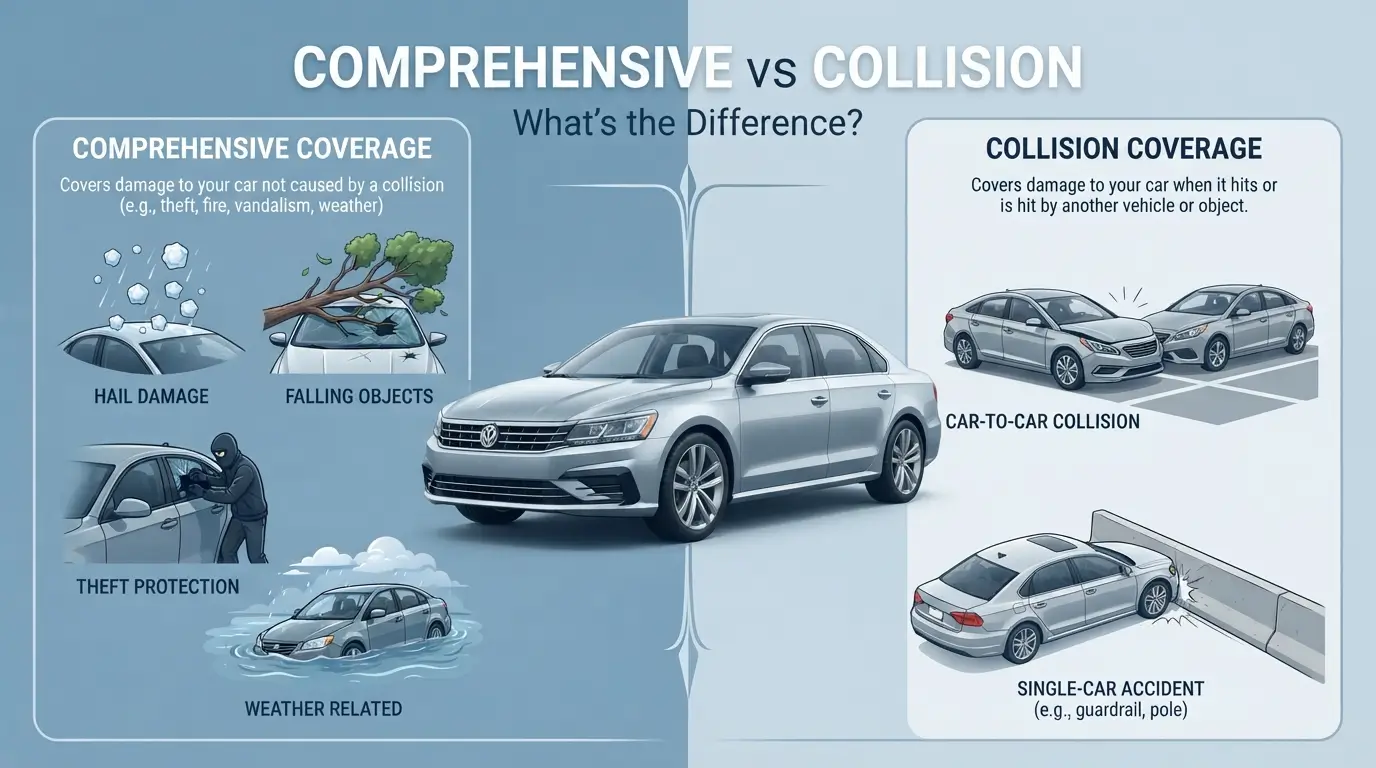
Choosing car insurance can feel confusing, especially when two important terms appear side by side: comprehensive and collision. They both help pay for damage to your own vehicle, but they protect against different types of events.
The difference between comprehensive and collision is mainly about what caused the damage. Collision coverage generally applies when your vehicle hits another vehicle or object, or when it overturns. Comprehensive coverage generally applies to covered losses that are not caused by a collision, such as theft, fire, hail, flooding, vandalism, falling objects, or certain animal impacts.
People search for the difference between comprehensive and collision because insurance policies can use these terms without explaining them in plain English. Understanding the difference between comprehensive and collision can help you choose suitable coverage, understand a claim, and avoid assuming one policy covers everything.
This guide explains the difference between comprehensive and collision with simple examples, a side-by-side table, common mistakes, terminology advice, and practical situations. It also explains why having both may provide broader protection for your vehicle.
Quick Answer
The easiest way to remember the difference between comprehensive and collision is:
Collision = damage caused by your vehicle hitting something or overturning.
Comprehensive = covered damage caused by many events other than a collision.
For example:
- You hit another car → Collision
- You hit a tree → Collision
- Your car rolls over → Collision
- A tree branch falls on your car → Comprehensive
- Your car is stolen → Comprehensive
- Hail damages your car → Comprehensive
- Your car is damaged by fire → Comprehensive
- An animal damages your vehicle → Usually comprehensive
The National Association of Insurance Commissioners (NAIC) describes collision coverage as protection for physical damage resulting from your vehicle colliding with an object, while comprehensive covers damage from non-collision events such as fire, theft, weather, and animal impact.
A simple memory trick
Think of it this way:
Collision asks: “Did my vehicle collide with something?”
Comprehensive asks: “Was my vehicle damaged by a covered event other than a collision?”
This is a useful shortcut, but the actual policy wording always controls.
The Origin of Difference Between Comprehensive and Collision
The two words have different histories, and their ordinary English meanings help explain why insurers use them.
Where does “comprehensive” come from?
Comprehensive is an adjective. It describes something that covers a wide range or includes many parts.
Merriam-Webster traces comprehensive to comprehension and records its first known use in English in 1614. The word is related to the idea of taking in or including something broadly.
In everyday English, you might say:
She prepared a comprehensive report.
This means the report covers a broad range of relevant information.
Insurance uses the same basic idea, but with a specific technical meaning. Comprehensive auto coverage protects against a broad set of covered causes that are generally outside collision losses.
Where does “collision” come from?
Collision is a noun. Merriam-Webster traces it through Middle English to Latin collision- and collisio, from collidere. The Latin verb is associated with striking together. The dictionary records the first known English use of collision in the 15th century.
The everyday meaning is still very close to its historical sense:
The two cars were involved in a collision.
In insurance, collision coverage takes this basic idea and applies it to damage to the insured vehicle resulting from a collision.
Pronunciation
The two words do not sound alike.
Comprehensive: approximately kom-pri-HEN-siv
Collision: approximately kuh-LIZH-un
Merriam-Webster gives comprehensive as approximately ˌkäm-pri-ˈhen(t)-siv and collision as kə-ˈli-zhən.
Parts of speech
The words also have different grammatical roles.
Comprehensive is an adjective:
We purchased comprehensive coverage.
It describes the type of coverage.
Collision is mainly a noun:
The collision damaged the front bumper.
But in the insurance phrase collision coverage, it functions as a noun modifier describing the type of coverage.
The distinction matters because the words do not operate as interchangeable synonyms.
What Does Comprehensive Insurance Cover?
Comprehensive coverage generally protects your vehicle against covered losses that are not caused by a collision.
Common examples include:
- Theft
- Fire
- Hail
- Windstorm
- Flood
- Vandalism
- Falling objects
- Certain animal-related damage
- Broken glass in covered circumstances
The NAIC lists fire, severe weather, vandalism, floods, theft, broken glass, and other non-collision causes among examples of comprehensive coverage.
Example
Suppose you park your car outside during a severe hailstorm. The hail leaves dents across the hood and roof.
You did not hit another vehicle or object.
That type of damage would generally fall under comprehensive coverage, assuming your policy covers the loss.
Another example
Imagine you return to your parking space and discover that your vehicle has been stolen.
There was no collision.
A comprehensive policy may provide coverage for theft, subject to the policy’s terms, deductible, and limits.
What Does Collision Insurance Cover?
Collision coverage generally pays for physical damage to your vehicle when it collides with another vehicle or object.
Examples include:
- Hitting another car
- Hitting a tree
- Hitting a fence
- Hitting a pole
- Hitting a guardrail
- Hitting a mailbox
- Damaging your vehicle in a rollover
- Certain pothole-related damage
The NAIC specifically describes collision as coverage for physical damage caused when your vehicle collides with an object, such as another car or a tree.
Example
You are driving through a parking lot and accidentally hit a concrete barrier.
Your front bumper is badly damaged.
That is the kind of loss collision coverage is designed to address, assuming the policy applies.
What if you hit another vehicle?
Collision coverage can help pay for damage to your own vehicle.
That is different from liability coverage.
If you are legally responsible for damaging another person’s vehicle, your property-damage liability coverage may address the other person’s loss, subject to the policy and applicable law. The NAIC distinguishes liability coverage from collision and comprehensive coverage.
Comprehensive vs Collision: Side-by-Side Comparison
| Feature | Comprehensive | Collision |
|---|---|---|
| Main purpose | Covers many non-collision losses | Covers damage from covered collisions |
| Theft | Generally yes | No |
| Fire | Generally yes | No |
| Hail | Generally yes | No |
| Flood | Generally yes | No |
| Vandalism | Generally yes | No |
| Falling object | Generally yes | No |
| Animal damage | Generally yes | No |
| Hit another car | No | Generally yes |
| Hit a tree | No | Generally yes |
| Hit a pole | No | Generally yes |
| Rollover | Generally no | Generally yes |
| Deductible | Often applies | Often applies |
| Required by state law? | Generally no | Generally no |
| May be required by lender? | Yes | Yes |
| Protects your vehicle? | Yes | Yes |
The exact covered events, exclusions, deductibles, and limits depend on the policy. The NAIC notes that collision and comprehensive are generally optional under state law, although lenders or lessors may require them.
British English vs American English Spelling
There is no meaningful British-versus-American spelling difference between comprehensive and collision.
Both varieties use:
- comprehensive
- collision
The words are spelled the same in British English and American English.
There can be differences in insurance terminology between countries because insurance systems and regulations differ. However, that is a usage and legal-system issue, not a spelling issue.
For example, the phrase comprehensive coverage is common in American auto insurance discussions. In other English-speaking countries, insurers may organize or name vehicle coverage differently.
Therefore, do not change the spelling based on whether your audience is in the United States or the United Kingdom.
Comparison table
| Term | American English | British English |
|---|---|---|
| Comprehensive | comprehensive | comprehensive |
| Collision | collision | collision |
| Spelling difference | None | None |
| Main variation | Insurance terminology | Insurance terminology |
| Pronunciation | Similar | Similar, with accent differences |
Which Spelling Should You Use?
There is no spelling choice to make.
Use comprehensive and collision in both American and British English.
The more important question is which insurance term fits the situation.
For a US audience
Use the terms comprehensive coverage and collision coverage when discussing standard US auto insurance.
The NAIC and Insurance Information Institute use these terms when explaining vehicle physical-damage coverage.
For a UK or Commonwealth audience
Use the terminology used by the local insurer or regulator. Do not assume that an American insurance policy structure is identical to the system in another country.
For a global audience
Explain the terms instead of assuming readers already know them.
For example:
Collision coverage generally applies to damage caused when the insured vehicle hits another vehicle or object, while comprehensive coverage generally applies to covered non-collision losses.
That wording is clear and easy for international readers to understand.
Common Mistakes
Mistake 1: Thinking comprehensive means “everything”
The name can be misleading.
Comprehensive does not mean unlimited or complete protection against every possible loss.
A comprehensive policy still has exclusions, conditions, limits, and a deductible. The actual policy contract determines what is covered.
Mistake 2: Thinking comprehensive covers crashes
This is one of the most common misunderstandings.
If you collide with another vehicle or object, collision coverage is generally the relevant physical-damage coverage for your vehicle.
Comprehensive generally addresses covered causes other than collision.
Mistake 3: Thinking collision only means hitting another car
Collision coverage is broader than that.
Your vehicle may collide with:
- A tree
- A wall
- A pole
- A fence
- Another object
It may also apply to damage from a rollover, depending on the policy.
Mistake 4: Assuming comprehensive covers every animal accident
Animal-related claims can be covered by comprehensive insurance, but the exact circumstances and policy language matter.
Do not assume that every situation involving an animal is automatically covered.
Mistake 5: Confusing liability with collision
Collision coverage generally protects your vehicle.
Liability coverage generally addresses covered damage or injuries you cause to other people, subject to the applicable policy and law.
These are different types of protection.
Mistake 6: Assuming both coverages are always legally required
Collision and comprehensive are generally optional under state law in the United States. However, a lender or leasing company may require them as part of the financing or lease agreement.
Mistake 7: Assuming a deductible works the same way in every situation
Both coverages often have deductibles.
A deductible is the amount you generally pay toward a covered loss before the insurer pays the remaining covered amount, subject to policy terms.
The NAIC advises consumers to consider deductibles when comparing auto insurance options.
Difference Between Comprehensive and Collision in Everyday Examples
The easiest way to master these terms is to see them in realistic sentences.
1. In an email
My vehicle was damaged by hail last night, so I am contacting the insurer about a comprehensive claim.
Here, the damage resulted from weather rather than a collision.
Another example:
I hit a concrete barrier this morning and need to report the damage under my collision coverage.
2. In a news article
The vehicle suffered extensive damage after colliding with a roadside barrier.
This sentence uses collision in its ordinary meaning.
A news article might say:
The vehicle was later damaged by fire.
If the question is about insurance, that type of event may fall under comprehensive coverage, depending on the policy.
3. On social media
Someone might post:
Hail destroyed the roof of my car. Glad I had comprehensive coverage.
Or:
I hit a pole today. Now I need to file a collision claim.
These examples show the practical difference clearly.
4. In formal writing
Comprehensive coverage generally addresses covered losses resulting from events other than collision, while collision coverage addresses physical damage resulting from covered collisions.
This is a suitable style for an educational article or insurance guide.
5. At the insurance office
You might explain:
The damage happened when another vehicle struck my car.
The insurer may then determine which coverage applies based on the circumstances and policy.
The key is to describe what happened, rather than choosing a coverage label yourself.
Should You Have Both Comprehensive and Collision?
For many drivers, having both can provide broader physical-damage protection for their vehicle.
The two cover different risks.
Consider this simplified example:
You have only collision coverage.
- You hit a tree → potentially covered
- Another car hits your car → potentially covered
- Hail damages your car → generally not covered by collision
- Your car is stolen → generally not covered by collision
Now consider having comprehensive and collision.
- You hit a tree → collision
- You hit another car → collision
- Hail damages your car → comprehensive
- Your car is stolen → comprehensive
- A branch falls on your car → comprehensive
The Insurance Information Institute also explains that collision and comprehensive protect against different categories of vehicle damage.
Whether both are worth buying depends on factors such as your vehicle’s value, deductible, premium, financial situation, risk exposure, and whether a lender requires the coverage.
For an older vehicle with low market value, the cost of physical-damage coverage may deserve closer consideration. The Insurance Information Institute recommends evaluating whether purchasing these coverages makes financial sense for an older car.
Google Trends and Search Intent
The search phrase “difference between comprehensive and collision” has clear informational and consumer intent.
People searching for it are usually trying to answer practical questions such as:
- What does comprehensive insurance cover?
- What does collision insurance cover?
- Do I need both?
- Is hail comprehensive or collision?
- Is hitting another car comprehensive or collision?
- Does comprehensive cover theft?
- Does collision cover damage to another person’s car?
- Which coverage should I choose?
Search interest should not be confused with actual word usage, and it would be misleading to provide unsupported search-volume figures or percentages without current, verified data.
For SEO content, the best approach is to answer the practical question quickly and then explain the distinction with examples. This satisfies readers who want a short answer while giving more detail to people comparing coverage.
FAQs
1. What is the main difference between comprehensive and collision?
Collision generally covers damage to your vehicle from a collision with another vehicle or object. Comprehensive generally covers covered non-collision events such as theft, fire, hail, vandalism, and certain animal damage.
2. Is hitting another car comprehensive or collision?
Damage to your own vehicle from hitting another car is generally handled under collision coverage, subject to the policy terms.
3. Does comprehensive insurance cover theft?
Generally, yes. Theft is one of the common examples of a loss covered by comprehensive auto insurance.
4. Does comprehensive insurance cover hail damage?
Generally, yes. Hail is considered a non-collision event and is commonly covered under comprehensive coverage, subject to the policy.
5. Does collision insurance cover hitting a tree?
Generally, yes. If your vehicle collides with a tree, the resulting vehicle damage is typically a collision claim, subject to your policy and deductible.
6. Do I need both comprehensive and collision?
Not necessarily. State law generally does not require these physical-damage coverages, but a lender or leasing company may require them. Whether you personally want both depends on your vehicle, finances, risks, and policy costs.
7. Is comprehensive insurance the same as full coverage?
No. “Full coverage” is commonly used as an informal term rather than a single universal insurance product. In many US contexts, people use it to mean liability coverage plus comprehensive and collision, but the exact package can vary. The NAIC notes that what an auto policy covers depends on the coverage selected.
Conclusion
Comprehensive and collision insurance may sound similar, but they protect against different kinds of vehicle damage. Knowing that difference makes insurance choices much easier.
Collision generally deals with crashes, impacts, and rollovers. Comprehensive generally handles covered losses such as theft, fire, hail, vandalism, and falling objects.
The best choice depends on your car, budget, risks, deductible, and policy terms. Read the policy carefully and ask questions before choosing coverage.
Keep these words in practice when writing emails, comparing policies, or discussing car insurance. Clear language makes confusing choices feel much simpler.

Eliza Marlowe is a passionate content strategist and comparison writer at diffnexx.com. She specializes in breaking down complex “difference between” topics into clear, reader-friendly guides. With a background in linguistics and digital research, Eliza focuses on accuracy, clarity, and content that helps readers make informed decisions with confidence.







