When people hear the words murder and homicide, they often assume they mean exactly the same thing. In everyday conversation, that assumption is understandable. Both words relate to one person causing another person’s death. But in legal and professional writing, the distinction matters.
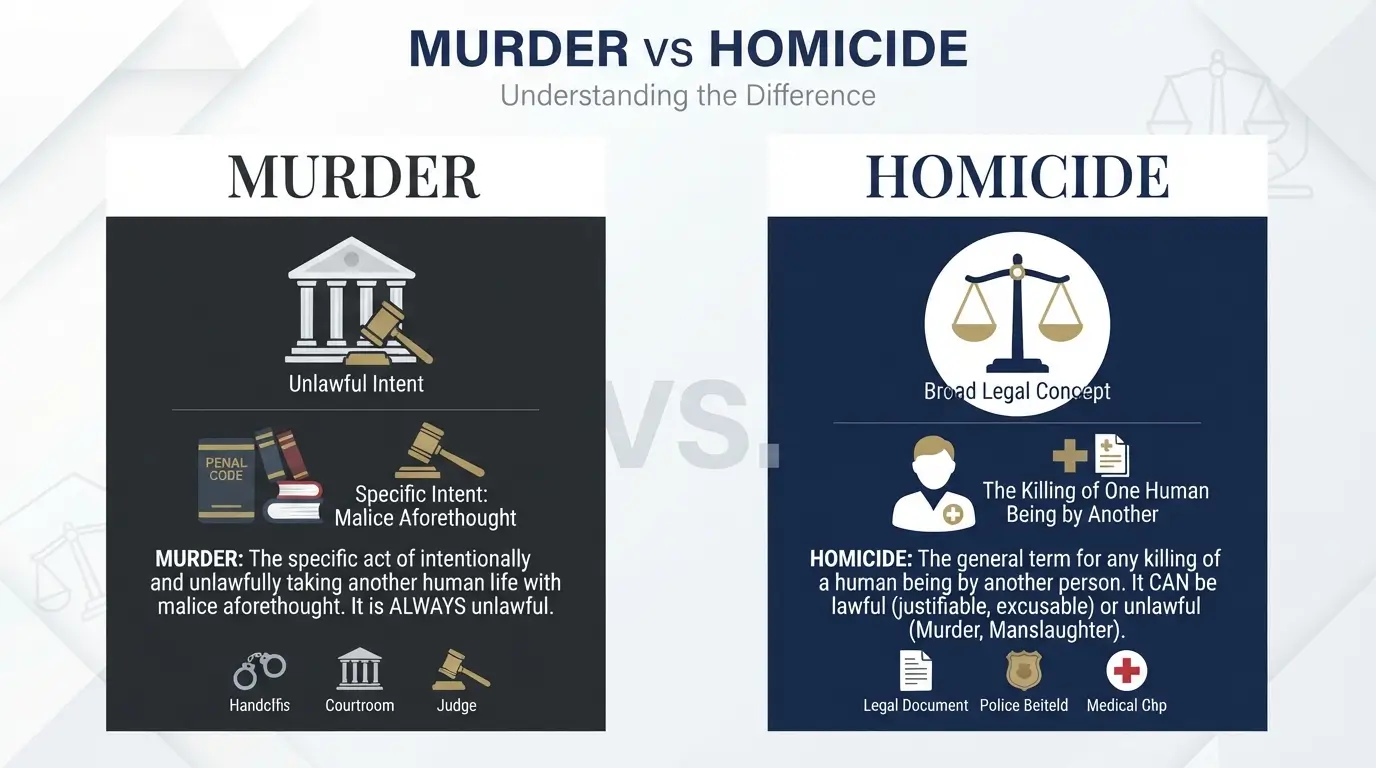
The difference between murder and homicide mainly comes down to scope and legal classification. Homicide is a broad term for one person causing the death of another person. Murder is a specific type of unlawful homicide, although the exact legal definition varies by jurisdiction.
Understanding the difference between murder and homicide can help you read crime reports, legal documents, news stories, and academic material more accurately. It also explains why a case may initially be described as a homicide without being called murder.
In this guide, we will explain the difference between murder and homicide in simple English, look at their origins, compare their usage in British and American English, and examine common mistakes. By the end, the difference between murder and homicide should be much easier to remember and use correctly.
Quick Answer
The simplest way to remember the difference between murder and homicide is:
Homicide is the broader term; murder is a specific type of unlawful homicide.
Homicide generally means one human being causes the death of another human being. The word itself does not automatically tell you whether the killing was intentional, accidental, justified, or criminal. Legal systems can classify different homicides in different ways.
Murder, by contrast, refers to an unlawful killing that meets the legal requirements for murder in the relevant jurisdiction. In the United States, for example, the precise definition and degrees of murder vary by state.
Think of the relationship like this:
Homicide → broad category
- Murder
- Manslaughter
- Other forms of unlawful killing
- In some contexts, lawful or justified killing
So, all murder is homicide, but not all homicide is murder.
Simple examples
- A person deliberately kills another person unlawfully → homicide and potentially murder.
- A person causes another person’s death through criminally reckless conduct → homicide, but it may be manslaughter rather than murder.
- A person kills an attacker in circumstances legally recognized as self-defense → homicide in the broad sense, but generally not murder.
The final legal classification depends on the applicable law and the facts of the case.
The Origin of Difference Between Murder and Homicide
Although murder and homicide are now closely associated with criminal law, they come from different linguistic histories.
Where does “homicide” come from?
Homicide entered English through Middle English and Anglo-French, ultimately deriving from Latin. Merriam-Webster traces it to Latin homicida (“a person who kills another”) and homicidium (“the killing of a human being”). These Latin forms are connected with homo, meaning “human being,” and the -cide element associated with killing.
This history helps explain why modern English contains related words such as:
- homicide
- homicidal
- suicide
- genocide
- pesticide
The ending -cide is associated with killing or an agent of killing.
Homicide has been used in English since the medieval period, with Merriam-Webster recording its first known use in the 14th century.
Where does “murder” come from?
Murder has a much older Germanic history. Merriam-Webster traces the modern English word partly through Middle English forms such as murther and murdre, with roots connected to Old English morthor and related Germanic words.
The word was already established in English before the 12th century as a noun referring to unlawful killing. Its verb use developed later.
This gives the two words different linguistic backgrounds:
| Word | Main linguistic route | Basic historical idea |
|---|---|---|
| Homicide | Latin → French → Middle English | Killing a human being |
| Murder | Germanic/Old English → Middle English | Unlawful killing |
There is therefore no British-versus-American spelling difference between these two words. Their different forms exist because they have different historical origins, not because one English variety changed the spelling.
Pronunciation
The words are also pronounced differently:
- Homicide: HOM-uh-side or HOH-muh-side
- Murder: MUR-der
Merriam-Webster gives pronunciations for homicide including ˈhä-mə-ˌsīd and ˈhō-, while murder is pronounced approximately ˈmər-dər.
Parts of speech
Both words can function as nouns.
Homicide is mainly used as a noun:
- The police investigated the homicide.
- The case was classified as a homicide.
Murder can be both a noun and a verb:
- The police investigated the murder. (noun)
- The defendant was accused of murdering the victim. (verb)
This difference can affect sentence structure.
British English vs American English Spelling
There is no meaningful spelling difference between British and American English for murder or homicide.
Both varieties spell them:
- murder
- homicide
There is also no important standard pronunciation difference that changes their identity between the two varieties. Some speakers may pronounce vowels slightly differently because of their regional accent, but the words remain the same.
The more important difference is legal usage, not spelling.
In the United States, homicide is commonly used as a broad legal and investigative term, while individual states define murder and other homicide offenses under their own laws. Cornell’s Legal Information Institute notes that murder definitions and degrees vary by jurisdiction.
In England and Wales, official sources also use homicide as a broad category. The Crown Prosecution Service explains that murder and manslaughter are crimes in which one person unlawfully kills another, and both can be described as homicide.
The Office for National Statistics similarly describes homicide offences in England and Wales as including murder, manslaughter, and infanticide for statistical purposes.
Comparison table
| Feature | British English | American English |
|---|---|---|
| Murder spelling | murder | murder |
| Homicide spelling | homicide | homicide |
| Regional spelling difference | None | None |
| Homicide as broad term | Yes | Yes |
| Murder as specific legal concept | Yes | Yes |
| Exact legal definition | Depends on UK law | Depends on jurisdiction |
| Main difference | Legal framework | State/federal legal framework |
So, if you are writing for either a British or American audience, do not change the spelling.
Which Spelling Should You Use?
The answer is simple: use “murder” and “homicide” exactly as spelled above in both British and American English.
The choice between the words depends on meaning, not geography.
Use “homicide” when:
You are discussing a death caused by one person and the exact legal classification is not yet established.
For example:
Police are investigating a suspected homicide.
This wording does not necessarily say that the person responsible committed murder.
Use “murder” when:
You are specifically referring to a killing that legally qualifies as murder.
For example:
The defendant was convicted of murder.
For US audiences
Be especially careful when discussing criminal law because murder classifications can differ between states. Terms such as first-degree and second-degree murder do not have one universal definition across every jurisdiction.
For UK/Commonwealth audiences
Follow the legal terminology of the specific country. Do not assume that a US definition of first-degree or second-degree murder automatically applies in England, Scotland, Wales, or Northern Ireland.
For example, England and Wales currently use murder and manslaughter as the principal homicide offences, while legal reform proposals published in 2026 are considering a different structure.
For global writing
If your audience is international, homicide can be the safer broad term when you are discussing the general phenomenon of one person causing another’s death.
Use murder only when the context clearly supports that specific classification.
Common Mistakes with Difference Between Murder and Homicide
These words are often confused because ordinary conversation does not always follow strict legal terminology.
Mistake 1: Treating every homicide as murder
Incorrect:
Every homicide is murder.
Better:
Murder is one category of homicide.
Not every killing caused by another person legally qualifies as murder. Some cases involve manslaughter or lawful or justified killing.
Mistake 2: Assuming homicide always means a crime
The word homicide describes the killing of one human being by another. Depending on the legal context, the killing may be criminal, justified, or otherwise legally classified.
Mistake 3: Using “homicide” as a synonym for “murder” in every sentence
In casual speech, people may use the words almost interchangeably. In legal writing, however, that can remove an important distinction.
Compare:
Detectives are investigating a homicide.
with:
The defendant was convicted of murder.
The first describes an investigation into a death caused by another person. The second identifies a particular criminal conviction.
Mistake 4: Assuming murder always requires advance planning
This is an important misconception.
Some legal systems distinguish forms of murder based on premeditation, while others recognize murder without advance planning. Cornell’s Legal Information Institute explains that the exact degrees and definitions vary by jurisdiction.
Therefore, do not automatically define murder as “a killing planned days in advance.”
Mistake 5: Confusing motive with intent
Motive explains why someone may have acted.
Intent concerns what the person meant to do.
These are not identical legal concepts. The Crown Prosecution Service specifically notes that intent is different from motive in the context of murder.
Mistake 6: Assuming spelling changes in British English
They do not.
Write:
- British: murder, homicide
- American: murder, homicide
There is no standard spelling such as mourdər or another regional alternative.
Difference Between Murder and Homicide in Everyday Examples
The best way to remember the distinction is to see how the words work in real communication.
1. In emails
General investigation:
The report states that the police are investigating the death as a possible homicide.
Specific criminal case:
The court documents state that the defendant was charged with murder.
The first is broader. The second is more specific.
2. In news writing
News organizations often use homicide when reporting on an investigation before the final legal classification is known.
Example:
Police opened a homicide investigation after a person was found dead.
Later, if prosecutors charge someone with murder, a report might say:
Prosecutors charged the suspect with murder.
This progression reflects the difference between describing a death investigation and naming a particular criminal charge.
3. On social media
Social media posts often use murder more broadly and emotionally:
This case was described as a murder.
For responsible communication, however, it is better not to label someone a murderer before the facts and legal proceedings support that statement.
A neutral alternative is:
The person was arrested on suspicion of murder.
4. In academic writing
Academic writing may use homicide when discussing the broader phenomenon.
For example:
Researchers study patterns of homicide across different populations.
If the research specifically concerns murder convictions, the word murder may be more appropriate:
The study examined factors associated with murder convictions.
5. In formal legal writing
Legal documents require particular care because terminology can have jurisdiction-specific meanings.
For example:
The defendant was charged with murder.
is different from:
The death was classified as a homicide.
The second statement does not necessarily identify the precise criminal offense.
6. In police reporting
“Homicide investigation” is often used as an investigative classification.
That does not necessarily mean investigators have already established that the death was murder.
7. In ordinary conversation
People often say:
He was murdered.
when they mean:
He was unlawfully killed.
This is understandable in everyday English, but formal writing should follow the terminology appropriate to the legal context.
Murder vs Homicide: Side-by-Side Comparison
| Feature | Murder | Homicide |
|---|---|---|
| Part of speech | Noun and verb | Mainly noun |
| Basic meaning | Unlawful killing that meets the legal definition of murder | Killing of one human being by another |
| Scope | Narrower | Broader |
| Can include manslaughter? | No | Yes, depending on legal classification |
| Can describe lawful killing? | Generally no | In broad usage, potentially yes |
| Requires criminality? | Generally yes | Not necessarily |
| Can be an investigation term? | Yes | Very common |
| Can be a criminal charge? | Yes | Depends on jurisdiction |
| Spelling in US English | murder | homicide |
| Spelling in UK English | murder | homicide |
| Advance planning always required? | No universal rule | Not applicable |
| Exact legal meaning | Jurisdiction-dependent | Jurisdiction-dependent |
The central relationship remains:
Homicide is the wider concept. Murder is a particular legal category within homicide.
Homicide, Murder, and Manslaughter: What Is the Difference?
A third word helps make the distinction clearer: manslaughter.
Manslaughter generally refers to a killing that is less culpable than murder, but its exact definition differs between legal systems. Cornell’s Legal Information Institute describes manslaughter as a distinct category involving less culpability than murder.
In the United States, the Model Penal Code and state laws can classify manslaughter in different ways.
In England and Wales, manslaughter can include killings that would otherwise satisfy the elements of murder but are reduced because of a partial defense, as well as certain forms of involuntary manslaughter.
A simple conceptual diagram is:
HOMICIDE
↓
Different legal classifications
→ Murder
→ Manslaughter
→ Other homicide classifications, depending on jurisdiction
This is why replacing homicide with murder in every sentence can produce an inaccurate statement.
Why Do News Reports Say “Homicide” Instead of “Murder”?
News reports often use homicide because the facts or legal classification may still be developing.
Imagine that someone dies after another person allegedly causes their death. At the beginning of an investigation, authorities may not yet know whether the death resulted from murder, manslaughter, an accident, self-defense, or another circumstance.
“Homicide investigation” can therefore be a more neutral description.
This is especially useful before prosecutors make a charging decision or before a court determines criminal responsibility.
The distinction also matters because an arrest or accusation is not the same as a conviction.
For example:
Police arrested a suspect on suspicion of murder.
does not mean:
The suspect was convicted of murder.
The first describes an allegation or procedural event. The second describes a legal outcome.
Google Trends and Search Intent
People searching for “difference between murder and homicide” are usually looking for a clear explanation of terminology rather than a statistical comparison.
The search intent can include several related questions:
- Is homicide the same as murder?
- Is murder a type of homicide?
- Can homicide be accidental?
- What makes a killing murder?
- What is the difference between murder and manslaughter?
- Why do police call something a homicide?
- Do British and American English use these words differently?
The most useful answer is therefore one that starts with the simple distinction and then explains the legal nuance.
Search interest should also not be confused with actual word frequency. Without a live Google Trends dataset for a specific comparison period, it would be misleading to give numerical search-volume claims, percentages, or rankings.
For SEO purposes, the strongest approach is to satisfy the reader’s intent directly: define both terms, explain their relationship, show examples, and clearly state that legal definitions vary by jurisdiction.
FAQs
1. Is homicide the same as murder?
No. Homicide is broader than murder. Homicide generally means one person causes the death of another, while murder is a particular form of unlawful homicide defined by applicable law.
2. Is murder always homicide?
Generally, yes. If murder is legally established, it is a form of homicide because it involves one person unlawfully causing another person’s death.
3. Can a homicide be accidental?
Yes, depending on what is meant by homicide and the applicable legal system. A death caused by another person may be classified as accidental, negligent, manslaughter, or another category rather than murder.
4. Does homicide always mean someone committed a crime?
No. The broad term can include killings that are later determined to be legally justified or otherwise not criminal. Self-defense is one example recognized in many legal systems.
5. Does murder always involve premeditation?
No. The requirement for premeditation depends on the applicable law and the degree or type of murder involved. Some jurisdictions distinguish premeditated murder from other forms of murder.
6. Are “murder” and “homicide” spelled differently in British English?
No. Both British and American English use murder and homicide. The important differences are legal and contextual rather than spelling-based.
7. Which word should I use: murder or homicide?
Use homicide when you mean the broader concept of one person causing another person’s death or when the exact classification is unclear. Use murder when the context specifically concerns an unlawful killing legally classified as murder.
Conclusion
The difference between murder and homicide is easier to remember when you focus on scope: homicide is broad, while murder is a specific form of unlawful killing under applicable law.
These words also have different histories. Homicide comes through Latin and French, while murder has older Germanic and Old English roots, giving each word its distinct form.
In everyday English, the words may overlap, but careful writing benefits from choosing the more precise term. Legal definitions can change between countries and jurisdictions.
Keep practicing this distinction in emails, essays, news summaries, and daily conversations. The more you use these words correctly, the more natural your English will become.

Anton Reyes is a contributing writer at DiffNexx.com, where he explores meaningful differences in language, culture, and everyday concepts. With a background in creative nonfiction, Anton brings clarity and balance to complex comparisons. His writing helps readers understand subtle distinctions in words and ideas, making learning both insightful and engaging.







