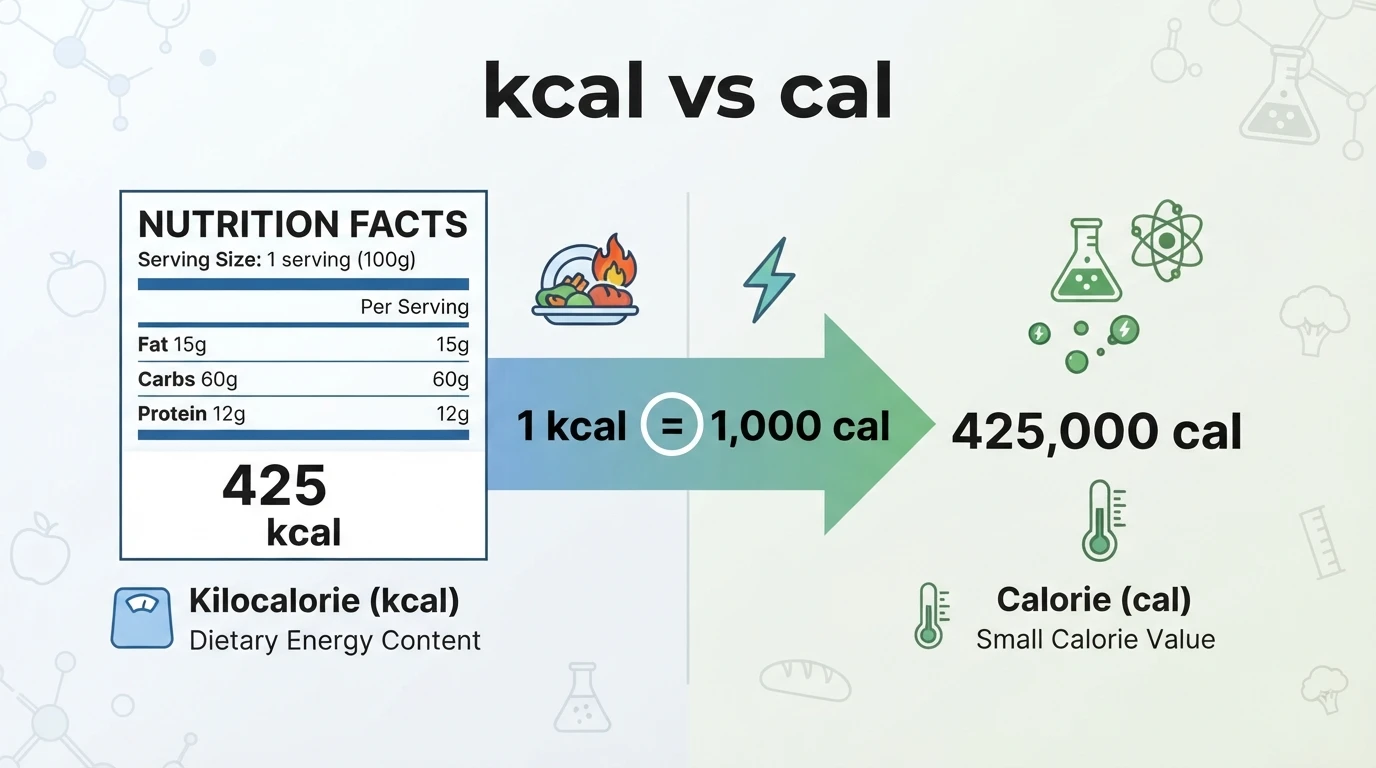
The difference between kcal and cal is their size. A kilocalorie (kcal) equals 1,000 small calories (cal). The lowercase cal is a scientific unit of energy, while kcal is the unit commonly used to describe the energy in food. In everyday nutrition, the word “calorie” often means a kilocalorie, even when the abbreviation is not shown.
So, if a food contains 200 kcal, it contains 200,000 small calories. However, you would normally just call it 200 Calories or 200 calories when talking about food.
The difference between kcal and cal can seem confusing because nutrition labels often use “Calories” instead of “kilocalories.” Understanding the capitalization and context makes the difference much easier to remember.
kcal vs. cal at a Glance
| Feature | cal | kcal |
|---|---|---|
| Full name | calorie | kilocalorie |
| Size | Smaller unit | Larger unit |
| Relationship | 1 cal | 1,000 cal |
| Food use | Rarely used for food energy | Commonly used |
| Common nutrition term | Small calorie | Calorie |
| Energy equivalent | About 4.184 joules | About 4,184 joules |
| Example | 500 cal | 0.5 kcal |
| Common abbreviation | cal | kcal |
The key conversion is simple:
1 kcal = 1,000 cal
And:
1 cal = 0.001 kcal
What Is a Calorie (cal)?
A calorie, written with a lowercase c as cal, is a small unit of energy.
In traditional scientific terms, a calorie is approximately the amount of energy needed to raise the temperature of 1 gram of water by 1°C. There are different historical definitions of the calorie, so its exact conversion to joules can vary slightly depending on the convention being used.
For ordinary nutrition questions, however, the important point is that the small calorie is much smaller than the unit used to measure food energy.
That is why nutritionists do not normally describe a meal as containing hundreds of thousands of small calories.
Instead, they use kilocalories.
What Is a Kilocalorie (kcal)?
A kilocalorie, abbreviated kcal, is equal to 1,000 small calories.
So:
1 kcal = 1,000 cal
A kilocalorie is also the unit commonly used for the energy provided by food.
For example:
- 1 kcal = 1,000 cal
- 10 kcal = 10,000 cal
- 50 kcal = 50,000 cal
- 100 kcal = 100,000 cal
- 500 kcal = 500,000 cal
The large numbers produced by using small calories are one reason the kilocalorie is more practical for nutrition.
NIST identifies the kilocalorie as the calorie used to express the energy content of foods.
Why Do Food Labels Say “Calories” Instead of “kcal”?
This is the part that causes most of the confusion.
On many food labels, especially in the United States, you will see something like:
Calories 250
You may not see 250 kcal.
In nutrition, that 250 Calories means approximately 250 kilocalories.
So:
250 Calories = 250 kcal = 250,000 cal
The capital C in Calorie has traditionally been used to distinguish the food-energy unit from the small scientific calorie.
In everyday writing, however, people often use lowercase calories even when they mean kilocalories.
The FDA’s Nutrition Facts label uses the term “Calories” for the energy provided by a serving of food.
Cal vs. Cal vs. kcal
Capitalization creates another layer of confusion.
These three forms can refer to different things:
cal
cal usually means the small calorie.
1 cal = 0.001 kcal
Cal
A capital Cal can refer to a food Calorie, which is equal to one kilocalorie.
1 Cal = 1 kcal = 1,000 cal
kcal
kcal directly means kilocalorie.
It is the clearest abbreviation when you want to specify the larger food-energy unit.
So, in nutrition:
1 Cal = 1 kcal
But:
1 cal = 0.001 kcal
That single capital letter can therefore matter.
Why Is kcal Used for Food?
Food provides relatively large amounts of energy.
Imagine describing a meal as containing 500,000 calories.
That number is technically understandable if you mean small calories, but it is inconvenient.
The same amount can be written as:
500 kcal
That is much easier to read and use.
The kilocalorie therefore gives nutrition professionals and consumers a more practical number for food energy.
NIST notes that the “kilogram calorie” or large calorie is the kilocalorie used to express food energy, although the prefix “kilo” is often omitted in practice.
How Many cal Are in 1 kcal?
There are 1,000 cal in 1 kcal.
Here are some quick conversions:
| kcal | cal |
|---|---|
| 0.5 kcal | 500 cal |
| 1 kcal | 1,000 cal |
| 5 kcal | 5,000 cal |
| 10 kcal | 10,000 cal |
| 25 kcal | 25,000 cal |
| 50 kcal | 50,000 cal |
| 100 kcal | 100,000 cal |
| 200 kcal | 200,000 cal |
| 500 kcal | 500,000 cal |
| 1,000 kcal | 1,000,000 cal |
The conversion is simply:
kcal × 1,000 = cal
How to Convert cal to kcal
To convert small calories to kilocalories, divide by 1,000.
Formula:
kcal = cal ÷ 1,000
For example:
Example 1
You have 5,000 cal.
5,000 ÷ 1,000 = 5 kcal
Example 2
You have 25,000 cal.
25,000 ÷ 1,000 = 25 kcal
Example 3
You have 150,000 cal.
150,000 ÷ 1,000 = 150 kcal
The reverse is just as easy.
To convert kcal to cal:
cal = kcal × 1,000
How Many kcal Are in 1,000 cal?
There is 1 kcal in 1,000 cal.
For example:
1,000 cal ÷ 1,000 = 1 kcal
This is why the prefix kilo- is useful.
In the metric system, “kilo” means 1,000. The same idea appears in other units:
- 1 kilogram = 1,000 grams
- 1 kilometer = 1,000 meters
- 1 kilocalorie = 1,000 calories
How Many Calories Are in 1 kcal?
This depends on what you mean by “calories.”
If you mean the small scientific calories:
1 kcal = 1,000 cal
But if you mean the everyday nutrition term Calories, then:
1 kcal = 1 Calorie
This is the most important distinction to remember.
For example, a food label showing:
300 Calories
is describing:
300 kcal
It does not mean 300 small calories.
Is 1 kcal the Same as 1 Calorie?
Yes, when Calorie refers to the food-energy unit.
In nutrition:
1 Calorie = 1 kcal
The capital-C spelling helps distinguish this larger unit from the small calorie.
However, everyday writing often uses lowercase “calorie” for the same food-energy unit.
That is why you may see:
- 200 calories
- 200 Calories
- 200 kcal
In a nutrition context, the first two generally mean the same amount as 200 kcal.
kcal and Calories on Food Labels
When reading a food label, focus on the number of calories per serving and the serving size.
For example, suppose a package says:
Calories: 180
That means one listed serving provides 180 food Calories, or about 180 kcal.
It does not mean the food contains only 180 small calories.
The FDA also points out that the calorie number is usually based on the listed serving size. If you eat two servings, you consume twice the calories shown for one serving.
For example:
1 serving = 180 kcal
If you eat:
2 servings = 360 kcal
This makes serving size just as important as the calorie number.
Do You Need to Convert kcal to cal When Counting Calories?
Usually, no.
If you are tracking food intake, you normally do not need to convert kcal into small calories.
For example, if a meal-tracking app says:
Dinner: 650 kcal
you can treat that as:
650 Calories
There is no reason to turn it into 650,000 small calories for normal food tracking.
Likewise, if a nutrition label says:
Calories: 650
you can understand it as approximately:
650 kcal
The conversion to small calories is mainly useful when studying energy units or working with scientific calculations.
kcal vs. kJ: Another Common Confusion
You may also see kJ on food labels.
kJ means kilojoule, another unit of energy.
Unlike kcal and cal, which are based on the calorie unit, the joule is the SI unit used for energy.
A useful approximate conversion is:
1 kcal ≈ 4.184 kJ
And:
1 kJ ≈ 0.239 kcal
For example:
100 kcal ≈ 418.4 kJ
Food labels in some countries show both kcal and kJ.
NIST lists the kilocalorie as approximately 4.184 kilojoules under the thermochemical definition.
Why Does a Food Label Sometimes Show kcal and Calories Together?
Some labels and nutrition databases use kcal, while others use Calories.
They are usually describing the same food-energy quantity.
For example:
Energy: 250 kcal
and:
Energy: 250 Calories
represent the same nutritional energy amount.
The difference is mainly the terminology and labeling convention.
This is why seeing “kcal” on one website and “Calories” on another does not automatically mean the numbers need to be converted.
Are kcal and Calories Always Exactly the Same?
In ordinary nutrition use, kcal and food Calories refer to the same unit.
The important distinction is between a food Calorie and a small calorie.
Scientific literature can also use different historical calorie definitions, such as thermochemical and International Table calories. NIST lists slightly different joule conversions for these versions.
For everyday food tracking, this technical distinction is usually not important.
The practical rule remains:
Food Calorie = kcal
Common Mistakes About kcal and cal
Mistake 1: Thinking 100 calories means 100 cal
When talking about food, “100 calories” normally means 100 kcal, not 100 small calories.
Mistake 2: Thinking 1 kcal equals 1 cal
It does not.
1 kcal = 1,000 cal.
Mistake 3: Converting food calories unnecessarily
If your food tracker says 400 kcal, you do not need to convert it to 400,000 cal.
For everyday nutrition, 400 kcal and 400 Calories are the useful ways to express the amount.
Mistake 4: Ignoring serving size
A label’s calorie number is generally tied to a stated serving.
If you eat two servings, you consume twice the listed calories.
Mistake 5: Assuming “calorie-free” means zero energy in every possible sense
Food labeling has specific rules for calorie claims. For practical nutrition decisions, use the actual Nutrition Facts information rather than relying only on marketing language.
Easy Way to Remember kcal and cal
Remember the prefix:
kilo = 1,000
So:
1 kcal = 1,000 cal
For food, remember:
1 Calorie = 1 kcal
A simple three-line rule is:
cal = small calorie
kcal = 1,000 small calories
Calorie = food calorie = kcal
That removes most of the confusion.
Frequently Asked Questions
Is kcal the same as calories?
In everyday nutrition, yes. A food “Calorie” is a kilocalorie, so 1 Calorie = 1 kcal. But a lowercase cal is a much smaller unit: 1 kcal = 1,000 cal.
Is 100 kcal equal to 100 calories?
Yes, when “calories” means the food-energy unit used in nutrition. 100 kcal = 100 Calories.
Is 1 kcal equal to 1,000 calories?
Yes, if “calories” means the small scientific cal unit. 1 kcal = 1,000 cal.
Why do nutrition labels say calories instead of kcal?
Nutrition labels often use the familiar word Calories for food energy. In that context, the number refers to kilocalories. The FDA uses “Calories” on its Nutrition Facts label.
Which is bigger, kcal or cal?
A kcal is bigger. One kilocalorie contains 1,000 small calories.
Do I need to convert kcal to calories when counting food?
No. For normal food tracking, you can treat kcal and food Calories as equivalent. Conversion to small calories is rarely useful for everyday nutrition.
Test Your Knowledge
1. How many small calories are in 1 kcal?
A. 10
B. 100
C. 1,000
D. 10,000
Correct answer: C. 1,000
2. What does kcal stand for?
A. Kilocalorie
B. Kilogram calorie rate
C. Calorie kilogram
D. Kinetic calorie
Correct answer: A. Kilocalorie
3. A food label says 250 Calories. Approximately how many kcal is that?
A. 0.25 kcal
B. 2.5 kcal
C. 25 kcal
D. 250 kcal
Correct answer: D. 250 kcal
4. What does lowercase “cal” normally represent?
A. A kilocalorie
B. A small calorie
C. A kilojoule
D. A gram of food
Correct answer: B. A small calorie
5. How many kcal are in 50,000 cal?
A. 5 kcal
B. 50 kcal
C. 500 kcal
D. 5,000 kcal
Correct answer: B. 50 kcal
6. Which statement is correct?
A. 1 cal = 1,000 kcal
B. 1 kcal = 1,000 cal
C. 01 kcal = 100 cal
D. 1 Calorie = 1 cal in food labeling
Correct answer: B. 1 kcal = 1,000 cal
Conclusion
The difference between kcal and cal is simple once you separate scientific calories from food Calories. A cal is the smaller energy unit, while a kcal is 1,000 cal. In nutrition, the word Calorie usually refers to a kilocalorie.
So when you see 200 Calories on a food label, you can read it as 200 kcal, not 200 small calories. You only need to convert it to small calories when a calculation specifically calls for that unit.
The easiest rule to remember is:
1 kcal = 1,000 cal
and
1 food Calorie = 1 kcal.
External Link Sources
- NIST — Guide to the SI, Footnotes
- NIST — Energy Conversion Factors
- FDA — Calories on the Nutrition Facts Label
- FDA — How to Understand and Use the Nutrition Facts Label
- CDC — Nutrition Facts Label and Your Health

Anton Reyes is a contributing writer at DiffNexx.com, where he explores meaningful differences in language, culture, and everyday concepts. With a background in creative nonfiction, Anton brings clarity and balance to complex comparisons. His writing helps readers understand subtle distinctions in words and ideas, making learning both insightful and engaging.







