A new lump, bump, or unusual swelling can be worrying. Many people search for tumor or cyst because these two medical terms are often used when discussing an unexpected growth in the body. But they do not mean the same thing.
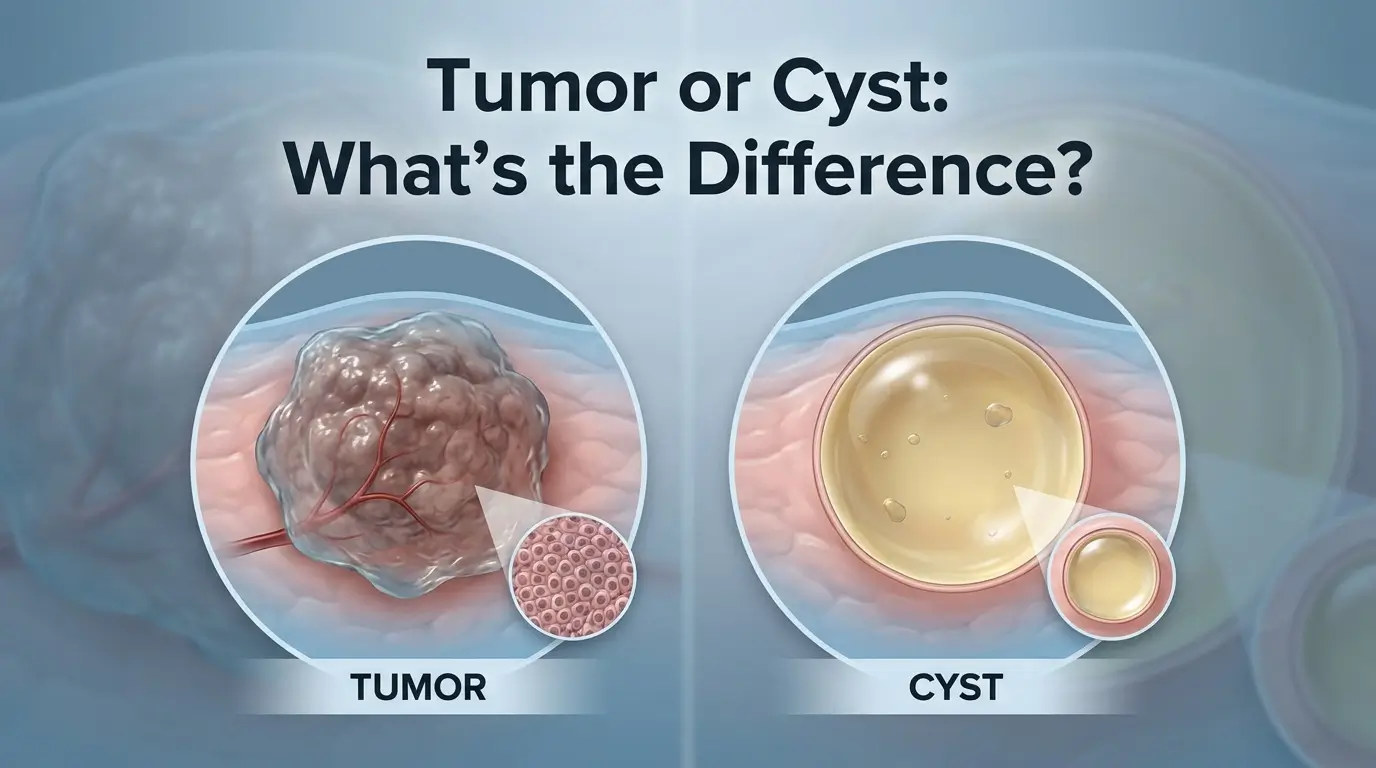
Understanding tumor or cyst can help you make sense of medical reports, scan results, and conversations with healthcare professionals. A cyst is usually a sac-like structure that contains fluid, air, pus, or another material. A tumor is an abnormal mass of tissue formed by cells that grow or survive when they should not.
The question of tumor or cyst also matters because neither word automatically tells you whether a growth is cancerous. Most cysts are benign, while tumors can be either benign or malignant.
In this guide, we will explain tumor or cyst in simple terms, compare their meanings, explore their word origins, review British and American spelling, and show how these terms are used in everyday medical writing.
Quick Answer
A cyst is a closed, sac-like pocket that may contain fluid, air, pus, or other material. A tumor is an abnormal mass of tissue caused by abnormal cell growth or survival.
Both can appear in many parts of the body. Both can sometimes be found during a physical examination or on imaging such as an ultrasound, CT scan, or MRI.
The simplest distinction is:
- Cyst: usually a sac or pocket containing fluid or other material.
- Tumor: an abnormal mass of tissue or cells.
- Cyst: most are benign, meaning not cancer.
- Tumor: may be benign or malignant.
- Cyst: can sometimes contain solid areas or develop because of cancer.
- Tumor: may sometimes have cystic or fluid-filled areas.
This means the words describe different features of a growth. They do not, by themselves, provide a final cancer diagnosis. Mayo Clinic notes that a cyst can occasionally be associated with cancer, while a tumor can be either benign or malignant.
For example:
The scan showed a small cyst near the kidney.
Here, cyst describes the type of structure.
The scan showed a benign tumor.
Here, tumor describes an abnormal tissue mass, while benign tells us that it is not cancer.
Pronunciation and Part of Speech
Both tumor and cyst are nouns.
Tumor is commonly pronounced with two syllables. American English uses a pronunciation close to /ˈtuː.mər/, while British pronunciation may sound closer to /ˈtjuː.mə/ or /ˈtʃuː.mə/ depending on the dictionary model and speaker.
Cyst is pronounced /sɪst/. It has one syllable.
Neither word is normally confused because of identical pronunciation. The main confusion comes from their medical meanings.
The Origin of Tumor or Cyst
The two words have different histories.
The Origin of Tumor
Tumor comes from Middle English tumour, which came from Latin tumor, meaning a swelling or related to being swollen. The Latin word is connected with tumēre, meaning “to swell.” Merriam-Webster records the English word from the 15th century, while Oxford traces the medical word to late Middle English.
This history makes sense because the original idea behind the word was associated with swelling or enlargement.
In modern medicine, however, tumor has a more specific meaning. The National Cancer Institute defines a tumor as an abnormal mass of tissue that forms when cells grow and divide more than they should or fail to die when they should.
The modern medical sense therefore goes beyond the simple idea of swelling.
The Origin of Cyst
Cyst has a different origin. Merriam-Webster traces it through New Latin cystis to Greek kystis, meaning “bladder” or “pouch.” Oxford similarly gives the origin as late Latin cystis, from Greek kustis, meaning “bladder.”
The connection is easy to understand. A cyst often forms a sac-like structure that can hold fluid or other material.
Merriam-Webster records the English noun cyst from around 1723, while Oxford describes its origin as early 18th century.
Why Does Tumor Have Two Spellings?
The main spelling difference is not between tumor and cyst. It is between tumor and tumour.
American English normally uses:
tumor
British English normally uses:
tumour
The extra u reflects a broader historical spelling pattern found in many British English words influenced by French forms, while American English has adopted shorter spellings in a number of cases.
The two spellings have the same meaning.
British English vs American English Spelling
There is a genuine regional spelling difference for tumor/tumour, but not for cyst.
| Term | American English | British English | Meaning |
| Tumor | tumor | tumour | Abnormal mass of tissue |
| Cyst | cyst | cyst | Sac-like structure containing fluid or other material |
| Benign tumor | benign tumor | benign tumour | Noncancerous tumor |
| Brain tumor | brain tumor | brain tumour | Tumor occurring in the brain |
| Ovarian cyst | ovarian cyst | ovarian cyst | Cyst involving an ovary |
Cambridge identifies tumor as the US spelling and tumour as the UK spelling. Oxford also lists tumour as the British form and tumor as the US form.
There is no comparable British-American spelling difference for cyst. Both varieties use cyst.
Examples
American English:
The doctor ordered an MRI to examine the brain tumor.
British English:
The doctor ordered an MRI to examine the brain tumour.
Notice that MRI, brain, and the rest of the sentence do not change. Only the spelling of tumor/tumour changes.
For cyst:
The ultrasound showed a small ovarian cyst.
This spelling remains cyst in both varieties.
Which Spelling Should You Use?
Choose the spelling based on your audience and the style of English you are writing.
For American Readers
Use tumor.
Examples:
- brain tumor
- benign tumor
- malignant tumor
- tumor cells
This is the standard spelling in American English.
For British Readers
Use tumour.
Examples:
- brain tumour
- benign tumour
- malignant tumour
- tumour cells
The same applies to many British medical publications and educational materials.
For Commonwealth Audiences
British-style spelling is often appropriate in countries that traditionally use British English, although local style guides can differ. When writing professionally, follow the spelling standard used by the institution or publication.
For Global Websites
Consistency matters more than trying to use both spellings randomly.
If your website mainly targets US readers, use tumor throughout. If it targets UK readers, use tumour throughout.
Do not write:
The patient has a tumor, and the tumour was examined.
Choose one style and maintain it.
The word cyst does not require this regional choice.
Common Mistakes
Medical vocabulary can be confusing because everyday language often uses words such as “lump,” “growth,” and “mass” loosely. Here are some common mistakes.
Mistake 1: Assuming Every Tumor Is Cancer
This is one of the biggest misunderstandings.
A tumor can be benign or malignant. Benign tumors are not cancerous, while malignant tumors are cancerous and can invade nearby tissue or spread to other parts of the body.
Better:
The scan found a benign tumor.
Not:
The word tumor means cancer.
Mistake 2: Assuming Every Cyst Is Completely Harmless
Most cysts are benign, but “cyst” does not guarantee that no further evaluation is needed.
Some cysts can have solid components or other features that require medical assessment. In some cases, cancer can cause a cystic structure.
Better:
The doctor will determine whether the cyst needs monitoring or further testing.
Mistake 3: Using “Tumor” and “Cyst” as Exact Synonyms
They are not interchangeable.
A mass may be caused by a cyst, tumor, hormonal changes, immune reactions, or other conditions.
Better:
The doctor found a mass and ordered imaging to identify what caused it.
Mistake 4: Thinking Touch Can Always Identify the Growth
A person may notice that one lump feels soft and another feels firm. However, touch alone cannot reliably establish whether a lump is a cyst, tumor, or another type of mass.
Cleveland Clinic emphasizes that professional assessment is needed to determine what a lump actually is.
Mistake 5: Treating “Benign” as Meaning “Never Needs Attention”
A benign growth is not cancer, but it can still cause problems depending on its size and location.
A benign tumor may press on nearby structures and cause symptoms.
Everyday Examples
These words appear in many types of communication. The correct choice depends on what the writer is describing.
In Emails
A patient might write:
My doctor found a cyst during an ultrasound and recommended a follow-up appointment.
Or:
My report mentions a benign tumor. Could you explain what that means?
In professional emails, avoid making a diagnosis based only on a symptom or image. Use the exact terminology given by the healthcare professional when possible.
In News Writing
A medical news report might say:
Doctors discovered a benign tumor during the examination.
Or:
Imaging revealed a fluid-filled cyst that required further evaluation.
News writing often explains the medical term for general readers.
In Social Media
People may write:
I recently learned that my lump was a cyst, not a tumor.
This is understandable informal language, but it does not mean that every cyst is harmless or every tumor is dangerous.
In Formal Writing
A formal medical sentence might say:
Imaging identified a cystic lesion, and additional evaluation was recommended.
Or:
Pathology confirmed that the tumor was benign.
Formal medical writing often uses more precise terms because different types of masses can have different characteristics.
In Educational Writing
A simple explanation might be:
A cyst is generally a sac-like structure, while a tumor is an abnormal tissue mass.
This is a useful starting point, but real medical diagnosis can be more complex.
Key Differences at a Glance
| Feature | Tumor | Cyst |
| Basic meaning | Abnormal mass of tissue | Closed sac-like pocket |
| Main contents | Usually tissue or cells | Fluid, air, pus, or other material |
| Can be benign? | Yes | Yes |
| Can be malignant? | Yes | Most are not cancerous, but some cystic lesions can be associated with cancer |
| Can occur anywhere? | Tumors can develop in many body areas | Cysts can form in many body areas |
| Usually solid? | Often, but tumors can have cystic areas | Often fluid-filled, but contents can vary |
| Diagnosis | May involve examination, imaging, and sometimes biopsy | Often involves examination and imaging; sometimes further testing |
| Spelling difference | tumor/tumour | cyst |
| Part of speech | Noun | Noun |
The table gives a general language and medical distinction. It should not be used to diagnose an individual lump.
How Doctors Tell a Tumor and Cyst Apart
Doctors may begin with a physical examination. They may then use imaging depending on the location and suspected cause.
Ultrasound can be especially useful for determining whether a structure appears fluid-filled or has solid components. CT or MRI may also be used when more detailed information is needed.
The appearance of a growth on imaging can provide important clues, but it does not always provide the final answer. Mayo Clinic notes that a cyst with solid components may require further evaluation, while a biopsy can help determine whether tissue is benign or malignant when tissue diagnosis is needed.
This is why it is not safe to diagnose a lump simply by looking at it or feeling it.
A new, changing, painful, or rapidly growing lump should be assessed by a qualified healthcare professional, particularly if it is accompanied by other concerning symptoms. Cleveland Clinic recommends medical evaluation rather than trying to identify a lump at home.
FAQs
1. Is a cyst a tumor?
Not usually. A cyst is a sac-like structure containing fluid, air, pus, or other material, while a tumor is an abnormal mass of tissue. They are different types of growths.
2. Which is more dangerous, a tumor or a cyst?
Neither word alone tells you how dangerous a growth is. Most cysts are benign, while tumors can be benign or malignant. The location, appearance, size, behavior, and test results all matter.
3. Can a cyst become cancerous?
Most cysts are not cancerous. However, some cystic lesions can be associated with cancer, so an unusual or complex cyst may need medical evaluation.
4. Can a tumor be harmless?
Yes. A benign tumor is not cancer and generally does not invade nearby tissue or spread to distant parts of the body. Some benign tumors still require monitoring or treatment because of their size or location.
5. Is “tumor” American and “tumour” British?
Yes. Tumor is the standard American spelling, while tumour is the standard British spelling. The meaning is the same. Cyst is spelled the same in both varieties.
6. How is cyst pronounced?
Cyst has one syllable and is pronounced /sɪst/. The pronunciation is essentially the same in standard British and American English.
7. Can you tell if a lump is a cyst or tumor by touching it?
No. A lump may feel soft, firm, movable, or fixed, but these features are not enough for a reliable diagnosis. A healthcare professional may need imaging or other tests to identify it.
Conclusion
Knowing the difference between a tumor and a cyst can make medical language much less frightening. A clear definition helps you understand reports without jumping to conclusions.
A cyst usually describes a sac-like structure, while a tumor describes an abnormal tissue mass. Neither term alone tells you the full medical story or confirms cancer.
Remember that tumors can be benign or malignant, and most cysts are benign. When a lump changes, grows, hurts, or worries you, professional advice matters.
Keep building your vocabulary with care. Practice these terms in emails, essays, and daily conversations so medical English becomes clearer and easier to understand.

Anton Reyes is a contributing writer at DiffNexx.com, where he explores meaningful differences in language, culture, and everyday concepts. With a background in creative nonfiction, Anton brings clarity and balance to complex comparisons. His writing helps readers understand subtle distinctions in words and ideas, making learning both insightful and engaging.







