Chemistry becomes much easier when you can tell positive and negative ions apart. Yet the words cation and anion look and sound similar, so they often cause confusion for students, writers, and anyone reviewing basic chemistry.
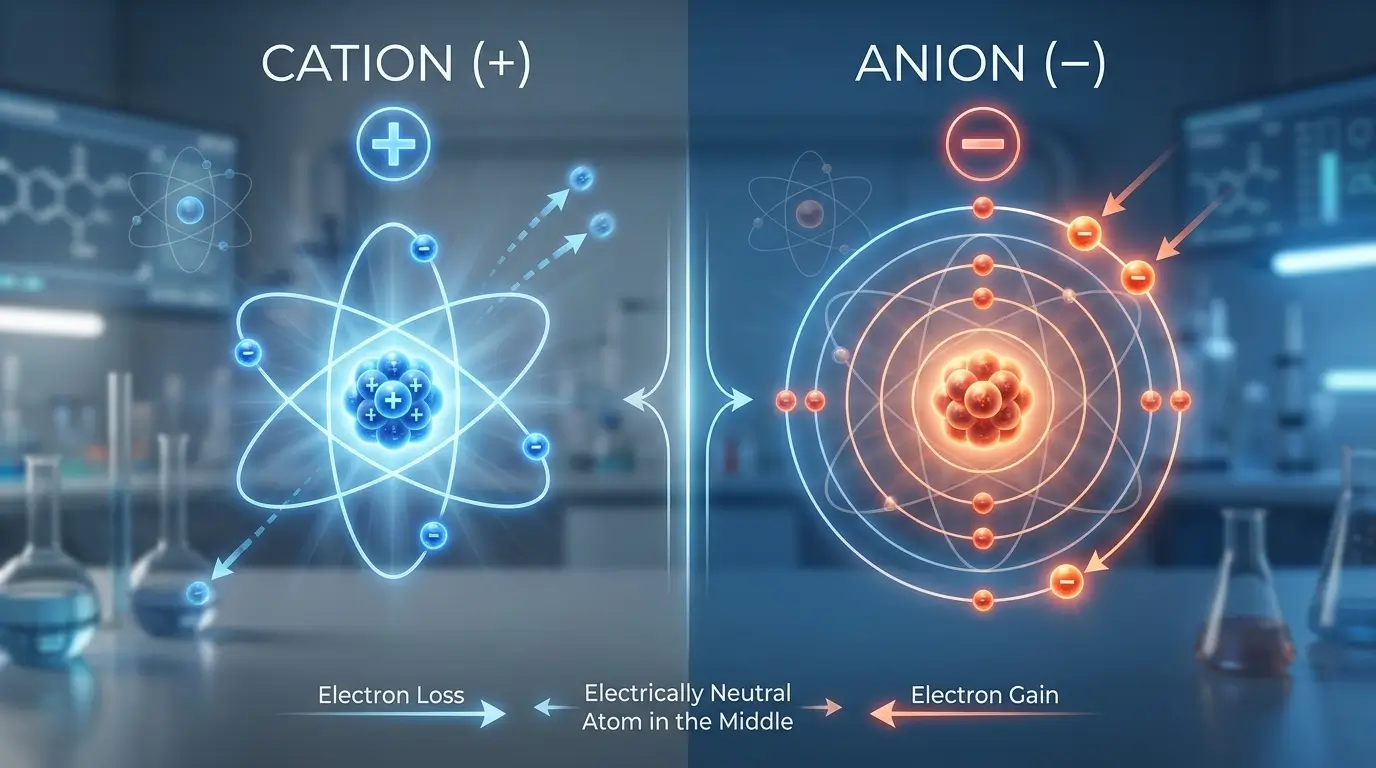
The difference between cation and anion is simple at its core: a cation has a positive electrical charge, while an anion has a negative electrical charge. This charge comes from a difference between the number of protons and electrons in the particle.
Understanding the difference between cation and anion also helps explain common substances such as sodium chloride, calcium chloride, and many acids and bases. The difference between cation and anion becomes even clearer when you connect charge to electron loss and gain.
This guide explains the difference between cation and anion in simple language. You will learn their meanings, origins, pronunciation, spelling, common mistakes, examples, and easy memory tricks.
Quick Answer
A cation is an ion with a positive charge. An anion is an ion with a negative charge.
The key difference is what happens to electrons:
- Cation → loses electrons → becomes positive
- Anion → gains electrons → becomes negative
For example, a neutral sodium atom has 11 protons and 11 electrons. When it loses one electron, it becomes Na⁺, a sodium cation.
A chlorine atom has 17 protons and normally 17 electrons. When it gains one electron, it becomes Cl⁻, a chloride anion.
| Feature | Cation | Anion |
|---|---|---|
| Electrical charge | Positive | Negative |
| Electron change | Loses electrons | Gains electrons |
| Example | Na⁺ | Cl⁻ |
| Common elemental examples | Na⁺, K⁺, Ca²⁺ | Cl⁻, F⁻, O²⁻ |
| Attracted toward | Negative electrode in electrolysis | Positive electrode in electrolysis |
One important point is that the terms describe ions, not neutral atoms. An atom becomes an ion when its numbers of protons and electrons are no longer equal.
The Origin of Cation and Anion
The words cation and anion have an interesting shared history. Both entered scientific English in the 19th century as part of the developing vocabulary of electrochemistry.
Merriam-Webster records the first known use of cation and anion as 1834. Their roots come from Greek words associated with movement: kation meant something like “going down,” while anion referred to something “going up.”
The terms were associated with the work of English scientist Michael Faraday. Historical etymological sources also credit the English polymath William Whewell with proposing the terminology that Faraday used in his work on electrolysis.
The older terms were connected to the behavior of ions during electrolysis. A cation was the ion moving toward the cathode, while an anion moved toward the anode. The modern chemical definitions focus more directly on electrical charge: cations are positive and anions are negative.
The word ion itself also comes from Greek and is connected with the idea of “going.” Merriam-Webster gives its first known use as around 1834.
This history explains why the two words look so similar. They were created as related technical terms, not as unrelated words that happened to develop similar spellings.
Why Do Cation and Anion Look So Similar?
Both words contain -ion, which reflects their shared relationship with the broader concept of an ion.
The first parts help distinguish them:
- cat- in cation comes from a Greek element meaning “down.”
- an- in anion comes from a Greek element meaning “up.”
Their historical meanings were connected to the direction of movement in electrolysis. Today, however, students normally need to remember their charges rather than their original Greek meanings.
Pronunciation and Part of Speech
Both cation and anion are nouns. They name types of electrically charged particles.
They are pronounced differently, although their endings sound similar.
- cation: commonly pronounced with the first syllable sounding like “cat”
- anion: begins with a vowel sound and has a similar “-ion” ending
Merriam-Webster gives pronunciations including /ˈkætˌaɪ.ən/ for cation and /ˈeɪˌnaɪ.ən/-type guidance for anion in its dictionary entries.
Because these are technical nouns, they usually appear in sentences such as:
- “Sodium is a common cation.”
- “Chloride is a common anion.”
- “The solution contains both cations and anions.”
The related adjectives are cationic and anionic.
For example:
- “The membrane allows cationic particles to pass.”
- “The compound contains an anionic group.”
British English vs American English Spelling
There is no meaningful British English versus American English spelling difference for cation and anion.
Both varieties use:
- cation
- anion
- cations
- anions
- cationic
- anionic
These are international scientific terms, so their spelling remains stable across major English varieties.
| Term | British English | American English |
|---|---|---|
| Positive ion | cation | cation |
| Negative ion | anion | anion |
| Plural of cation | cations | cations |
| Plural of anion | anions | anions |
| Adjective | cationic | cationic |
| Adjective | anionic | anionic |
So, unlike pairs such as colour/color or centre/center, there is no regional spelling choice to make here.
If you are writing a chemistry essay for a British university, use cation and anion. If you are writing for an American school, journal, or website, use the same spellings.
Which Spelling Should You Use?
Use cation when you mean a positively charged ion.
Use anion when you mean a negatively charged ion.
There is no need to change the spelling based on your audience. The same forms are standard in British, American, Canadian, Australian, and international scientific English.
The bigger challenge is choosing the correct word, not choosing a regional spelling.
A useful rule is:
Cation = positive ion. Anion = negative ion.
For formal scientific writing, always check the charge rather than relying only on memory. For example, Na⁺ is a cation, while Cl⁻ is an anion.
Common Mistakes
1. Saying that a cation gains electrons
This is one of the most common errors.
Incorrect:
“A sodium atom gains an electron and becomes a cation.”
Correct:
“A sodium atom loses an electron and becomes a cation.”
Losing a negatively charged electron leaves the particle with a net positive charge.
2. Saying that an anion is positive
An anion is negative.
For example:
- Cl⁻ = chloride anion
- O²⁻ = oxide anion
- F⁻ = fluoride anion
The minus sign is a direct clue to the charge.
3. Confusing the words with cathode and anode
The words are related, but they are not interchangeable.
A cation is an ion.
A cathode is an electrode.
An anion is an ion.
An anode is an electrode.
In an electrolytic cell, cations move toward the cathode, while anions move toward the anode.
4. Assuming every atom is an ion
A neutral atom has equal numbers of protons and electrons.
For example, neutral sodium has:
- 11 protons
- 11 electrons
After losing one electron:
- 11 protons
- 10 electrons
It now has a net +1 charge and is a cation.
5. Thinking a negative ion has gained protons
Ions usually become charged through changes in their electron count, not by gaining or losing protons.
If an atom gains electrons, it becomes more negative.
If it loses electrons, it becomes more positive.
Everyday Examples
The terms appear often in chemistry, medicine, biology, environmental science, and technical writing.
In an Email
A teacher or student might write:
“Please review the difference between cations and anions before tomorrow’s chemistry class.”
Here, the words are used as ordinary scientific nouns.
In News Writing
A science article might discuss an ion-exchange process:
“The material can selectively remove certain cations from water.”
The word cation is appropriate because the particles being discussed carry positive charges.
In Social Media
A student might write:
“My easiest chemistry trick: cations are positive, anions are negative.”
This is informal but scientifically useful.
In Formal Writing
A chemistry report might say:
“The solution contains positively charged cations and negatively charged anions.”
This makes the electrical relationship clear.
In Common Compounds
Sodium chloride provides a simple example.
Sodium forms Na⁺, a cation.
Chlorine forms Cl⁻, a chloride anion.
The opposite charges help form the ionic compound NaCl.
Calcium chloride provides another example:
- Ca²⁺ = calcium cation
- Cl⁻ = chloride anion
Two chloride ions are needed to balance one calcium ion, giving the formula CaCl₂.
Easy Comparison Table
| Category | Cation | Anion |
|---|---|---|
| Definition | Positively charged ion | Negatively charged ion |
| Charge | + | − |
| Electron behavior | Loses electrons | Gains electrons |
| Proton count | Greater than electron count | Lower than electron count |
| Example | Na⁺ | Cl⁻ |
| Another example | Ca²⁺ | O²⁻ |
| Common formation | Metal atoms often form cations | Nonmetal atoms often form anions |
| Related electrode in electrolysis | Cathode | Anode |
| Word type | Noun | Noun |
| Adjective | Cationic | Anionic |
| British spelling | Cation | Anion |
| American spelling | Cation | Anion |
A Simple Memory Trick
A common memory aid is:
CATions are PAWsitive.
The word cation can remind you of positive because both begin with a strong “cat/p” contrast in the mnemonic.
For anions, remember:
ANion = A Negative ion.
These are memory tricks, not word origins. They can help you remember the chemistry even though they do not explain where the terms historically came from.
Cation and Anion in Chemistry
Cations and anions are central to ionic chemistry.
Many metals tend to form cations because they can lose one or more outer electrons. Sodium, potassium, magnesium, and calcium are familiar examples.
Many nonmetals tend to form anions because they can gain electrons. Chlorine, fluorine, and oxygen can form negatively charged ions.
However, this pattern is a useful beginner’s guide, not a rule that applies without exception to every chemical situation. Some elements can form multiple ions or participate in bonding patterns that are more complex.
For example, iron can form both:
- Fe²⁺, called iron(II) or ferrous ion
- Fe³⁺, called iron(III) or ferric ion
Both are cations because both carry positive charges.
Likewise, anions are not limited to single atoms. Some are polyatomic ions, which contain multiple atoms but have an overall negative charge.
Examples include:
- OH⁻ = hydroxide
- NO₃⁻ = nitrate
- SO₄²⁻ = sulfate
- CO₃²⁻ = carbonate
This is important because an ion does not have to be a single atom. An ion can also be a group of atoms with a net electrical charge.
Search Interest and Common Usage
People searching for “difference between cation and anion” are usually looking for a simple chemistry explanation rather than a linguistic spelling comparison.
Common search intentions include:
- understanding positive and negative ions
- preparing for a chemistry exam
- learning electron gain and loss
- distinguishing cations from anions
- understanding ionic compounds
- remembering which ion has which charge
- reviewing basic electrochemistry
Search interest should not be confused with actual scientific usage. A search query tells us what people want to learn online, but it does not by itself measure how often scientists use the terms.
In scientific writing, both cation and anion are established technical terms. They are not alternative spellings of the same word. They describe two opposite types of ions.
FAQs
1. What is the main difference between a cation and an anion?
A cation is a positively charged ion, while an anion is a negatively charged ion. Cations generally form when atoms lose electrons, while anions generally form when atoms gain electrons.
2. Is Na⁺ a cation or an anion?
Na⁺ is a cation because it has a positive charge. A neutral sodium atom becomes Na⁺ when it loses one electron.
3. Is Cl⁻ a cation or anion?
Cl⁻ is an anion because it has a negative charge. A chlorine atom becomes chloride, Cl⁻, when it gains one electron.
4. Do cations gain or lose electrons?
Cations form when an atom or particle loses electrons. Since electrons have negative charges, losing them can leave the particle with a net positive charge.
5. Do anions gain or lose electrons?
Anions form when an atom or particle gains electrons. The extra negative charge gives the particle an overall negative charge.
6. Are cation and anion spelled differently in British and American English?
No. Both British and American English use cation and anion. These scientific terms do not have a standard regional spelling difference.
7. What is the easiest way to remember cation and anion?
Remember that a cation is positive and an anion is negative. You can also connect the “A” in anion with the phrase “a negative ion” as a simple memory aid.
Conclusion
The difference between cation and anion is simple: cations are positive ions, while anions are negative ions. Electron loss creates positive charge; electron gain creates negative charge.
Once you connect charge with electron movement, these two terms become much easier to recognize. Simple examples such as Na⁺ and Cl⁻ make the idea clear.
There is also no British-American spelling issue here. Both varieties use cation and anion, so focus on choosing the correct term for the charge.
Keep practicing these words in chemistry notes, emails, essays, and daily study. With a little practice, the difference will soon feel natural.

Aamer Shahzad is the founder of Diffnexx.com, a fast-growing educational platform focused on high-intent “difference between” topics. With over 8 years of experience in English language education and analytical writing, I specialize in breaking down complex “difference between” topics into clear, structured, and easy-to-understand explanations. Diffnexx.com is your go-to resource for enhancing English skills and writing with confidence.
I specializes in building search-optimized, research-driven comparison content designed for clarity, authority, and long-term digital asset value.







