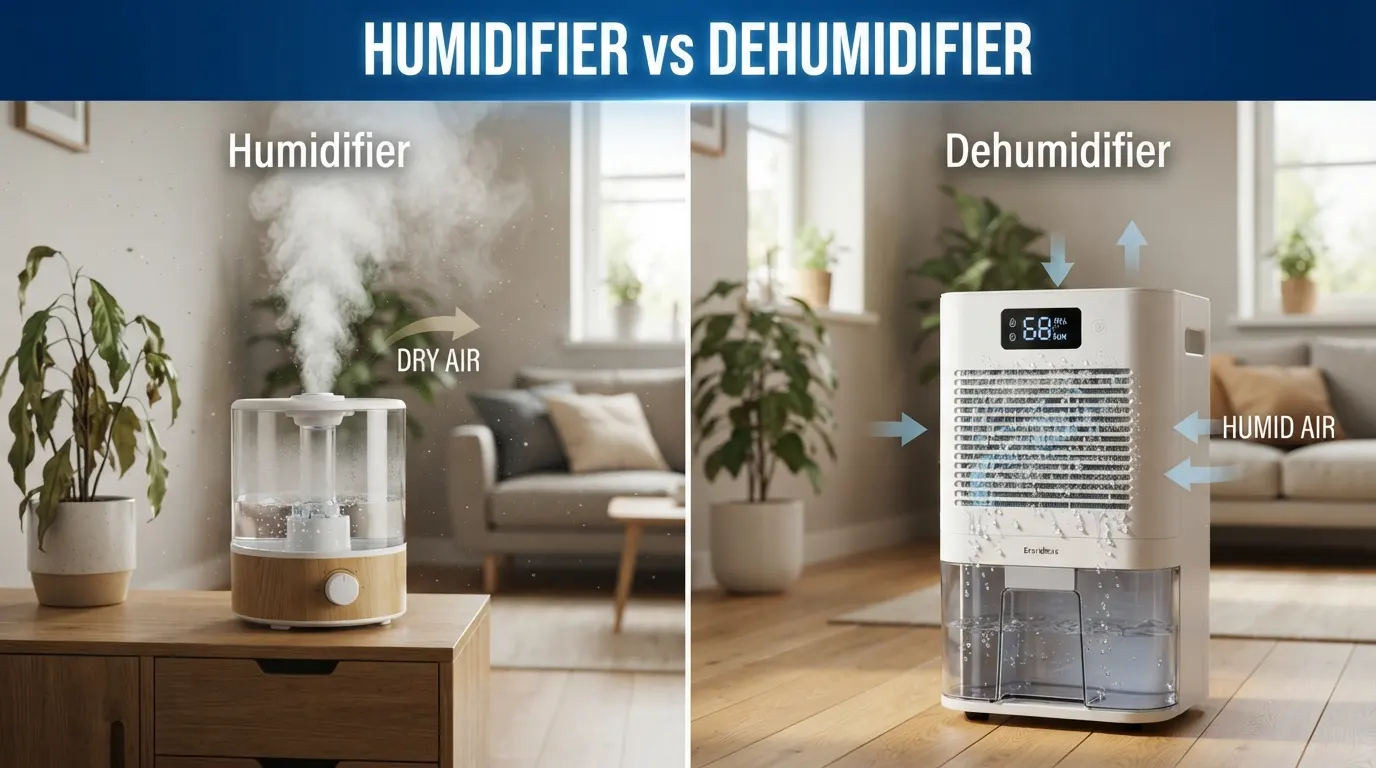
The difference between a humidifier and dehumidifier is simple: a humidifier adds moisture to the air, while a dehumidifier removes moisture from the air. They solve opposite indoor-air problems. A humidifier is useful when a room is too dry, while a dehumidifier helps when a room is too damp.
The best way to choose between them is to check the room’s relative humidity (RH) instead of guessing from how the air feels. The EPA generally recommends keeping indoor humidity around 30% to 50%. A hygrometer can tell you the actual humidity level.
So, if you are trying to understand the difference between humidifier and dehumidifier, remember this: humidifier = adds moisture; dehumidifier = removes moisture.
Humidifier vs. Dehumidifier: Quick Comparison
| Feature | Humidifier | Dehumidifier |
|---|---|---|
| Main job | Adds moisture to air | Removes moisture from air |
| Best for | Dry rooms | Damp rooms |
| Raises humidity? | Yes | No |
| Lowers humidity? | No | Yes |
| Common problem | Dry skin, dry throat, static | Condensation, musty odors, excess moisture |
| Common location | Bedroom, living room, heated rooms | Basement, bathroom, laundry area |
| Main maintenance | Clean water tank and replace/refill water | Empty and clean water collection system |
| Works toward | A healthier moisture level | A healthier moisture level |
The appliances may look similar, but their jobs are essentially opposite.
What Is a Humidifier?
A humidifier is a device that increases the amount of moisture in indoor air.
When air becomes very dry, it can feel uncomfortable. Dry indoor air may contribute to a dry nose or throat, cracked lips, irritated airways, and dry skin. A humidifier can add moisture and make the room more comfortable.
Humidifiers are especially common during periods when indoor heating dries the air.
When Should You Use a Humidifier?
A humidifier may make sense when:
- Indoor humidity is low.
- Your nose or throat feels dry.
- Your skin becomes unusually dry indoors.
- Static electricity becomes a frequent problem.
- The air feels noticeably dry during heating season.
However, more moisture is not always better.
The EPA advises not humidifying indoor spaces above 50% relative humidity, because excess moisture can encourage biological growth. If you see water collecting on windows or other surfaces, the humidity may already be too high.
Common Types of Humidifiers
Humidifiers use different methods to add moisture.
Common types include:
- Evaporative humidifiers — use airflow to help water evaporate.
- Ultrasonic humidifiers — use high-frequency vibrations to create a fine mist.
- Steam vaporizers — heat water and release steam.
- Central humidifiers — are connected to a home’s HVAC system.
The right type depends on the room, maintenance needs, noise level, and manufacturer’s instructions.
What Is a Dehumidifier?
A dehumidifier does the opposite. It removes excess water vapor from indoor air.
It can be useful in rooms that feel damp, clammy, or musty. High indoor humidity can also contribute to condensation and create conditions that support mold and other biological growth.
Dehumidifiers are often useful in:
- Basements
- Bathrooms
- Laundry rooms
- Damp bedrooms
- Poorly ventilated areas
- Homes in humid climates
When Should You Use a Dehumidifier?
A dehumidifier may be appropriate when:
- Humidity readings are consistently high.
- Windows frequently collect condensation.
- A room feels damp or clammy.
- You notice a persistent musty smell.
- Moisture problems are occurring in a basement or other enclosed area.
The EPA recommends controlling indoor moisture and keeping humidity around 30% to 50%. Dehumidifiers can be one way to reduce excess moisture, although ventilation, exhaust fans, air conditioning, and fixing leaks may also be important.
The Biggest Difference: Add Moisture vs. Remove Moisture
The easiest way to remember the difference is to focus on the prefixes.
Humidifier: adds humidity.
Dehumidifier: reduces humidity.
For example, imagine two rooms.
Room A has very dry air during winter. A humidifier can add moisture.
Room B has damp air and condensation on the windows. A dehumidifier can remove moisture.
Using the wrong appliance can move the room farther from the desired humidity level.
How Do You Know Which One You Need?
Don’t rely only on how the room feels.
The most useful first step is to measure the relative humidity with a hygrometer or humidity meter.
The EPA recommends indoor humidity of roughly 30% to 50%.
A simple guide is:
- Below the recommended range: consider whether added moisture is needed.
- Around 30%–50%: the room may already be in a suitable range.
- Above the recommended range: look for ways to reduce moisture.
The exact situation matters. A bathroom after a hot shower may temporarily have high humidity, while a whole house may have a different average level.
This is why measuring humidity is more useful than buying an appliance based only on a symptom such as “the room feels dry.”
Can You Use Both a Humidifier and Dehumidifier?
Yes. Having both does not automatically mean there is a problem.
Different rooms can have different humidity levels. A basement may be damp while an upstairs bedroom becomes dry during winter heating.
The appliances can also be useful during different seasons.
For example:
Winter: A heated bedroom may become too dry, so a humidifier could be useful.
Summer: A basement or poorly ventilated room may become too humid, making a dehumidifier more appropriate.
The important point is to control the humidity rather than run both appliances unnecessarily.
If a room is already within a comfortable humidity range, adding moisture and then removing it simply works against itself.
Humidifier vs. Dehumidifier for Allergies
Humidity can affect indoor allergens, but neither appliance should be treated as a universal allergy treatment.
High humidity can encourage conditions favorable to dust mites and mold, while very dry air can irritate the nose and throat. The American Academy of Allergy, Asthma & Immunology recommends monitoring humidity and keeping it in a moderate range.
If you have allergies, the goal is usually humidity control, not simply making the air more humid.
A dirty humidifier can also become a source of microorganisms or minerals. The EPA recommends proper cleaning and maintenance, while Mayo Clinic notes that poorly maintained humidifiers can contribute to health problems.
Humidifier vs. Dehumidifier for a Bedroom
A bedroom does not automatically need a humidifier or a dehumidifier.
The right choice depends on its humidity level.
Choose a humidifier when:
- The bedroom air is too dry.
- You experience dry-air discomfort.
- Indoor heating is making the room unusually dry.
Choose a dehumidifier when:
- The bedroom is damp.
- Condensation appears on windows.
- There is a persistent musty smell.
- Humidity remains high.
If the humidity is already in a suitable range, you may not need either appliance.
Humidifier vs. Dehumidifier for a Basement
Basements are often associated with excess moisture, so a dehumidifier is commonly the more relevant choice.
A dehumidifier can remove moisture from the air, but it cannot fix every moisture problem.
If water is entering through a leak, foundation problem, plumbing issue, or flooding, the source of the water needs to be addressed. The EPA also recommends ventilation and moisture control as part of a broader strategy.
A dehumidifier treats excess moisture in the air. It does not replace repairs.
Does an Air Conditioner Work Like a Dehumidifier?
An air conditioner can reduce humidity as part of its normal cooling process, but it is not exactly the same as a standalone dehumidifier.
An air conditioner is primarily designed to cool air. A dehumidifier is designed specifically to remove moisture.
Mayo Clinic notes that air conditioners can dry indoor air, while dehumidifiers collect excess moisture without providing the same cooling function.
This distinction matters if your main problem is humidity rather than temperature.
Common Mistakes to Avoid
1. Buying an appliance before measuring humidity
A room can feel uncomfortable for many reasons. Use a hygrometer to determine whether humidity is actually too low or too high.
2. Assuming more humidity is always better
It is not.
Too much moisture can contribute to mold and dust-mite problems. The EPA recommends keeping indoor humidity around 30%–50% and advises against humidifying above 50%.
3. Ignoring humidifier cleaning
A humidifier contains water, so maintenance matters. Dirty tanks can support microbial growth and may release contaminants into the air.
4. Using a dehumidifier to hide a water leak
A dehumidifier can lower humidity, but it cannot repair a leaking pipe, roof, foundation, or other water source.
5. Thinking humidity control replaces ventilation
Bathrooms and kitchens can create large amounts of moisture. Exhaust fans and proper ventilation can help remove that moisture at its source.
How to Maintain a Humidifier Safely
If you use a humidifier, regular maintenance is important.
The EPA recommends emptying portable humidifier tanks, wiping surfaces dry, and refilling them with fresh water daily. It also recommends using low-mineral water where appropriate and following the manufacturer’s cleaning instructions.
Watch for signs of excess humidity, such as:
- Wet windows
- Damp carpets
- Moist walls
- Water collecting around the appliance
- A room that feels unusually damp
If these occur, reduce the humidifier’s output or stop using it until the humidity is under control.
How to Maintain a Dehumidifier
Dehumidifiers also need regular care.
Depending on the model, you may need to:
- Empty the water collection tank.
- Clean the tank.
- Clean or replace filters.
- Keep air openings unobstructed.
- Follow the manufacturer’s maintenance schedule.
A neglected dehumidifier can become dirty and less effective. Mayo Clinic also recommends cleaning the moisture tray regularly to help prevent bacterial and mold growth.
Can a Humidifier and Dehumidifier Be Used in the Same Home?
Absolutely.
The important question is not whether a home should have one or the other. It is whether each room has the humidity problem that the appliance is designed to solve.
For example, one home could have:
- A dry upstairs bedroom that occasionally needs a humidifier.
- A damp basement that needs a dehumidifier.
- A living room that needs neither.
Humidity can vary significantly from room to room, especially in homes with different temperatures, ventilation patterns, and moisture sources.
Humidifier or Dehumidifier: Which One Is Better?
Neither appliance is universally better.
A humidifier is better for a room that is too dry.
A dehumidifier is better for a room that is too humid.
If the humidity is already in a suitable range, neither may be necessary.
The most reliable approach is to measure the humidity first, identify the source of the problem, and then choose the appliance that moves the room in the needed direction.
Frequently Asked Questions
What is the main difference between a humidifier and a dehumidifier?
A humidifier adds moisture to indoor air. A dehumidifier removes moisture. They perform opposite jobs.
Should I use a humidifier or dehumidifier in winter?
It depends on the humidity inside your home. Indoor heating can make some rooms too dry, while other spaces may still have excess moisture. Measure the humidity before choosing.
Can a dehumidifier make a room too dry?
Yes. A dehumidifier removes moisture, so running one unnecessarily or setting it too low can make the air drier than needed. Monitoring humidity helps prevent this.
Can a humidifier cause mold?
It can contribute to excess moisture if used improperly. High humidity can support mold growth, and a dirty humidifier itself can become contaminated. Proper humidity control and cleaning are important.
Do I need a humidifier if my air feels dry?
Not necessarily. First check the room’s relative humidity with a hygrometer. If humidity is already within a suitable range, the cause of discomfort may be something else.
Can I run a humidifier and dehumidifier at the same time?
You can, but doing so in the same room may be counterproductive if they are working against each other. They may make sense in different rooms or under different seasonal conditions.
Final Takeaway
The difference between humidifier and dehumidifier comes down to the direction of moisture control.
A humidifier adds moisture to dry air. A dehumidifier removes moisture from damp air.
For most homes, the smarter starting point is a humidity measurement rather than an appliance purchase. Keeping indoor humidity in a moderate range can improve comfort and help control moisture-related problems. The EPA generally recommends 30%–50% relative humidity indoors.
If the air is too dry, consider a humidifier. If it is too damp, consider a dehumidifier. And if the humidity is already suitable, you may not need either.
External Sources
American Academy of Allergy, Asthma & Immunology (AAAAI) — Humidifiers and Indoor Allergies
U.S. Environmental Protection Agency (EPA) — Use and Care of Home Humidifiers
U.S. Environmental Protection Agency (EPA) — Care for Your Air: A Guide to Indoor Air Quality
U.S. Environmental Protection Agency (EPA) — Controlling Moisture in Your Home
Mayo Clinic — Humidifiers: Ease Skin and Breathing Symptoms

Anton Reyes is a contributing writer at DiffNexx.com, where he explores meaningful differences in language, culture, and everyday concepts. With a background in creative nonfiction, Anton brings clarity and balance to complex comparisons. His writing helps readers understand subtle distinctions in words and ideas, making learning both insightful and engaging.







