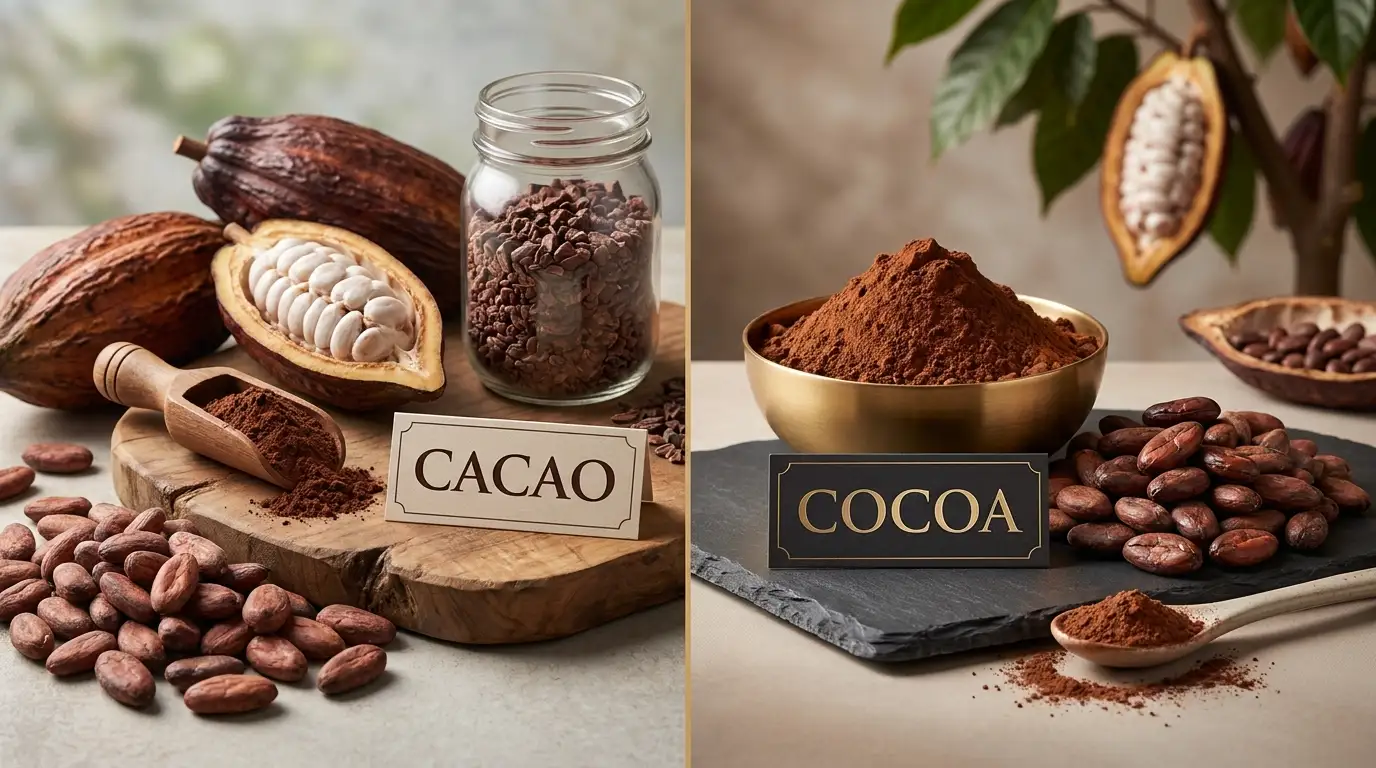
If you have ever compared chocolate powders, baking ingredients, or chocolate bars, you may have wondered about the difference between cacao and cocoa. The two words are closely related, but they are not always used in exactly the same way.
The difference between cacao and cocoa can be confusing because both terms can refer to products made from the same plant, Theobroma cacao. In everyday food writing, the words may even appear to be interchangeable. Yet they can point to different stages, forms, or styles of processing.
Understanding the difference between cacao and cocoa is useful when reading recipes, shopping for ingredients, or writing about chocolate. The word cacao often points more directly to the cacao plant and its beans, while cocoa is strongly associated with processed products such as cocoa powder and cocoa beverages.
The difference between cacao and cocoa also has an interesting language history. The two words came into English through related paths, and their spelling developed over time.
This guide explains their meanings, pronunciation, history, usage, spelling, common mistakes, and practical examples so you can choose the right word with confidence.
Quick Answer
The simplest answer is this:
Cacao usually refers to the Theobroma cacao tree, its fruit, or its seeds and beans.
Cocoa commonly refers to products made from cacao beans, especially cocoa powder, and can also refer to the drink made from that powder.
For example:
- Cacao beans are harvested from cacao pods.
- Cocoa powder is made by processing cacao beans and removing some of their fat.
- Cocoa can also mean a hot drink made with cocoa powder and milk or water.
- Cacao may be used broadly for the plant, beans, or ground bean material.
The distinction is not absolute. Dictionaries recognize overlap between the two terms, and food companies may use cacao and cocoa differently for branding or product descriptions.
The U.S. Food and Drug Administration also uses cacao for the plant and its beans while describing cocoa as a powder produced after processing the beans.
A simple example
Farmers grow cacao trees and harvest cacao beans.
Manufacturers process those beans into products such as cocoa powder.
This is a useful general distinction, but real-world usage is more flexible.
The Origin of Difference Between Cacao and Cocoa
The history of these words explains why their spellings look so similar.
Cacao entered English through Spanish cacao, which came from Nahuatl, the language associated with the Indigenous peoples of central Mexico. Merriam-Webster traces cacao to Nahuatl cacahuatl and records its first known English use in 1555.
The word cocoa developed later. Merriam-Webster identifies it as a modification of Spanish cacao and records its first known English use in 1730.
The Online Etymology Dictionary gives a more detailed account. It says cocoa developed as a variant of cacao, with the spelling influenced by coco. It also notes that confusion between the words was already present in English and that cocoa became the regular spelling around the beginning of the 19th century.
There is therefore no good reason to think that cacao and cocoa are two completely unrelated words. They are historically connected.
Interestingly, modern usage gave the two words somewhat different jobs. Cacao remains strongly associated with the plant and beans, while cocoa became especially common for processed powder and the beverage made from it. Merriam-Webster defines cocoa as powdered ground roasted cacao beans with some fat removed, as well as the drink prepared from the powder.
Why do the spellings differ?
The spelling difference developed through the history of English rather than through a British-versus-American spelling rule.
In other words:
cacao → an older form in English
cocoa → a later variant that became standard in many English contexts
The exact historical development contains some uncertainty, but reputable dictionary sources agree that cocoa is historically connected to cacao. The idea that cocoa developed partly through influence from coco is documented by etymological sources, rather than being a modern spelling invention.
Pronunciation and Part of Speech
Both cacao and cocoa are primarily nouns.
They can name the plant, beans, powder, or a prepared drink depending on context.
Cacao
Merriam-Webster gives more than one established pronunciation for cacao. English speakers may pronounce it with the stress toward the final syllable or use a pronunciation closer to the spelling.
For learners, the important point is that cacao has more than one accepted English pronunciation.
Cocoa
Cocoa is usually pronounced with two syllables, roughly like KOH-koh.
The pronunciation is different enough from cacao that learners should not treat the two words as homophones.
Examples as nouns
- Cacao grows in tropical climates.
- The farmer harvested the cacao beans.
- Add two tablespoons of cocoa to the cake mixture.
- I made a cup of hot cocoa.
Notice that the word’s grammatical role stays simple: both are nouns, but their meanings depend on the context.
British English vs American English Spelling
There is no major British English versus American English spelling difference between cacao and cocoa.
Both British and American English use:
- cacao
- cocoa
You should not change cacao to another spelling simply because you are writing for a British audience. Likewise, American English does not require a special alternative spelling of cacao.
The main difference is usage and context, not regional spelling.
For example, food packaging and recipe writing may use cacao to create a distinction between less-processed ingredients and cocoa for conventional cocoa products. That does not mean British speakers use cacao while Americans use cocoa. The distinction is often commercial, culinary, or contextual.
The FDA itself uses both terms in its food-related materials and describes cacao as the plant and its beans while using cocoa for products such as cocoa powder.
British English vs American English comparison
| Feature | British English | American English |
| Cacao spelling | cacao | cacao |
| Cocoa spelling | cocoa | cocoa |
| Cacao pronunciation | Accepted | Accepted |
| Cocoa pronunciation | Accepted | Accepted |
| Major spelling difference | None | None |
| Cocoa powder | Common | Common |
| Cacao beans | Common | Common |
So, if you are writing an article, recipe, school assignment, or business document, do not change the spelling simply to match UK or US English.
Which Spelling Should You Use?
The best word depends more on what you mean than where your reader lives.
Use “cacao” when talking about the plant or beans
Choose cacao when discussing:
- The cacao tree
- Cacao pods
- Cacao beans
- Farming
- The crop itself
- The botanical source of chocolate
Examples:
The farmer grows cacao in a tropical region.
The cacao beans were fermented before drying.
Use “cocoa” for powder and common food products
Choose cocoa when you mean:
- Cocoa powder
- Hot cocoa
- A conventional cocoa ingredient
- Many familiar baking products
Examples:
Add one tablespoon of cocoa powder.
We drank hot cocoa after dinner.
What about product labels?
This is where things can become less clear.
A product labeled cacao powder and another labeled cocoa powder may use different processing methods, but the word alone does not guarantee a specific processing method.
Do not assume that every product called cacao is automatically raw, unprocessed, healthier, or nutritionally superior. Likewise, cocoa does not by itself tell you everything about how a product was manufactured.
Read the ingredient list and product information when the processing method matters.
Common Mistakes
1. Thinking cacao and cocoa are completely different plants
They are not.
Both terms are closely connected to Theobroma cacao. Cacao is also the standard name used for the plant and its seeds.
Incorrect idea: Cacao comes from one plant and cocoa comes from another.
Better: Cocoa products are made from cacao beans.
2. Assuming cocoa always means a drink
Cocoa can refer to powder as well as a drink.
The recipe needs cocoa powder.
Here, cocoa is an ingredient, not a beverage.
3. Assuming cacao always means raw
This is one of the most common modern food-marketing assumptions.
The word cacao by itself does not guarantee that a product is completely raw or minimally processed.
Always check the product description for processing information.
4. Treating “cacao” as a British spelling of “cocoa”
This is incorrect.
Both words are used in British and American English.
5. Using “cocoa bean” and “cacao bean” as completely different ingredients
Both expressions can refer to the seeds of Theobroma cacao. Merriam-Webster even lists cocoa bean as another name for the cacao bean.
6. Assuming cocoa and chocolate mean exactly the same thing
They do not.
Cocoa can refer to powder or a beverage, while chocolate generally refers to food made from processed cacao ingredients, often with other ingredients added.
The FDA distinguishes among cacao products, cocoa, and chocolate products in its food standards and guidance.
Everyday Examples
The best way to remember the distinction is to see the words in real sentences.
In an email
Hi Sarah,
Could you please order cacao beans for our chocolate-making workshop?
Here, cacao refers to the beans.
Another example:
Please add cocoa powder to the shopping list.
Here, cocoa refers to a processed ingredient.
In a news article
Cocoa prices have affected chocolate manufacturers.
In this context, cocoa may appear in discussions of the wider cocoa and chocolate industry.
On social media
I made these brownies with unsweetened cocoa powder.
This is a natural everyday use of cocoa.
You might also see:
These energy bites contain cacao nibs.
Cacao nibs refers to pieces of processed cacao beans.
In formal writing
Cacao is the source plant for many products used in chocolate manufacturing.
Or:
Cocoa powder is commonly used in baked goods and chocolate-flavored beverages.
Formal writing benefits from choosing the word that best matches the specific product or stage being discussed.
In a recipe
A recipe may say:
3 tablespoons cocoa powder
This normally means a processed cocoa powder intended for baking.
A health-food recipe may instead say:
2 tablespoons cacao powder
That wording may reflect the producer’s terminology or a particular processing method. It should not automatically be interpreted as proof that one ingredient is healthier.
Cacao vs Cocoa: Search Interest and Usage Patterns
People often search for difference between cacao and cocoa because food labels, recipes, health articles, and product descriptions use the words in different ways.
Search interest does not necessarily tell us how frequently people use a word in everyday speech. Without current Google Trends data for a specific time range, it would be misleading to give exact search volumes, percentages, or rankings.
The broader search intent is easier to identify.
People commonly want to know:
- Whether cacao and cocoa come from the same plant
- Whether cacao is raw
- Whether cocoa is processed
- Which one should be used for baking
- Whether one is healthier
- Whether the words are interchangeable
- Why the spellings are different
The most reliable answer is that context matters. Cacao is strongly associated with the plant and beans, while cocoa has a particularly strong connection with processed powder and the familiar beverage.
The FDA similarly distinguishes cacao as the source plant and beans while describing cocoa powder as a processed cacao product.
Comparison Table
| Feature | Cacao | Cocoa |
| Word type | Noun | Noun |
| Refers to the plant | Yes | Sometimes |
| Refers to beans | Yes | Yes |
| Refers to powder | Yes, depending on context | Yes |
| Commonly means hot drink | No | Yes |
| Often associated with processing | Less specifically | More strongly |
| UK spelling | cacao | cocoa |
| US spelling | cacao | cocoa |
| Same plant source | Yes | Yes |
| Botanical name | Theobroma cacao | Theobroma cacao |
| Typical example | cacao beans | cocoa powder |
| Historical relationship | Older English form | Later variant |
The table shows why a strict “cacao equals X and cocoa equals Y” rule can be misleading. The terms overlap, but their most common modern uses are different.
FAQs
1. Is cacao the same as cocoa?
They are closely related, but the terms are not always used in exactly the same way. Cacao commonly refers to the plant and beans, while cocoa often refers to processed powder or the drink made from it.
2. Is cacao healthier than cocoa?
You cannot determine that from the word alone. Processing methods, serving size, added ingredients, and the specific product all matter. A label saying cacao does not automatically make a product healthier.
3. Is cocoa made from cacao?
Yes. Cocoa products are made from the seeds of the cacao plant. Cocoa powder is produced by processing cacao beans and removing some of their fat.
4. Can I use cacao powder instead of cocoa powder?
Often, yes, but the result may differ in flavor, texture, color, and acidity depending on the products. For baking, follow the recipe and check whether it specifies natural cocoa, Dutch-process cocoa, or another type.
5. Is cacao pronounced like cocoa?
No. The words have different established pronunciations. Cocoa normally has two syllables, while cacao has more than one accepted English pronunciation.
6. Is cacao a British spelling?
No. Cacao is not simply the British version of cocoa. Both spellings are used in both British and American English.
7. Why is cocoa spelled differently from cacao?
Cocoa developed historically as a variant of cacao. Etymological sources connect the spelling change with the history of the word in English, including influence from coco.
Conclusion
Knowing the difference between cacao and cocoa makes recipes, labels, and chocolate discussions much easier. The two words share the same plant source but often serve different uses.
Cacao usually points to the plant, fruit, or beans, while cocoa commonly describes processed powder or the familiar drink. Context still matters.
The spellings are not a British-versus-American issue. Both forms are standard in both varieties of English, so choose based on meaning, not location.
Keep practicing these words in emails, essays, recipes, and daily conversations. The more you see them in context, the more natural the difference will feel.

Eliza Marlowe is a passionate content strategist and comparison writer at diffnexx.com. She specializes in breaking down complex “difference between” topics into clear, reader-friendly guides. With a background in linguistics and digital research, Eliza focuses on accuracy, clarity, and content that helps readers make informed decisions with confidence.







