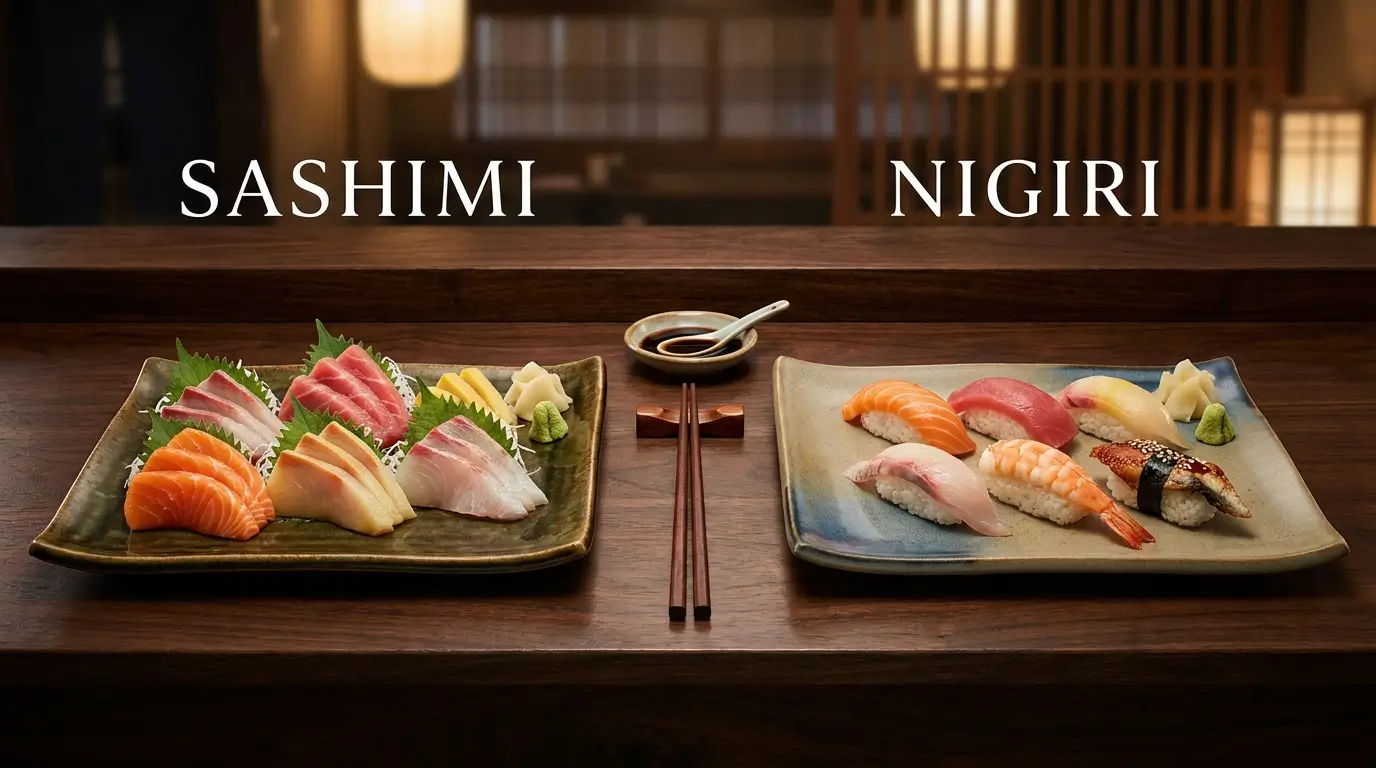
Japanese cuisine offers many beautiful ways to enjoy seafood, but some menu terms can be confusing. Sashimi and nigiri are two of the most common examples. Both may feature fresh raw fish, yet they are not the same dish.
The difference between sashimi and nigiri mainly comes down to rice and presentation. Sashimi is usually sliced raw seafood served without sushi rice. Nigiri consists of a hand-shaped portion of sushi rice topped with a slice of seafood or another ingredient.
People often search for the difference between sashimi and nigiri because both appear on sushi menus and can look similar at first glance. The difference between sashimi and nigiri also matters when choosing a meal based on taste, texture, portion size, or personal preference.
Understanding the difference between sashimi and nigiri makes Japanese restaurant menus easier to read. It also helps you order more confidently and appreciate why each style has its own preparation and serving method.
Quick Answer
The simplest answer is this:
Sashimi is sliced raw seafood served without sushi rice. Nigiri is sushi rice topped with a slice of seafood or another ingredient.
For example, a chef may serve thin slices of salmon or tuna alone as sashimi. The same type of fish can be placed over a small mound of seasoned sushi rice to make nigiri.
| Feature | Sashimi | Nigiri |
|---|---|---|
| Main component | Sliced seafood or other ingredients | Sushi rice with a topping |
| Rice | No | Yes |
| Seafood | Often raw | Often raw, but not always |
| Shape | Slices or pieces | Small rice mound topped with a slice |
| Preparation | Focuses on slicing and presentation | Involves shaping rice and adding a topping |
| Typical eating experience | Fish-forward | Combination of fish and seasoned rice |
| Category | Japanese dish | Type of sushi |
One important point is that sashimi is not technically sushi. Sushi is defined by its use of vinegared rice, while sashimi does not contain sushi rice.
Nigiri, by contrast, is a type of sushi because it combines a topping with seasoned sushi rice.
The Origin of Sashimi and Nigiri
The words sashimi and nigiri come from Japanese, and their meanings connect closely to how the foods are prepared.
Sashimi is commonly written 刺身 in Japanese. The characters can be understood as “pierced body,” although the exact historical development of the culinary term is more complex than a simple literal translation. The word refers to thinly sliced raw food, especially seafood, served as a dish.
Japanese culinary history contains long traditions of eating fresh fish and seafood in sliced or raw forms. However, it is important not to treat one simple origin story as a complete history of modern sashimi. The practice developed over time alongside Japanese food culture, preservation methods, knife skills, and regional traditions.
Nigiri comes from the Japanese verb nigiru, meaning “to grasp” or “to squeeze.” The name reflects the chef’s action of shaping or pressing the rice by hand. The full term nigiri-zushi literally relates to hand-formed sushi.
Modern nigiri sushi developed in Japan as part of the evolution of sushi culture. It became strongly associated with the Edo period style of sushi that used fresh seafood and hand-shaped rice.
The two words therefore describe different ideas:
- Sashimi focuses on the sliced ingredient.
- Nigiri refers to the hand-shaped rice-and-topping form.
Why Do Sashimi and Nigiri Look Similar?
The confusion comes from the seafood. A slice of salmon served as sashimi can look almost identical to a slice of salmon placed on nigiri.
The difference is what surrounds it.
If the fish is served by itself without sushi rice, it can be sashimi.
If the fish sits on a small portion of vinegared sushi rice, it is nigiri.
This distinction is simple but important.
Pronunciation and Part of Speech
Sashimi and nigiri are nouns when used in English. They name foods or styles of Japanese cuisine.
They do not have a major British-versus-American pronunciation difference. English speakers may vary slightly in how closely they reproduce Japanese sounds, but the terms remain recognizable in both varieties.
A simple pronunciation guide is:
- sashimi: roughly “suh-SHEE-mee”
- nigiri: roughly “nee-GHEE-ree,” with the middle sound influenced by Japanese pronunciation
Japanese pronunciation is not identical to English pronunciation, so these guides are only approximations.
In sentences, they function as nouns:
- “I ordered sashimi.”
- “She chose salmon nigiri.”
- “The restaurant serves fresh sashimi.”
- “We shared several pieces of nigiri.”
The words can also be used in compound food descriptions:
- sashimi platter
- sashimi-grade fish
- salmon nigiri
- tuna nigiri
British English vs American English Spelling
There is no meaningful British English versus American English spelling difference for sashimi or nigiri.
Both British and American English use the same spellings:
| Term | British English | American English |
|---|---|---|
| Raw sliced seafood dish | sashimi | sashimi |
| Hand-formed sushi | nigiri | nigiri |
| Sashimi plural in common English | sashimi / sashimi pieces | sashimi / sashimi pieces |
| Nigiri plural in common English | nigiri / pieces of nigiri | nigiri / pieces of nigiri |
These are Japanese culinary terms borrowed into English. They do not follow the spelling patterns that create common regional differences such as colour/color or centre/center.
You may sometimes see different ways of handling Japanese words in English because of differences in romanization or style guides. That does not create a standard British-versus-American spelling distinction for these two food names.
Which Spelling Should You Use?
Use sashimi when referring to the Japanese dish of sliced raw seafood or other ingredients served without sushi rice.
Use nigiri when referring to hand-formed sushi rice topped with an ingredient.
There is no need to choose a British spelling or an American spelling. The standard English forms are the same.
For a restaurant menu, food blog, recipe, school assignment, or general article, sashimi and nigiri are the safest standard forms.
If you are writing for an audience unfamiliar with Japanese cuisine, adding a short explanation can help:
“Nigiri is hand-shaped sushi rice topped with fish.”
Likewise:
“Sashimi is thinly sliced seafood served without sushi rice.”
This makes the terms easier for new readers to understand.
Common Mistakes
1. Calling sashimi a type of sushi
This is the most common mistake.
Incorrect:
“Sashimi is raw fish sushi.”
Better:
“Sashimi is sliced raw seafood served without sushi rice.”
Sashimi and sushi can both include raw fish, but the presence of seasoned rice is an important distinction.
2. Thinking all nigiri contains raw fish
Not necessarily.
Nigiri often features raw fish, such as salmon or tuna, but chefs can also use cooked seafood, egg, or other toppings.
Therefore, nigiri means more than raw fish on rice.
3. Thinking sashimi must always be fish
Sashimi is strongly associated with seafood, especially fish, but the broader Japanese culinary tradition includes other ingredients prepared in sashimi style.
The exact ingredients available can vary by restaurant and region.
4. Confusing nigiri with other sushi
Nigiri is only one form of sushi.
For example, maki is rolled sushi, usually formed with rice and fillings inside seaweed. Nigiri is shaped by hand into a small piece of rice with the topping placed on top.
5. Assuming sashimi and nigiri taste exactly the same
The same fish can be used for both, but the eating experience changes.
Sashimi lets you focus more directly on the fish’s flavor and texture.
Nigiri combines the fish with seasoned rice, creating a different balance of flavors and textures.
6. Assuming “raw” automatically means sashimi
Raw seafood alone does not define sashimi.
The preparation and serving style matter. Raw fish placed on sushi rice is generally nigiri rather than sashimi.
Everyday Examples
These words appear in many everyday food situations.
In an Email
A person planning a dinner might write:
“Could you check whether the restaurant has both sashimi and salmon nigiri?”
Here, the terms identify two different menu choices.
In a Restaurant Review
A reviewer might say:
“The sashimi was delicate, while the nigiri had a pleasant balance between fish and seasoned rice.”
This clearly describes two different eating experiences.
In Social Media
A food post might say:
“Tonight’s dinner: tuna sashimi and salmon nigiri.”
This is a natural informal use of both terms.
In Formal Writing
A food article might explain:
“Sashimi and nigiri both highlight fresh ingredients, but nigiri includes seasoned sushi rice while sashimi is served without it.”
This style is suitable for educational or culinary writing.
On a Restaurant Menu
You may see:
Sashimi
- Salmon sashimi
- Tuna sashimi
- Yellowtail sashimi
Nigiri
- Salmon nigiri
- Tuna nigiri
- Shrimp nigiri
- Egg nigiri
The menu categories help show the main difference.
Comparison Table
| Category | Sashimi | Nigiri |
|---|---|---|
| What is it? | Sliced seafood or other ingredients | Hand-formed sushi |
| Sushi rice | None | Essential |
| Vinegar-seasoned rice | No | Yes |
| Fish | Often raw | Often raw |
| Other toppings | Possible | Possible |
| Main focus | Ingredient and texture | Rice-topping combination |
| Typical shape | Thin slices or pieces | Small oval mound |
| Seaweed | Usually absent | Usually absent from the main piece |
| Is it sushi? | No | Yes |
| Common example | Salmon sashimi | Salmon nigiri |
| Eating style | Often eaten as individual slices | Usually eaten as individual pieces |
What Is the Difference in Taste?
The biggest taste difference comes from the rice.
Sashimi allows the seafood to take center stage. You can notice its texture, freshness, richness, and subtle flavor with little else competing for attention.
Nigiri adds seasoned sushi rice. The mild acidity and texture of the rice create a different balance with the topping.
For someone who enjoys the taste of fresh fish on its own, sashimi may be appealing.
For someone who wants a more complete bite that combines seafood with rice, nigiri may be the better choice.
The type of fish, seasoning, sauce, and preparation also affect the final taste, so two dishes made with the same seafood can still feel quite different.
Is Sashimi Healthier Than Nigiri?
It depends on what you mean by “healthier” and what ingredients are used.
Sashimi does not contain the rice found in nigiri, so it generally provides fewer carbohydrates from rice. Nigiri adds a source of carbohydrates because it includes sushi rice.
However, nutrition depends on the seafood, portion size, sauces, toppings, and preparation. A simple comparison based only on the food name can be misleading.
Raw seafood also requires careful handling and appropriate food-safety practices. People with certain health risks may need to avoid or limit raw seafood.
So, rather than assuming one is always healthier, consider the ingredients and your own dietary needs.
Which One Should You Order?
Choose sashimi if you want:
- More focus on the seafood
- No sushi rice
- A lower-carbohydrate option compared with rice-based sushi
- Thinly sliced fish or seafood served simply
Choose nigiri if you want:
- Seafood combined with sushi rice
- A classic sushi experience
- A balanced bite of topping and seasoned rice
- Different toppings in small individual portions
If you are new to Japanese cuisine, trying both can be a useful way to understand the difference.
Start with a familiar fish, such as salmon or tuna, and compare the same ingredient as sashimi and nigiri. The contrast becomes much easier to notice.
Search Interest and User Intent
People who search for “difference between sashimi and nigiri” usually want practical information before ordering food or learning more about Japanese cuisine.
Their search intent may include:
- understanding sushi menu terms
- learning whether sashimi is sushi
- finding out whether nigiri contains rice
- comparing taste and texture
- deciding what to order
- learning basic Japanese food vocabulary
- understanding the difference between raw fish dishes
Search interest reflects what people want to learn online. It does not provide a reliable measure of how often the terms are used in restaurants or everyday speech.
For content creators, the topic also has strong educational value because the two terms are closely related in restaurant menus but describe different food formats.
FAQs
1. What is the main difference between sashimi and nigiri?
Sashimi is usually sliced raw seafood served without sushi rice. Nigiri is hand-shaped sushi rice topped with seafood or another ingredient.
2. Is sashimi sushi?
No. Sashimi is not technically sushi because it does not contain vinegared sushi rice. It is a separate Japanese dish.
3. Does nigiri always contain raw fish?
No. Nigiri often uses raw fish, but it can also feature cooked seafood, egg, or other toppings. The defining feature is the hand-formed sushi rice.
4. Which is better for someone who does not like rice?
Sashimi is usually the better choice because it is served without sushi rice. It lets you enjoy the seafood on its own.
5. Can the same fish be used for sashimi and nigiri?
Yes. Salmon, tuna, and other seafood can be served in both styles. The main difference is how the ingredient is presented and whether sushi rice is included.
6. Is sashimi always raw?
Sashimi is strongly associated with raw seafood, but the broader term can cover carefully prepared sliced ingredients beyond the most familiar raw fish examples. Restaurant terminology may vary by dish.
7. Which is easier for beginners, sashimi or nigiri?
Nigiri can be an approachable starting point because the seasoned rice balances the flavor of the topping. However, the best choice depends on personal taste and comfort with raw seafood.
Conclusion
The difference between sashimi and nigiri is easy to remember once you focus on the rice. Sashimi is served without sushi rice, while nigiri includes hand-shaped rice.
Both dishes can showcase fresh seafood, yet they create different tastes, textures, and eating experiences. The same fish can work beautifully in either style.
There is no British or American spelling difference between the terms. Both sashimi and nigiri keep the same standard forms in English.
Keep practicing these useful food terms in menus, emails, essays, and daily conversations. The more you use them, the easier Japanese food vocabulary becomes.

Anton Reyes is a contributing writer at DiffNexx.com, where he explores meaningful differences in language, culture, and everyday concepts. With a background in creative nonfiction, Anton brings clarity and balance to complex comparisons. His writing helps readers understand subtle distinctions in words and ideas, making learning both insightful and engaging.







