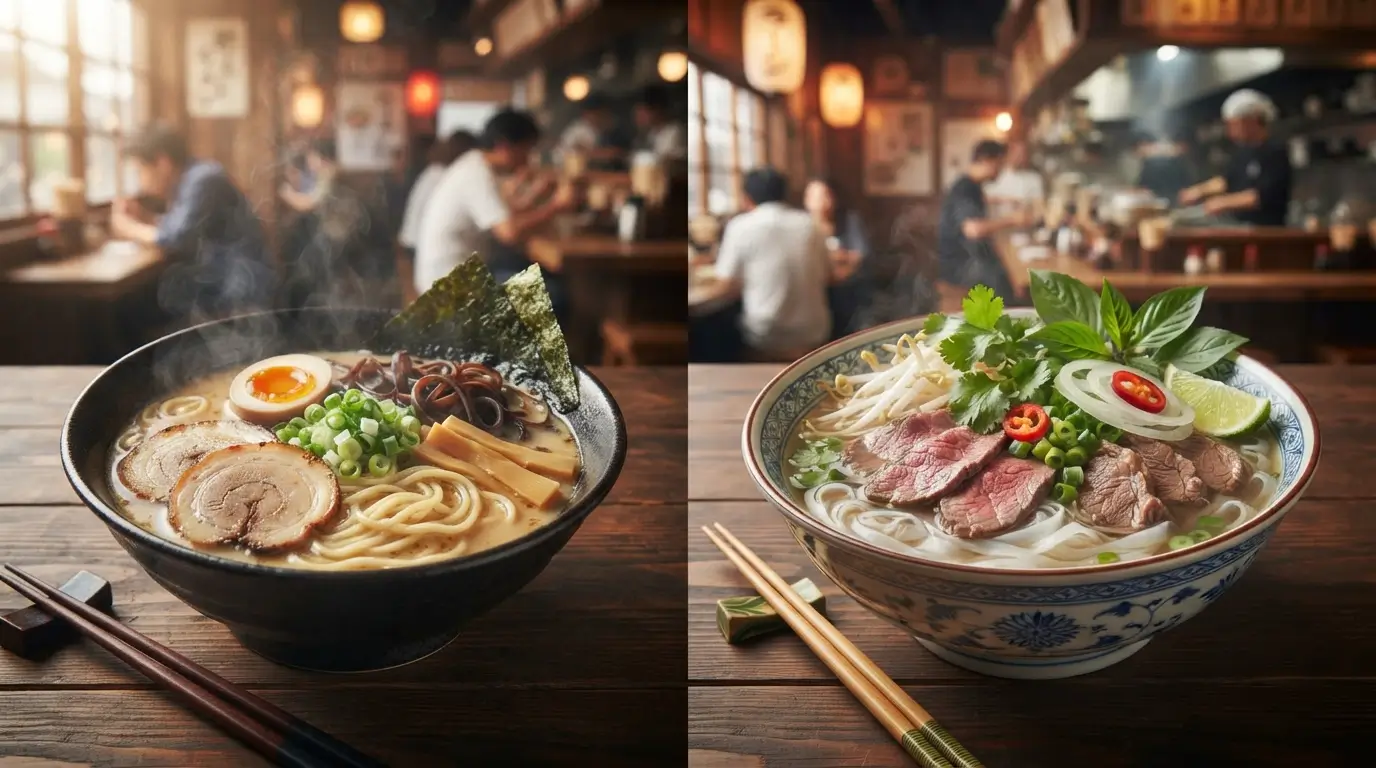
When you look at a bowl of ramen and a bowl of pho, the two dishes can seem almost alike. Both are noodle soups served hot, both can include meat and vegetables, and both are popular far beyond their countries of origin. Yet the difference between ramen and pho is clear once you look at the noodles, broth, seasonings, toppings, and culinary history.
People often search for the difference between ramen and pho because restaurant menus can make both dishes sound similar. New diners may also wonder why ramen noodles feel chewy while pho noodles are soft and flat.
Understanding the difference between ramen and pho can help you order with confidence, describe each dish correctly, and understand what makes each one special. The difference between ramen and pho also reflects two distinct food traditions: Japanese ramen developed from Chinese-style wheat noodle dishes, while pho emerged in northern Vietnam and developed during the French colonial period.
This guide explains the key differences in simple language, including pronunciation, word history, ingredients, spelling, everyday examples, and common mistakes.
Quick Answer
The main difference between ramen and pho is the type of noodle and the style of broth.
Ramen is a Japanese noodle dish that normally uses wheat noodles. The noodles are usually firm, springy, and chewy. Ramen broth can be clear, creamy, salty, rich, or deeply savory. Common styles include shoyu, shio, miso, and tonkotsu ramen.
Pho is a Vietnamese noodle soup made with flat rice noodles. Its broth is often clear and aromatic, with spices such as star anise, cinnamon, ginger, and coriander. Beef pho and chicken pho are common varieties.
A simple comparison looks like this:
| Feature | Ramen | Pho |
|---|---|---|
| Main tradition | Japanese | Vietnamese |
| Noodles | Wheat | Rice |
| Noodle shape | Often round, straight, or wavy | Flat and thin |
| Texture | Firm and chewy | Soft and delicate |
| Broth | Many styles | Usually clear and aromatic |
| Common proteins | Pork, chicken, seafood | Beef or chicken |
| Common additions | Egg, nori, scallions, bamboo | Herbs, bean sprouts, lime |
| Typical flavor | Savory, rich, deep | Fragrant, fresh, aromatic |
For a broader food comparison, you can also read this external guide on the difference between ramen and pho.
The Origins of Ramen and Pho
Ramen and pho have different histories, even though both are now recognized around the world as Asian noodle dishes.
The origin of ramen
Ramen is strongly associated with Japan, but its history includes Chinese culinary influence. Chinese-style wheat noodle dishes reached Japan through Chinese communities, especially in port cities during the late 19th and early 20th centuries.
Japan then developed its own regional ramen traditions. By the early 20th century, specialized ramen restaurants were appearing in Tokyo. The dish continued to change as Japanese cooks developed different broths, seasonings, noodle shapes, and toppings.
The origin of the word ramen is less certain than its culinary history. One widely discussed explanation connects the Japanese word with the Chinese term lamian, meaning pulled noodles. However, the relationship between the name and the modern Japanese dish is not completely settled. Japan’s government cultural publication also notes that the exact origin of the word has several theories.
This is an important distinction: the name may be connected to a Chinese noodle term, but modern ramen developed as its own Japanese food tradition.
The origin of pho
Pho has a different story. It is generally associated with northern Vietnam and became popular in places such as Hanoi and Nam Dinh during the French colonial period. Its exact origin remains debated.
Several theories connect pho with French and Chinese culinary influences. One theory links the name to French feu, as in pot-au-feu, while another proposes a connection with Chinese terminology for flat rice noodles. The evidence is not strong enough to treat one explanation as certain.
Because the etymology is disputed, it is better to say that the origin of the name pho is uncertain rather than present one theory as proven fact.
Why the spellings look so different
The words ramen and pho come from different languages and writing systems.
“Ramen” is the common English spelling of Japanese ラーメン.
“Pho” represents Vietnamese phở. The Vietnamese spelling includes the diacritic ở and a tone mark. English-language writing often removes the Vietnamese diacritics and uses the simpler spelling pho.
So, there is no British-versus-American spelling dispute here. The spelling difference comes from the languages themselves.
How to Pronounce Ramen and Pho
Pronunciation is another useful part of understanding these food names.
How to pronounce ramen
In English, ramen is commonly pronounced roughly like:
RAH-men
The first syllable is usually stressed.
Japanese pronunciation is closer to rah-men, although the Japanese vowel sounds do not map perfectly onto English sounds.
How to pronounce pho
Pho is commonly approximated in English as:
fuh
It is not normally pronounced “foe” as if it rhymed with “go.”
The original Vietnamese pronunciation includes a tone that English does not reproduce naturally. English speakers therefore use an approximation rather than perfectly matching Vietnamese pronunciation.
The key point is simple:
- ramen → roughly “RAH-men”
- pho → roughly “fuh”
What Is the Difference in the Noodles?
The noodles are one of the easiest ways to tell ramen and pho apart.
Ramen noodles
Ramen noodles are generally made from wheat flour, water, salt, and kansui, an alkaline ingredient that affects the noodles’ texture and appearance. They can be straight, wavy, thin, or thicker depending on the style.
The result is usually a noodle with a firm, springy bite.
Pho noodles
Pho uses rice noodles, commonly called bánh phở. They are flat, thin, and more delicate than typical ramen noodles.
Their soft texture allows them to absorb the fragrant broth while remaining distinct from the soup.
This gives you a quick visual test:
Wheat + chewy = ramen
Rice + soft and flat = pho
What Is the Difference in the Broth?
The broth creates another major contrast.
Ramen has a wide range of broth styles. Shoyu ramen uses soy sauce as a key seasoning, shio ramen is salt-based, miso ramen uses miso, and tonkotsu is known for a rich pork-bone broth. Ramen broth can therefore range from light and clear to thick and creamy.
Pho is usually associated with a clear, aromatic broth. Traditional beef pho can use beef bones along with ingredients such as charred onion, ginger, star anise, and other spices. Chicken pho uses chicken rather than beef.
This does not mean every ramen broth is heavy or every pho broth is light. Both dishes have regional and modern variations.
Still, as a general guide:
- Ramen: broader range of rich, savory, salty, and creamy broths
- Pho: clear, fragrant broth with a strong aromatic-spice profile
Toppings and Serving Style
Ramen often comes with toppings that add richness and texture.
Common choices include:
- Chashu pork
- Soft-boiled egg
- Nori
- Bamboo shoots
- Scallions
- Mushrooms
- Fish cakes
- Corn
Pho tends to highlight fresh and aromatic additions.
Common ingredients include:
- Thinly sliced beef or chicken
- Bean sprouts
- Cilantro
- Thai basil
- Lime
- Green onions
- Fresh chilies
Pho is also often served with herbs and other additions on the side, allowing diners to adjust the bowl to their taste.
British English vs American English Spelling
There is no meaningful British-versus-American spelling difference between ramen and pho.
Both British English and American English normally use:
- ramen
- pho
The Vietnamese form may also appear as phở when the original diacritics are retained.
| Term | British English | American English | Difference |
|---|---|---|---|
| Ramen | ramen | ramen | None |
| Pho | pho | pho | None |
| Vietnamese original | phở | phở | Same original spelling |
| Ramen in Japanese | ラーメン | ラーメン | Not an English regional issue |
So, there is no reason to change ramen to another British spelling or pho to an American alternative.
The main variation you may see is whether writers preserve the Vietnamese diacritic in phở.
Which Spelling Should You Use?
For general English writing, use ramen and pho.
If you are writing for an international audience, pho is usually the easiest form for readers to recognize. You can introduce the original spelling as phở if cultural or linguistic accuracy matters.
For example:
I ordered pho for lunch.
In a more detailed article, you might write:
Phở is a Vietnamese noodle soup made with rice noodles and aromatic broth.
For US readers, UK readers, and most global audiences, the same basic English spellings work.
Parts of Speech: Ramen and Pho
Both ramen and pho are primarily nouns when used in English.
They name foods or dishes.
Examples:
- “We had ramen after work.”
- “She ordered pho for lunch.”
- “This ramen has a spicy broth.”
- “The pho comes with fresh herbs.”
They do not normally function as verbs or adjectives.
You may see compounds such as ramen restaurant, ramen noodles, or pho broth. In these phrases, the food name modifies another noun, but the original word remains a food noun.
Common Mistakes with Ramen and Pho
Mistake 1: Calling pho ramen
Pho and ramen are both noodle soups, but they are not the same dish.
Better: “Pho is a Vietnamese rice-noodle soup.”
Mistake 2: Assuming both use wheat noodles
This is one of the most important ingredient differences.
Better: Remember that traditional ramen noodles are wheat-based, while pho uses rice noodles.
Mistake 3: Pronouncing pho like “foe”
The English approximation is closer to fuh.
Better: Say “fuh” rather than “foe.”
Mistake 4: Assuming all ramen has a heavy broth
Ramen includes many styles. Some broths are relatively light and clear.
Better: Describe ramen as having a wide range of broth styles.
Mistake 5: Treating the origin of pho as settled
Pho’s history has several competing theories.
Better: Say that its exact origins and name etymology remain debated.
Mistake 6: Thinking instant ramen represents every type of ramen
Instant ramen is only one form of the broader ramen tradition.
Better: Separate packaged instant noodles from restaurant-style ramen when discussing the cuisine.
Ramen and Pho in Everyday Examples
These words are common in casual writing, restaurant conversations, food reviews, and online posts.
In an email
Hi Sara,
I found a great ramen place near the office. Would you like to go there for lunch tomorrow?
In a news or food article
Pho has become one of Vietnam’s best-known culinary traditions, while ramen has developed many regional styles across Japan.
On social media
Cold evening, hot ramen, and a good movie. Perfect combination.
In formal writing
Ramen and pho are distinct noodle dishes that differ in their ingredients, preparation methods, and culinary histories.
In everyday conversation
“Do you want ramen or pho tonight?”
“Pho. I want something with rice noodles and a fragrant broth.”
These examples show that both words are simple nouns and fit naturally into everyday English.
Ramen vs Pho: Side-by-Side Comparison
| Category | Ramen | Pho |
|---|---|---|
| Country most associated with dish | Japan | Vietnam |
| Historical influences | Chinese and Japanese | Vietnamese, Chinese, and French influences are discussed |
| Main noodle | Wheat | Rice |
| Shape | Straight or wavy | Flat and thin |
| Texture | Firm and springy | Soft and delicate |
| Broth | Highly varied | Usually clear and aromatic |
| Common broth flavors | Soy sauce, salt, miso, pork bone | Beef or chicken with aromatic spices |
| Common meat | Pork, chicken, seafood | Beef or chicken |
| Typical toppings | Egg, nori, scallions, bamboo | Herbs, bean sprouts, lime, chilies |
| Flavor profile | Savory and varied | Fragrant, aromatic, fresh |
| Common English pronunciation | RAH-men | fuh |
| Part of speech | Noun | Noun |
| British/American spelling | Same | Same |
The table makes the central distinction easy to remember: ramen is built around wheat noodles and a highly varied Japanese broth tradition, while pho is built around flat rice noodles and an aromatic Vietnamese broth tradition.
FAQs
1. Is ramen or pho healthier?
Neither dish has one fixed nutritional profile. Ingredients, portion size, broth, meat, oils, and toppings can change the nutritional content. It is better to compare the specific bowl rather than the dish name alone.
2. Is pho made with ramen noodles?
No. Traditional pho uses flat rice noodles. Ramen uses wheat-based noodles.
3. Does pho taste like ramen?
Usually, no. Pho tends to have a lighter, aromatic broth with prominent spices and herbs. Ramen has a much wider range of broth flavors, including soy, miso, salt, and rich pork-bone styles.
4. Is pho Japanese or Vietnamese?
Pho is Vietnamese. It is strongly associated with northern Vietnam, where it became popular during the French colonial period. Its exact origin is still debated.
5. Is ramen Chinese or Japanese?
Modern ramen is strongly associated with Japan and developed there from Chinese-style wheat noodle traditions. Its history reflects both Chinese influence and Japanese culinary development.
6. Why is pho pronounced “fuh”?
The Vietnamese word phở has pronunciation features that do not map neatly onto English spelling. English speakers commonly approximate it as “fuh.” The Vietnamese pronunciation also includes a tone.
7. Can you use ramen noodles in pho?
You can substitute noodles when cooking at home, but the result will no longer have the typical texture of traditional pho. Ramen noodles are wheat-based and chewy, while pho noodles are soft rice noodles.
Conclusion
Ramen and pho may share a bowl, broth, and noodles, but their ingredients and traditions tell two very different stories. Knowing that makes each dish easier to appreciate.
Ramen brings chewy wheat noodles, varied broths, and rich toppings. Pho brings soft rice noodles, fragrant broth, herbs, and a distinct Vietnamese food tradition.
Once you learn these simple differences, ordering becomes easier. You can also describe both dishes with more confidence in everyday English.
Keep practicing these words in emails, essays, menus, and daily conversations. A little food vocabulary can make language learning feel delicious.

Aamer Shahzad is the founder of Diffnexx.com, a fast-growing educational platform focused on high-intent “difference between” topics. With over 8 years of experience in English language education and analytical writing, I specialize in breaking down complex “difference between” topics into clear, structured, and easy-to-understand explanations. Diffnexx.com is your go-to resource for enhancing English skills and writing with confidence.
I specializes in building search-optimized, research-driven comparison content designed for clarity, authority, and long-term digital asset value.







