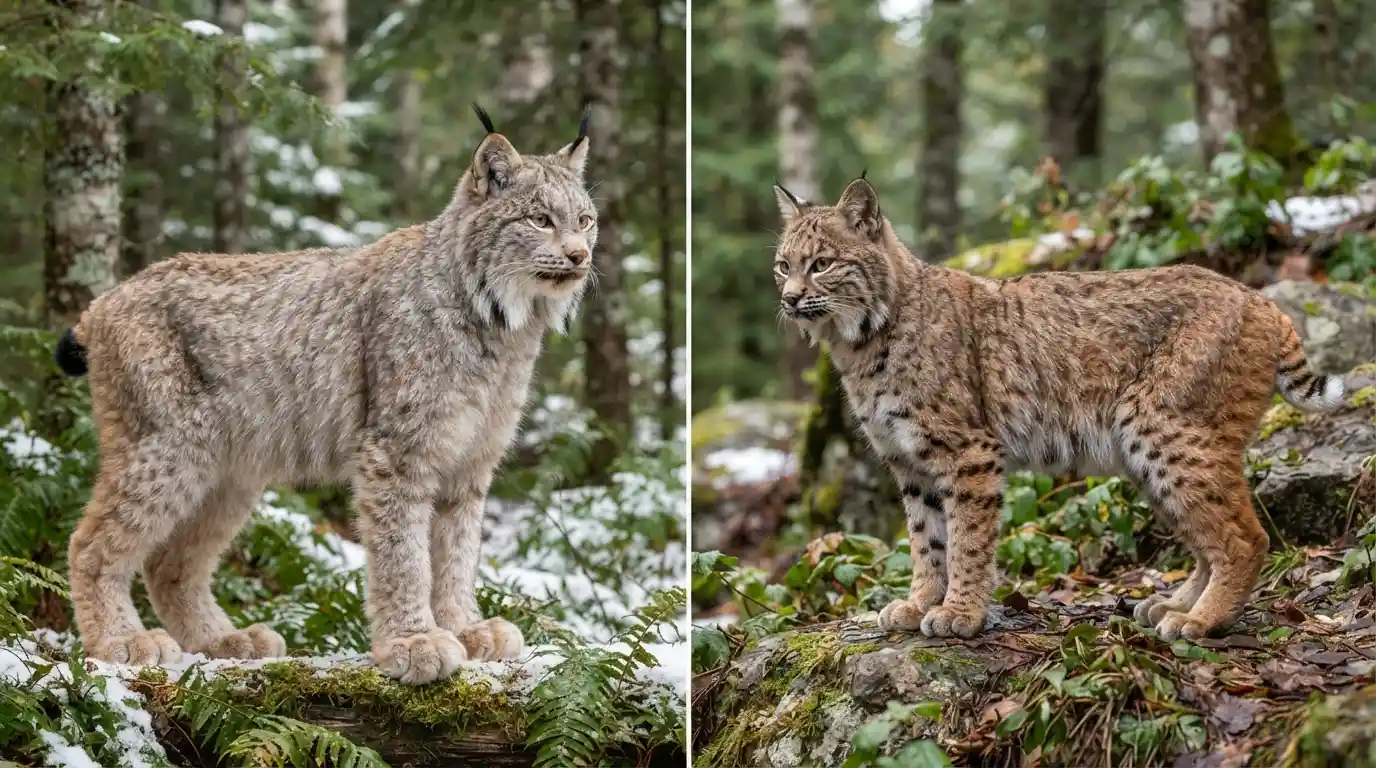
At first glance, a lynx and a bobcat can look like the same wild cat. Both have spotted or patterned fur, short tails, pointed ears, and small black ear tufts. Both also belong to the cat family and can live in parts of North America. So, what is the real difference between lynx and bobcat?
People often search for the difference between lynx and bobcat because the two animals are closely related and can share parts of the same range. A quick photo can make identification difficult, especially when the animal is far away or moving through thick vegetation.
The difference between lynx and bobcat becomes easier to see when you compare their feet, tails, ear tufts, legs, body shape, habitat, and diet. The Canada lynx is especially adapted to deep snow, while the bobcat can live in a much wider range of habitats.
Understanding the difference between lynx and bobcat is useful for wildlife lovers, students, writers, and anyone who wants to identify these fascinating cats correctly. This guide breaks down the key facts in simple terms.
Quick Answer
The main difference between lynx and bobcat is that the Canada lynx has larger furry feet, longer legs, longer ear tufts, and a completely black-tipped tail. The bobcat generally has smaller feet, shorter ear tufts, and a tail with a black upper surface but a lighter underside.
In North America, the comparison usually means:
- Canada lynx: Lynx canadensis
- Bobcat: Lynx rufus
Both belong to the genus Lynx, which explains why they look so similar.
The easiest clues are:
Large furry feet + long legs + long ear tufts = Canada lynx
Smaller feet + shorter ear tufts + bobbed tail = bobcat
The Canada lynx is strongly associated with northern boreal forests and snowy environments. Its large paws spread its weight over soft snow, helping it move through deep winter conditions.
Bobcats are more adaptable. They can live in forests, mountains, brushland, semi-deserts, and other habitats across much of North America.
The Origin of Lynx and Bobcat
The words lynx and bobcat have very different histories.
The origin of lynx
Lynx is an old English word for a type of wild cat. English received it through Latin lynx, which came from Greek lyngx. The word has related forms in several other European languages.
The deeper origin is not completely certain. One traditional explanation connects the word with an ancient root associated with light or brightness, possibly referring to the animal’s eyes. However, linguistic evidence presents problems for that explanation, so it should not be treated as proven. Another scholarly view suggests that the Greek word may come from an older non-Indo-European source.
The scientific genus name Lynx comes from this older word.
The genus includes several species, including the Canada lynx, Eurasian lynx, Iberian lynx, and bobcat.
The origin of bobcat
Bobcat is much more transparent as an English compound.
The name combines bob and cat. It refers to the animal’s unusually short tail. The word bobcat is recorded in English from the 19th century, with an 1873 reference associated with Maine.
The word bob has been used in English in connection with something shortened or cut short. Its deeper history is less certain, and dictionaries describe parts of its origin as obscure.
So the names tell us something useful:
- lynx is an ancient animal name with Greek and Latin history.
- bobcat is a later English name describing the cat’s short tail.
There is no British-American spelling conflict between these names. Their different forms come from their separate linguistic histories, not from regional English spelling rules.
Are Lynx and Bobcat the Same Animal?
No. They are separate species, although they are closely related.
The Canada lynx is Lynx canadensis, while the bobcat is Lynx rufus. Both are members of the genus Lynx and the family Felidae.
This explains why they can be difficult to tell apart.
Their shared features include:
- Short tails
- Pointed ears
- Ear tufts
- Spotted or patterned coats
- Carnivorous diets
- Solitary behavior
- Strong hunting abilities
Their differences developed alongside different habitats and ecological needs.
The Canada lynx is especially specialized for hunting snowshoe hares and traveling through snowy northern forests. Bobcats have a broader habitat and prey range.
Physical Differences Between Lynx and Bobcat
The body is the best place to start when identifying one of these cats.
1. Feet
The Canada lynx has exceptionally large, furry paws. The wide feet act almost like natural snowshoes.
This helps the animal move across deep, loose snow without sinking as easily.
Bobcat feet are smaller and less heavily furred.
This is one of the strongest clues when tracks are visible.
2. Legs
Canada lynx have relatively long legs, especially their hind legs. Their body structure helps them move through snowy terrain.
Bobcats have shorter-looking legs and a more compact appearance.
3. Ear tufts
Both animals have pointed ears with tufts of dark hair.
However, the Canada lynx generally has longer and more prominent black ear tufts. Bobcat ear tufts are usually shorter.
Ear tufts alone should not always be used for identification because their appearance can vary and photographs can be misleading.
4. Tail
The tail is another useful clue.
A Canada lynx has a very short tail with a black tip all around. The bobcat also has a short tail, but its black coloring is generally concentrated on the upper surface, with a lighter underside.
The bobcat’s short tail is also the source of its common name.
5. Face
Canada lynx often have a broad facial appearance with noticeable pale facial fur or ruffs.
Bobcats can also have facial ruffs, but their overall face tends to look smaller and less heavily framed.
6. Coat
Canada lynx often have grayish or gray-brown fur, with seasonal changes in appearance. Their spots can be faint.
Bobcats commonly have stronger dark spots and stripes, although coat patterns vary considerably between individuals and regions.
Because fur color changes with season and lighting, coat color alone is not a reliable identification method.
Habitat: Where Do Lynx and Bobcats Live?
Habitat provides another strong clue.
Canada lynx habitat
The Canada lynx is associated with northern forests, especially boreal forest environments. It occurs across much of Canada and Alaska, with additional populations in parts of the northern and western United States.
These areas can receive substantial snowfall.
The lynx’s large paws, long legs, and dense fur make it well suited to such conditions.
Bobcat habitat
Bobcats are much more flexible in habitat choice.
They can live in:
- Forests
- Mountains
- Brushland
- Semi-deserts
- Grassland environments
- Areas near human development
Their range extends from southern Canada through much of the United States and into Mexico.
This broader habitat range is one reason bobcats are encountered more widely across the United States than Canada lynx.
Diet and Hunting Differences
Both cats are carnivores, but their hunting patterns differ.
The Canada lynx has a particularly strong relationship with the snowshoe hare, which is its main prey. Changes in snowshoe hare populations can influence lynx populations.
Bobcats have a broader diet. They may hunt rabbits, rodents, birds, reptiles, and other animals. They can also take larger prey when opportunities arise.
Research comparing the two species describes the bobcat as having a broader dietary niche, while the Canada lynx is more closely associated with its specialized prey relationship.
This difference reflects their habitats and hunting strategies.
British English vs American English Spelling
There is no meaningful British English versus American English spelling difference for lynx or bobcat.
Both varieties normally use:
- lynx
- bobcat
- Canada lynx
The scientific names are also unchanged:
- Lynx canadensis
- Lynx rufus
| Term | British English | American English | Spelling Difference |
|---|---|---|---|
| Lynx | lynx | lynx | None |
| Bobcat | bobcat | bobcat | None |
| Canada lynx | Canada lynx | Canada lynx | None |
| Lynx canadensis | Lynx canadensis | Lynx canadensis | None |
| Lynx rufus | Lynx rufus | Lynx rufus | None |
Some regional wildlife sources may use different descriptive terms, but that is a matter of terminology or local naming, not a British-American spelling rule.
Which Spelling Should You Use?
Use lynx and bobcat in both American and British English.
If you are writing for a US audience, Canada lynx and bobcat are clear and familiar terms.
For a UK or Commonwealth audience, the same spellings remain correct.
For scientific or academic writing, use the scientific names when precise identification matters:
- Canada lynx — Lynx canadensis
- Bobcat — Lynx rufus
When introducing the animals, a useful style is:
The Canada lynx (Lynx canadensis) has larger paws than the bobcat (Lynx rufus).
After that, you can simply use Canada lynx and bobcat.
Pronunciation of Lynx and Bobcat
The two words are not pronounced alike.
Lynx
Lynx is pronounced roughly:
links
It has one syllable.
The final x represents the /ks/ sound.
Example:
“We saw a lynx in the wildlife documentary.”
Bobcat
Bobcat is pronounced:
BOB-kat
It has two syllables.
The word combines bob and cat, which makes its pronunciation easy for English speakers.
Simple pronunciation guide
| Word | Simple pronunciation | Syllables |
|---|---|---|
| Lynx | links | 1 |
| Bobcat | BOB-kat | 2 |
Neither word has a major British-American pronunciation split that changes its identity.
Parts of Speech: Lynx and Bobcat
Both lynx and bobcat are primarily nouns.
They name animals.
Examples:
- “The lynx crossed the snowy trail.”
- “A bobcat was seen near the forest.”
- “The researcher studied a Canada lynx.”
- “The bobcat has a short tail.”
The plural form of lynx can be lynx or lynxes. In scientific and general wildlife writing, lynx is common as a plural.
Examples:
Several lynx were observed in the region.
The study examined multiple lynxes.
Bobcat normally takes the regular plural bobcats.
Examples:
Several bobcats live in the area.
Knowing the part of speech helps you build sentences correctly. Both words normally function as nouns rather than verbs or adjectives.
Common Mistakes with Lynx and Bobcat
Mistake 1: Saying that every lynx is a bobcat
A bobcat is a particular species, Lynx rufus. The term lynx can refer to members of the genus Lynx more broadly.
Correct: A bobcat is one species in the lynx genus.
Mistake 2: Using tail length as the only clue
Both animals have short tails.
Correct: Look at the tail tip, feet, legs, and ear tufts together.
Mistake 3: Assuming the larger cat is always a lynx
Size ranges overlap. Individual animals can vary, and some bobcats can be substantial in size.
Correct: Use several physical features rather than size alone.
Mistake 4: Assuming every spotted cat is a bobcat
Canada lynx can also show spots, although their pattern may be less distinct.
Correct: Examine the entire animal.
Mistake 5: Thinking lynx only live in Canada
The Canada lynx occurs in Alaska and parts of the contiguous United States as well as Canada.
Mistake 6: Thinking their ranges never overlap
Canada lynx and bobcats can occur in some of the same broad regions, particularly near the edges of their ranges. Researchers have studied both species in areas where they live together.
Lynx and Bobcat in Everyday Examples
These animal names can appear in emails, news reports, social posts, schoolwork, and formal writing.
In an email
Hi Mark,
I found an interesting article about how researchers identify lynx and bobcats from wildlife camera images.
In news writing
Wildlife researchers are monitoring Canada lynx habitat in areas where the species overlaps with bobcat populations.
On social media
I finally spotted a bobcat on my trail camera last night!
In formal writing
The Canada lynx and bobcat are closely related felids with different adaptations to habitat and prey.
In a school essay
The Canada lynx has large, furry paws that help it move across deep snow.
For everyday conversation
“Was that a lynx?”
“It may have been a bobcat. Look at the tail and the size of the paws.”
These examples show that both words work naturally as common nouns.
Lynx vs Bobcat: Side-by-Side Comparison
| Feature | Canada Lynx | Bobcat |
|---|---|---|
| Scientific name | Lynx canadensis | Lynx rufus |
| Genus | Lynx | Lynx |
| Family | Felidae | Felidae |
| Main range | Northern North America | Much of North America |
| Typical habitat | Boreal and northern forests | Forests, mountains, brush, semi-deserts, and more |
| Feet | Very large and furry | Smaller |
| Legs | Relatively long | Shorter-looking |
| Ear tufts | Usually longer | Usually shorter |
| Tail | Very short, black-tipped all around | Short, black on upper surface |
| Coat | Often gray-brown, sometimes faintly spotted | Often more strongly spotted or striped |
| Main prey association | Snowshoe hare | Broad range of prey |
| Snow adaptation | Strong | Less specialized |
| Common name origin | Ancient animal name | Named for short tail |
| Pronunciation | “links” | “BOB-kat” |
| Part of speech | Noun | Noun |
One important point is that no single feature is perfect in every photograph. Wildlife identification is more reliable when several traits are considered together.
FAQs
1. Are lynx and bobcats the same species?
No. The Canada lynx is Lynx canadensis, while the bobcat is Lynx rufus. They are separate species in the same genus.
2. Which has bigger paws, a lynx or a bobcat?
The Canada lynx has much larger, more heavily furred paws. This is an adaptation for moving through deep snow.
3. How can you tell a lynx from a bobcat?
Look at several features. A Canada lynx usually has larger furry feet, longer legs, longer ear tufts, and a completely black-tipped tail.
4. Why is a bobcat called a bobcat?
The name refers to its short, or “bobbed,” tail. The word is recorded in English from the 19th century.
5. Do lynx and bobcats live in the same places?
Their ranges can overlap in parts of southern Canada and the northern United States. Researchers have studied them in areas where both species occur.
6. Are lynx bigger than bobcats?
Canada lynx are generally larger in important body dimensions and have longer legs and larger feet, but size ranges overlap. Physical identification should not depend on size alone.
7. Can lynx and bobcats mate?
Yes. Scientific evidence has confirmed hybridization between Canada lynx and bobcats in the wild. DNA analysis identified hybrids in Minnesota.
Conclusion
The difference between lynx and bobcatis easiest to remember through their feet, tails, ears, and habitat. Canada lynx have large furry paws, longer legs, and strong snow adaptations.
Bobcats have smaller feet and shorter ear tufts, and they live across a wider range of habitats. Their short tail is also the reason behind their common English name.
Both cats belong to the genus Lynx, so their similar appearance makes sense. Learning a few key features can make wildlife identification much easier and more accurate.
Keep practicing these terms in emails, essays, and daily conversations. The more you use them, the easier it becomes to describe wildlife with confidence.

Eliza Marlowe is a passionate content strategist and comparison writer at diffnexx.com. She specializes in breaking down complex “difference between” topics into clear, reader-friendly guides. With a background in linguistics and digital research, Eliza focuses on accuracy, clarity, and content that helps readers make informed decisions with confidence.







