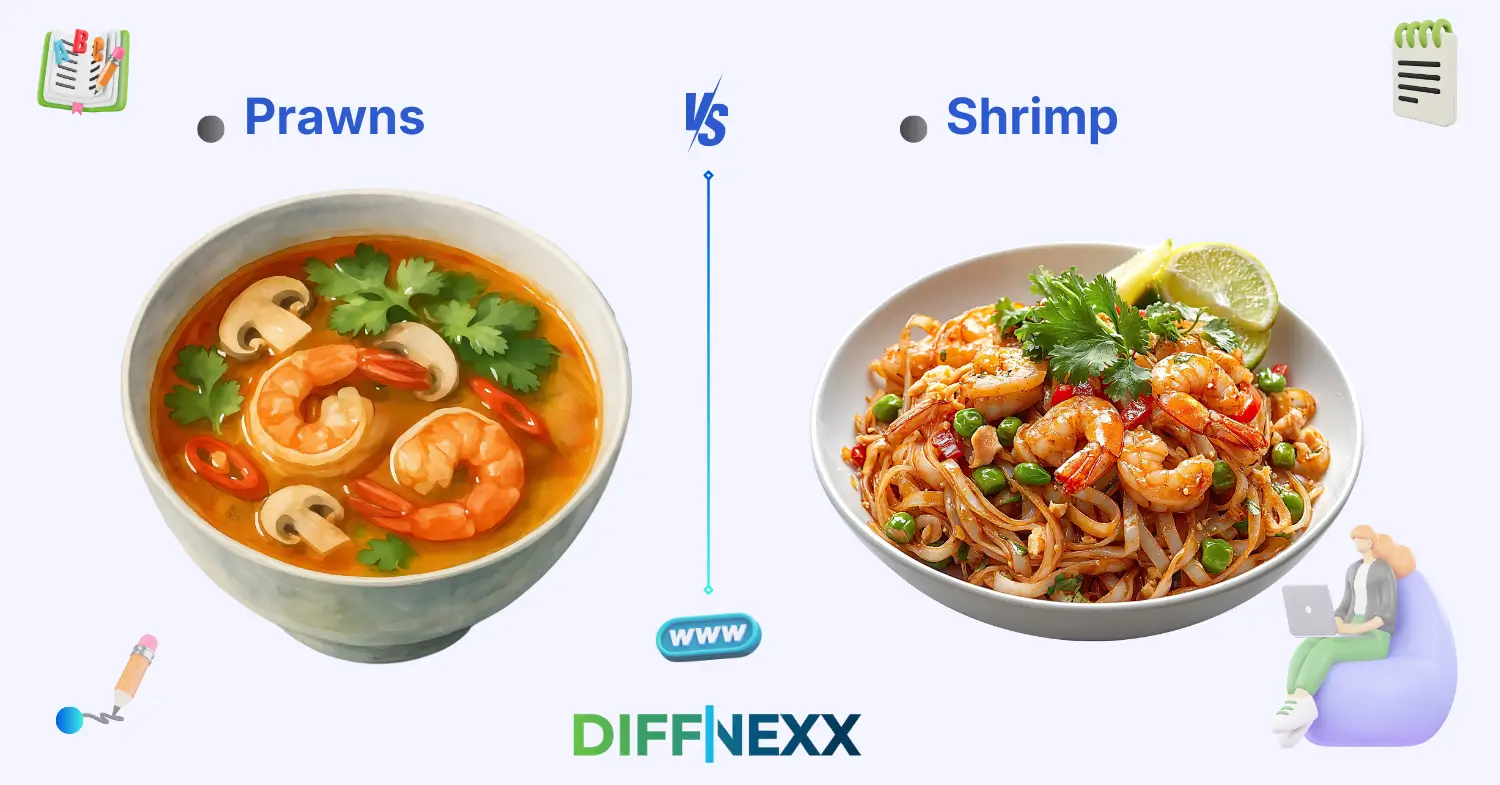
Difference between prawns and shrimp often comes up at a seafood restaurant. You read the menu and pause. One dish says grilled prawns. Another says garlic shrimp. You wonder if they taste different or if the name just changes.
The difference between prawns and shrimp can feel confusing because both look similar. They are small, shellfish-like sea creatures with long bodies and legs. Many people use the words as if they mean the same thing.
However, the difference between prawns and shrimp is real in biology. Scientists classify them into different groups. In cooking, though, the names often overlap.
Let’s break it down clearly so you never mix them up again. 🦐
Key Difference Between the Two
The main difference lies in biological classification and body structure.
Prawns and shrimp belong to different suborders of crustaceans. Their gill structure, leg formation, and body shape differ slightly.
In everyday cooking and shopping, people often use the terms interchangeably. But in science, they are not the same animal.
Why Is Their Difference Necessary to Know
Students studying marine biology must understand the difference. It helps them classify species correctly and avoid scientific errors.
Chefs and seafood suppliers benefit from clarity. Different regions label seafood differently, and correct naming builds trust with customers.
In society, clear knowledge reduces confusion. When people travel or read recipes from other countries, they understand what they are buying or eating.
Now let’s learn how to pronounce each word correctly.
🔊 Pronunciation
Prawns
US: /prɔːnz/
UK: /prɔːnz/
Shrimp
US: /ʃrɪmp/
UK: /ʃrɪmp/
Although pronunciation differs clearly, both refer to similar-looking seafood. Now, let’s define them carefully.
📚 Core Definitions
Prawns
Prawns are larger crustaceans that belong to the suborder Dendrobranchiata. They have branching gills and longer legs. They often live in both fresh and salt water.
The tone feels slightly formal or culinary in British English.
Example:
Seafood Dish – “The chef served grilled prawns with lemon butter.”
Shrimp
Shrimp belong to the suborder Pleocyemata. They have plate-like gills and a slightly curved body shape. Most shrimp live in salt water.
The tone feels casual in American English.
Example:
Dinner Plate – “She ordered shrimp pasta for dinner.”
📚 10 Clear Differences Between Prawns and Shrimp
1. Biological Classification
Prawns belong to Dendrobranchiata.
Shrimp belong to Pleocyemata.
Example for Prawns: “Marine biologists studied prawn reproduction.”
Example for Shrimp: “Researchers examined shrimp anatomy.”
2. Gill Structure
Prawns have branching gills.
Shrimp have plate-like gills.
Example for Prawns: “The prawn’s gills look tree-shaped.”
Example for Shrimp: “Shrimp gills lie flat.”
3. Body Shape
Prawns have a straighter body.
Shrimp have a curved body.
Example for Prawns: “The prawn looked long and straight.”
Example for Shrimp: “The shrimp curled naturally.”
4. Claw Structure
Prawns have claws on three pairs of legs.
Shrimp have claws on two pairs.
Example for Prawns: “The prawn’s claws were longer.”
Example for Shrimp: “The shrimp’s claws were smaller.”
5. Habitat
Prawns live in fresh and salt water.
Shrimp mostly live in salt water.
Example for Prawns: “Farmers raised prawns in freshwater ponds.”
Example for Shrimp: “Fishermen caught shrimp in the ocean.”
6. Regional Usage
British English favors “prawns.”
American English favors “shrimp.”
Example for Prawns: “The UK menu listed spicy prawns.”
Example for Shrimp: “The US recipe called for shrimp.”
7. Culinary Naming
Large shrimp may be labeled as prawns in markets.
Shrimp remains the general American term.
Example for Prawns: “The package said jumbo prawns.”
Example for Shrimp: “The store sold frozen shrimp.”
8. Perceived Size
People often think prawns are larger.
Shrimp are often considered smaller.
Example for Prawns: “The prawns filled the plate.”
Example for Shrimp: “The shrimp looked bite-sized.”
9. Scientific Precision
Scientists separate them clearly.
Consumers often ignore the difference.
Example for Prawns: “The textbook described prawn taxonomy.”
Example for Shrimp: “The shopper bought shrimp without checking species.”
10. Expression Style
“Prawns” sounds refined in some regions.
“Shrimp” sounds everyday and casual.
Example for Prawns: “The restaurant advertised king prawns.”
Example for Shrimp: “He grilled shrimp at home.”
🎯 Why Knowing the Difference Matters
Students gain clarity in biology and food science. Accurate classification builds strong academic foundations.
Professionals in seafood trade avoid labeling mistakes. Clear terminology improves export and import standards.
Consumers feel confident when reading menus or shopping abroad. Knowledge prevents misunderstandings in recipes and travel.
Real-World Consequences of Confusion
A traveler in the UK might expect shrimp but receive large prawns instead. Understanding regional naming avoids surprise.
🧠 Why People Get Confused
Similar Appearance
Both look nearly identical at first glance.
Semantic Overlap
Markets use the words loosely.
Context-Based Usage
Different countries prefer different terms.
Influence of Informal Speech
Chefs and stores often label by size rather than biology.
🎭 Connotation & Emotional Tone
Connotation = emotional meaning attached to a word.
Connotation (bold) = the emotional meaning associated with a word.
Prawns
Positive: Premium or gourmet feeling.
Example: “The prawns tasted luxurious.”
Negative: Can sound unfamiliar to Americans.
Example: “He wasn’t sure what prawns were.”
Neutral: Simple seafood name.
Example: “Prawns cook quickly.”
Shrimp
Positive: Friendly and common.
Example: “Shrimp tacos are popular.”
Negative: In slang, “shrimp” can mean small person.
Example: “They teased him as a shrimp.”
Neutral: Everyday seafood term.
Example: “Shrimp is easy to prepare.”
🗣 Usage in Metaphors, Similes & Idioms
Shrimp appears in English idioms.
- “He felt like a shrimp among giants.”
Example Sentence:
“At the seafood buffet, the prawns looked royal, while the shrimp seemed modest.”
📊 Comparison Table
| Feature | Prawns | Shrimp |
|---|---|---|
| Meaning | Dendrobranchiate crustacean | Pleocyemate crustacean |
| Tone | Slightly formal (UK) | Casual (US) |
| Usage | British English | American English |
| Context | Biology & cuisine | Cuisine & daily speech |
| Formality | Moderate | Informal |
⚖️ Which Is Better in What Situation?
When to Use Prawns
Use prawns in British English contexts or when referring to specific biological classification.
When to Use Shrimp
Use shrimp in American English or casual cooking conversation.
Situational Clarity
Match the term to your audience’s region.
Contextual Correctness
In scientific writing, use the correct biological term.
📖 Literary or Cultural References
- “The Prawn Cocktail Years” (Memoir, Simon Hopkinson, 2007) reflects British culinary culture.
- The movie “Forrest Gump” (USA, 1994) famously features shrimp dishes in American cuisine.
These references show regional usage differences.
❓ FAQs
1. Are prawns and shrimp the same species?
No. They belong to different biological suborders. However, they look similar and taste similar.
2. Why do Americans call them shrimp?
American English traditionally uses shrimp for most small crustaceans of this type.
3. Are prawns bigger than shrimp?
Often yes, but size alone does not define the species.
4. Do they taste different?
Their flavor is very similar. Cooking method affects taste more than species.
5. Which term should I use in recipes?
Follow regional preference or match the ingredient label.
🏁 Conclusion
The difference between prawns and shrimp lies mainly in biology, not taste. Prawns and shrimp belong to separate scientific groups, with differences in gills, claws, and body shape.
In daily life, people often use the words interchangeably. British English favors prawns, while American English prefers shrimp. Understanding this distinction improves clarity in science, cooking, and travel.
When you see either term on a menu, you now know what it means. Keep exploring language and food—you’ll always discover something new. 🦐

Anton Reyes is a contributing writer at DiffNexx.com, where he explores meaningful differences in language, culture, and everyday concepts. With a background in creative nonfiction, Anton brings clarity and balance to complex comparisons. His writing helps readers understand subtle distinctions in words and ideas, making learning both insightful and engaging.