Difference between average and median often comes up in everyday life. Imagine your teacher shares test scores, and one student scores very low while others score high. The final result may look confusing. Is the class doing well or not?
The difference between average and median helps us understand such situations clearly. Both terms are used to describe the “middle” or “typical” value in a set of numbers, but they do it in different ways.
Many learners mix them up because they sound similar and are used in math and statistics. However, knowing the difference between average and median can change how you understand data.
Let’s break it down step by step so it becomes simple and clear.
🔍 Key Difference Between the Both
The main difference is:
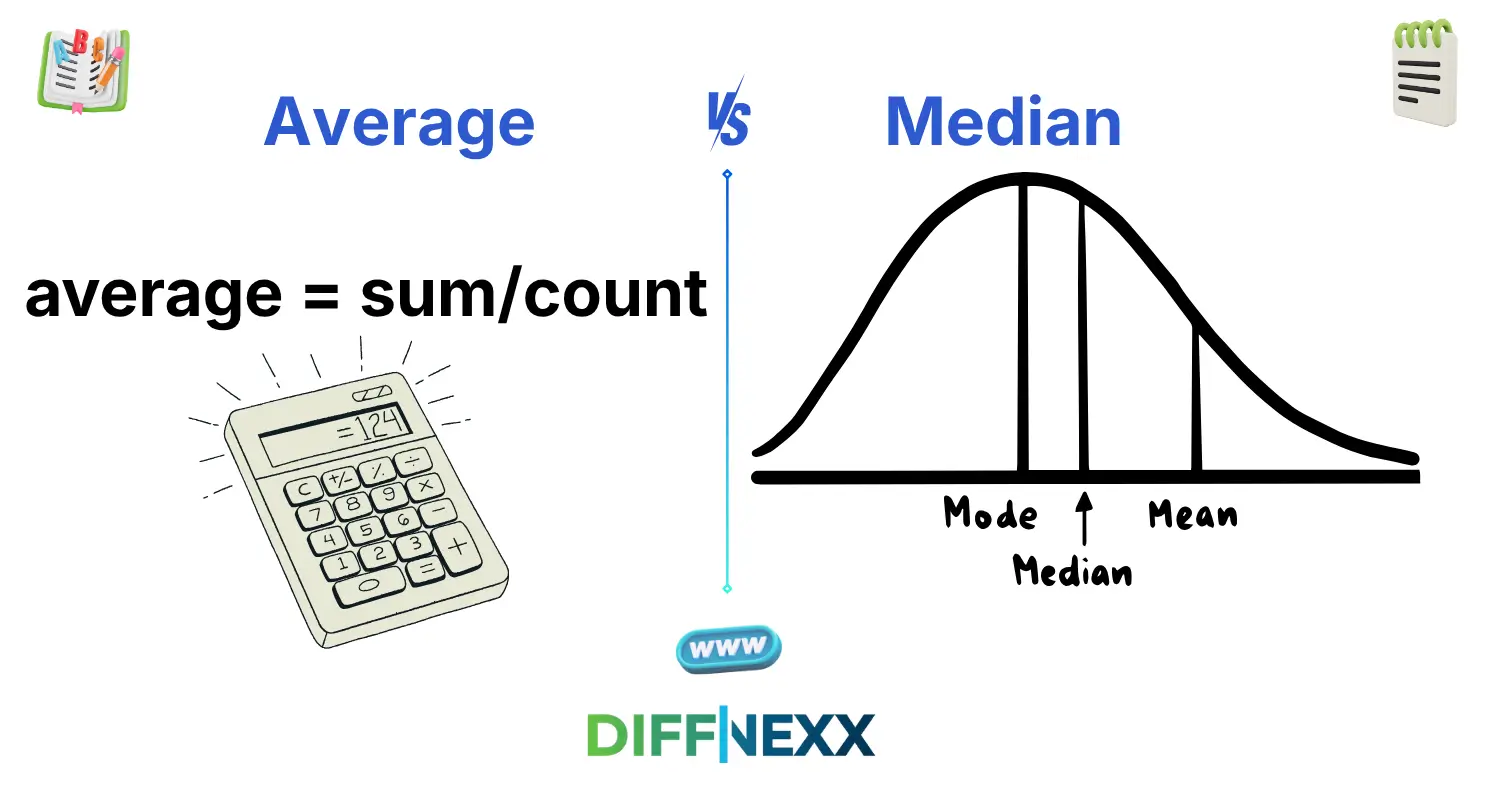
- Average (mean) adds all values and divides by the total number.
- Median finds the middle value after arranging numbers in order.
In short, average uses all values, while median focuses on the center value.
🌍 Importance – Why Their Difference Matters
Understanding this difference is very important in education and real life.
For students, it helps in solving math problems correctly. It also improves data understanding in exams and studies.
For professionals like analysts, teachers, and researchers, choosing the right measure gives accurate results. Using the wrong one can lead to misleading conclusions.
In society, people often hear about “average income” or “median salary.” Knowing the difference helps people understand real-world data better.
🔊 Pronunciation Section
Average
US: /ˈævərɪdʒ/
UK: /ˈævərɪdʒ/
Median
US: /ˈmiːdiən/
UK: /ˈmiːdiən/
Now that you can pronounce them correctly, let’s understand their meanings.
📚 Core Definitions
Average
Average, also called the mean, is the sum of all numbers divided by how many numbers there are. It considers every value in the dataset.
Example: The average of 2, 4, and 6 is 4.
Median
Median is the middle number when all values are arranged in order. It ignores extreme values.
Example: The median of 2, 4, and 100 is 4.
📊 10 Clear Differences Between Average and Median
1. Calculation Method
Average uses addition and division.
Median uses ordering and position.
- Example for Average: Add all marks and divide by total students.
- Example for Median: Arrange marks and pick the middle one.
2. Effect of Outliers
Average is affected by very high or low values.
Median is not affected by extreme values.
- Example for Average: One low score reduces the result.
- Example for Median: Middle value stays stable.
3. Focus
Average focuses on all data points.
Median focuses on the central value.
- Example for Average: Uses every number.
- Example for Median: Uses only position.
4. Accuracy in Skewed Data
Average may give misleading results in uneven data.
Median gives a more realistic center.
- Example for Average: Income looks higher due to rich individuals.
- Example for Median: Shows true middle income.
5. Simplicity
Average is easy to calculate but needs math.
Median is simple but needs sorting.
- Example for Average: Quick calculation.
- Example for Median: Needs arrangement first.
6. Usage Context
Average is used in general math and daily calculations.
Median is used in statistics and research.
- Example for Average: School grades.
- Example for Median: Income reports.
7. Sensitivity
Average is sensitive to changes in data.
Median is stable and resistant.
- Example for Average: Changes quickly.
- Example for Median: Changes slowly.
8. Representation
Average shows overall trend.
Median shows central position.
- Example for Average: Overall class performance.
- Example for Median: Typical student score.
9. Data Type Suitability
Average works best with uniform data.
Median works best with uneven data.
- Example for Average: Balanced numbers.
- Example for Median: Skewed numbers.
10. Interpretation
Average can sometimes mislead.
Median is easier to interpret in real life.
- Example for Average: Salary looks higher than reality.
- Example for Median: Gives realistic value.
🎯 Why Knowing the Difference Matters
Students must know this difference to solve math problems correctly. It helps them choose the right method during exams.
Professionals rely on accurate data analysis. Choosing average or median affects reports, research, and decisions.
In everyday life, people hear about “average salary” and “median income.” Understanding both prevents misunderstanding.
Real-world consequences of confusion
If a company uses average salary, it may appear higher than reality. This can mislead job seekers. Using median gives a clearer picture.
🧠 Why People Get Confused
Similar Terms
Both words relate to “middle” or “typical value,” which creates confusion.
Semantic Overlap
They are both measures of central tendency.
Context-Based Usage
People use them interchangeably in casual speech.
Informal Speech
In daily talk, “average” is often used for any middle value.
🎭 Connotation & Emotional Tone
Connotation = the emotional meaning associated with a word.
Average
- Positive: Normal, balanced
- Negative: Ordinary or not special
- Neutral: Mathematical value
- Example: “He is an average student.”
Median
- Positive: Accurate, fair
- Neutral: Statistical term
- Example: “Median income gives a fair picture.”
🗣 Usage in Metaphors, Similes & Idioms
These words are not commonly used in idioms, but appear in explanations:
- “The average tells the whole story.”
- “The median shows the real middle.”
Example sentences:
- The average score looked high.
- The median score showed the true result.
📊 Comparison Table
| Feature | Average | Median |
|---|---|---|
| Meaning | Sum divided by count | Middle value |
| Tone | General, common | Precise, statistical |
| Usage | Daily math | Data analysis |
| Context | Simple calculations | Research |
| Formality | Informal to formal | Formal |
⚖️ Which Is Better in What Situation?
When to use Average
Use average when data is balanced and has no extreme values. It works well for marks, temperatures, and simple calculations.
When to use Median
Use median when data has extreme values or is uneven. It gives a more accurate middle value.
Situational clarity
If you want an overall picture, use average. If you want a fair center, use median.
Contextual correctness
Choose based on data type. Balanced data needs average, while skewed data needs median.
📖 Literary or Cultural References
- Book: Naked Statistics (Non-fiction, Charles Wheelan, 2013)
Explains average and median in simple terms. - Movie: Moneyball (USA, 2011)
Shows how data and statistics help in decision-making.
❓ FAQs
1. Is average the same as median?
No, average is calculated using all values, while median is the middle value.
2. Which is more accurate?
Median is more accurate when data has extreme values.
3. Why is average misleading sometimes?
Because extreme values can change the result.
4. When should I use median?
Use it when data is uneven or skewed.
5. Is median always better?
No, it depends on the situation and data type.
6. What is an outlier?
An outlier is a value much higher or lower than others.
7. Can both be used together?
Yes, they are often used together for better understanding.
8. Is average easier than median?
Average is easier to calculate, but median is easy to understand.
9. Why do news reports use median income?
Because it gives a more realistic picture.
10. Do both show central tendency?
Yes, both are measures of central tendency.
🏁 Conclusion
The difference between average and median lies in how they measure the center of data. Average uses all values, while median focuses on the middle position.
This difference is important because it affects how we understand numbers. In balanced data, average works well. In uneven data, median gives a clearer picture.
Learning this helps in studies, work, and daily life. It prevents confusion and improves decision-making.
Keep practicing and exploring, understanding numbers becomes easier step by step.

Aamer Shahzad is the founder of Diffnexx.com, a fast-growing educational platform focused on high-intent “difference between” topics. With over 8 years of experience in English language education and analytical writing, I specialize in breaking down complex “difference between” topics into clear, structured, and easy-to-understand explanations. Diffnexx.com is your go-to resource for enhancing English skills and writing with confidence.
I specializes in building search-optimized, research-driven comparison content designed for clarity, authority, and long-term digital asset value.