Difference between slander and libel often comes up in real life. Imagine someone spreads a false rumor about you in a meeting, and later, the same claim appears online.
Many people feel confused here. Is spoken harm the same as written harm? This is where the difference between slander and libel becomes important.
In simple words, both involve false statements that damage a person’s reputation. But the key difference lies in how the information is shared.
Understanding the difference between slander and libel helps you communicate wisely and avoid legal trouble. Let’s explore this clearly.
⚖️ Key Difference Between the Both
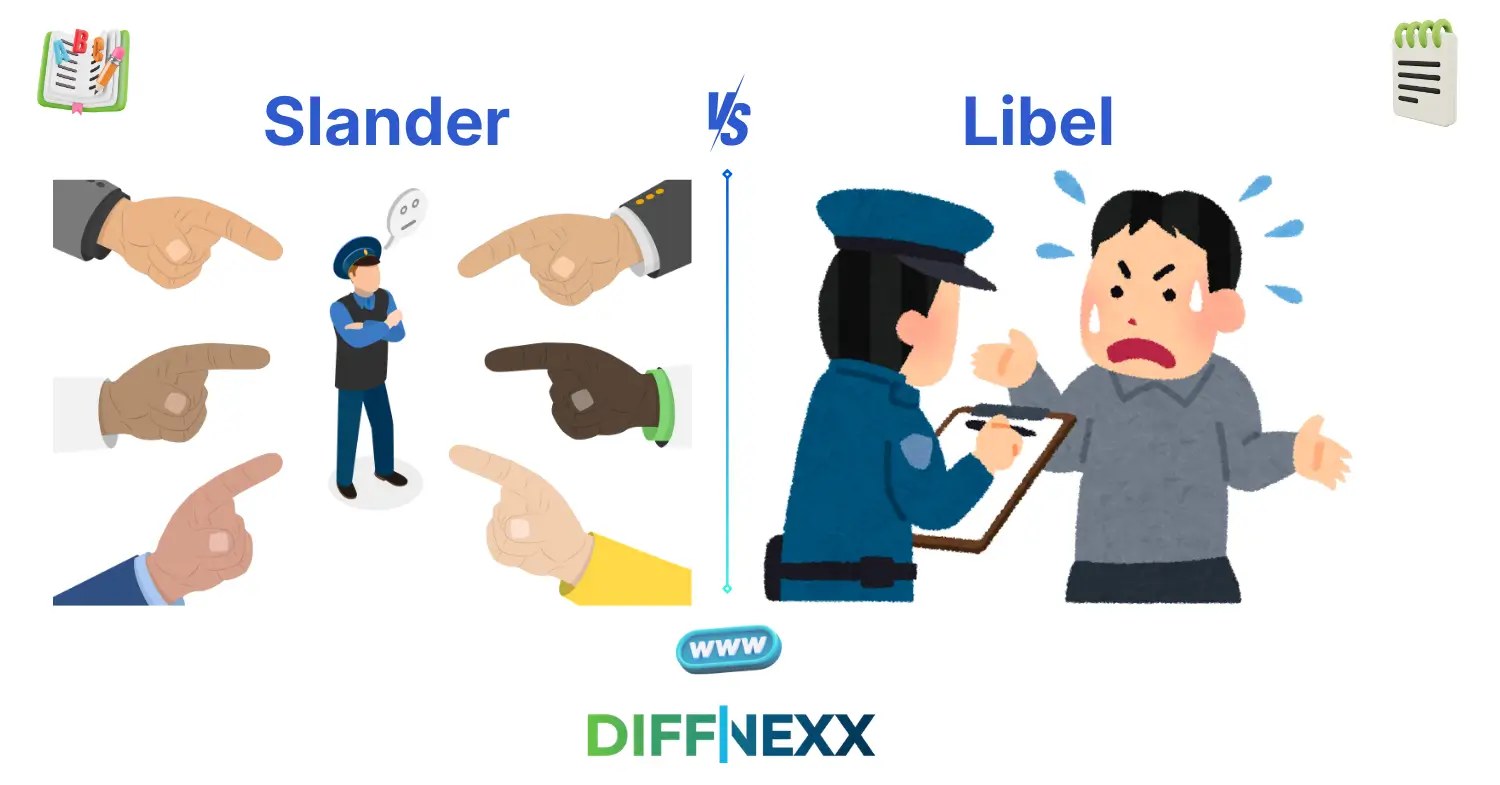
The main difference is how the false statement is expressed.
- Slander is spoken defamation
- Libel is written or published defamation
👉 In short:
Slander = Spoken
Libel = Written
🌍 Importance – Why Knowing the Difference Matters
Understanding this difference is useful for everyone.
🎓 For Learners:
It builds strong language skills and improves understanding of legal terms.
👨⚖️ For Professionals:
Lawyers, journalists, and writers must use these terms correctly to avoid serious legal issues.
🌐 In Society:
Clear communication protects people’s reputation and promotes responsible speech.
🔊 Pronunciation Section
Slander
US: /ˈslæn.dər/
UK: /ˈslɑːn.dər/
Libel
US: /ˈlaɪ.bəl/
UK: /ˈlaɪ.bəl/
Now that you know how to say them, let’s understand their meanings.
📚 Core Definitions
🗣️ Slander
Slander means making a false spoken statement that harms someone’s reputation. It is usually temporary but can still cause damage.
Example: Saying false things about a colleague in a meeting.
📝 Libel
Libel means making a false written or published statement that harms someone’s reputation. It is more permanent because it is recorded.
Example: Posting false accusations on social media.
📊 10 Clear Differences Between Slander and Libel
1. 🗣️ Expression Style
Slander is spoken. Libel is written or published.
- Example (Slander): A false rumor shared verbally
- Example (Libel): A false post on a website
2. ⏳ Duration
Slander is short-lived. Libel lasts longer because it is recorded.
- Example (Slander): Words spoken in a conversation
- Example (Libel): An article online
3. 📄 Permanence
Slander disappears after speaking. Libel stays as evidence.
- Example (Slander): A spoken insult
- Example (Libel): A printed newspaper claim
4. ⚖️ Legal Proof
Slander is harder to prove. Libel is easier due to written proof.
- Example (Slander): No recording available
- Example (Libel): Written statement saved
5. 💥 Impact Level
Libel often causes more damage due to wide reach.
- Example (Slander): Limited audience
- Example (Libel): Viral social media post
6. 🌍 Audience Reach
Slander reaches fewer people. Libel can reach many.
- Example (Slander): Private conversation
- Example (Libel): Public blog
7. 🧠 Psychological Impact
Libel may cause long-term stress. Slander may fade quickly.
- Example (Slander): Temporary embarrassment
- Example (Libel): Ongoing reputation harm
8. 📢 Context of Use
Slander happens in speech. Libel happens in media.
- Example (Slander): Office gossip
- Example (Libel): News article
9. 🧾 Formality
Libel is more formal in legal cases. Slander is informal.
- Example (Slander): Casual talk
- Example (Libel): Official publication
10. 🎭 Tone
Both are negative, but libel often sounds more serious.
- Example (Slander): Casual false claim
- Example (Libel): Strong written accusation
🎯 Why Knowing the Difference Matters
Students benefit by improving vocabulary and understanding real-world language.
Professionals avoid legal risks by using the correct term.
Clear knowledge helps prevent harm and supports ethical communication.
🔍 Real-world Consequences of Confusion
- Legal trouble due to misuse
- Damage to reputation
- Miscommunication in serious situations
🧠 Why People Get Confused
🔤 Similar Sound
Both words sound somewhat similar.
📚 Meaning Overlap
Both involve false statements.
🗨️ Context Usage
People often use them interchangeably.
📱 Informal Speech
Social media mixes spoken and written forms.
🎭 Connotation & Emotional Tone
Connotation = emotional meaning associated with a word
Slander
Negative
It suggests harmful spoken lies.
Example: He was accused of slander.
Libel
Negative
It suggests serious written harm.
Example: The article was considered libel.
🗣 Usage in Metaphors, Similes & Idioms
These words are not common in idioms, but can be used creatively.
- “His words felt like slander, sharp and unfair.”
- “The article stood as libel, written in black and white.”
📊 Comparison Table
| Feature | Slander | Libel |
|---|---|---|
| Meaning | Spoken defamation | Written defamation |
| Tone | Negative | Negative |
| Usage | Speech | Writing/media |
| Context | Informal talk | Public platforms |
| Formality | Less formal | More formal |
⚖️ Which Is Better in What Situation?
🗣️ When to Use Slander
Use “slander” when talking about spoken false statements. For example, rumors spread in conversation.
📝 When to Use Libel
Use “libel” when referring to written or published false statements. For example, online posts.
🔍 Situational Clarity
Think about the medium—speech or writing.
✅ Contextual Correctness
Use the correct term to avoid confusion and ensure clarity.
📖 Literary or Cultural References
- Book: To Kill a Mockingbird by Harper Lee (1960) – explores reputation and false claims
- Movie: The Social Network (USA, 2010) – shows legal and reputation issues
❓ FAQs
1. What is the main difference?
Slander is spoken. Libel is written.
2. Which is more serious?
Libel is often more serious due to permanence.
3. Can slander be recorded?
Yes, but it is still spoken originally.
4. Is social media libel?
Yes, if the statement is written and false.
5. Are both illegal?
Yes, both can be illegal.
6. Which is harder to prove?
Slander is harder to prove.
7. Can a joke be slander?
Yes, if it harms reputation.
8. Does libel last longer?
Yes, because it is recorded.
9. Can both happen together?
Yes, if spoken and written forms exist.
10. Why is it important?
It helps avoid legal and social problems.
🏁 Conclusion
The difference between slander and libel is simple but important. Slander happens through speech, while libel exists in written or published form.
Understanding this difference helps you use language correctly and responsibly. It also protects you from legal risks and misunderstandings.
Both terms carry serious consequences, so careful communication matters. When you know when to use each word, you build trust and clarity.
Keep learning and applying these concepts in real life. Clear language leads to better communication and stronger understanding.

Aamer Shahzad is the founder of Diffnexx.com, a fast-growing educational platform focused on high-intent “difference between” topics. With over 8 years of experience in English language education and analytical writing, I specialize in breaking down complex “difference between” topics into clear, structured, and easy-to-understand explanations. Diffnexx.com is your go-to resource for enhancing English skills and writing with confidence.
I specializes in building search-optimized, research-driven comparison content designed for clarity, authority, and long-term digital asset value.