The difference between graveyard and cemetery often comes up when people visit burial places and wonder if both words mean the same thing.
A visitor may walk through a churchyard or memorial ground and hear both terms used, which creates confusion about the difference between graveyard and cemetery.
At a basic level, the difference between graveyard and cemetery is linked to location, ownership, and historical use.
Understanding the difference between graveyard and cemetery helps students, writers, and learners use these words correctly in respectful communication.
⚰️ Key Difference Between Graveyard and Cemetery
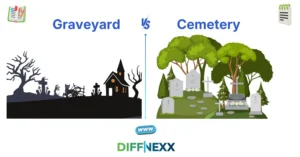
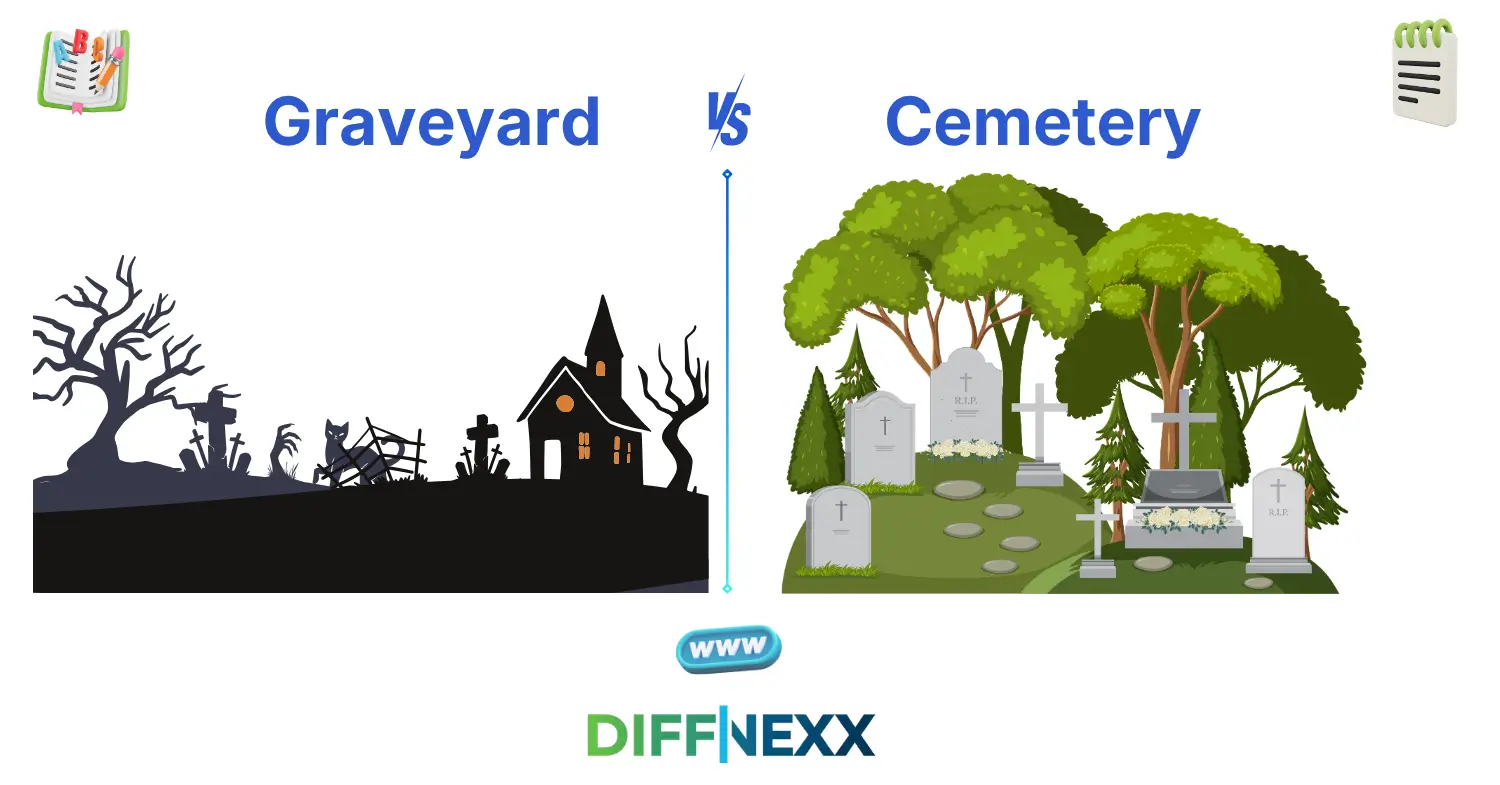
A graveyard is usually attached to a church, while a cemetery is a separate burial ground not connected to a church.
Graveyards are older and often smaller, while cemeteries are larger and more organized modern spaces.
This difference affects location, management, and cultural usage.
🌍 Importance – Why Knowing the Difference Matters
Students learning English or history need to understand these terms for accurate reading and writing.
Professionals in writing, journalism, and history must use correct terminology for clarity and respect.
In society, using the right word helps avoid confusion and shows cultural awareness in sensitive topics.
🧠 Real-world consequences of confusion
Using the wrong term may misrepresent historical sites or create misunderstandings in formal writing.
🔊 PRONUNCIATION SECTION
⚰️ Graveyard
US: /ˈɡreɪv.jɑːrd/
UK: /ˈɡreɪv.jɑːd/
⚰️ Cemetery
US: /ˈsem.ə.ter.i/
UK: /ˈsem.ɪ.tri/
Now let’s explore both terms in detail to understand them clearly.
📚 CORE DEFINITIONS
⚰️ Graveyard
A graveyard is a burial ground attached to a church. It is usually older and smaller in size. The tone is traditional and historical.
Example: The old graveyard sits beside the village church.
⚰️ Cemetery
A cemetery is a large, independent burial place not attached to a church. It is modern, organized, and maintained by authorities.
Example: The city cemetery has rows of well-maintained graves.
🔍 10 CLEAR DIFFERENCES BETWEEN GRAVEYARD AND CEMETERY
1. Location Difference
A graveyard is located next to a church. A cemetery is separate from religious buildings.
- Example for Graveyard: The church graveyard is small.
- Example for Cemetery: The cemetery is outside the city.
2. Ownership
Graveyards are usually owned by churches. Cemeteries are managed by governments or private groups.
- Example for Graveyard: The church manages the graveyard.
- Example for Cemetery: The city manages the cemetery.
3. Size
Graveyards are smaller. Cemeteries are larger and more spacious.
- Example for Graveyard: The graveyard has limited space.
- Example for Cemetery: The cemetery covers a wide area.
4. Historical Age
Graveyards are older and traditional. Cemeteries are more modern.
- Example for Graveyard: This graveyard dates back centuries.
- Example for Cemetery: The cemetery was built recently.
5. Religious Connection
Graveyards are tied to religious buildings. Cemeteries are secular spaces.
- Example for Graveyard: Burials happen near the church.
- Example for Cemetery: The cemetery is non-religious.
6. Design and Layout
Graveyards are less structured. Cemeteries are organized with planned layouts.
- Example for Graveyard: Graves are irregularly placed.
- Example for Cemetery: Graves are arranged in rows.
7. Maintenance Level
Cemeteries are better maintained. Graveyards may be older and less maintained.
- Example for Graveyard: The graveyard looks aged.
- Example for Cemetery: The cemetery is well-kept.
8. Cultural Usage
Graveyards are used in traditional contexts. Cemeteries are used in modern urban life.
- Example for Graveyard: Old village graveyard stories.
- Example for Cemetery: City cemetery records.
9. Emotional Perception
Graveyards feel historical and quiet. Cemeteries feel formal and structured.
- Example for Graveyard: The graveyard feels ancient.
- Example for Cemetery: The cemetery feels organized.
10. Expression Style
Graveyard is used in storytelling. Cemetery is used in official documents.
- Example for Graveyard: The haunted graveyard story.
- Example for Cemetery: The cemetery records are updated.
🎯 Why Knowing the Difference Matters
Students benefit by understanding historical and cultural vocabulary in reading and writing.
Writers and journalists must use accurate terms to describe places respectfully and clearly.
In everyday communication, knowing the difference helps avoid confusion in sensitive discussions about death and burial.
🧠 Real-world consequences of confusion
Misusing these terms can create factual errors in reports or misunderstand historical context.
🧠 Why People Get Confused
Similar Meaning
Both refer to burial places, so people assume they are identical.
Overlapping Usage
In casual speech, people often use both words interchangeably.
Context Differences
Old texts use “graveyard,” modern texts prefer “cemetery.”
Informal Influence
Movies and stories blur the distinction between the two.
🎭 Connotation & Emotional Tone
⚰️ Graveyard
- Positive: historical, peaceful
- Negative: eerie, spooky in stories
- Neutral: traditional burial site
⚰️ Cemetery
- Positive: respectful, organized
- Negative: emotionally heavy
- Neutral: official burial ground
(Connotation = emotional meaning attached to a word.)
🗣 Usage in Metaphors & Idioms
- “Silent as a graveyard” means extremely quiet.
- “Rest in peace in the cemetery” is used in formal writing.
- “A graveyard of memories” describes forgotten things.
Examples:
- The graveyard looked silent at night.
- The cemetery is well maintained.
📊 COMPARISON TABLE
| Feature | Graveyard | Cemetery |
|---|---|---|
| Meaning | Church burial ground | Independent burial ground |
| Tone | Traditional, historical | Formal, organized |
| Usage | Old villages, churches | Cities, modern areas |
| Context | Religious setting | Secular setting |
| Formality | Less formal | More formal |
⚖️ WHICH IS BETTER IN WHAT SITUATION?
⚰️ When to use Graveyard
Use “graveyard” when referring to older, church-based burial places or in historical or storytelling contexts. It gives a traditional or emotional tone.
⚰️ When to use Cemetery
Use “cemetery” in formal writing, modern descriptions, or official records. It sounds more neutral and professional.
🧭 Situational clarity
Graveyard fits cultural or historical narratives. Cemetery fits administrative and urban contexts.
📖 LITERARY OR CULTURAL REFERENCES
- Hamlet (Tragedy, William Shakespeare, 1603) – graveyard scene symbolism
- The Lovely Bones (Film, USA, 2009) – cemetery themes in storytelling
These works show how both terms appear in literature and film.
❓ FAQS
1. Is graveyard the same as cemetery?
No, they are similar but not identical. Graveyards are church-based, cemeteries are separate.
2. Which is older, graveyard or cemetery?
Graveyards are generally older.
3. Are cemeteries religious?
Not always. Cemeteries are often secular.
4. Why are graveyards smaller?
Because they are attached to churches with limited space.
5. Can both words be used interchangeably?
In casual speech, yes, but not in formal writing.
6. Which term is more modern?
Cemetery is the modern term.
7. Are graveyards still used today?
Yes, especially in older churches.
8. What is the main difference?
Location and ownership.
9. Which word is used in law or records?
Cemetery is more commonly used officially.
10. Why do movies use graveyard more?
Because it sounds more emotional and dramatic.
🏁 CONCLUSION
The difference between graveyard and cemetery mainly lies in location, size, and usage.
Graveyards are traditional church-based burial places, while cemeteries are modern, organized spaces.
Understanding this difference improves reading, writing, and cultural awareness in English.
When used correctly, both terms help communicate respectfully about sensitive topics like burial and memory.
Learning these distinctions strengthens vocabulary and makes communication more accurate and thoughtful.

Eliza Marlowe is a passionate content strategist and comparison writer at diffnexx.com. She specializes in breaking down complex “difference between” topics into clear, reader-friendly guides. With a background in linguistics and digital research, Eliza focuses on accuracy, clarity, and content that helps readers make informed decisions with confidence.