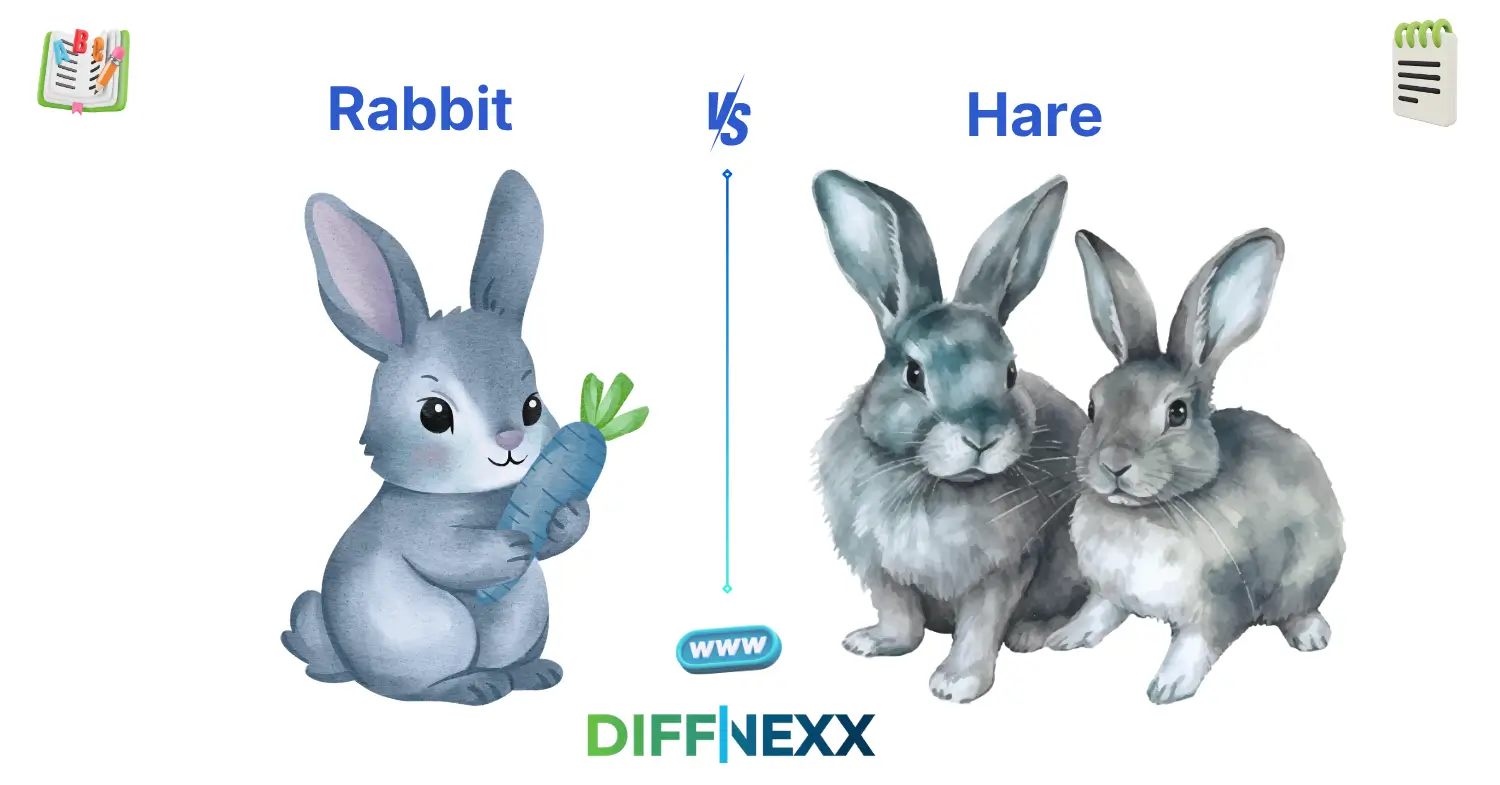
The difference between rabbit and hare often confuses learners when they see these two animals in books or cartoons. A child sees a bunny and calls it a rabbit, but what about a hare in the wild?
The difference between rabbit and hare becomes clearer when you notice their size, behavior, and habitat. Both belong to the same family but live very different lives.
The difference between rabbit and hare is important in biology and everyday English because both words appear in stories, exams, and nature descriptions.
Rabbits are often seen as cute pets, while hares are known for speed and wild survival. Let’s explore their real differences in a simple and clear way.
📊 Key Difference Between Rabbit and Hare
The main difference is that rabbits are smaller, social, and live in burrows, while hares are larger, faster, and live above ground in open spaces.
🌍 Importance – Why Knowing the Difference Matters
Understanding the difference helps students in biology exams and nature studies. It builds correct animal knowledge and improves vocabulary accuracy.
For professionals like writers, teachers, and researchers, using the correct term shows clarity and expertise in communication.
In daily life, people often mix both words. Knowing the difference improves communication and avoids misunderstanding in conversations, storytelling, and education.
🧠 Real-world consequences of confusion
Confusing rabbit and hare can lead to wrong descriptions in learning materials, nature documentaries, and even school exams.
🔊 Pronunciation Section
Rabbit
US: /ˈræbɪt/
UK: /ˈræbɪt/
Hare
US: /hɛr/
UK: /heə/
Now let’s move deeper into their meanings and characteristics.
📚 Core Definitions
🐇 Rabbit
A rabbit is a small, soft-furred animal that lives in burrows underground. It is social and often lives in groups. Rabbits are commonly domesticated as pets.
- Example: A rabbit was eating carrots in the garden.
- Tone: Gentle and harmless
🐰 Hare
A hare is a larger, faster wild animal that lives above ground in open fields. It is more independent and does not dig burrows like rabbits.
- Example: A hare ran quickly across the field.
- Tone: Wild and energetic
🔍 10 Clear Differences Between Rabbit and Hare
1. Size Difference
Rabbits are smaller and softer in appearance. Hares are larger and leaner.
- Rabbit example: A small rabbit hopped in the grass.
- Hare example: A large hare sprinted away fast.
2. Speed
Hares are much faster than rabbits due to stronger legs.
- Rabbit: The rabbit moved slowly in the garden.
- Hare: The hare escaped quickly from danger.
3. Habitat
Rabbits live in burrows underground. Hares live in open fields above ground.
- Rabbit: The rabbit hid in its burrow.
- Hare: The hare rested under a bush.
4. Social Behavior
Rabbits are social animals. Hares are mostly solitary.
- Rabbit: Rabbits live in groups.
- Hare: A hare lives alone.
5. Birth and Babies
Rabbit babies are born blind and helpless. Hare babies are born with fur and open eyes.
- Rabbit: Baby rabbit depends on its mother.
- Hare: Baby hare can move quickly after birth.
6. Ear Length
Hares have longer ears than rabbits.
- Rabbit: Shorter ears help it stay hidden.
- Hare: Long ears help it hear danger.
7. Domestication
Rabbits are commonly kept as pets. Hares are wild animals.
- Rabbit: A pet rabbit lives in a cage.
- Hare: A hare lives freely in the wild.
8. Defense Style
Rabbits hide in burrows. Hares rely on speed.
- Rabbit: It hides underground.
- Hare: It runs very fast to escape.
9. Fur Color and Texture
Rabbits have softer fur. Hares often have rougher and seasonal fur changes.
- Rabbit: Soft white rabbit fur.
- Hare: Brown hare fur in summer.
10. Behavior in Danger
Rabbits freeze or hide. Hares run in zig-zag patterns.
- Rabbit: It stays still to avoid detection.
- Hare: It runs in fast curves to escape.
🎯 Why Knowing the Difference Matters
Students need this knowledge for science exams and reading comprehension. It helps them identify animals correctly in textbooks.
Professionals like wildlife researchers and writers must use correct terms to avoid misinformation. Accuracy builds trust.
In society, correct understanding improves communication, especially in education and nature awareness programs.
🧠 Why People Get Confused
Many people confuse rabbits and hares because they look similar at first glance. Both have long ears and strong back legs.
Their names also sound simple and close in meaning. This creates confusion in casual speech.
In informal English, people often use “rabbit” for both animals, increasing misunderstanding.
🎭 Connotation & Emotional Tone
For Rabbit
(Connotation = emotional meaning associated with a word)
- Positive: Cute, friendly, harmless
- Negative: Weak or fragile
- Neutral: Small animal in nature
Example: A rabbit looks cute in cartoons.
For Hare
- Positive: Fast, strong, wild
- Negative: Nervous or alert
- Neutral: Wild animal in fields
Example: A hare represents speed in stories.
🗣 Usage in Idioms & Expressions
- “Fast as a hare” → used to describe extreme speed
- “Quiet as a rabbit” → used to describe calm behavior
Example:
- The runner was fast as a hare.
- She stayed quiet as a rabbit during the test.
📊 Comparison Table
| Feature | Rabbit | Hare |
|---|---|---|
| Meaning | Small burrowing animal | Large wild field animal |
| Tone | Cute, soft | Wild, fast |
| Usage | Pets, farms | Nature, wildlife |
| Context | Domestic settings | Open fields |
| Formality | Informal/common | Formal/scientific |
⚖️ Which Is Better in What Situation?
🐇 When to use Rabbit
Use “rabbit” when talking about pets, cartoons, or small animals. It is common in daily speech and children’s stories.
🐰 When to use Hare
Use “hare” in scientific writing, wildlife studies, or describing wild animals. It gives a more accurate meaning.
🧭 Situational Clarity
Choosing the right word improves clarity. It avoids confusion in exams, writing, and conversations.
📖 Literary or Cultural References
- The Tortoise and the Hare (Fable, Aesop, Ancient Greece)
- Watership Down (Novel, Richard Adams, 1972)
- Alice’s Adventures in Wonderland (Book, Lewis Carroll, 1865) – includes hare character
❓ FAQs
1. Are rabbits and hares the same species?
No, they are different species. They belong to the same family but have different behavior and habitats. Rabbits live in burrows while hares live in open fields.
2. Which is faster, rabbit or hare?
Hares are faster than rabbits. They have longer legs and stronger muscles. This helps them escape predators quickly.
3. Can rabbits and hares interbreed?
No, they cannot interbreed. Their genetic structures are different even though they look similar.
4. Which one is commonly kept as a pet?
Rabbits are commonly kept as pets. Hares are wild animals and are not domesticated.
5. Why are they often confused?
They look similar in appearance. Both have long ears and strong hind legs, which leads to confusion.
🏁 Conclusion
The difference between rabbit and hare is mainly in size, behavior, and habitat. Rabbits are small and social, while hares are fast and wild.
Understanding this difference improves accuracy in learning, writing, and communication. It helps students and writers use correct biological terms.
Clear knowledge also avoids confusion in storytelling and education. Both animals are unique and important in nature.
Keep practicing these differences in daily learning. It will strengthen your vocabulary and understanding of the natural world.

Aamer Shahzad is the founder of Distinly.com, a fast-growing educational platform focused on high-intent “difference between” topics. With over 8 years of experience in English language education and analytical writing, I specialize in breaking down complex “difference between” topics into clear, structured, and easy-to-understand explanations. Distinly.com is your go-to resource for enhancing English skills and writing with confidence.
I specializes in building search-optimized, research-driven comparison content designed for clarity, authority, and long-term digital asset value.