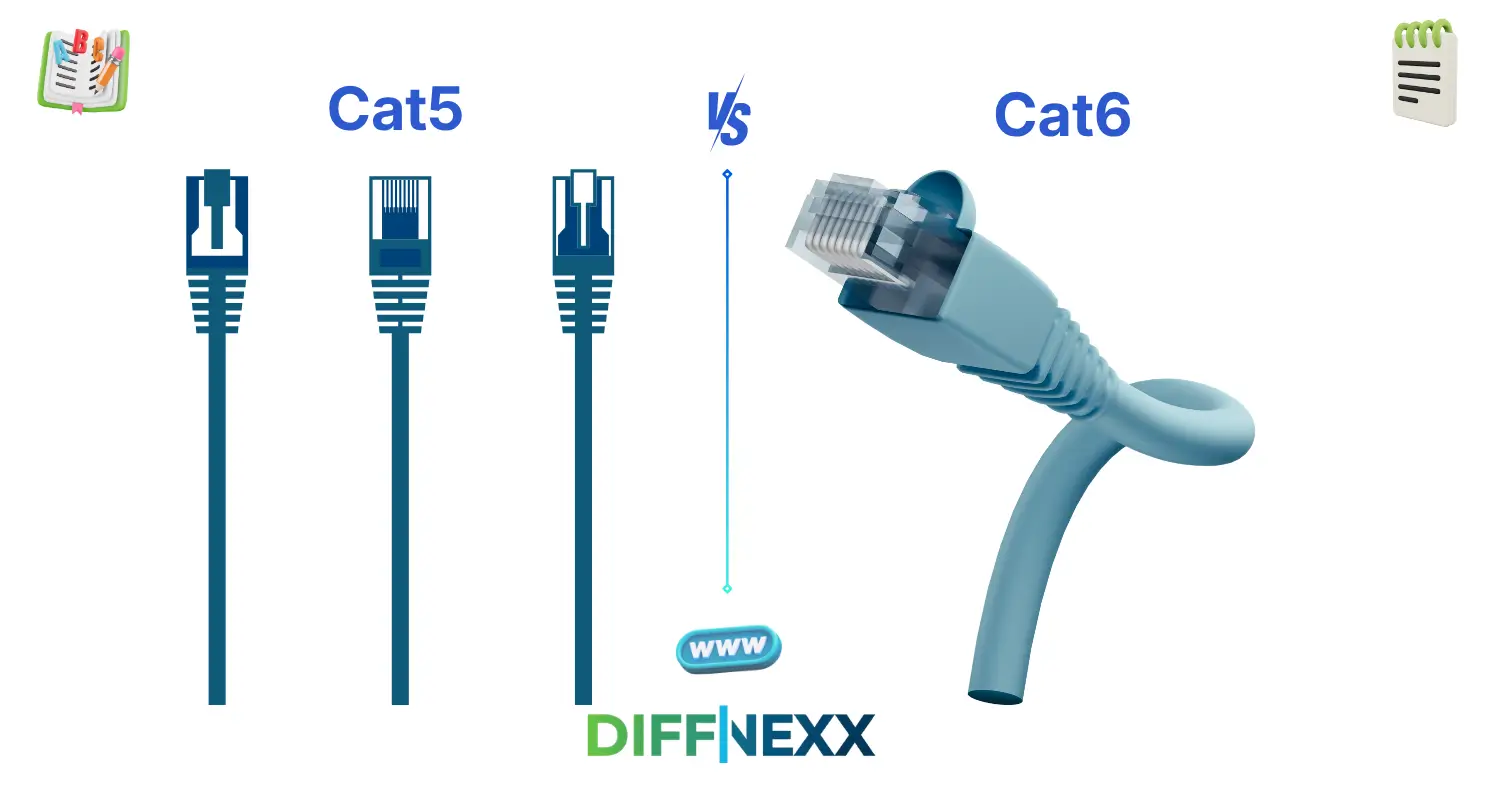
Difference between cat5 and cat6 becomes important when you set up internet at home or in an office. Imagine you’re streaming a movie 🎬, but the video keeps buffering. Someone tells you, “Maybe your cable is the problem.” That’s where this topic starts to matter.
The difference between cat5 and cat6 is mainly about speed, performance, and reliability. Both are types of Ethernet cables used to connect devices to a network. However, they are not the same in how they handle data.
Many people see these cables as identical, but the difference between cat5 and cat6 can affect internet speed, gaming, and even office productivity. Knowing which one to use can save time and improve performance.
Let’s explore their differences in a simple and clear way.
Key Difference Between the Both
The main difference is:
- Cat5 supports slower speeds and lower bandwidth.
- Cat6 supports faster speeds and higher bandwidth.
In simple terms, Cat6 is newer and more advanced than Cat5.
Importance – Why Their Difference Matters
Understanding the difference between these cables is useful in everyday life.
First, students and learners benefit because they can make better decisions when setting up networks. It helps them understand how internet systems work.
Second, professionals in IT and networking must know the difference clearly. Choosing the wrong cable can reduce performance and cause problems in business operations.
Finally, in society, fast and stable internet is essential. From online classes to remote work, the right cable ensures smooth communication 🌐.
🔊 Pronunciation Section
Cat5
US: /ˈkæt faɪv/
UK: /ˈkæt faɪv/
Cat6
US: /ˈkæt sɪks/
UK: /ˈkæt sɪks/
Now that you know how to say them, let’s define each one before comparing them in detail.
📚 Core Definitions
Cat5
Cat5 (Category 5) is an older type of Ethernet cable used for networking. It supports speeds up to 100 Mbps and is suitable for basic internet use.
- Example: A small home network using Cat5 for browsing and emails.
Cat6
Cat6 (Category 6) is a newer and faster Ethernet cable. It supports speeds up to 1 Gbps or more and offers better performance with less interference.
- Example: A gaming setup using Cat6 for fast and stable internet.
📚 10 Clear Differences Between Cat5 and Cat6
1. Speed Capacity
Cat5 offers lower speed compared to Cat6. Cat6 handles faster data transfer.
- Example for Cat5: Basic browsing at 100 Mbps.
- Example for Cat6: High-speed streaming at 1 Gbps.
2. Bandwidth
Cat5 supports up to 100 MHz. Cat6 supports up to 250 MHz.
- Example for Cat5: Limited data flow in a small network.
- Example for Cat6: Smooth data flow in a busy office.
3. Interference Protection
Cat6 reduces interference better than Cat5.
- Example for Cat5: Signal drops in crowded networks.
- Example for Cat6: Stable connection with less noise.
4. Performance Consistency
Cat6 provides more stable performance over time.
- Example for Cat5: Slower speed during heavy use.
- Example for Cat6: Consistent speed even under load.
5. Build Quality
Cat6 cables have tighter twists and better insulation.
- Example for Cat5: Basic internal design.
- Example for Cat6: Advanced internal structure.
6. Distance Efficiency
Cat5 loses performance over longer distances faster than Cat6.
- Example for Cat5: Weak signal in long cables.
- Example for Cat6: Strong signal over longer runs.
7. Cost
Cat5 is cheaper than Cat6. Cat6 costs more due to better performance.
- Example for Cat5: Budget home setup.
- Example for Cat6: Professional network setup.
8. Usage Context
Cat5 suits simple networks. Cat6 suits high-demand environments.
- Example for Cat5: Basic office tasks.
- Example for Cat6: Data centers or gaming setups.
9. Future Readiness
Cat6 supports modern internet needs better than Cat5.
- Example for Cat5: Outdated for modern speeds.
- Example for Cat6: Ready for future upgrades.
10. Reliability
Cat6 is more reliable in high-speed environments.
- Example for Cat5: Occasional lag.
- Example for Cat6: Smooth and stable performance.
🎯 Why Knowing the Difference Matters
Students need to understand these differences to build strong technical knowledge. It helps them in studies related to IT and networking.
Professionals must choose the right cable for efficiency. A poor choice can slow down systems and affect productivity.
In daily life, using the wrong cable can cause slow internet. This affects work, learning, and entertainment.
Real-world consequences of confusion
If someone installs Cat5 in a high-speed network, they may face slow performance. This leads to frustration and wasted resources.
🧠 Why People Get Confused
Similar Naming
Cat5 and Cat6 look almost the same in name, which confuses beginners.
Overlapping Usage
Both cables connect devices, so people assume they are identical.
Context-Based Use
In casual talk, people say “Ethernet cable” without specifying type.
Influence of Informal Speech
Non-technical discussions often ignore differences, causing misunderstanding.
🎭 Connotation & Emotional Tone
Connotation = the emotional meaning associated with a word.
Cat5
- Neutral: Seen as basic and older technology.
- Example: “This setup still uses Cat5 cables.”
Cat6
- Positive: Seen as modern and high-performance.
- Example: “Upgrade to Cat6 for better speed.”
🗣 Usage in Metaphors, Similes & Idioms
These terms are sometimes used informally:
- “This system runs like Cat6 fast and smooth.”
- “That network feels like Cat5 slow and outdated.”
These expressions compare speed and efficiency.
📊 Comparison Table
| Feature | Cat5 | Cat6 |
|---|---|---|
| Meaning | Older Ethernet cable | Newer Ethernet cable |
| Tone | Basic | Advanced |
| Usage | Simple networks | High-speed networks |
| Context | Home/basic use | Professional use |
| Formality | Technical | Technical |
⚖️ Which Is Better in What Situation?
When to use Cat5
Use Cat5 for basic internet tasks like browsing or emailing. It works well in small networks with low demand.
When to use Cat6
Use Cat6 for gaming, streaming, or office work. It supports higher speeds and better stability.
Situational clarity
Choose based on your internet needs. Low demand needs Cat5, high demand needs Cat6.
Contextual correctness
Using the right cable improves performance and avoids network issues.
📖 Literary or Cultural References
- “Computer Networking: A Top-Down Approach” (Academic Book, James Kurose, 2000s)
- “The Social Network” (Movie, USA, 2010) – shows importance of fast digital systems
❓ FAQs
1. What is the main difference between Cat5 and Cat6?
Cat5 supports slower speeds and lower bandwidth, while Cat6 supports faster speeds and higher bandwidth. Cat6 is more advanced.
2. Can I use Cat5 instead of Cat6?
Yes, but performance may be limited. Cat5 may not handle high-speed internet effectively.
3. Is Cat6 worth the extra cost?
Yes, if you need faster and more stable internet. It is better for modern networks.
4. Do Cat5 and Cat6 look different?
They look similar, but Cat6 usually has better internal design and labeling.
5. Which cable is better for gaming?
Cat6 is better because it provides faster speed and lower lag.
🏁 Conclusion
The difference between cat5 and cat6 comes down to speed, performance, and reliability. Cat5 works for basic needs, while Cat6 supports modern, high-speed demands.
Understanding this difference helps you choose the right cable for your setup. It also improves your technical knowledge and prevents common mistakes.
Whether you are a student, professional, or everyday user, selecting the correct cable ensures better internet performance. Keep learning these simple differences, and you will make smarter technology choices every day 💡.

Anton Reyes is a contributing writer at DiffNexx.com, where he explores meaningful differences in language, culture, and everyday concepts. With a background in creative nonfiction, Anton brings clarity and balance to complex comparisons. His writing helps readers understand subtle distinctions in words and ideas, making learning both insightful and engaging.