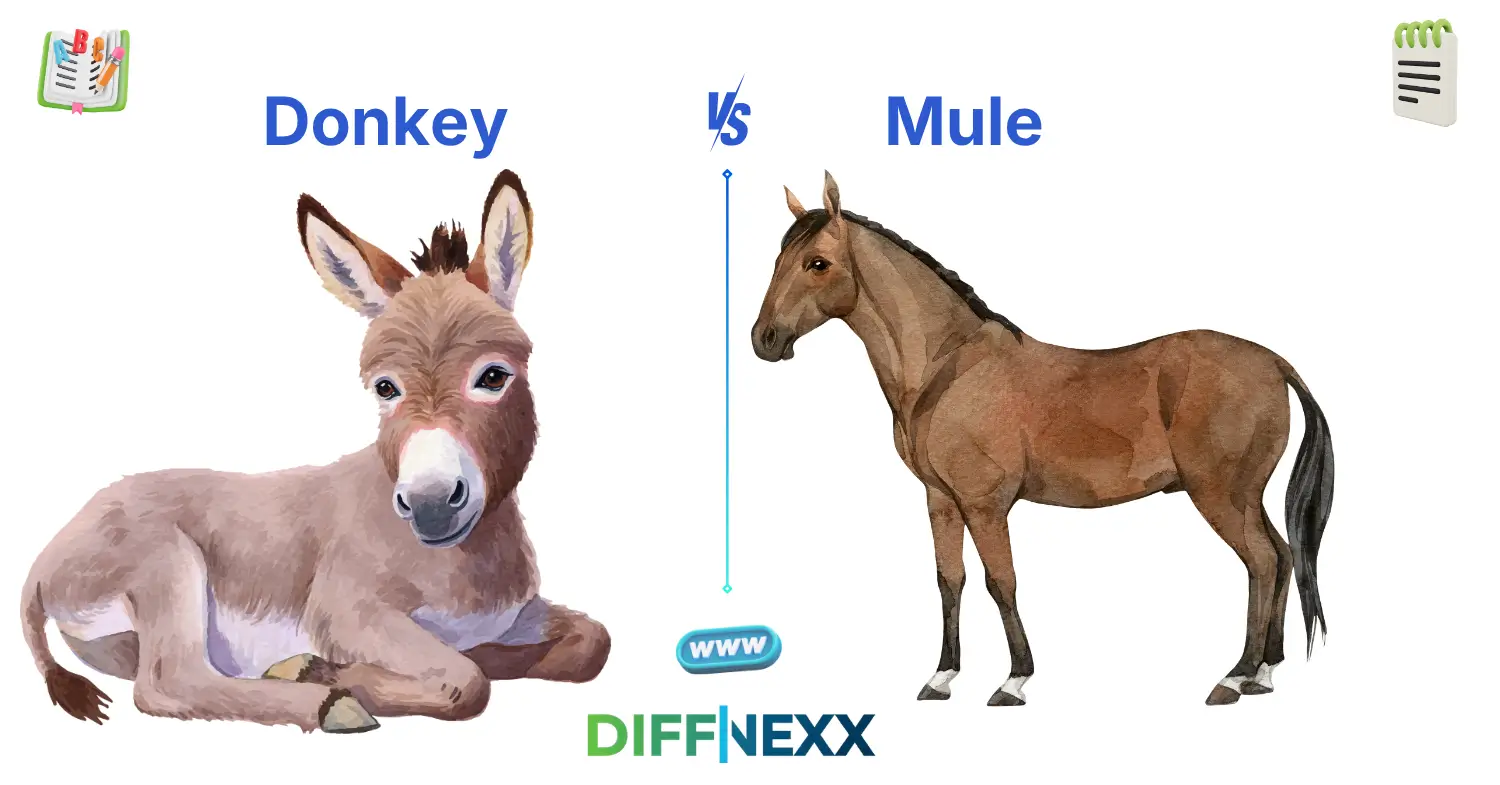
Difference between donkey and mule is something many people notice when they see these animals on farms or in villages. At first glance, they look very similar. You may even think they are the same animal with different names.
The difference between donkey and mule becomes clear when you learn how they are born and how they behave. A donkey is a natural animal species, while a mule is a hybrid animal created by humans through breeding.
Many learners often confuse them because of their similar size, ears, and uses. But once you understand the difference between donkey and mule, it becomes easy to tell them apart.
Let’s explore their differences step by step in a simple and clear way.
🔍 Key Difference Between the Both
The main difference is:
- A donkey is a natural animal species.
- A mule is a hybrid animal, born from a male donkey and a female horse.
In simple words, donkeys are born naturally, while mules are created through crossbreeding.
🌍 Importance – Why Their Difference Matters
Understanding the difference is important in both learning and real life.
For students, it improves knowledge about animals and biology. It helps them understand how hybrid animals are formed.
For farmers and animal experts, this knowledge is very useful. Donkeys and mules have different strengths, behaviors, and uses in work.
In society, people often use these animals for transport and farming. Knowing their difference helps in choosing the right animal for the right job.
🔊 Pronunciation Section
Donkey
US: /ˈdɑːŋki/
UK: /ˈdɒŋki/
Mule
US: /mjuːl/
UK: /mjuːl/
Now that you can say both words correctly, let’s understand what they really mean.
📚 Core Definitions
Donkey
A donkey is a domesticated animal related to horses. It is known for its strength, patience, and loud braying sound.
Example: Farmers use donkeys to carry loads in villages.
Mule
A mule is a hybrid animal produced by breeding a male donkey with a female horse. It is strong, intelligent, and used for heavy work.
Example: Mules are often used to transport goods in mountainous areas.
📊 10 Clear Differences Between Donkey and Mule
1. Origin
Donkeys are natural animals.
Mules are hybrid animals created by humans.
- Example for Donkey: A donkey is born from donkey parents.
- Example for Mule: A mule is born from a donkey father and horse mother.
2. Fertility
Donkeys can reproduce.
Mules are usually sterile and cannot reproduce.
- Example for Donkey: Donkeys can have babies.
- Example for Mule: Mules cannot produce offspring.
3. Physical Appearance
Donkeys are smaller with shorter bodies.
Mules are larger and look like a mix of horse and donkey.
- Example for Donkey: Short legs and stocky body.
- Example for Mule: Taller body with horse-like shape.
4. Strength
Donkeys are strong but limited.
Mules are stronger and can carry heavier loads.
- Example for Donkey: Carries small farm loads.
- Example for Mule: Carries heavy goods in mountains.
5. Intelligence
Donkeys are intelligent but cautious.
Mules are considered smarter and more alert.
- Example for Donkey: Stops when unsure.
- Example for Mule: Quickly adapts to tasks.
6. Temperament
Donkeys are calm but sometimes stubborn.
Mules are more energetic and responsive.
- Example for Donkey: Refuses to move when scared.
- Example for Mule: Reacts faster to commands.
7. Speed
Donkeys are slower.
Mules are faster due to horse genes.
- Example for Donkey: Walks slowly with load.
- Example for Mule: Moves faster over long distances.
8. Lifespan
Donkeys have a long lifespan.
Mules also live long but may vary.
- Example for Donkey: Lives up to 30–40 years.
- Example for Mule: Similar lifespan but depends on care.
9. Usage
Donkeys are used for light work.
Mules are used for heavy and tough work.
- Example for Donkey: Used in small farms.
- Example for Mule: Used in military or transport.
10. Adaptability
Donkeys adapt well to dry climates.
Mules adapt to many environments.
- Example for Donkey: Thrives in deserts.
- Example for Mule: Works in mountains and plains.
🎯 Why Knowing the Difference Matters
Students need to understand this difference to learn basic biology and animal classification. It builds clear knowledge about species and hybrids.
Professionals like farmers and transport workers must know the difference to choose the right animal. Using the wrong animal can reduce efficiency.
In everyday life, correct understanding avoids confusion in communication. It also shows better knowledge in discussions.
Real-world consequences of confusion
If someone chooses a donkey instead of a mule for heavy work, it may lead to poor results. Similarly, expecting a mule to reproduce will cause misunderstanding.
🧠 Why People Get Confused
Similar Appearance
Both animals have long ears and similar body shapes, which makes them look alike.
Semantic Overlap
Both are used for carrying loads, so people assume they are the same.
Context-Based Usage
In many regions, people use both terms interchangeably.
Influence of Informal Speech
In casual language, people often call mules “donkeys,” which creates confusion.
🎭 Connotation & Emotional Tone
Connotation = the emotional meaning associated with a word.
Donkey
- Positive: Hardworking, patient
- Negative: Sometimes used to mean “stubborn”
- Neutral: Farm animal
- Example: “He worked like a donkey all day.”
Mule
- Positive: Strong, reliable
- Negative: Also linked with stubbornness
- Neutral: Hybrid working animal
- Example: “The mule carried heavy सामान easily.”
🗣 Usage in Metaphors, Similes & Idioms
- “Stubborn as a mule” → means very stubborn
- “Work like a donkey” → means to work very hard
Examples:
- He is as stubborn as a mule when making decisions.
- She worked like a donkey to finish her task.
📊 Comparison Table
| Feature | Donkey | Mule |
|---|---|---|
| Meaning | Natural animal | Hybrid animal |
| Tone | Simple, rural | Strong, working |
| Usage | Light work | Heavy work |
| Context | Farms, villages | Transport, mountains |
| Formality | Informal | Neutral |
⚖️ Which Is Better in What Situation?
When to use Donkey
Use a donkey for light tasks like carrying small loads or farm work. It is easy to manage and works well in dry areas.
When to use Mule
Use a mule for heavy work and long-distance travel. It is stronger and more efficient.
Situational clarity
Choose based on the task. Light work needs a donkey, while heavy work needs a mule.
Contextual correctness
In farming, donkeys are enough. In transport or tough terrain, mules are better.
📖 Literary or Cultural References
- Book: Animal Farm (Political Satire, George Orwell, 1945)
Features donkey characters symbolizing patience and wisdom. - Movie: Shrek (USA, 2001)
The character “Donkey” is humorous and energetic, showing a playful image of donkeys.
❓ FAQs
1. Is a mule the same as a donkey?
No, a mule is a hybrid animal, while a donkey is a natural species.
2. Can mules reproduce?
Most mules are sterile and cannot reproduce.
3. Which is stronger, donkey or mule?
Mules are generally stronger and can carry heavier loads.
4. Why are mules used in mountains?
Mules are strong, sure-footed, and can handle rough terrain better.
5. Are donkeys intelligent?
Yes, donkeys are intelligent but cautious animals.
6. Why are mules called stubborn?
Mules are careful and resist unsafe actions, which people call stubbornness.
7. Which animal lives longer?
Both have long lifespans, often up to 30–40 years.
8. Are mules faster than donkeys?
Yes, mules are usually faster due to horse genes.
9. What do donkeys eat?
Donkeys eat grass, hay, and plants.
10. Can a mule be female?
Yes, mules can be male or female, but both are usually infertile.
🏁 Conclusion
The difference between donkey and mule mainly lies in their origin and abilities. A donkey is a natural animal, while a mule is a hybrid created by crossing a donkey and a horse.
This difference affects their strength, behavior, and uses. Donkeys are ideal for light work, while mules are better for heavy tasks and tough conditions.
Understanding this helps you make better choices in real life and improves your knowledge. It also prevents confusion when discussing animals.
Keep learning and exploring—small differences often lead to big understanding.

Anton Reyes is a contributing writer at DiffNexx.com, where he explores meaningful differences in language, culture, and everyday concepts. With a background in creative nonfiction, Anton brings clarity and balance to complex comparisons. His writing helps readers understand subtle distinctions in words and ideas, making learning both insightful and engaging.