Difference between median and average often becomes clear during everyday situations. Imagine your class takes a math test. Most students score between 70 and 80. But one student scores 10. Suddenly, the class “average” drops sharply. That feels unfair, right?
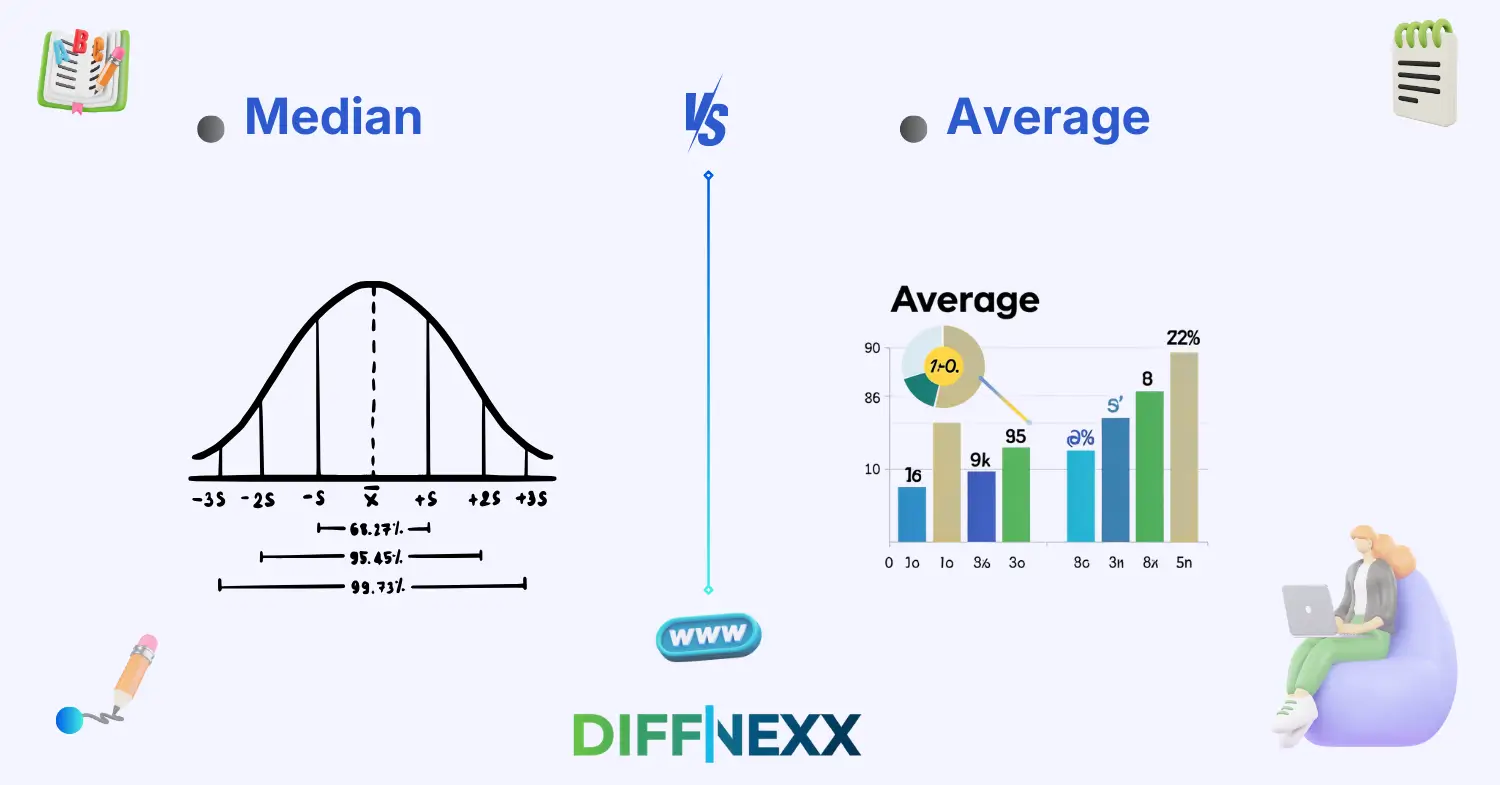
The difference between median and average explains why this happens. The average (also called the mean) adds all numbers and divides by how many there are. The median finds the middle number in a sorted list.
When people misunderstand the difference between median and average, they may misread data. News reports, salaries, exam results, and property prices all use these numbers. But they do not always tell the same story.
Let’s explore how they differ and why choosing the right one matters.
Key Difference Between the Two
The key difference is simple.
The average (mean) uses every number in a data set. It calculates a total and divides it equally.
The median focuses only on the middle position. It ignores how large or small extreme values are.
So, the average is sensitive to outliers. The median resists them.
Why Is Their Difference Necessary to Know
Understanding the difference helps learners interpret information correctly. Students who know when to use the median avoid wrong conclusions in math and statistics.
Professionals rely on this knowledge too. Economists, teachers, doctors, and researchers often choose between median and average depending on the data shape.
In society, this difference affects public opinion. For example, income inequality looks very different when using median income instead of average income.
Now, before we compare them deeply, let’s clarify how to pronounce both terms.
🔊 Pronunciation
Median
US: /ˈmiːdiən/
UK: /ˈmiːdiən/
Average
US: /ˈævərɪdʒ/
UK: /ˈævərɪdʒ/
Now that we know how to say them, let’s define them clearly.
📚 Core Definitions
Median
The median is the middle value in a sorted list of numbers. If there is an even number of values, we average the two middle numbers.
It feels balanced and stable because extreme numbers do not change it much.
Example:
Numbers: 10, 20, 30
Median = 20
Average (Mean)
The average adds all numbers together and divides by how many numbers there are.
It gives a general “overall” value. However, extreme values can push it up or down.
Example:
Numbers: 10, 20, 30
Average = (10 + 20 + 30) ÷ 3 = 20
📚 10 Clear Differences Between Median and Average
1. Sensitivity to Extreme Values
The average changes when one value is very high or very low.
The median stays stable.
Example for Median:
1, 2, 3, 100 → Median = 2.5
Example for Average:
1, 2, 3, 100 → Average = 26.5
2. Calculation Method
The median sorts and finds the center.
The average calculates a total and divides.
Example for Median:
Sort first, then choose middle.
Example for Average:
Add all, then divide.
3. Representation Style
The median shows position.
The average shows distribution.
Example for Median:
Middle exam score.
Example for Average:
Overall class performance.
4. Use in Skewed Data
The median works better when data is uneven.
The average may mislead in skewed sets.
Example for Median:
Income reports often use median salary.
Example for Average:
Luxury salaries raise the average income.
5. Stability
The median remains steady with outliers.
The average shifts easily.
Example for Median:
One billionaire does not change median income much.
Example for Average:
One billionaire increases average income greatly.
6. Mathematical Importance
The average is used more in formulas and higher math.
The median is simpler conceptually.
Example for Median:
Basic data summaries.
Example for Average:
Scientific calculations.
7. Data Requirement
The median requires ordered data.
The average does not.
Example for Median:
Sort numbers first.
Example for Average:
Order does not matter.
8. Application in Daily Life
The median explains housing prices clearly.
The average may exaggerate prices.
Example for Median:
Middle home price in a city.
Example for Average:
Luxury homes inflate the figure.
9. Emotional Impact
The median often feels fairer.
The average can feel shocking.
Example for Median:
“Most people earn this much.”
Example for Average:
“Overall income is high.”
10. Educational Level
Students learn average earlier in school.
Median appears slightly later.
Example for Median:
Introduced in statistics lessons.
Example for Average:
Taught in early arithmetic.
🎯 Why Knowing the Difference Matters
Students must understand this difference to answer exam questions correctly. Many math mistakes happen because learners choose the wrong measure.
Professionals must choose wisely. A financial analyst uses median income to reflect fairness. A scientist may use average in precise calculations.
In communication, wrong usage creates confusion. Media headlines can mislead readers if they select the wrong measure.
Real-World Consequences of Confusion
If a city reports only average income, people may think residents earn more than they really do. This misunderstanding can affect policy decisions and social debates.
🧠 Why People Get Confused
Similar Meaning
Both describe a “middle” or “typical” value. So learners mix them up.
Semantic Overlap
In normal conversation, people say “average” when they really mean “typical.”
Informal Speech
Casual language reduces precision. People rarely say “median” in daily talk.
Clear education solves this confusion.
🎭 Connotation & Emotional Tone
Connotation = the emotional meaning associated with a word.
Median
Positive:
Feels fair and realistic.
Example: “The median income reflects ordinary families.”
Negative:
Sometimes sounds technical or statistical.
Example: “The median figure may seem abstract.”
Neutral:
Common in research.
Example: “Researchers calculated the median age.”
Average
Positive:
Simple and familiar.
Example: “Your average score improved.”
Negative:
Can imply ordinary or not special.
Example: “He is just average.”
Neutral:
Common in math contexts.
Example: “Find the average of these numbers.”
🗣 Usage in Metaphors, Similes & Idioms
Average appears in idioms more often.
- “Above average”
- “Below average”
Example Sentence:
“She performed above average, but her income was close to the median salary in her field.”
The median rarely appears in idioms. It stays mostly technical.
📊 Comparison Table
| Feature | Median | Average |
|---|---|---|
| Meaning | Middle value | Sum divided by count |
| Tone | Technical, stable | Common, general |
| Usage | Skewed data | Balanced data |
| Context | Income, housing | Math, science |
| Formality | Statistical | Everyday + formal |
⚖️ Which Is Better in What Situation?
When to Use Median
Use the median when data has extreme values. It works best for income, property prices, or uneven distributions.
When to Use Average
Use the average for balanced data. It fits classroom scores and scientific research.
Situational Clarity
Choose based on data shape. Ask: Are there extreme numbers?
Contextual Correctness
If fairness and realism matter, use median. If total performance matters, use average.
📖 Literary or Cultural References
Statistics books often explain this difference clearly, such as:
- “How to Lie with Statistics” (Nonfiction, Darrell Huff, 1954) — Discusses misleading averages.
- “Moneyball” (USA, 2011) — Shows how statistics influence decisions in baseball.
These works highlight how numbers shape perception.
❓ FAQs
1. Is median always better than average?
No. It depends on data shape. If values are balanced, average works well. If data has outliers, median gives a clearer picture.
2. Why does income data use median more often?
Because a few very rich people raise the average. The median shows what most people actually earn.
3. Can median and average be the same?
Yes. In symmetrical data, they often match. For example, 10, 20, 30 gives both 20.
4. Which is easier to calculate?
Average is easier for beginners. Median requires sorting first.
5. Do scientists prefer average?
Often yes, because formulas use mean values. However, they still use median when data is skewed.
🏁 Conclusion
The difference between median and average may seem small, but it changes how we understand data. The average uses every number and shows overall performance. The median finds the middle and protects against extreme values.
Both tools are powerful. The key is choosing wisely. Students improve accuracy when they apply the correct measure. Professionals avoid misleading conclusions when they understand the data shape.
Numbers tell stories. When you know which measure to use, you tell the story honestly and clearly. Keep practicing, and your statistical thinking will grow stronger every day.

Aamer Shahzad is the founder of Distinly.com, a fast-growing educational platform focused on high-intent “difference between” topics. With over 8 years of experience in English language education and analytical writing, I specialize in breaking down complex “difference between” topics into clear, structured, and easy-to-understand explanations. Distinly.com is your go-to resource for enhancing English skills and writing with confidence.
I specializes in building search-optimized, research-driven comparison content designed for clarity, authority, and long-term digital asset value.