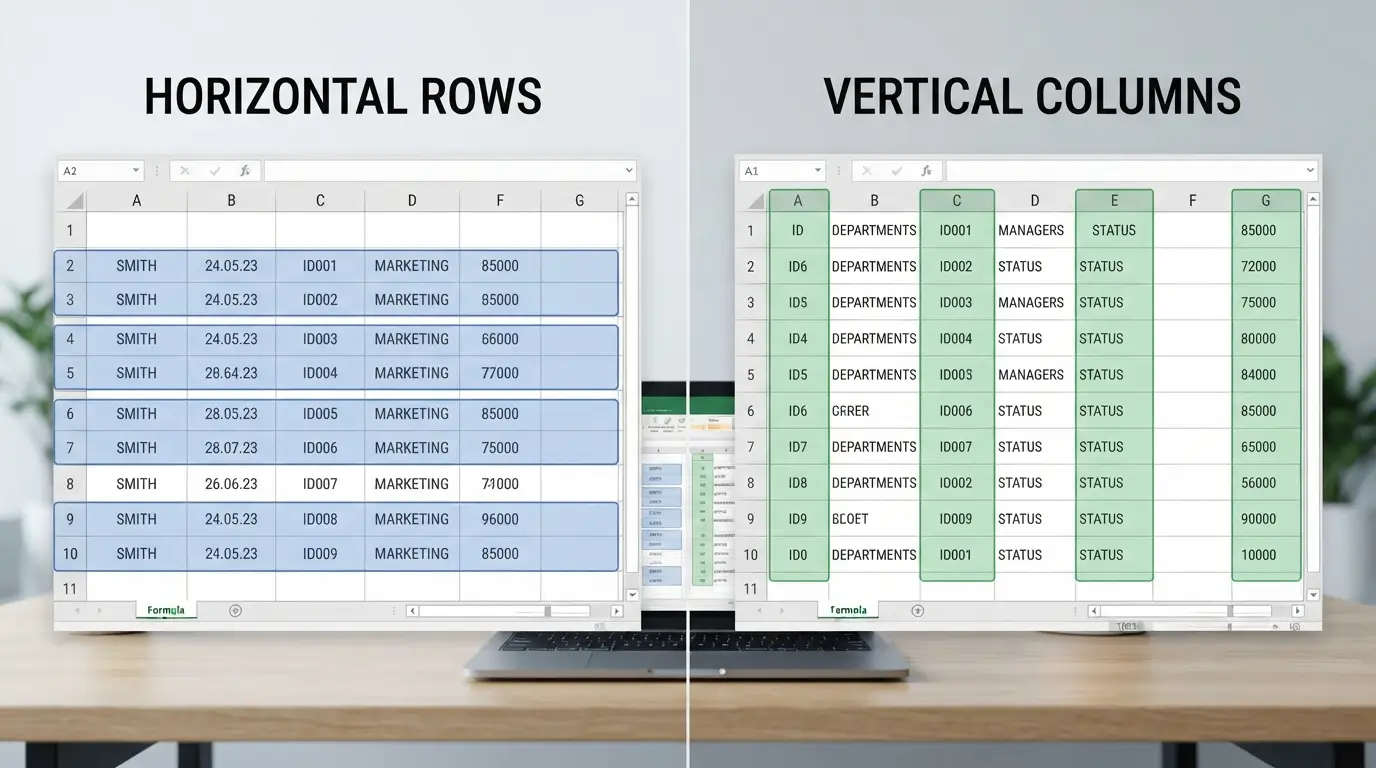
At first glance, a row and a column may seem like two names for parts of the same table. They are closely related, but they move in different directions. Understanding that difference makes spreadsheets, charts, databases, and tables much easier to read.
People often search for the difference between row and column when learning Excel, Google Sheets, mathematics, data analysis, or basic computer skills. The confusion usually comes from remembering which one goes across and which one goes down.
The difference between row and column is simple: a row runs horizontally, while a column runs vertically. In a spreadsheet, rows are normally identified by numbers, while columns are identified by letters. For example, Excel uses A, B, C for columns and 1, 2, 3 for rows.
Learning the difference between row and column also helps you understand cell references such as A1, organize data, read tables, and communicate clearly when working with spreadsheets.
The difference between row and column becomes easy to remember once you connect each word with its direction and purpose.
Quick Answer
A row is a horizontal arrangement of cells, numbers, people, objects, or other items.
A column is a vertical arrangement of cells, numbers, or other items.
The simplest rule is:
- Row = goes across
- Column = goes down
Think of a classroom.
If several students sit side by side from left to right, they form a row.
If students sit one behind another from front to back, they form a column.
The same basic idea applies to spreadsheets.
For example:
| A | B | C | |
|---|---|---|---|
| 1 | Apple | Red | Fruit |
| 2 | Car | Blue | Vehicle |
| 3 | Rose | Pink | Flower |
Here:
- Row 1 contains Apple, Red, and Fruit.
- Row 2 contains Car, Blue, and Vehicle.
- Column A contains Apple, Car, and Rose.
- Column B contains Red, Blue, and Pink.
Microsoft Excel describes worksheets as collections of cells organized into rows and columns. It labels columns with letters and rows with numbers.
For a deeper explanation of the difference between row and column, it helps to look at how the two words developed and how they are used today.
The Origin of Row and Column
The words row and column have different histories.
Origin of “row”
When row means a line or series of things, it comes from an old Germanic word family.
Etymonline traces this sense through Middle English forms such as reue and rewe to Old English rǣw and rāw. It is related to words in other Germanic languages that carry meanings connected with a row, line, or series.
The meaning developed naturally around things arranged in a line.
For example:
A row of houses
A row of trees
A row of chairs
Today, the same basic idea appears in spreadsheets and tables.
There is also another English row with a completely different meaning. As a verb, to row means to move a boat using oars. That word has a different history.
There is even another noun row, especially common in British English, meaning a noisy argument or disturbance. It is pronounced differently from the “line” meaning.
So, English has several unrelated words spelled row.
Origin of “column”
Column entered English through French from Latin columna, meaning a pillar or supporting structure.
The word originally referred to a physical architectural support. Later, its meaning expanded to include a vertical division of a page. Etymonline records the page-layout sense from the Middle English period.
This history helps explain why column works so well for vertical arrangements.
A building column stands upright.
A newspaper column runs vertically down a page.
A spreadsheet column also extends vertically.
The modern computing meaning follows this long-standing idea of a vertical division.
Part of speech
Both row and column are most commonly used as nouns when discussing tables and spreadsheets.
Examples:
Select the entire row.
Delete the second column.
Row can also be a verb when it means moving a boat with oars:
They row across the lake.
Column is mainly a noun in ordinary usage, although related words such as columnist and columnar are common.
Row vs Column: Direction and Position
Direction is the fastest way to tell them apart.
A row is horizontal
A row moves from left to right or right to left.
For example:
A → B → C → D
That is a row.
If a spreadsheet has ten cells arranged across the screen, those cells form part of the same row.
A column is vertical
A column moves up and down.
For example:
A
B
C
D
That is a column.
In a spreadsheet, a column can extend far down the page.
Easy memory trick
Use the word row with road.
A road usually stretches forward across a landscape.
For column, think of a building column. It stands upright.
Another useful rule is:
Rows run; columns climb.
The first letters are different, but the idea is easy to remember: rows move across, while columns move down.
How Rows and Columns Work in Spreadsheets
The difference becomes especially important in programs such as Microsoft Excel.
A spreadsheet is built from cells arranged into rows and columns. Excel normally labels columns with letters and rows with numbers.
For example:
- A1 = column A, row 1
- B3 = column B, row 3
- D5 = column D, row 5
This order matters.
In B3:
- B tells you the column.
- 3 tells you the row.
Microsoft’s documentation explains that a cell reference uses the column letter followed by the row number.
So if someone says:
“Look at cell C7.”
You should move to column C and then find row 7.
The point where the row and column meet is the cell.
Why this matters
Rows and columns make large amounts of information easier to organize.
For example, a sales table might use:
- Columns for product, price, quantity, and total.
- Rows for individual products.
This creates a clear structure.
Microsoft also notes that rows and columns allow users to organize data, sort and filter information, calculate values, and create charts.
Rows and Columns in Tables
The same idea applies outside spreadsheets.
Consider this table:
| Student | Subject | Grade |
|---|---|---|
| Maya | English | A |
| Daniel | Math | B |
| Sara | Science | A |
Each row represents one complete record.
For example:
Maya | English | A
This row contains information about one student and subject.
Each column represents a category or type of information.
For example:
Student
Subject
Grade
This is one of the most useful ways to understand the difference.
Rows often contain individual records. Columns often contain categories or fields.
This is not a rule for every table, but it is a common structure in spreadsheets and databases.
British English vs American English Spelling
There is no meaningful British-American spelling difference between row and column.
Both British English and American English use:
- row
- rows
- column
- columns
The spelling does not change between the two major varieties.
| Word | British English | American English |
|---|---|---|
| row | row | row |
| rows | rows | rows |
| column | column | column |
| columns | columns | columns |
There can be differences in pronunciation or meaning for row because English has multiple words spelled the same way.
When row means a line or series, it is pronounced like “roh.”
When British English uses row to mean a noisy argument, it is pronounced like “rau”, rhyming roughly with cow.
These are different words despite having the same spelling. Dictionary sources trace their origins separately.
For the spreadsheet meaning, however, there is no important British-American spelling difference.
Which Spelling Should You Use?
You do not need to choose a different spelling based on your audience.
Use row and column in:
- American English
- British English
- Canadian English
- Australian English
- International English
The spelling remains the same.
If you are writing an Excel guide for American readers, write:
Select the entire row.
For British readers, write the same thing:
Select the entire row.
The main thing to remember is the meaning.
If you are discussing spreadsheets, tables, or data, row means the horizontal arrangement and column means the vertical arrangement.
Common Mistakes
1. Saying that a row goes down
This is the most common mistake.
Incorrect:
A row goes vertically down the spreadsheet.
Correct:
A row runs horizontally across the spreadsheet.
2. Mixing up letters and numbers
In standard Excel references, columns use letters and rows use numbers.
So:
D4
means column D, row 4.
It does not mean row D and column 4.
3. Thinking a column is always a newspaper column
A newspaper column is one use of the word.
In spreadsheets, a column is a vertical group of cells.
The underlying idea of a vertical division connects these meanings.
4. Writing “rows” when you mean categories
Suppose your table has:
| Name | Age | City |
|---|
These are columns, because each one represents a category.
A row might contain:
| Ahmed | 25 | Lahore |
That row represents one complete set of information.
5. Forgetting that rows and columns intersect
A cell exists where a row and a column meet.
For example:
Column B + Row 4 = B4
This simple idea is the foundation of spreadsheet references.
6. Confusing “row” with the verb “row”
The word row has multiple meanings.
Compare:
The numbers are in the first row.
and:
We will row across the lake.
The first row means a horizontal line. The second row is a verb related to moving a boat.
Context tells you which meaning is intended.
Everyday Examples
In an email
Please enter the customer’s name in the first column and each new customer on a separate row.
This is common workplace language.
In a news article
The table includes several columns showing age, location, and income.
Here, columns describe categories of information.
On social media
I keep mixing up rows and columns in Excel!
This is an informal but natural use of both words.
In formal writing
Each row represents an individual observation, while each column identifies a variable.
This sentence is common in academic and data-related writing.
In a classroom
A teacher might say:
Write your answers across the row.
Or:
Add the names in the first column.
Both instructions depend on understanding direction.
Row vs Column: Side-by-Side Comparison
| Feature | Row | Column |
|---|---|---|
| Main direction | Horizontal | Vertical |
| Movement | Across | Up and down |
| Spreadsheet label | Usually numbers | Usually letters |
| Example | Row 5 | Column C |
| Cell reference role | Second part | First part |
| Common table role | Often a record | Often a category |
| Plural | Rows | Columns |
| Main part of speech | Noun | Noun |
| Common visual clue | Goes across | Goes down |
| Example cell | A5 is in row 5 | A5 is in column A |
The most important difference is direction.
If you can remember across = row and down = column, most spreadsheet questions become much easier.
FAQs
What is the easiest way to remember row vs column?
Remember: rows go across, columns go down. You can also picture a building column standing vertically.
Is a row horizontal or vertical?
A row is horizontal. It extends across a table or spreadsheet.
Is a column horizontal or vertical?
A column is vertical. It extends from the top toward the bottom of a table or spreadsheet.
Are rows numbers and columns letters?
In standard Excel worksheets, yes. Rows are identified with numbers, while columns are identified with letters.
In A1, which is the row and which is the column?
In A1, A identifies the column and 1 identifies the row. Therefore, A1 is the cell at the intersection of column A and row 1.
What is the difference between a row and a column in a database?
A row often represents one record, while a column usually represents a field or type of information. For example, a row could describe one person, while columns could store that person’s name, age, and city.
Does British English spell row and column differently?
No. Row and column have the same standard spellings in British and American English. The words may have different meanings or pronunciations in other contexts, but there is no regional spelling change for these terms.
Conclusion:
The difference between row and column is simple: rows move across, while columns move down. This rule works well for spreadsheets, tables, and data.
Rows often hold individual records, while columns often organize categories. A cell appears where one row and one column meet.
The words also have long histories. Row comes from an old Germanic word family, while column traces back through French to Latin.
Once you learn this small distinction, spreadsheets feel much less confusing. Practice using both words in emails, essays, and daily work until the difference feels natural.

Aamer Shahzad is the founder of Diffnexx.com, a fast-growing educational platform focused on high-intent “difference between” topics. With over 8 years of experience in English language education and analytical writing, I specialize in breaking down complex “difference between” topics into clear, structured, and easy-to-understand explanations. Diffnexx.com is your go-to resource for enhancing English skills and writing with confidence.
I specializes in building search-optimized, research-driven comparison content designed for clarity, authority, and long-term digital asset value.







