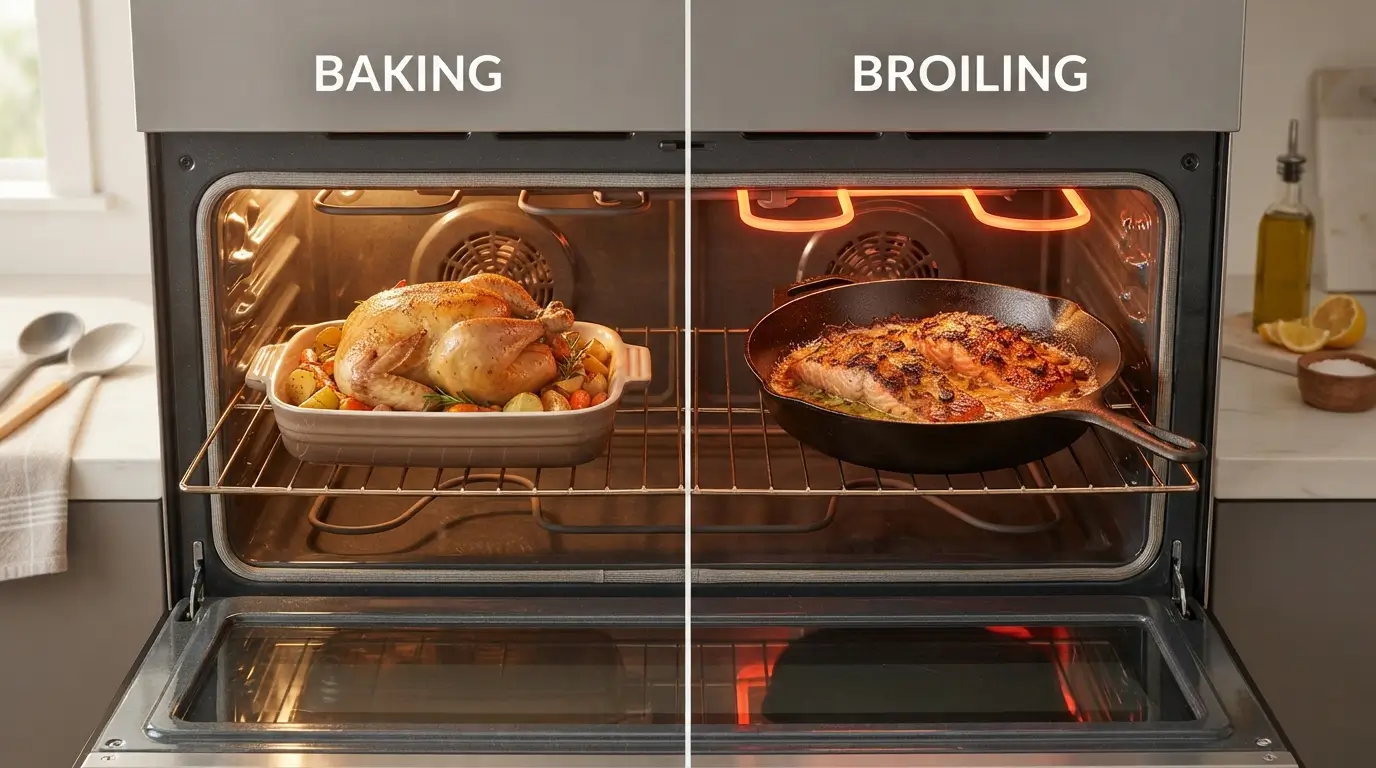
When a recipe tells you to broil or bake food, the two oven settings may seem similar. Both use heat, and both can cook food in an oven. However, they work in very different ways. Knowing the difference between broil and bake can help you avoid burnt food, undercooked meals, and confusing recipe instructions.
People often search for the difference between broil and bake because modern ovens usually include both settings. A recipe may tell you to bake chicken and then broil it for a few minutes. That can make beginners wonder why the cooking method changes.
The difference between broil and bake mainly comes down to where the heat comes from and how quickly it reaches the food. Baking normally surrounds food with steady, indirect oven heat. Broiling uses intense direct heat, usually from above.
Understanding the difference between broil and bake also makes recipe instructions easier to follow. Once you know what each setting does, you can choose the right method for cakes, vegetables, meat, fish, cheese, and many other foods.
Quick Answer
The simple difference between broil and bake is the direction and intensity of the heat.
Bake cooks food with steady, surrounding heat inside the oven. The food usually sits in the middle or lower part of the oven. Baking works well for foods that need more time to cook through, such as cakes, bread, casseroles, potatoes, and many chicken dishes.
Broil uses very strong direct heat, usually from an element above the food. It cooks the surface quickly and can create browning, crisp edges, or a lightly charred finish.
| Method | Main heat | Typical result | Common uses |
|---|---|---|---|
| Bake | Surrounding oven heat | Even cooking | Cakes, bread, casseroles |
| Broil | Strong direct heat | Fast browning and crisping | Steak, fish, cheese, vegetables |
For example, you might bake a chicken breast until it cooks through and then broil it briefly to brown the top.
So, baking is generally better for cooking food throughout, while broiling is useful when you want strong surface heat and fast browning.
The Origin of Broil and Bake
The words broil and bake have different histories.
The verb bake comes from Old English bacan. Oxford traces it to Germanic origins and connects it with related words in languages such as Dutch and German. The basic idea has long involved cooking with dry heat.
The word broil has a different path. Oxford traces the cooking sense to Middle English and Old French, with the Old French form related to bruler, meaning “to burn.” The deeper origin remains uncertain.
These different origins explain why broil and bake do not look alike. They developed from different linguistic sources rather than from one common English word.
Both words function mainly as verbs when they describe cooking actions:
- Bake the bread for 30 minutes.
- Broil the fish for five minutes.
They also appear in related forms:
- bake → baked → baking
- broil → broiled → broiling
In modern cooking English, the two words describe different methods even though both involve dry heat.
What Does Bake Mean?
Bake is a verb that means to cook food by dry heat, usually inside an oven.
The heat surrounds the food and gradually cooks it. The exact oven temperature depends on the recipe and food.
Examples include:
- Bake the cake for 25 minutes.
- She baked the potatoes until they became tender.
- We baked the fish with lemon and herbs.
- The recipe says to bake the casserole at 180°C.
Baking is common for foods that need steady heat. Cakes, bread, cookies, pastries, casseroles, vegetables, and many meat and fish dishes can all be baked.
The word bake can also describe the effect of strong heat on something that is not food. For example, people can say that the sun baked the dry ground. Oxford also records this broader use.
What Does Broil Mean?
Broil is a verb that means to cook food with intense direct heat.
In American English, an oven’s broiler usually places the heating element above the food. Cambridge defines broil as cooking something under a very hot surface in a stove.
For example:
- Broil the salmon for five minutes.
- Broil the vegetables until the edges become brown.
- Broil the cheese until it melts and turns golden.
Broiling works especially well when you want to brown or crisp the surface of food.
Because broiling uses very strong heat, food can burn quickly. You should watch food closely rather than treating broiling like ordinary baking.
Broil vs Bake: How the Heat Works
The biggest practical difference involves the position and strength of the heat.
During baking, the oven creates a controlled environment with hot air and heating elements. The food usually cooks more gradually.
During broiling, the food sits close to a powerful heat source. The intense heat acts directly on the surface.
Think of the two methods this way:
Bake = cook through
Broil = brown or crisp the surface
This is not an absolute rule because cooking results depend on the food, oven, temperature, rack position, and cooking time. Still, it provides a useful starting point.
For example, a thick piece of chicken may need baking to cook safely and evenly. After that, a short period under the broiler can improve the color and texture of the outside.
British English vs American English Spelling
There is no major British-versus-American spelling difference between bake and broil.
Both varieties spell these words the same way:
- bake
- baked
- baking
- broil
- broiled
- broiling
The important regional difference involves usage, especially the word broil.
In American English, broil commonly describes cooking food under intense heat from above.
In British English, grill is normally used for this cooking method. Cambridge specifically labels broil as a US term and gives grill as the UK equivalent.
| Meaning | American English | British English |
|---|---|---|
| Cook under strong heat from above | Broil | Grill |
| Oven function | Broil | Grill |
| Cook with surrounding oven heat | Bake | Bake |
| Past form of bake | Baked | Baked |
| Past form of broil | Broiled | Broiled |
There is also an important difference in the word grill. In both varieties, grill can refer to cooking food over direct heat, but British English commonly uses grill for the oven method that American English calls broil.
So, the spelling itself does not change. The main difference is regional vocabulary.
Pronunciation of Broil and Bake
Broil and bake have clearly different pronunciations.
- broil — /brɔɪl/
- bake — /beɪk/
You can think of them as:
- broil: “broyl”
- bake: “bayk”
The vowel sounds are different, so these words should not sound alike.
Oxford gives the pronunciation of broil as /brɔɪl/ and bake as /beɪk/.
This difference matters when following spoken cooking instructions. If someone says, “Broil the fish,” they are not asking you to bake it.
Which Spelling Should You Use?
Since bake and broil have the same spelling in American and British English, you do not need to choose a regional spelling.
The main choice concerns the cooking word you use.
If you write for a US audience
Use broil when you mean cooking food under intense direct heat.
Example:
Broil the steak for two minutes on each side.
If you write for a UK audience
Use grill for the oven method that American English calls broiling.
Example:
Grill the steak for two minutes on each side.
If you write for a global audience
You can reduce confusion by giving both terms when useful.
Example:
Grill (broil in US English) the vegetables until lightly browned.
This approach helps international readers understand the instruction without changing the actual cooking method.
Common Mistakes with Broil and Bake
Several mistakes appear when people confuse these cooking methods.
1. Using broil for a food that needs long cooking
Broiling creates intense surface heat. It may brown the outside before the inside becomes fully cooked.
Better: Bake the food first when the recipe requires thorough cooking, then broil briefly for browning.
2. Treating broil and bake as interchangeable
They are not simply two names for the same oven function.
Better: Check where the heat comes from and what result the recipe wants.
3. Leaving food unattended while broiling
Broiling can change the surface of food very quickly.
Better: Stay nearby and check the food often.
4. Confusing British “grill” with American “grill”
A British recipe may say grill when an American recipe would say broil.
Better: Consider the regional variety before changing the cooking method.
5. Thinking the spelling changes in British English
The words bake and broil do not need different spellings in British English.
Better: Focus on the regional use of broil versus grill.
Broil and Bake in Everyday Examples
Understanding these words becomes easier when you see them in natural sentences.
In an email
Please bake the lasagna for 30 minutes and broil it for two minutes before serving.
Here, bake describes the main cooking process, while broil describes the final browning step.
In a recipe
Bake the salmon until cooked through. Broil for one to two minutes for a golden top.
The writer uses the two methods for different purposes.
On social media
I baked these vegetables with garlic, then broiled them for a crispy finish.
This sentence shows how both methods can work together.
In formal writing
The vegetables were baked at a moderate temperature and briefly broiled before serving.
The passive form were baked and broiled is appropriate in formal food writing, although active sentences often sound clearer.
In everyday conversation
Should I bake the chicken or broil it?
A natural answer might be:
Bake it first, then broil it for a few minutes if you want a browned top.
A Simple Rule to Remember
If you only remember one idea, remember this:
Bake for steady cooking. Broil for intense surface heat.
You can also use the location of the heat as a clue.
With baking, the food usually sits farther from a single intense heating element. With broiling, the food normally sits close to the broiler.
This explains why broiling can brown food so quickly.
For example, melted cheese on a casserole may already be hot after baking, but a short broiling step can turn the top golden and slightly crisp.
Broil vs Bake: Comparison Table
| Feature | Bake | Broil |
|---|---|---|
| Part of speech | Verb | Verb |
| Main meaning | Cook with dry oven heat | Cook with intense direct heat |
| Heat pattern | More surrounding and steady | Strong and direct |
| Typical position | Middle or lower oven area | Close to broiler element |
| Cooking speed at surface | Moderate | Very fast |
| Main purpose | Cook food through | Brown, crisp, or finish food |
| Common foods | Bread, cake, casseroles, potatoes | Steak, fish, cheese, vegetables |
| US term | Bake | Broil |
| UK term | Bake | Grill |
| Past form | Baked | Broiled |
| Pronunciation | /beɪk/ | /brɔɪl/ |
FAQs
1. Is broiling the same as baking?
No. Baking uses steady oven heat to cook food, while broiling uses intense direct heat, usually from above. The two methods can sometimes be used together.
2. Is broil hotter than bake?
Broiling usually exposes the food to much more intense direct heat at the surface. The exact temperature and heating system depend on the oven, so the settings should not be treated as identical across all appliances.
3. Can I bake and then broil the same food?
Yes. This is common when food needs time to cook through but also needs a browned or crisp surface. For example, you might bake a casserole and broil it briefly at the end.
4. What is broil called in British English?
British English normally uses grill for the oven cooking method that American English calls broil. Cambridge identifies broil as a US term and grill as the UK equivalent.
5. Which is better for chicken: bake or broil?
It depends on the recipe and the desired result. Baking can provide steady cooking, while broiling can brown the surface quickly. A recipe may use both methods at different stages.
6. How do you pronounce broil?
Broil is pronounced /brɔɪl/, roughly like “broyl.” Bake is pronounced /beɪk/, roughly like “bayk.”
7. Does broil mean grill?
In American English, broil commonly refers to cooking under intense heat in an oven. British English generally uses grill for this method. The exact equipment can vary by oven.
Conclusion
The difference between broil and bake becomes simple once you focus on heat. Bake for steady cooking, and broil when you want fast, strong heat on the surface.
Both methods have useful roles in the kitchen. Baking helps food cook through, while broiling can add color, crispness, and a fresh finishing touch.
Knowing these words also improves your English, especially when you read recipes from different countries. The US uses “broil,” while the UK often says “grill.”
Keep practicing these terms in emails, recipes, essays, and daily conversations. Small word choices can make your English clearer and more natural.

Anton Reyes is a contributing writer at DiffNexx.com, where he explores meaningful differences in language, culture, and everyday concepts. With a background in creative nonfiction, Anton brings clarity and balance to complex comparisons. His writing helps readers understand subtle distinctions in words and ideas, making learning both insightful and engaging.







