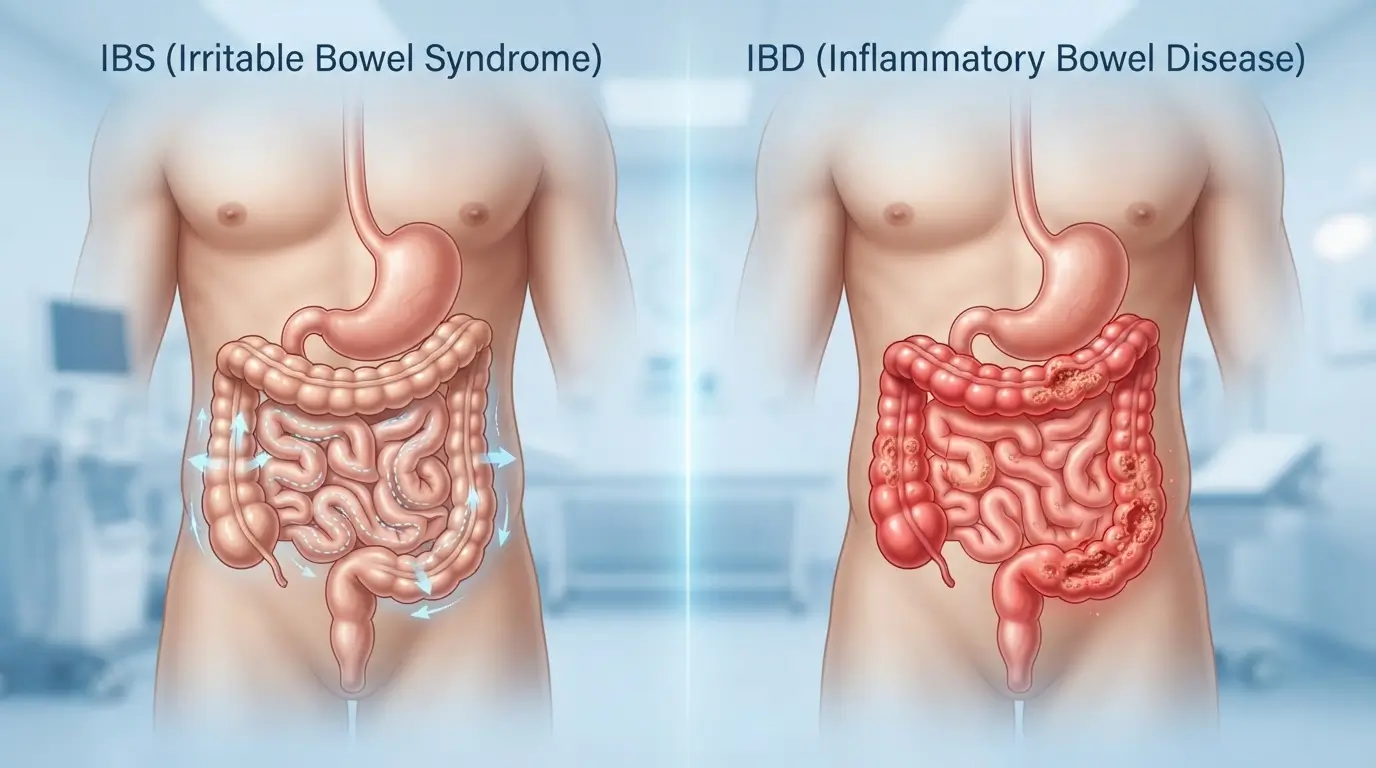
Stomach pain, diarrhea, constipation, bloating, and changes in bowel habits can make everyday life difficult. Because several digestive conditions can cause similar symptoms, many people search for the difference between IBS and IBD when trying to understand what these terms mean. Although the names look similar, IBS and IBD describe different health conditions.
The difference between IBS and IBD matters because one is mainly a disorder of gut function, while the other involves inflammation and disease-related changes in the digestive tract. IBS stands for irritable bowel syndrome. IBD stands for inflammatory bowel disease.
Understanding the difference between IBS and IBD can also make medical information easier to follow. Both conditions may cause abdominal pain and diarrhea, but their causes, diagnosis, treatment, and possible complications differ. The difference between IBS and IBD is therefore more than a difference between two abbreviations.
This guide explains the terms in simple English and shows how to use them correctly in everyday and formal writing.
Quick Answer
The simplest way to understand the difference between IBS and IBD is to focus on function versus inflammation.
IBS, or irritable bowel syndrome, is a disorder of gut-brain interaction. It can cause repeated abdominal pain and changes in bowel movements, including diarrhea, constipation, or both. Doctors do not find visible digestive-tract damage that explains IBS itself.
IBD, or inflammatory bowel disease, refers to a group of diseases that cause inflammation in the digestive tract. The two main types are Crohn’s disease and ulcerative colitis.
A quick comparison:
- IBS: affects how the digestive system works.
- IBD: involves inflammation and physical disease in the digestive tract.
- IBS: may cause pain, bloating, diarrhea, and constipation.
- IBD: may cause diarrhea, abdominal pain, weight loss, bleeding, and other symptoms.
- IBS: does not cause visible damage to the digestive tract by itself.
- IBD: can cause inflammation, ulcers, and other complications.
The symptoms can overlap, so symptoms alone cannot always tell you which condition a person has.
The Origin of IBS and IBD
The names IBS and IBD are medical abbreviations rather than ordinary words. Understanding the full terms makes their meanings easier to remember.
What does IBS mean?
IBS stands for irritable bowel syndrome.
- Irritable means easily irritated or sensitive.
- Bowel refers to the intestines.
- Syndrome refers to a group of signs and symptoms that occur together.
The modern name reflects the symptom-based nature of the condition. NIDDK notes that IBS has also been called terms such as spastic colon, mucous colitis, and nervous colon in the past.
The term has evolved as medical understanding of the condition has changed. Modern descriptions focus on interactions between the brain and gut rather than treating IBS as simple inflammation of the colon.
What does IBD mean?
IBD stands for inflammatory bowel disease.
The words describe the condition more directly:
- Inflammatory relates to inflammation.
- Bowel refers to the intestines.
- Disease identifies a recognized medical disorder.
IBD is an umbrella term. Its main forms include Crohn’s disease and ulcerative colitis. These conditions involve inflammation caused by abnormal immune responses and can affect the digestive tract in different ways.
The similar abbreviations can cause confusion, but IBS and IBD are not two names for the same condition.
IBS vs. IBD: The Main Medical Difference
The most important distinction is the presence of inflammation and physical disease.
With IBS, a person can experience real and sometimes severe symptoms even though tests do not show the type of visible intestinal damage associated with IBD. NIDDK describes IBS as a functional gastrointestinal disorder, now often discussed within the broader concept of disorders of gut-brain interaction.
IBD is different. It involves actual inflammation in the digestive tract. Crohn’s disease can affect different parts of the digestive tract, while ulcerative colitis primarily affects the large intestine and its inner lining.
| Feature | IBS | IBD |
|---|---|---|
| Full name | Irritable bowel syndrome | Inflammatory bowel disease |
| Meaning | Functional gastrointestinal disorder | Group of inflammatory diseases |
| Main types | IBS-C, IBS-D, IBS-M | Crohn’s disease, ulcerative colitis |
| Inflammation | Not the defining feature | Central feature |
| Visible intestinal damage | Not expected from IBS itself | May occur |
| Common symptoms | Pain, bloating, diarrhea, constipation | Diarrhea, pain, weight loss, bleeding, fatigue |
| Disease pattern | Symptoms may come and go | Flares and remission are common |
| Diagnosis | Symptom pattern and evaluation | Blood, stool, endoscopy, imaging, and other tests may be used |
| Potential complications | IBS itself does not cause intestinal damage | Can cause significant intestinal and other complications |
What Is IBS?
IBS affects the way the digestive system functions. Common symptoms include repeated abdominal pain and changes in bowel movements. Some people mainly experience constipation, some mainly experience diarrhea, and others experience both.
NIDDK identifies three common IBS patterns:
- IBS-C: IBS with constipation
- IBS-D: IBS with diarrhea
- IBS-M: IBS with mixed bowel habits
Bloating and a feeling that a bowel movement is incomplete can also occur.
Doctors do not have one single cause for IBS. Research points to several possible factors, including altered brain-gut interactions, changes in bowel movement, increased gut sensitivity, previous infections, food sensitivities, genetics, and other factors.
Treatment focuses on controlling symptoms. Depending on the person, doctors may recommend dietary changes, physical activity, stress management, medicines, probiotics, or other approaches.
What Is IBD?
IBD is a group of chronic diseases involving inflammation in the digestive tract.
The two major forms are:
Crohn’s disease
Crohn’s disease can affect any part of the digestive tract, from the mouth to the anus. It most commonly affects the small intestine and the beginning of the large intestine.
Symptoms can include:
- Diarrhea
- Abdominal pain and cramping
- Weight loss
- Fatigue
- Fever
- Anemia
- Reduced appetite
Crohn’s disease can also cause complications such as intestinal obstruction, fistulas, abscesses, and ulcers.
Ulcerative colitis
Ulcerative colitis causes inflammation and ulcers on the inner lining of the large intestine. Symptoms may include diarrhea, blood in the stool, and abdominal pain.
Both Crohn’s disease and ulcerative colitis can have periods of active symptoms called flares and periods when symptoms improve or disappear called remission.
Symptoms: IBS vs. IBD
The symptoms overlap, which explains why people often confuse the conditions.
Symptoms commonly associated with IBS
IBS may cause:
- Abdominal pain
- Bloating
- Diarrhea
- Constipation
- Changes in bowel habits
- A feeling of incomplete bowel movements
- Mucus in the stool
The symptoms can change over time. Some people experience constipation on certain days and diarrhea on others.
Symptoms that can occur with IBD
IBD may cause:
- Diarrhea
- Abdominal pain or cramping
- Weight loss
- Blood in the stool
- Fatigue
- Fever
- Anemia
- Reduced appetite
The exact symptoms depend on the type and location of the disease.
A key point is that having diarrhea or stomach pain does not automatically mean someone has IBS or IBD. Several digestive conditions can produce similar symptoms.
Diagnosis: How IBS and IBD Differ
Doctors approach the two conditions differently.
For IBS, doctors usually look for a characteristic pattern of symptoms and review medical and family history. They may also use tests to rule out other conditions when appropriate.
IBD requires a different evaluation because doctors need to identify inflammation and determine where it occurs. Depending on the suspected condition, testing can include blood tests, stool tests, endoscopy, colonoscopy, and imaging.
For example, blood tests can help identify signs such as anemia or inflammation. Stool tests can help look for inflammation or rule out certain infections. Endoscopy allows doctors to examine the digestive tract directly and may allow tissue samples to be collected.
This is why persistent or concerning digestive symptoms should not be self-diagnosed from an online comparison.
Pronunciation and Part of Speech
The abbreviations IBS and IBD are normally pronounced by saying their letters:
- IBS: “eye-bee-ess”
- IBD: “eye-bee-dee”
The full terms are pronounced differently:
- Irritable: roughly “IR-it-uh-bul”
- Inflammatory: roughly “in-FLAM-uh-tor-ee”
- Bowel: roughly “BOW-uhl”
- Disease: roughly “dih-ZEEZ”
There is no major pronunciation problem between the full terms. The confusion usually comes from their similar abbreviations.
Part of Speech
The full terms function as noun phrases:
- irritable bowel syndrome → noun phrase
- inflammatory bowel disease → noun phrase
The abbreviations IBS and IBD also function as nouns.
Examples:
“She was diagnosed with IBS.”
“The patient has IBD.”
You can also use the terms as modifiers:
- IBS symptoms
- IBS treatment
- IBD diagnosis
- IBD research
British English vs. American English Spelling
There is no meaningful British-American spelling difference in the terms IBS and IBD themselves.
Both British and American English use:
- irritable bowel syndrome
- inflammatory bowel disease
- IBS
- IBD
However, some related medical words can differ between varieties of English.
For example:
- diarrhea → common American English spelling
- diarrhoea → common British English spelling
This difference belongs to the word diarrhea/diarrhoea, not to IBS or IBD.
| Term | American English | British English |
|---|---|---|
| Irritable bowel syndrome | IBS | IBS |
| Inflammatory bowel disease | IBD | IBD |
| Diarrhea/diarrhoea | diarrhea | diarrhoea |
| Constipation | constipation | constipation |
| Abdominal | abdominal | abdominal |
So there is no reason to change IBS or IBD when writing for a British or American audience.
Which Spelling Should You Use?
For IBS and IBD, use the same spelling regardless of your target English variety.
If your audience is mainly American, use American spellings in related terms, such as diarrhea.
If your audience is mainly British or follows British English, diarrhoea is the standard spelling.
For global health content, consistency matters most. Choose one regional spelling system for related vocabulary and use it throughout the article.
Common Mistakes
Mistake 1: Treating IBS and IBD as the same condition
Incorrect:
“IBS is another name for inflammatory bowel disease.”
Correct:
“IBS and IBD are different conditions.”
IBS is a functional gastrointestinal disorder, while IBD refers to inflammatory diseases such as Crohn’s disease and ulcerative colitis.
Mistake 2: Assuming IBS causes intestinal inflammation
Inflammation is central to IBD, but IBS is not defined by visible inflammation or intestinal damage.
Mistake 3: Using IBD as if it were one specific disease
IBD is an umbrella term. Crohn’s disease and ulcerative colitis are major types of IBD.
Mistake 4: Assuming all abdominal pain means IBS
Abdominal pain has many possible causes. A symptom alone cannot establish an IBS diagnosis.
Mistake 5: Thinking IBD always means Crohn’s disease
Crohn’s disease is one type of IBD. Ulcerative colitis is another major type.
Mistake 6: Confusing a flare with a permanent level of symptoms
IBD can involve periods of active symptoms and remission. Symptoms may become less noticeable during remission.
Everyday Examples
Understanding how these terms appear in real writing can make the distinction easier.
In an email
“I have been having IBS symptoms and may need to adjust my appointment.”
Here, IBS identifies a specific digestive disorder.
In a news article
“Researchers continue to study new approaches to treating inflammatory bowel disease.”
Here, inflammatory bowel disease refers to the broader group of inflammatory conditions.
On social media
“Learning about IBS helped me understand why certain foods affect my symptoms.”
The sentence uses IBS as a noun.
In formal writing
“Although IBS and IBD can share some gastrointestinal symptoms, they differ in their underlying characteristics and clinical evaluation.”
This sentence makes the distinction without treating the two conditions as interchangeable.
In a medical discussion
“The doctor wants to rule out IBD before confirming the cause of the symptoms.”
Here, IBD refers to a group of diseases that can require specific diagnostic testing.
IBS and IBD: Side-by-Side Comparison
| Category | IBS | IBD |
|---|---|---|
| Full name | Irritable bowel syndrome | Inflammatory bowel disease |
| Category | Functional GI disorder | Group of inflammatory diseases |
| Main examples | IBS-C, IBS-D, IBS-M | Crohn’s disease, ulcerative colitis |
| Main feature | Altered gut function and symptoms | Digestive-tract inflammation |
| Abdominal pain | Common | Common |
| Diarrhea | Can occur | Can occur |
| Constipation | Can occur | Not a defining feature |
| Blood in stool | Not a typical IBS feature | Can occur, especially with ulcerative colitis |
| Weight loss | Not a defining feature | Can occur |
| Visible intestinal damage | Not expected from IBS itself | Can occur |
| Diagnosis | Symptom pattern and appropriate evaluation | Blood/stool tests, endoscopy, imaging, and other evaluation |
| Treatment approach | Symptom management | Control of inflammation and disease activity |
| Can symptoms flare? | Symptoms can come and go | Flares and remission are common |
The table provides a basic educational comparison. It should not be used to diagnose either condition.
FAQs
1. What is the main difference between IBS and IBD?
IBS is a functional gastrointestinal disorder involving symptoms such as abdominal pain and changes in bowel habits. IBD refers to diseases involving inflammation in the digestive tract.
2. Can IBS turn into IBD?
IBS and IBD are different conditions. Having IBS does not simply mean that it will develop into Crohn’s disease or ulcerative colitis. However, someone can have more than one digestive condition, so persistent or changing symptoms deserve proper medical evaluation.
3. Is IBD more serious than IBS?
They are different medical conditions and should not be compared only by a simple severity label. IBD can cause intestinal inflammation and complications, while IBS can cause significant and persistent symptoms without the intestinal damage associated with IBD.
4. Can IBS cause inflammation?
IBS is not defined by the type of intestinal inflammation seen in IBD. Research continues to explore biological changes associated with IBS, but visible inflammatory disease is not the defining feature of the condition.
5. Are Crohn’s disease and ulcerative colitis the same?
No. Both are forms of IBD, but they affect the digestive tract differently. Crohn’s disease can affect different areas from the mouth to the anus, while ulcerative colitis primarily affects the large intestine.
6. Can IBS and IBD have the same symptoms?
Yes. Both can involve abdominal pain and changes in bowel movements. This overlap is one reason medical evaluation can be important when symptoms persist or raise concern.
7. Should I diagnose myself based on IBS or IBD symptoms?
No. Symptoms can overlap with many digestive conditions. Doctors may use medical history, physical examination, blood or stool tests, endoscopy, imaging, and other information to determine the cause.
Conclusion
The difference between IBS and IBD becomes clearer when you remember one key idea: IBS affects gut function, while IBD involves inflammation and disease in the digestive tract.
Both conditions can cause real digestive symptoms, including pain and changes in bowel habits. Still, their causes, diagnosis, and medical management are not the same.
Learning the full names behind IBS and IBD makes health information easier to read. It also helps you avoid confusing two terms that only look similar.
Keep practicing these terms in emails, essays, and daily conversations. Small steps can make medical vocabulary feel much easier over time.

Eliza Marlowe is a passionate content strategist and comparison writer at diffnexx.com. She specializes in breaking down complex “difference between” topics into clear, reader-friendly guides. With a background in linguistics and digital research, Eliza focuses on accuracy, clarity, and content that helps readers make informed decisions with confidence.







