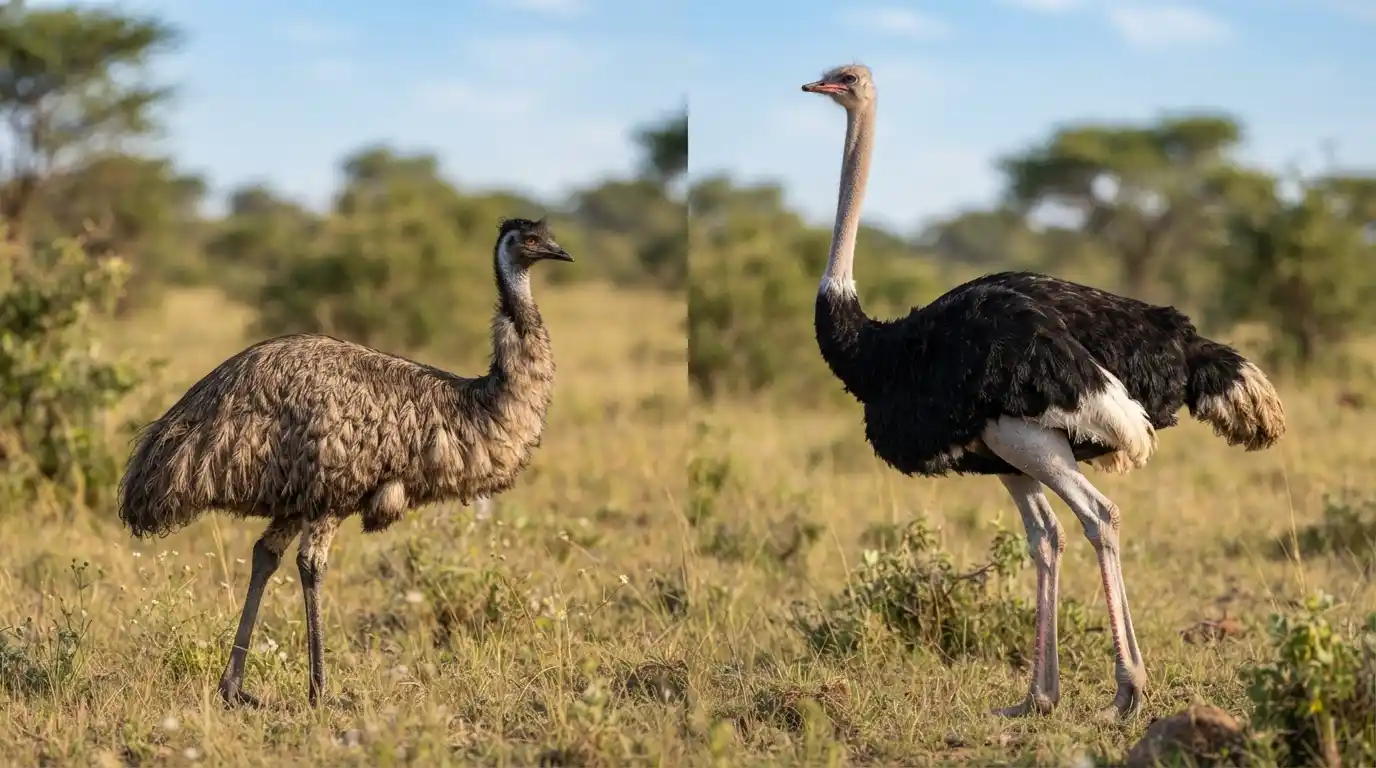
If you are looking for the difference between emu and ostrich, the easiest clue is size and appearance. An emu is a large, shaggy, flightless bird from Australia, while an ostrich is a much taller and heavier flightless bird from Africa.
The difference between emu and ostrich also includes their feet, feathers, eggs, nesting habits, and body shape. The difference between emu and ostrich becomes especially clear when you compare their toes: emus have three toes on each foot, while ostriches have only two.
Ostriches are also the largest living birds, while emus rank second by size.
Emu vs. Ostrich: Quick Answer
An emu and an ostrich are both large, flightless birds, but they are different species with different native ranges and physical traits.
The main differences are:
- Emus live in Australia; ostriches are native to Africa.
- Ostriches are much taller and heavier.
- Emus have three toes; ostriches have two.
- Emus have a more feathered neck.
- Ostriches have a mostly bare-looking neck with fine, wispy feathers.
- Emu eggs are dark green; ostrich eggs are large, pale, and whitish.
- Male emus incubate the eggs alone.
- Male and female ostriches both take part in incubation.
- Ostriches can run faster than emus.
Emu and Ostrich Comparison Table
| Feature | Emu | Ostrich |
|---|---|---|
| Scientific name | Dromaius novaehollandiae | Struthio camelus |
| Native region | Australia | Africa |
| Flight | Flightless | Flightless |
| Adult height | About 4.9–6.2 ft (1.5–1.9 m) | Up to about 9 ft (2.7 m) |
| Adult weight | About 66–121 lb (30–55 kg) | About 200–300 lb (90–136 kg) |
| Toes | 3 on each foot | 2 on each foot |
| Neck | More heavily feathered | Mostly bare-looking with fine feathers |
| Egg color | Dark green | Pale or whitish |
| Egg weight | About 1–1.4 lb (450–650 g) | Up to about 3 lb (1.4 kg) |
| Incubation | About 8 weeks | About 42–46 days |
| Main habitat | Australian forests, woodlands, shrublands, and open areas | African grasslands, savannas, shrublands, and some dry areas |
| Maximum running speed | About 31 mph (50 km/h) | Up to about 43 mph (69–70 km/h) |
The exact measurements can vary by individual, sex, and source.
What Is an Emu?
An emu is a large flightless bird native to Australia. Its scientific name is Dromaius novaehollandiae.
Emus have long legs, a long neck, a large body, and very small wings. Their loose, shaggy feathers give them a different look from the smoother appearance of an ostrich.
An adult emu can reach about 6.2 feet (1.9 meters) in height. The Smithsonian lists average adult male weights around 50–55 kilograms, with females generally weighing slightly more.
Emus live in a range of Australian environments. These include woodlands, eucalyptus forests, heathlands, desert shrublands, and open areas. They can travel long distances when food or water becomes scarce.
One unusual feature of emu reproduction is that the male takes responsibility for incubating the eggs. After the female lays her eggs, the male sits on them for about 56 days and remains with the chicks after they hatch.
What Is an Ostrich?
An ostrich is the world’s largest living bird. The common ostrich, Struthio camelus, is native to Africa.
Ostriches have extremely long necks and powerful legs. Adult birds can reach about 9 feet in height and weigh roughly 200–300 pounds, depending on sex and individual size.
Unlike emus, ostriches have large visible wings. They cannot use these wings for flight, but the wings still have important functions. Ostriches use them during running, courtship, and temperature regulation.
Ostriches live mainly in African grasslands, savannas, shrublands, and other open environments. They can also survive in some desert and woodland areas.
Emu vs. Ostrich: Size and Body Shape
Size is one of the easiest ways to tell these birds apart.
The ostrich is much larger. It can reach around 9 feet tall, while an emu generally reaches around 5–6 feet. Ostriches also weigh far more than emus.
Their body shapes also differ.
An ostrich has a tall, stretched appearance. Its long neck and very long legs make it look much taller than an emu.
An emu has a more compact body with a thicker-looking neck and shaggy feathers.
If you see two birds standing together, their overall size can often tell you which is which before you even examine their feet.
Their Feet Are a Major Clue
The feet provide one of the clearest physical differences.
Emus have three toes on each foot. Ostriches have only two.
This difference matters because both birds rely heavily on their legs for movement and defense.
Ostrich feet are especially distinctive. Each foot has two large toes, with a prominent claw that can help the bird defend itself.
Emu feet have three toes and are also adapted for running across large areas.
So, if you are trying to identify an unfamiliar bird, looking at its feet can be more reliable than judging its overall color.
Neck and Feather Differences
The neck is another useful identification clue.
An emu has a feathered neck, although areas of skin can show through its feathers. Its plumage tends to look loose and shaggy.
A common ostrich has a mostly bare-looking neck covered with fine, wispy feathers. Its long neck and exposed skin make its silhouette very different from an emu.
Color also helps.
Male ostriches typically have black plumage with white feathers around the wings and tail. Females are mostly brown or gray-brown.
Male and female emus look much more alike. Female emus are generally slightly larger than males, which is unusual compared with many bird species.
Emu vs. Ostrich: Which One Is Faster?
The ostrich is faster.
Smithsonian’s National Zoo reports that ostriches can sprint at speeds of up to about 43 mph (69 km/h). Emus can reach around 31 mph (50 km/h).
Both birds have long legs that help them cover large distances quickly.
The ostrich’s running ability is especially impressive because it is the fastest living bird on land. Its wings also help it steer while running.
Emus are also strong runners and can travel considerable distances while searching for food and water.
Emu vs. Ostrich Eggs
Their eggs are easy to tell apart.
Emu eggs
Emu eggs are dark green. A female may lay several eggs in a clutch, and the male takes over incubation. Smithsonian reports nests containing about 15–25 eggs, although egg numbers can vary.
San Diego Zoo lists emu eggs at about 450–650 grams each.
Ostrich eggs
Ostrich eggs are much larger and have a pale, whitish appearance.
An ostrich egg can weigh about 1.4 kilograms (3 pounds). That makes it the largest egg produced by a living bird.
Ostrich nests can also contain eggs from several females. The dominant male and female share incubation duties.
So, a simple memory trick is:
Green egg = emu.
Huge pale egg = ostrich.
Who Takes Care of the Eggs?
This is one of the most interesting differences.
For emus, the male handles incubation. After the female lays the eggs, the male settles on the nest and can remain there for weeks. He also stays with the chicks after they hatch.
Ostrich nesting works differently. Several females may lay eggs in a communal nest, while the dominant male and female take turns incubating them. The male generally incubates at night, while the dominant female tends the nest during the day.
This difference is easy to overlook because both birds belong to the group of large flightless birds often called ratites.
Where Do Emus and Ostriches Live?
The simplest geographic distinction is:
Emu = Australia
Ostrich = Africa
Emus are widespread across Australia and occupy many habitats, from woodland and shrubland to dry inland areas.
Common ostriches are mainly associated with the grasslands, savannas, shrublands, and open dry regions of Africa.
Their environments help explain their body design. Both birds have strong legs because they rely on running rather than flying to move through open landscapes and escape threats.
Are Emus and Ostriches Related?
Yes, but their relationship is more complicated than simply saying they are the same type of bird.
Both belong to Palaeognathae, a major lineage of birds that includes ostriches, emus, cassowaries, kiwis, rheas, and tinamous. Modern genetic research has helped clarify relationships within this group.
They are therefore related, but an emu is not a smaller ostrich.
The two belong to different families and have distinct evolutionary histories. The emu belongs to the family Dromaiidae, while the common ostrich belongs to Struthionidae.
Do Emus and Ostriches Fly?
No.
Both birds are flightless.
Their wings have become adapted for other functions rather than powered flight. Ostriches have relatively large wings that help with balance, steering, display, and cooling. Emus have much smaller wings that are mostly hidden beneath their body feathers.
Their inability to fly does not make them weak birds. Both species have powerful legs and can move quickly.
Do Ostriches Really Bury Their Heads in the Sand?
No. This is a popular myth.
Ostriches may lower their heads close to the ground when they inspect or tend their nests. They may also lie low when they sense danger. From a distance, this behavior can make it look as though the bird has buried its head.
So the phrase “bury your head in the sand” does not describe a real ostrich survival strategy.
Common Mistakes When Comparing Emus and Ostriches
Mistake 1: Calling an emu a small ostrich
They are separate birds. Their similar body shape comes from shared characteristics among flightless birds, not because an emu is a young or small ostrich.
Mistake 2: Thinking both birds have two toes
They do not.
An ostrich has two toes per foot, while an emu has three.
Mistake 3: Assuming the ostrich is only slightly bigger
The size gap is substantial. Ostriches can reach around 9 feet and weigh up to roughly 300 pounds, while emus generally remain much smaller.
Mistake 4: Assuming both species have the same nesting behavior
Emu males incubate the eggs alone. Ostrich males and females share incubation duties.
Frequently Asked Questions
Is an emu bigger than an ostrich?
No. The ostrich is considerably larger. It is the world’s largest living bird, while the emu is generally considered the second-largest living bird.
Is an emu faster than an ostrich?
No. Ostriches can reach higher running speeds. Smithsonian reports speeds of up to about 43 mph for ostriches and about 31 mph for emus.
Can an emu fly?
No. Emus are flightless birds. Their wings are very small and do not support flight.
Can an ostrich fly?
No. Ostriches are also flightless. However, they use their large wings for balance, steering, courtship displays, and cooling.
Do emus and ostriches lay the same color eggs?
No. Emu eggs are dark green, while ostrich eggs are large and pale or whitish.
Which bird has more toes, an emu or an ostrich?
An emu has three toes on each foot. An ostrich has two toes on each foot.
Are emus and ostriches the same bird?
No. They are separate species with different families, habitats, physical features, and behaviors. They are both flightless birds within the broader palaeognath group.
Conclusion
The difference between emu and ostrich is easiest to remember through a few clear traits: the ostrich is larger and faster, while the emu is smaller and has a more feathered neck.
Their feet also provide a quick clue. Emus have three toes, while ostriches have two. Their eggs are different too, with dark green emu eggs and much larger pale ostrich eggs.
Both birds are flightless, strong runners, and members of the broader palaeognath bird lineage. Yet their habitats, appearance, nesting behavior, and physical features make them easy to distinguish once you know what to look for.
External Sources
For further reliable information, these authoritative sources are useful:
- Smithsonian National Zoo — Emu
- Smithsonian National Zoo — Ostrich
- Smithsonian National Zoo — Ostrich Facts and Emu Comparison
- San Diego Zoo — Emu
- San Diego Zoo — Ostrich
- Peer-reviewed research on palaeognath bird relationships

Aamer Shahzad is the founder of Diffnexx.com, a fast-growing educational platform focused on high-intent “difference between” topics. With over 8 years of experience in English language education and analytical writing, I specialize in breaking down complex “difference between” topics into clear, structured, and easy-to-understand explanations. Diffnexx.com is your go-to resource for enhancing English skills and writing with confidence.
I specializes in building search-optimized, research-driven comparison content designed for clarity, authority, and long-term digital asset value.







