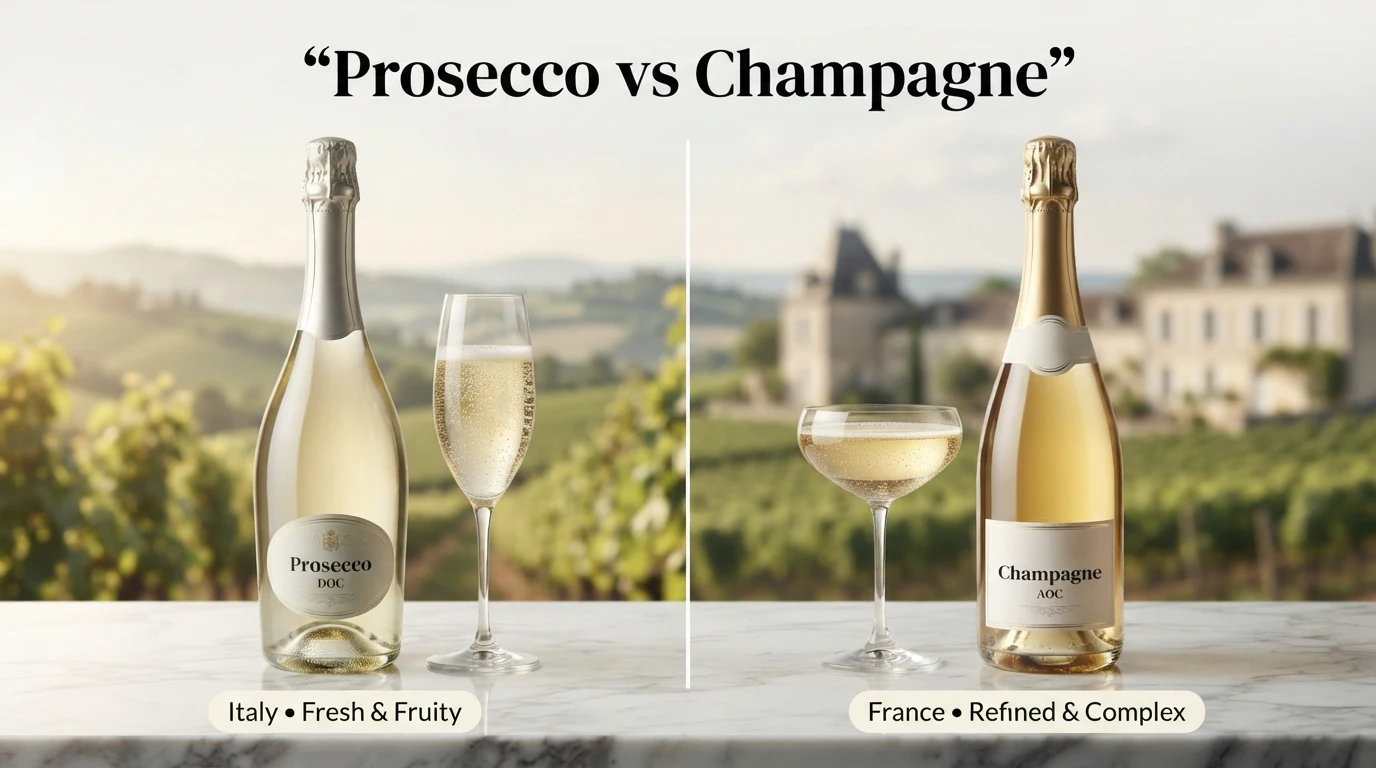
Choosing between sparkling wines can be confusing. At first glance, Prosecco and Champagne may look almost the same. Both are bubbly, both are often served at celebrations, and both can be used in cocktails. Yet the difference between Prosecco and Champagne is much more than the name on the bottle.
The main difference between Prosecco and Champagne comes from where they are made, which grapes are used, and how the wine gets its bubbles. These factors affect taste, texture, aroma, aging, and price. Understanding the difference between Prosecco and Champagne can also help you choose the right bottle for a wedding, dinner, party, or casual gathering.
People often search for the difference between Prosecco and Champagne because the terms are sometimes used as if they mean the same thing. They do not. Champagne is a protected wine from France’s Champagne region, while Prosecco is associated with designated areas of Italy. Their production methods are also different, which gives each wine its own character.
This guide breaks down the distinction in simple language so you can understand what you are drinking and make a more confident choice.
Quick Answer
The simplest answer is this: Champagne comes from the Champagne region of France, while Prosecco is produced in designated areas of northeastern Italy.
They also differ in production.
| Feature | Prosecco | Champagne |
|---|---|---|
| Main origin | Northeastern Italy | Champagne, France |
| Main grape | Glera | Chardonnay, Pinot Noir, Pinot Meunier |
| Common production method | Tank method | Traditional method |
| Typical flavor | Fruity and floral | More citrusy, toasty, and complex |
| Bubble character | Usually lighter and fruitier | Often finer and more persistent |
| Typical style | Fresh and approachable | Structured and complex |
| Aging potential | Usually enjoyed young | Many styles can age well |
| Price | Often more affordable | Often more expensive |
For example, a bottle of Prosecco may show fresh apple, pear, peach, or floral notes. Champagne can show citrus, brioche, toast, nuts, or mineral notes, especially after aging.
Neither is automatically “better.” They simply offer different experiences.
The Origin of Prosecco and Champagne
The names themselves are closely tied to geography.
Where does Prosecco come from?
Prosecco is an Italian sparkling wine associated with the Veneto and Friuli Venezia Giulia regions. Under the modern Italian appellation system, Prosecco DOC covers a broad designated production area, while Prosecco DOCG includes higher-status designated areas such as Conegliano Valdobbiadene.
The principal grape used for Prosecco is Glera. The grape was historically known by the name Prosecco, but the name Glera became the standard official grape name in the modern regulatory system. This helps separate the grape from the protected geographical name.
The word “Prosecco” has a long history connected with the northeastern Italian area and with the wine produced there. Its exact linguistic history is more complex than simply saying that it means “sparkling wine.”
Where does Champagne come from?
Champagne is a sparkling wine from the Champagne wine region of northeastern France. The name is geographically protected, so producers outside the Champagne appellation generally cannot label their sparkling wine as Champagne.
The principal permitted grape varieties include Chardonnay, Pinot Noir, and Meunier. Other authorized varieties also exist, but these three dominate modern Champagne production.
Champagne became strongly associated with sparkling wine through the development and refinement of sparkling-wine production in the Champagne region. The history involves many producers, winemakers, and technical developments rather than one simple inventor.
A common story credits Dom Pérignon with “inventing Champagne.” That claim is too simple. He was an important historical figure in Champagne wine production, but sparkling Champagne developed through a broader history of experimentation and winemaking practice.
Why do the names matter?
This is one of the most important points.
Prosecco is a protected geographical name connected to Italy’s designated production areas. Champagne is also a protected geographical indication associated with a specific region of France.
So calling any sparkling wine “Champagne” is not technically correct.
A sparkling wine made in Spain, for example, may be Cava. Italian sparkling wine may be Prosecco or another style. French sparkling wines made outside the Champagne appellation may use terms such as Crémant, depending on their origin and classification.
Pronunciation and Word Use
Although Prosecco and Champagne are both wine terms, they are pronounced differently.
Prosecco is commonly pronounced approximately:
proh-SEK-koh
The middle consonant has a clear “k” sound.
Champagne is commonly pronounced approximately:
sham-PAYN
The final letters are not pronounced as they would be in an English word such as “gain.”
Both words function mainly as nouns when referring to the wines.
Examples:
- “We served Prosecco at the party.”
- “They opened a bottle of Champagne.”
- “Champagne is produced in France.”
- “Prosecco is popular for casual celebrations.”
The words can also act as modifiers:
- “Prosecco cocktail”
- “Champagne glass”
- “Champagne producer”
- “Prosecco region”
One important usage point is that Champagne is not simply another word for sparkling wine. Sparkling wine is the broader category. Champagne is one specific type of sparkling wine.
British English vs American English Spelling
There is no meaningful British-versus-American spelling difference for these wine names.
Both British English and American English use:
- Prosecco
- Champagne
- sparkling wine
The differences people sometimes notice are more likely to involve pronunciation, wine terminology, labeling conventions, or style preferences rather than spelling.
| Term | British English | American English |
|---|---|---|
| Prosecco | Prosecco | Prosecco |
| Champagne | Champagne | Champagne |
| Sparkling wine | Sparkling wine | Sparkling wine |
| Chardonnay | Chardonnay | Chardonnay |
| Sommelier | Sommelier | Sommelier |
There is therefore no reason to change Prosecco or Champagne based on whether you are writing for a British or American audience.
The geographic identity of the wines is much more important than regional English spelling.
Which Spelling Should You Use?
Use Prosecco and Champagne in both US and UK English.
If you are writing for a global audience, keep the official wine names unchanged.
The more important rule is to use the terms accurately.
For example:
Correct:
“We chose Prosecco for the reception.”
Correct:
“The restaurant has a Champagne menu.”
Less accurate:
“We chose Champagne because all sparkling wines are Champagne.”
That last statement confuses a specific protected wine category with the broader category of sparkling wine.
For formal writing, wine menus, food articles, and product descriptions, accurate geographical terminology is especially important.
How Prosecco and Champagne Are Made
Production method is one of the biggest practical differences.
Prosecco and the tank method
Most Prosecco is made using the tank method, also called the Charmat method.
In this process, the second fermentation that creates the bubbles takes place in a large pressurized tank rather than inside each individual bottle.
The method helps preserve the fresh, fruity character of the wine.
That is why Prosecco often has aromas and flavors associated with:
- Pear
- Green apple
- Peach
- Melon
- Citrus
- White flowers
The wine is generally designed to be fresh and enjoyable rather than heavily shaped by long aging on yeast.
Champagne and the traditional method
Champagne is made using the traditional method, in which the second fermentation takes place in the bottle.
The wine then spends time aging with its yeast sediment, known as lees. This process contributes to the distinctive character found in many Champagnes.
Depending on the wine and its age, you may notice flavors such as:
- Lemon
- Apple
- Citrus
- Toast
- Brioche
- Almond
- Hazelnut
- Mineral notes
The production process is more labor-intensive, which is one factor that can contribute to Champagne’s higher price.
Taste: How Are They Different?
Taste is not identical across every bottle, but some broad patterns can help.
Prosecco
Prosecco often feels:
- Fresh
- Fruity
- Floral
- Light
- Easy to drink
A typical bottle may remind you of pear, apple, peach, or flowers.
Prosecco is often a good choice when you want a bright, youthful sparkling wine.
Champagne
Champagne often has greater complexity, especially when it has undergone extended aging.
You may find:
- Citrus
- Green apple
- Toast
- Bread
- Brioche
- Nuts
- Mineral characteristics
The wine can also have a more pronounced sense of structure and depth.
However, not every Champagne tastes strongly of toast or bread. Style, grape blend, vintage, producer, dosage, and aging all affect the final wine.
Bubbles and Texture
The bubbles in both wines come from carbon dioxide produced during fermentation.
The way the second fermentation occurs affects the wine’s texture and character.
Prosecco’s tank fermentation helps retain a fresh and fruity profile. Champagne’s bottle fermentation and lees aging can contribute to a more complex texture and finer mousse.
“Mousse” is a wine term used for the appearance and feel of the bubbles.
When you pour either wine, observe how the bubbles rise through the glass. The size and persistence of bubbles can vary greatly depending on the wine, glass, temperature, and serving conditions.
Price: Is Champagne More Expensive?
Champagne is often more expensive than Prosecco, but price alone does not determine quality.
Several factors influence the cost of Champagne, including:
- Vineyard land
- Production requirements
- Labor
- Aging time
- Producer reputation
- Vintage
- Market demand
Prosecco is often positioned as a more accessible sparkling wine.
This makes it popular for parties, brunches, casual celebrations, and cocktails.
Champagne can be chosen when the occasion calls for a more traditional or prestigious French sparkling wine.
Still, there are inexpensive Champagnes and premium Proseccos, so the categories should not be treated as simple price labels.
Prosecco vs Champagne for Different Occasions
Your choice can depend on the event.
Choose Prosecco when:
- You want a fresh and fruity drink.
- You are serving a larger group.
- You want a generally affordable sparkling wine.
- You are making cocktails.
- You prefer lighter fruit-driven flavors.
Choose Champagne when:
- You want a classic French sparkling wine.
- The occasion is especially formal.
- You enjoy more complex flavors.
- You want a wine that can develop with age.
- You appreciate traditional-method sparkling wine.
For a relaxed afternoon gathering, Prosecco may feel natural. For a formal dinner or major celebration, Champagne may be more appropriate.
But there is no strict rule. Personal taste matters most.
Common Mistakes About Prosecco and Champagne
Mistake 1: Calling every sparkling wine Champagne
Incorrect:
“We bought Champagne from Italy.”
Better:
“We bought Italian sparkling wine.”
If the wine is specifically Prosecco and meets its designation requirements, call it Prosecco.
Mistake 2: Assuming Prosecco is a grape
Today, the grape used for Prosecco is officially known as Glera.
So it is better to say:
“Prosecco is made primarily from Glera.”
Mistake 3: Thinking Champagne is always sweeter
Both Prosecco and Champagne come in different sweetness levels.
Look at the label rather than assuming one category is always sweet or dry.
Mistake 4: Thinking expensive means automatically better
Price reflects many factors. It does not guarantee that a particular wine will match your taste.
Mistake 5: Treating production methods as identical
Prosecco and Champagne generally use different methods for their second fermentation. This is a key reason their aromas, texture, and style can differ.
Difference Between Prosecco and Champagne in Everyday Examples
These terms appear often in menus, messages, articles, and conversations.
In an email
“Could you please confirm whether we should order Prosecco or Champagne for the reception?”
For a restaurant
“The customer asked whether the sparkling wine was Prosecco or Champagne.”
In social media
“Celebrating the weekend with a chilled glass of Prosecco!”
With news article
“The event featured Champagne from France and other sparkling wines from around the world.”
In formal writing
“Prosecco and Champagne are distinct sparkling wines with different geographical origins and production traditions.”
In a conversation
“What’s the difference between Prosecco and Champagne?”
“Prosecco comes from designated areas of Italy, while Champagne comes from the Champagne region of France.”
Prosecco vs Champagne: Side-by-Side Comparison
| Category | Prosecco | Champagne |
|---|---|---|
| Country | Italy | France |
| Key region | Veneto and Friuli Venezia Giulia | Champagne |
| Main grape | Glera | Chardonnay, Pinot Noir, Meunier |
| Main method | Tank method | Traditional method |
| Typical profile | Fruity and floral | Fruity, citrusy, toasty, complex |
| Aging style | Usually enjoyed young | Many styles benefit from aging |
| Typical price | Often lower | Often higher |
| Best known for | Freshness and fruit | Complexity and tradition |
| General occasion | Casual to festive | Festive to formal |
| Broader category | Sparkling wine | Sparkling wine |
What About Sparkling Wine, Cava, and Other Styles?
Understanding the larger category makes the distinction easier.
Sparkling wine is the broad term for wine containing significant dissolved carbon dioxide that creates bubbles.
Within that broad category are many regional styles.
Champagne comes from Champagne in France.
Prosecco is associated with designated areas of northeastern Italy.
Cava is a Spanish sparkling wine with its own production rules and geographical designations.
There are also sparkling wines produced in countries such as Germany, the United States, Australia, England, and New Zealand.
Therefore:
All Champagne is sparkling wine, but not all sparkling wine is Champagne.
Likewise:
Prosecco is sparkling wine, but not all sparkling wine is Prosecco.
This simple distinction removes much of the confusion.
Google Trends and Search Intent
People searching for difference between Prosecco and Champagne are usually trying to solve a practical comparison problem.
They may want to know:
- Which wine tastes sweeter?
- Which one is more expensive?
- Which one is better for a celebration?
- Can Prosecco replace Champagne?
- What makes Champagne different?
- Which sparkling wine should they buy?
Search interest should not be confused with actual wine consumption or sales. Without current, verified Google Trends data, it would be misleading to assign specific search volumes, percentages, or rankings.
For readers, the useful point is that this comparison reflects a common information need: understanding two popular sparkling wines before choosing one.
FAQs
1. Is Prosecco the same as Champagne?
No. Prosecco and Champagne are different sparkling wines with different geographical origins, grapes, and production traditions.
2. Which is sweeter, Prosecco or Champagne?
Neither is always sweeter. Both have different sweetness levels, so check the bottle’s sweetness designation rather than judging by the wine’s name.
3. Is Champagne more expensive than Prosecco?
Champagne is often more expensive, but this is not an absolute rule. Producer, quality, aging, and market factors affect price.
4. Can I use Prosecco instead of Champagne?
Often, yes, depending on the recipe or occasion. They are both sparkling wines, but their flavors and textures are different.
5. Why is Champagne called Champagne?
The name comes from the Champagne region of France, where the wine is produced under the region’s protected designation.
6. What grape is used in Prosecco?
Prosecco is made primarily from Glera. Other permitted grape varieties may also be used under the applicable production rules.
7. Which tastes fruitier, Prosecco or Champagne?
Prosecco is often more openly fruity and floral, with notes such as pear, apple, and peach. Champagne can show fruit too, but often develops more complex bread, toast, citrus, or nutty notes.
Conclusion
Prosecco and Champagne may both sparkle, but their origins, grapes, and production methods give them different personalities. Knowing this makes every choice easier.
Prosecco is often fresh, fruity, and approachable, while Champagne can offer greater complexity and a more traditional character shaped by bottle fermentation and aging.
There is no universal winner. The best choice depends on your taste, budget, meal, and occasion. Both can make a celebration feel special.
Once you understand the difference, choosing between them becomes simple. Use this knowledge when reading menus, shopping, or discussing sparkling wine with confidence.

Eliza Marlowe is a passionate content strategist and comparison writer at diffnexx.com. She specializes in breaking down complex “difference between” topics into clear, reader-friendly guides. With a background in linguistics and digital research, Eliza focuses on accuracy, clarity, and content that helps readers make informed decisions with confidence.







