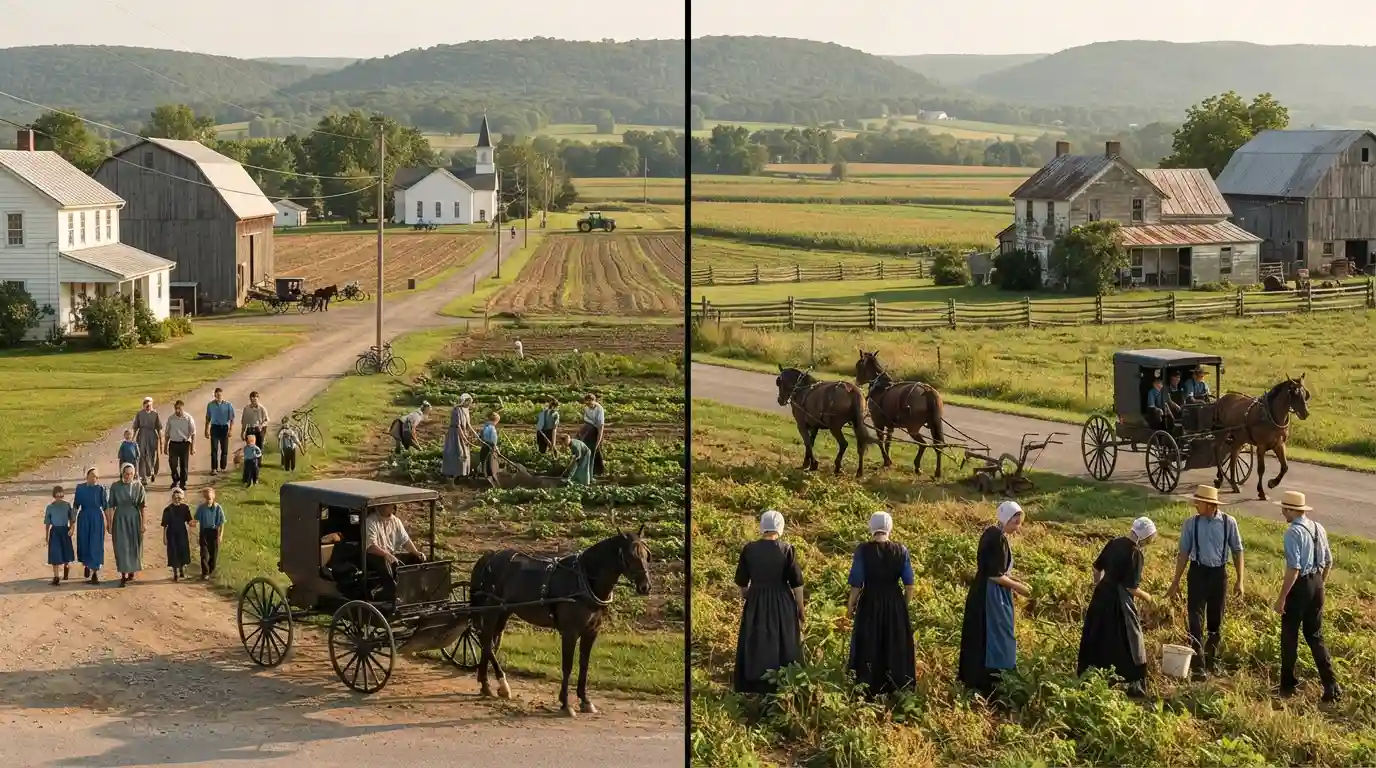
The difference between Mennonite and Amish is often misunderstood because both communities have roots in the Anabaptist Christian movement. They share important beliefs and a long history, but they are not the same group.
People often search for the difference between Mennonite and Amish because both are associated with simple living, close communities, plain clothing, and traditional religious practices. Images of horse-drawn buggies and rural communities can make the two groups seem almost identical.
The difference between Mennonite and Amish becomes clearer when you look at history, technology, clothing, church structure, and relationships with wider society. The Amish separated from other Swiss Anabaptists in the late 17th century, while Mennonite traditions developed from an earlier Anabaptist movement associated with Menno Simons.
It is also important to avoid treating either group as completely uniform. There are many Mennonite groups, and Amish communities can differ in local rules and practices. This guide explains the key similarities and differences without reducing either tradition to stereotypes.
Quick Answer
The simplest answer is that Mennonites and Amish are related Anabaptist Christian groups, but the Amish developed as a distinct community after a division among Swiss Anabaptists in 1693. The Amish generally developed stronger traditions of separation from wider society and tighter limits on modern technology, while Mennonite communities vary widely and many participate more openly in modern society.
Here is the basic picture:
| Feature | Mennonites | Amish |
|---|---|---|
| Religious family | Anabaptist | Anabaptist |
| Historical connection | Older Anabaptist tradition | Emerged from a 1693 division |
| Technology | Varies greatly by group | Often more restricted |
| Transportation | Often modern vehicles | Many traditional communities use horse-drawn buggies |
| Clothing | Varies from modern to plain | Often distinctive plain dress |
| Relationship with wider society | Usually more integrated | Traditionally more separate |
| Local rules | Vary by denomination and congregation | Local church districts set detailed rules |
| Common image | Service, community, peace traditions | Plain dress, buggies, separation |
The table gives a broad overview, not a rule for every individual. Mennonite Church USA itself notes that Mennonite groups differ in dress, worship, and their relationship with the wider world.
The Origin of Mennonite and Amish
The words Mennonite and Amish have different personal-name origins.
Where Does “Mennonite” Come From?
Mennonite is a noun when it refers to a member of a Mennonite community. It can also function as an adjective, as in “Mennonite church” or “Mennonite history.”
The name comes from Menno Simons, a Dutch priest who became an important Anabaptist leader in the 16th century. Mennonite Church USA explains that Mennonites took their name from Menno Simons, who helped consolidate and lead the Dutch Anabaptist movement.
The English word Mennonite is recorded from the 16th century and was formed from Menno Simons’ name with the suffix -ite, a suffix often used for people associated with a person, place, or movement.
Where Does “Amish” Come From?
Amish is also a noun and adjective.
The name comes from Jakob Ammann, a Swiss Anabaptist leader. In 1693, Ammann and his supporters separated from other Swiss Anabaptists over questions involving church discipline, separation from the wider world, and the practice of shunning. His followers eventually became known as the Amish.
The English word Amish is documented in American English from the 19th century. Earlier forms included names such as Ammanite, and the spelling and pronunciation developed as the name entered English and Pennsylvania German usage.
So the historical connection can be simplified like this:
Anabaptist movement → Mennonite tradition → 1693 Amish division → distinct Amish communities
This does not mean that every Mennonite community today is directly identical to the historical group from which the Amish separated. Both traditions have changed and diversified over time.
Are Mennonites and Amish the Same Religion?
They belong to the same broad Anabaptist Christian tradition, but they are distinct religious communities.
Anabaptism developed in 16th-century Europe. Early Anabaptists emphasized adult baptism and a church made up of committed believers rather than relying on infant baptism. Mennonite Church USA describes Mennonites as part of this Anabaptist tradition.
The Amish emerged later from the Swiss Anabaptist tradition.
This shared history explains why Mennonites and Amish have important similarities, including traditions involving:
- Adult baptism
- Strong community life
- Biblical faith
- Simplicity
- Service
- Peace and nonviolence
- Church discipline
- Mutual support
However, shared roots do not mean identical practices.
The main differences developed around how religious convictions should be lived out, especially questions about separation from society, discipline, clothing, technology, and community rules.
Mennonite vs Amish: Technology
Technology is one of the most visible differences, but it is also one of the areas where generalizations can be misleading.
Many Amish communities place significant limits on modern technology. Traditional Amish communities may restrict electricity in homes, automobiles, telephones, and other technologies. The exact rules can differ by church district.
Mennonite communities are much more varied.
Some Mennonites live with modern technology much like other Christians. They may use:
- Cars
- Electricity
- Computers
- Smartphones
- Modern farming equipment
- Internet services
Other Mennonite groups maintain stricter traditions.
This is why saying “Mennonites do not use modern technology” is inaccurate.
A better explanation is:
Amish communities often place stronger communal limits on technology, while Mennonite communities range from traditional to highly modern.
Mennonite vs Amish: Clothing
Clothing is another visible difference.
Many Amish communities are known for plain, modest clothing. Certain Amish groups use distinctive styles, colors, fasteners, and head coverings as part of their community traditions. Mennonite Church USA notes practices such as distinctive plain dress among some conservative Mennonite groups, but also stresses the diversity of Mennonite communities.
Mennonite clothing therefore cannot be defined by one universal style.
Some Mennonites wear clothing that looks much like mainstream clothing. Others maintain plain-dress traditions.
The key point is that plain clothing is not exclusive to the Amish.
Mennonite vs Amish: Transportation
Transportation provides another common contrast.
Many traditional Amish communities use horse-drawn buggies rather than owning automobiles. Transportation rules are determined within local Amish communities, so practices can vary.
Most Mennonites today use modern transportation, including cars.
However, some conservative Mennonite groups also maintain restrictions on automobiles and other technologies.
So this is a useful general pattern:
Amish: horse-and-buggy transportation is common in traditional communities.
Mennonite: automobile use is common in many modern Mennonite communities, but practices vary among groups.
Mennonite vs Amish: Relationship With Wider Society
Another major difference involves how communities relate to the surrounding society.
Many Amish communities emphasize separation from the wider world. Church districts can establish detailed expectations for clothing, technology, transportation, and other parts of daily life.
Mennonites are generally more integrated into wider society, although this varies considerably among Mennonite groups.
Mennonites may work in ordinary workplaces, attend universities, operate businesses, use modern technology, and participate in community service.
Mennonite Church USA describes service and mutual aid as important parts of Mennonite life.
This does not mean Amish people never interact with outsiders or that Mennonites have no community boundaries. It means their typical approaches to social separation have developed differently.
Mennonite vs Amish: Church Rules and Community Life
The Amish have a strong local structure based around church districts. Each district can have its own expectations about daily life.
This helps explain why one Amish community may have slightly different rules from another.
Mennonite communities also have church structures and traditions, but the range is much broader. Mennonite Church USA notes that there are numerous Mennonite and Anabaptist groups with differences in worship, dress, and relationships with society.
This diversity matters when discussing the difference between Mennonite and Amish.
There is no single lifestyle that describes every Mennonite.
Likewise, not every Amish community follows exactly the same local rules.
Pronunciation of Mennonite and Amish
The two words do not sound alike, so pronunciation is usually less confusing than their cultural relationship.
Mennonite
A simple pronunciation guide is:
MEN-uh-nite
The final part sounds like “night.”
Example:
She attends a Mennonite church.
Amish
A common English pronunciation is:
AH-mish
The first syllable is stressed.
Example:
They visited an Amish community.
The words are therefore easy to distinguish when spoken:
Mennonite → MEN-uh-nite
Amish → AH-mish
British English vs American English Spelling
There is no meaningful British-versus-American spelling difference for Mennonite or Amish.
Both varieties of English normally use:
- Mennonite
- Mennonites
- Mennonite church
- Amish
- Amish community
The difference is not like color/colour or center/centre.
| Term | British English | American English |
|---|---|---|
| Mennonite | Mennonite | Mennonite |
| Mennonites | Mennonites | Mennonites |
| Amish | Amish | Amish |
| Mennonite church | Mennonite church | Mennonite church |
| Amish community | Amish community | Amish community |
Regional English does not require you to change the spelling of these names.
Which Spelling Should You Use?
If you are writing for a US audience, use Mennonite and Amish.
For UK, Canadian, Australian, or other Commonwealth audiences, the same spellings are appropriate.
For global English, use the standard spellings and focus on accurate descriptions.
More important than spelling is capitalization.
Both names are normally capitalized because they refer to religious communities:
Mennonite beliefs vary among different groups.
The Amish community maintains its own traditions.
Do not write:
mennonite
or:
amish
in standard formal English unless the word appears in a context where capitalization is intentionally changed.
Common Mistakes With the Difference Between Mennonite and Amish
Mistake 1: Saying all Mennonites use horse and buggy
This is not accurate.
Many Mennonites use cars and other modern transportation. Mennonite communities vary widely in their practices.
Better:
Some conservative Mennonite groups maintain traditional transportation practices.
Mistake 2: Saying Amish and Mennonite are exactly the same
They share Anabaptist roots, but the Amish became a distinct community after the 1693 division associated with Jakob Ammann.
Better:
Amish and Mennonites are related Anabaptist communities with different historical and cultural developments.
Mistake 3: Treating all Mennonites as one group
Mennonite communities differ in worship, dress, technology, and social practices.
Better:
Mennonite practices vary among denominations and congregations.
Mistake 4: Assuming every Amish community follows identical rules
Amish church districts can establish their own rules.
Better:
Practices can differ between Amish communities and church districts.
Mistake 5: Using “Amish” as a synonym for “traditional”
Amish is the name of a particular Anabaptist Christian tradition. It should not simply be used as a general adjective for anything old-fashioned.
Difference Between Mennonite and Amish in Everyday Examples
Knowing how to use these words helps when writing about religion, history, culture, or communities.
In an email
I am researching Mennonite and Amish history for my school project.
This uses both words as adjectives describing the subject.
In a news article
The Amish community has maintained traditions that differ from those of many modern Mennonite communities.
The sentence makes a comparison without claiming that every person follows one lifestyle.
In a social media post
I learned today that Amish and Mennonite communities share Anabaptist roots but have different histories.
This is a simple and accurate way to summarize the connection.
In formal writing
The Amish emerged as a distinct Anabaptist community following a division among Swiss Anabaptists in 1693, while Mennonite traditions have a longer history within the Anabaptist movement.
This wording is more precise than saying that the two groups are simply different versions of the same church.
Mennonite vs Amish: Side-by-Side Comparison
| Category | Mennonite | Amish |
|---|---|---|
| Religious tradition | Anabaptist Christianity | Anabaptist Christianity |
| Historical name | Associated with Menno Simons | Associated with Jakob Ammann |
| Distinct separation | Developed from the broader Anabaptist movement | Emerged from a 1693 division |
| Technology | Ranges from modern to highly traditional | Often more restricted |
| Cars | Common among many Mennonites | Restricted in many traditional communities |
| Horse and buggy | Used by some conservative groups | Common in many traditional communities |
| Clothing | Ranges from modern to plain | Often distinctive plain dress |
| Community separation | Generally less socially separate | Stronger tradition of separation |
| Local variation | Very high | Also varies by church district |
| Modern society | Many communities participate openly | Traditional communities maintain stronger boundaries |
The most important point is variation. Neither label should be treated as a complete description of how an individual person lives.
FAQs
1. Are Mennonites and Amish related?
Yes. Both belong to the wider Anabaptist Christian tradition. The Amish emerged as a distinct group from Swiss Anabaptists in the late 17th century.
2. What is the biggest difference between Mennonite and Amish communities?
One major difference is their approach to separation from wider society and modern technology. Amish communities generally maintain stronger communal restrictions, while Mennonite practices vary widely.
3. Do Mennonites use cars?
Many Mennonites do use cars. However, some conservative Mennonite groups maintain stricter transportation practices.
4. Do Amish people use electricity?
Traditional Amish communities often restrict electricity in homes, but rules differ between communities. It is better to describe specific practices rather than assume every Amish person follows exactly the same rule.
5. Are Mennonites Amish?
No. Mennonites and Amish are distinct communities, although they share Anabaptist roots and historical connections.
6. Why do Amish people wear plain clothes?
Plain clothing is connected with Amish traditions of modesty, simplicity, and community identity. Specific clothing rules can vary between Amish groups.
7. Is Mennonite spelled differently in British English?
No. Mennonite has the same standard spelling in British and American English. Amish is also spelled the same way in both varieties.
Conclusion
The difference between Mennonite and Amish comes from shared Anabaptist roots but different historical paths, especially after the Amish division associated with Jakob Ammann in 1693.
Mennonite communities vary widely, while many Amish communities maintain stronger traditions of separation, plain dress, and limits on modern technology. Local practice matters in both traditions.
Learning the difference between Mennonite and Amish helps you write about these communities with greater care and accuracy. Small details can prevent major cultural misunderstandings.
Keep practicing these terms in emails, essays, and daily conversations, and explore the difference between Mennonite and Amish to learn more about their history and traditions.

Eliza Marlowe is a passionate content strategist and comparison writer at diffnexx.com. She specializes in breaking down complex “difference between” topics into clear, reader-friendly guides. With a background in linguistics and digital research, Eliza focuses on accuracy, clarity, and content that helps readers make informed decisions with confidence.







