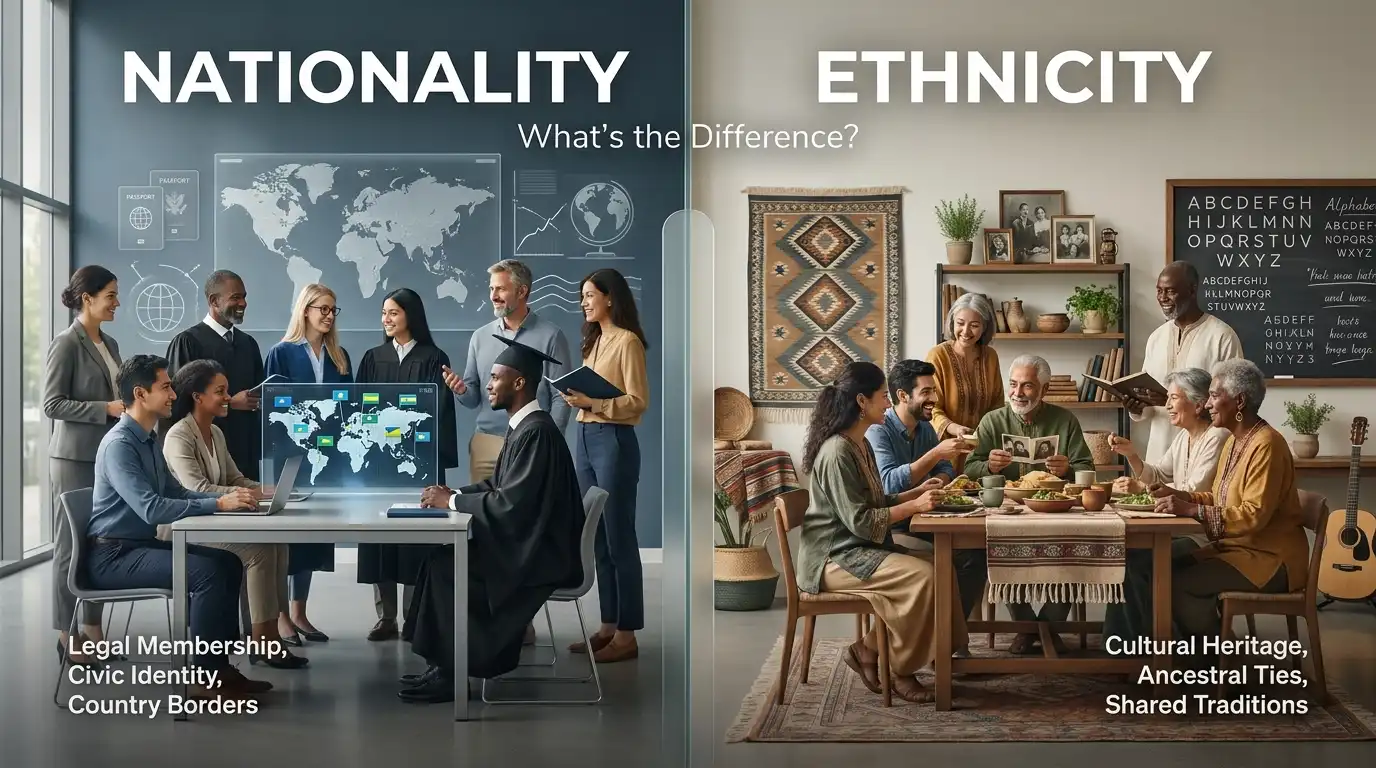
People often use nationality and ethnicity as if they mean the same thing. They can overlap, but they describe different parts of a person’s identity. Understanding the difference between nationality and ethnicity is useful when filling out forms, writing profiles, discussing culture, or simply trying to describe someone accurately.
The difference between nationality and ethnicity becomes clearer when you ask two simple questions: “Which country or nation do you legally belong to?” and “What cultural or ancestral group do you identify with?” Nationality is often connected to citizenship or membership in a nation, while ethnicity relates more closely to shared ancestry, history, language, traditions, and cultural identity.
The difference between nationality and ethnicity can also explain why two people from the same country may have different ethnic backgrounds. Likewise, people from the same ethnic group may have different nationalities. The difference between nationality and ethnicity is not always simple because countries and cultures use these terms in different ways.
This guide explains the distinction in clear English, with examples, common mistakes, pronunciation help, and practical usage.
Quick Answer
Nationality usually describes a person’s legal or national connection to a country or nation. Ethnicity describes a person’s cultural, ancestral, historical, or social identity.
For example, imagine a person who is a citizen of the United States and has Mexican family roots. Their nationality may be American, while their ethnicity may be Mexican or another ethnic identity, depending on how they identify.
Another person might have Pakistani nationality and identify ethnically as Punjabi, Pashtun, Sindhi, Baloch, or another group.
The key difference is this:
- Nationality is commonly connected to a nation or legal status.
- Ethnicity is commonly connected to cultural and ancestral identity.
- A person can have one nationality and identify with more than one ethnicity.
- People with the same ethnicity can have different nationalities.
- Nationality can sometimes change through legal processes such as naturalization.
- Ethnicity is generally more closely tied to identity, heritage, culture, and ancestry.
The United Nations notes that ethnicity is multidimensional and can involve shared history, territorial origins, language, religion, and cultural characteristics. It also warns against treating ethnicity as the same thing as country of citizenship or birthplace.
The Origin of Nationality and Ethnicity
The words nationality and ethnicity have different histories.
Nationality
Nationality is a noun formed from national plus the suffix -ity. Its deeper history connects to the word nation.
The English word nation came through Middle English and Anglo-French from Latin natio, meaning ideas such as birth, people, race, or nation. The Latin word is related to nasci, meaning “to be born.”
The word nationality has been used in English for several related ideas. Historical meanings have included national character, belonging to a nation, and membership in a particular national group. Modern legal usage can refer to the relationship between an individual and a state.
Ethnicity
Ethnicity comes from ethnic plus -ity. Its deeper history goes back through Latin to Greek ethnikos, related to ethnos, meaning a people, nation, or group.
The modern sense of ethnicity developed over time. Historical uses of ethnic were not identical to today’s common meaning, and the modern noun ethnicity is relatively recent in English. Etymological sources place its modern “ethnic character” use in the 20th century.
This history helps explain why the two words can sometimes overlap. Nationality has historically been used in some contexts for a people or cultural group, while modern official and everyday usage often makes a clearer distinction between nationality and ethnicity.
The United Nations also points out that countries do not all use these concepts in exactly the same way. Ethnicity can be measured using different combinations of ancestry, identity, language, religion, nationality, and other factors.
Part of Speech
Both words are nouns.
- Nationality — noun
- Ethnicity — noun
- National — adjective or noun in some contexts
- Ethnic — mainly an adjective in modern standard usage
Examples:
- “What is your nationality?”
- “She holds Canadian nationality.”
- “His ethnicity is part of his cultural identity.”
- “They celebrate several ethnic traditions.”
Pronunciation of Nationality and Ethnicity
The words nationality and ethnicity are not homophones, but their longer forms can be difficult for English learners because both contain several syllables.
Nationality has five syllables in common pronunciation, while ethnicity normally has four.
For learners, the main goal is to keep the words distinct in meaning:
- Nationality → nation or country connection
- Ethnicity → cultural or ancestral group identity
British English vs American English Spelling
There is no major British English versus American English spelling difference between nationality and ethnicity.
Both varieties use:
- nationality
- nationalities
- ethnicity
- ethnicities
This is different from spelling pairs such as colour/color or realise/realize. You do not need to change the spelling of these words based on whether your audience is in the United States, the United Kingdom, Canada, Australia, or another English-speaking region.
| Word | British English | American English | Meaning |
|---|---|---|---|
| Nationality | nationality | nationality | Connection or membership related to a nation |
| Plural | nationalities | nationalities | More than one nationality |
| Ethnicity | ethnicity | ethnicity | Cultural or ancestral identity |
| Plural | ethnicities | ethnicities | More than one ethnic identity |
| Ethnic | ethnic | ethnic | Relating to an ethnic group |
The spelling stays the same because these words do not have a standard regional spelling split.
There can still be differences in how forms, governments, organizations, or surveys define the terms. That is a usage issue rather than a British-versus-American spelling issue.
Which Spelling Should You Use?
For a US audience, use nationality and ethnicity.
For a UK or Commonwealth audience, use the same spellings while for a global audience, these spellings are also appropriate.
The more important issue is choosing the correct word.
If a form asks about nationality, it may be asking about your legal national status or the nation you belong to under that system.
If it asks about ethnicity, it may be asking about your ethnic or cultural background.
Always read the instructions on a specific form because governments, schools, employers, researchers, and organizations may define their categories differently.
The United Nations specifically notes that national circumstances vary and that there is no single internationally applicable classification for ethnicity.
Nationality vs Ethnicity: Key Differences
| Point | Nationality | Ethnicity |
|---|---|---|
| Main idea | National or legal connection | Cultural or ancestral identity |
| Usually linked to | Nation or state | People, culture, ancestry, history |
| Can be legal? | Yes | Usually not a legal citizenship status |
| Can change? | Often can change through legal processes | Identity can be complex and may change or develop |
| Can overlap? | Yes | Yes |
| Can someone have more than one? | Some people can have multiple nationalities | People may identify with multiple ethnicities |
| Example | Canadian | Punjabi, Irish, Yoruba, etc., depending on identity |
| Same for everyone in a country? | No | No |
The table gives a useful general distinction, but real-world identity can be more complex than a simple two-column definition.
Can Nationality and Ethnicity Be the Same?
Yes, they can overlap.
For example, someone may describe their nationality and ethnicity using the same country-related label. A person who is Japanese by nationality may also identify ethnically as Japanese.
But the two concepts are still not identical.
A person can have British nationality and identify with an Indian, Pakistani, Nigerian, Chinese, Caribbean, or other ethnic background.
Likewise, people from one ethnic group can hold different nationalities because they live in or have citizenship from different countries.
This is one of the most important points when understanding the difference between nationality and ethnicity: the two categories can intersect without being interchangeable.
Can One Person Have More Than One Ethnicity?
Yes.
Ethnic identity can be complex, particularly for people with parents or grandparents from different ethnic backgrounds.
For example, someone may identify with two ethnic communities because of their family history and cultural upbringing.
The United Nations recognizes that ethnicity has a subjective dimension and recommends allowing people to self-identify, including indicating more than one ethnic affiliation where appropriate.
This is why it is risky to guess someone’s ethnicity from appearance, name, accent, birthplace, or nationality alone.
Can One Person Have More Than One Nationality?
In some countries, yes.
Nationality is governed by national law, so the rules vary. Some countries allow dual or multiple nationality, while others restrict it or impose conditions.
This makes nationality different from a simple statement about where someone lives.
For example, being a resident of a country does not automatically mean that a person has that country’s nationality.
Similarly, being born in a country and holding its nationality are not concepts that should always be treated as identical. The legal rules of the country matter.
The United Nations recognizes nationality as a distinct legal and international concept, including the right to a nationality in Article 15 of the Universal Declaration of Human Rights.
Common Mistakes with Nationality and Ethnicity
Mistake 1: Using nationality as a synonym for ethnicity
Incorrect:
“Her nationality is Punjabi.”
This may be inaccurate if the question concerns legal nationality.
Better:
“Her nationality is Pakistani, and she identifies ethnically as Punjabi.”
The exact wording should still reflect how the person identifies and how the relevant form defines its categories.
Mistake 2: Assuming birthplace determines ethnicity
Being born in a country does not automatically tell you someone’s ethnicity.
A person can be born in one country while having parents, grandparents, or cultural roots connected to another ethnic group.
Mistake 3: Assuming citizenship and ethnicity are identical
A citizen can have many different ethnic backgrounds.
For example, a country’s citizens may belong to several ethnic communities.
Mistake 4: Guessing ethnicity from appearance
Physical appearance is not a reliable way to determine someone’s ethnicity.
Ethnicity can involve ancestry, history, language, traditions, culture, and personal identity. The United Nations describes ethnicity as multidimensional and emphasizes self-identification.
Mistake 5: Thinking nationality never changes
Nationality can change under the laws of a country, including through naturalization in appropriate circumstances.
Ethnic identity works differently and should not be treated as a simple legal status.
Difference Between Nationality and Ethnicity in Everyday Examples
In an email
“Please provide your nationality as listed on your passport and, if requested, your ethnic background separately.”
This makes the distinction clear.
In a news article
A news report might say:
“The survey collected information about nationality, ethnicity, language, and place of birth.”
These are separate concepts and should not automatically be treated as interchangeable.
On a social media profile
Someone might write:
“Pakistani nationality, with Punjabi heritage.”
This gives information about both national connection and cultural background without assuming they are the same thing.
In formal writing
A formal sentence could say:
“Nationality and ethnicity are related but distinct concepts that may overlap in individual cases.”
This is a safe and accurate way to describe the relationship.
In conversation
Someone may ask:
“What is your nationality?”
A natural answer might be:
“I’m Canadian.”
If they ask:
“What is your ethnic background?”
The answer may involve family heritage, cultural identity, ancestry, or another identity that is different from nationality.
Why the Difference Matters
The distinction matters because identity is not one-dimensional.
A passport can tell you about legal nationality. It does not necessarily describe every part of a person’s family history or cultural identity.
Likewise, ethnicity can tell you something about heritage and cultural belonging, but it does not necessarily tell you which country a person is legally connected to.
This distinction is especially important in official forms, research, education, healthcare, demographic studies, and public policy. The United Nations advises that ethnicity should not be confused with citizenship or country of birth and that the meaning of the categories should be explained clearly.
It also matters in everyday conversation. Asking someone about their identity with care is usually better than making assumptions based on their name, accent, appearance, or where they live.
Frequently Asked Questions
1. What is the main difference between nationality and ethnicity?
Nationality usually refers to a person’s connection or legal membership with a nation or state. Ethnicity generally refers to cultural, ancestral, historical, or social identity.
2. Can nationality and ethnicity be the same?
Yes. They can overlap, but they do not have to. A person may have a nationality associated with a country while identifying with a different ethnic background.
3. Is ethnicity the same as race?
No. Race and ethnicity are related concepts but are not identical. Ethnicity often involves culture, ancestry, language, history, traditions, and identity, while race has been used as a different system of human classification.
4. Can someone have two ethnicities?
Yes. Some people identify with multiple ethnic backgrounds, especially when their family history includes more than one ethnic community.
5. Can someone have two nationalities?
Yes, depending on the laws of the countries involved. Some states permit dual or multiple nationality, while others place restrictions on it.
6. Does nationality mean citizenship?
The terms can overlap, but they are not always used in exactly the same way. In many legal contexts, nationality refers to a person’s legal relationship with a state. Always check the definition used by the relevant country or organization.
7. Can I know someone’s ethnicity from their nationality?
No. Nationality alone does not reliably establish someone’s ethnicity. People with the same nationality may have many different ethnic backgrounds.
Conclusion
Nationality and ethnicity describe different parts of identity. One often relates to a nation or legal status, while the other reflects heritage, culture, ancestry, and belonging.
The difference becomes easier when you remember that nationality can connect a person to a state, while ethnicity can connect them to a cultural or ancestral community.
Neither term should be used carelessly. Identity can be layered, personal, and shaped by family history, culture, language, migration, and personal choice.
Keep practicing these words in emails, essays, and daily conversations. Clear language helps us describe people with accuracy, respect, and greater understanding.

Anton Reyes is a contributing writer at DiffNexx.com, where he explores meaningful differences in language, culture, and everyday concepts. With a background in creative nonfiction, Anton brings clarity and balance to complex comparisons. His writing helps readers understand subtle distinctions in words and ideas, making learning both insightful and engaging.







