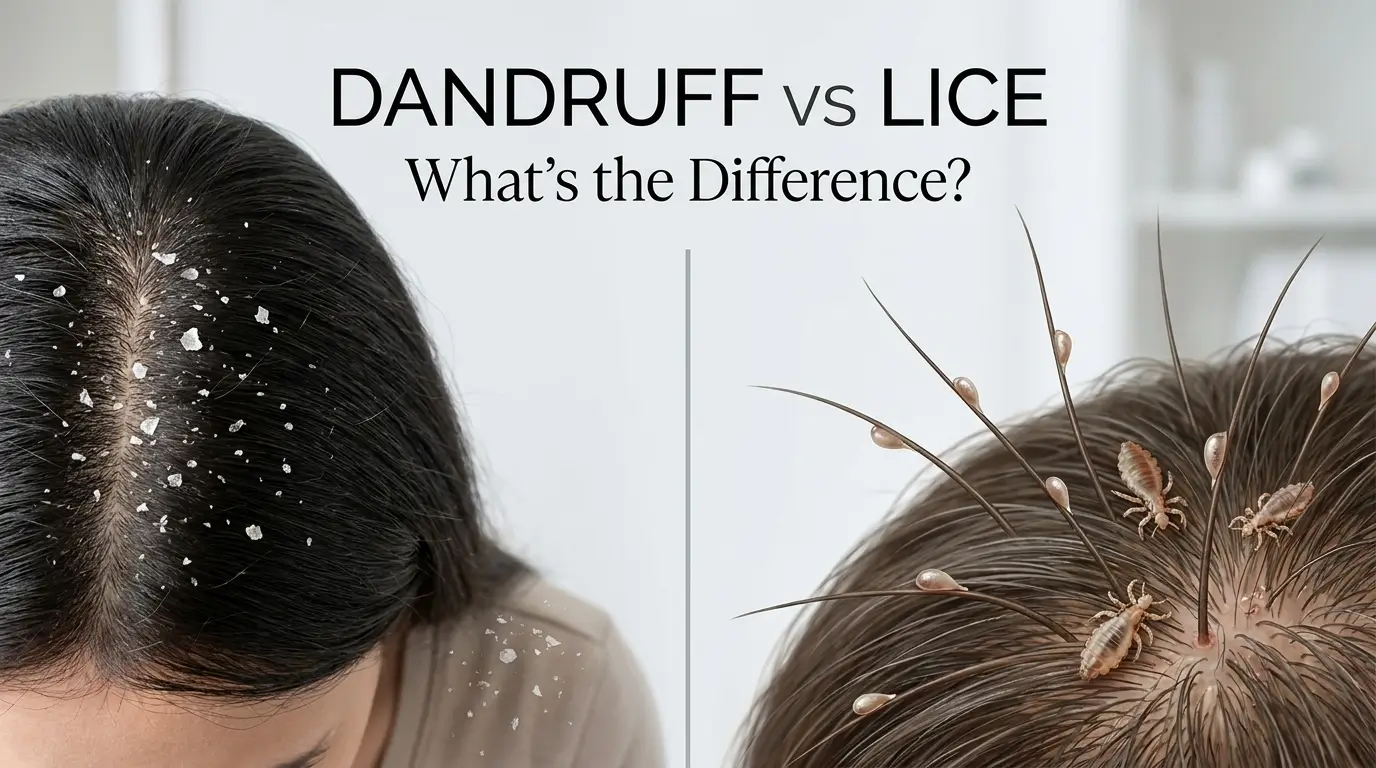
An itchy scalp can make you worry, especially when you notice small white flakes or tiny particles in your hair. Two common causes that people often confuse are dandruff and head lice. Although both can cause itching, they are very different problems and need different care. Understanding the difference between dandruff and lice can help you avoid unnecessary worry and choose the right next step.
The difference between dandruff and lice is mainly about what you see, where it appears, and how firmly it sticks to the hair. Dandruff creates loose flakes of dead skin, while lice are living insects that stay close to the scalp and lay eggs called nits on individual hairs. Knowing the difference between dandruff and lice is especially useful when checking a child’s hair or dealing with sudden scalp itching.
This guide explains the difference between dandruff and lice in simple terms. You will learn how each condition starts, how to recognize it, common mistakes people make, and when professional medical advice may be helpful.
Quick Answer
Dandruff is a common scalp condition that causes flakes of skin. Head lice are tiny parasitic insects that live on the human scalp and feed on blood.
The easiest way to tell them apart is to check whether the material moves or sticks firmly to the hair.
| Feature | Dandruff | Head Lice |
|---|---|---|
| What is it? | Flaking scalp skin | Small parasitic insects |
| Main cause | Scalp skin shedding and related scalp conditions | Infestation with head lice |
| Appearance | White or yellowish flakes | Small insects or eggs attached to hair |
| Moves? | No | Lice can move |
| Sticks to hair? | Usually loose | Nits are firmly attached |
| Common symptom | Itchy or flaky scalp | Itching, crawling feeling, irritation |
| Treatment | Anti-dandruff or medicated scalp care may help | Lice treatment and removal of live lice/nits |
Dandruff is not an insect infestation. It also does not mean that a person is unclean. Head lice, on the other hand, spread mainly through close head-to-head contact.
The Origin of Dandruff and Lice
The words dandruff and lice have different linguistic histories because they describe completely different things.
Dandruff is a noun referring to flakes of dead skin that come from the scalp. Its exact etymology is not completely certain. Historical English forms are related to scalp flaking, but the deeper origin of the word is disputed. Because the etymology is uncertain, it is better not to attach a definite ancient meaning to the word.
Lice is the plural of louse. The word louse is very old in English and belongs to a Germanic family of related words. English louse can be traced through Old English lus to an older Germanic form. The plural lice is an irregular plural rather than a spelling variation.
From a language point of view, the two terms are also different in grammar:
- Dandruff is a noun and is generally treated as an uncountable noun.
- Louse is a countable noun.
- Lice is the plural form of louse.
For example:
- “She has dandruff.”
- “There is dandruff on his shoulders.”
- “One louse was found in the hair.”
- “Several lice were found near the scalp.”
British English vs American English Spelling
There is no meaningful British-versus-American spelling difference for dandruff, louse, or lice.
Both British English and American English use:
- dandruff
- louse for one insect
- lice for more than one
- nit for a louse egg
The difference is therefore not like colour versus color or realise versus realize. These words keep the same standard spellings across major English varieties.
| Term | British English | American English | Meaning |
|---|---|---|---|
| Dandruff | dandruff | dandruff | Scalp flakes |
| One insect | louse | louse | A single head louse |
| More than one | lice | lice | Multiple lice |
| Egg | nit | nit | Louse egg attached to hair |
Pronunciation can also help with the singular and plural forms. Louse and lice are not pronounced the same way. Louse has the vowel sound found in words such as “house,” while lice has the long vowel sound found in “ice.”
Which Spelling Should You Use?
Use dandruff when you are talking about scalp flakes or a flaky scalp.
Use louse when referring to one insect.
While use lice when referring to two or more insects.
Use nits when referring to multiple lice eggs attached to hair.
If you write for an American audience, use the same spellings. If you write for a British or Commonwealth audience, the spellings remain the same.
For global websites, school assignments, emails, and general communication, there is no need to choose between British and American spellings for these terms.
The important point is choosing the correct word, not choosing a regional spelling.
How to Tell Dandruff and Lice Apart
The visual difference is often the fastest way to start.
1. Look at how the flakes or particles attach
Dandruff flakes usually come away from the scalp or hair fairly easily. They may fall onto clothing or shoulders.
Nits are different. They are attached to individual strands of hair, often close to the scalp. They can be difficult to remove with ordinary brushing.
2. Check for movement
Dandruff is not alive. A flake cannot crawl or move by itself.
A live louse is an insect. If you see a tiny insect moving through the hair, lice become much more likely.
However, not every tiny particle is a louse. Hair products, dirt, dried skin, and other debris can look similar.
3. Consider the location
Dandruff can appear across the scalp and may produce flakes that fall onto the shoulders.
Head lice tend to stay close to the scalp because they need access to the scalp for feeding. Nits are commonly found attached to hairs near the scalp.
4. Think about the type of itching
Both conditions can cause an itchy scalp, so itching alone cannot confirm either one.
Lice may cause an itching or crawling sensation, and some people can have an infestation without obvious symptoms at first.
Dandruff may also cause itching, especially when the scalp is dry or irritated.
5. Examine the hair carefully
When checking for lice, bright light can help. Separate the hair into small sections and look close to the scalp.
A fine-toothed lice comb can also be useful when checking for live lice.
If you are unsure whether something is a nit or dandruff, avoid relying on color alone. The way the material attaches to the hair can provide a more useful clue.
Common Mistakes with Dandruff and Lice
Mistake 1: Assuming every white flake is a nit
White flakes do not automatically mean lice.
Dandruff, dry skin, hair products, and other particles can look similar. A closer inspection is needed.
Mistake 2: Thinking lice only affect people with poor hygiene
This is a common misconception.
Head lice can affect people regardless of personal cleanliness. They usually spread through close head-to-head contact.
Mistake 3: Treating dandruff as if it were lice
Lice treatments are designed for an insect infestation. They are not simply stronger versions of dandruff treatments.
If the problem is dandruff, the appropriate approach is scalp care rather than unnecessary lice treatment.
Mistake 4: Assuming itching proves there are lice
Itching has many possible causes. Dandruff, scalp irritation, allergies, dryness, and other skin conditions can also cause itching.
Mistake 5: Confusing nits with dandruff
Nits are attached to individual hairs and tend to stay in place. Dandruff flakes are usually much easier to move or brush away.
Dandruff vs Lice: A Simple Comparison
| Question | Dandruff | Lice |
|---|---|---|
| Is it alive? | No | Yes |
| Is it an insect? | No | Yes |
| Can it move? | No | Live lice can move |
| Is it attached to hair? | Usually no | Nits are |
| Does it cause itching? | Often can | Often can |
| Can it spread by head contact? | No | Yes |
| Does it involve scalp skin? | Yes | Lice live on the scalp and hair |
| Main visual clue | Loose flakes | Moving insects or firmly attached nits |
This table is useful as a first check, but it should not replace professional assessment when the situation is unclear.
Difference Between Dandruff and Lice in Everyday Examples
In an email
A parent might write:
“My child has been scratching their scalp, and I noticed several white flakes. Could you let me know if the school has reported any cases of head lice?”
This wording is better than saying the child definitely has lice before confirming it.
In a news article
A health article may explain that head lice are spread mainly through close contact, while dandruff is a common scalp condition.
The terms should not be used as synonyms because they describe different problems.
In social media
Someone might post:
“I thought these were nits, but they brushed away easily, so I learned they were more likely to be dandruff.”
Social media can help people share experiences, but it should not be treated as a medical diagnosis.
In formal writing
A formal sentence could say:
“Dandruff produces scalp flakes, whereas head lice are parasitic insects that live on the scalp and hair.”
This is a clear way to show the contrast.
Can Dandruff Turn Into Lice?
No. Dandruff does not turn into lice.
Dandruff involves the shedding of scalp skin. Head lice are living insects that can spread from one person to another through close contact.
The two conditions can occur at the same time, however. Someone may have dandruff and also have head lice.
That is why identifying the actual signs matters more than assuming one condition must explain every symptom.
Frequently Asked Questions
1. How can I tell if white flakes are dandruff or lice?
Look at how they behave. Dandruff usually consists of loose skin flakes that can fall or brush away. Nits are attached firmly to individual hairs, while live lice can move.
2. Does dandruff itch like lice?
It can. Both dandruff and lice may cause an itchy scalp, so itching alone cannot tell you which problem is present.
3. Can lice look like dandruff?
Nits can sometimes be mistaken for dandruff because they are small and light-colored. Their firm attachment to individual hairs is an important clue.
4. Can dandruff cause head lice?
No. Dandruff does not cause head lice. They are separate conditions with different causes.
5. Are lice and dandruff the same thing?
No. Dandruff involves scalp flaking, while lice are parasitic insects that live on the scalp and hair.
6. What is the difference between a louse and lice?
Louse is singular, meaning one insect. Lice is the irregular plural form, meaning more than one insect.
7. When should I seek professional advice?
If you are unsure what you are seeing, symptoms are severe, the scalp becomes irritated or infected, or suspected lice do not improve after appropriate treatment, a healthcare professional or pharmacist can provide guidance.
Conclusion
Knowing the difference between dandruff and lice can turn a stressful scalp discovery into a clearer next step. Loose flakes and attached nits are not the same thing.
Dandruff is linked to scalp flaking, while lice are living parasites. Both can cause itching, but careful inspection can reveal useful clues.
There is no British or American spelling difference to worry about here. Focus instead on using dandruff, louse, lice, and nits correctly.
Keep practicing these words in emails, essays, and daily conversations. The more familiar they become, the easier it is to describe scalp problems clearly and confidently.

Eliza Marlowe is a passionate content strategist and comparison writer at diffnexx.com. She specializes in breaking down complex “difference between” topics into clear, reader-friendly guides. With a background in linguistics and digital research, Eliza focuses on accuracy, clarity, and content that helps readers make informed decisions with confidence.







