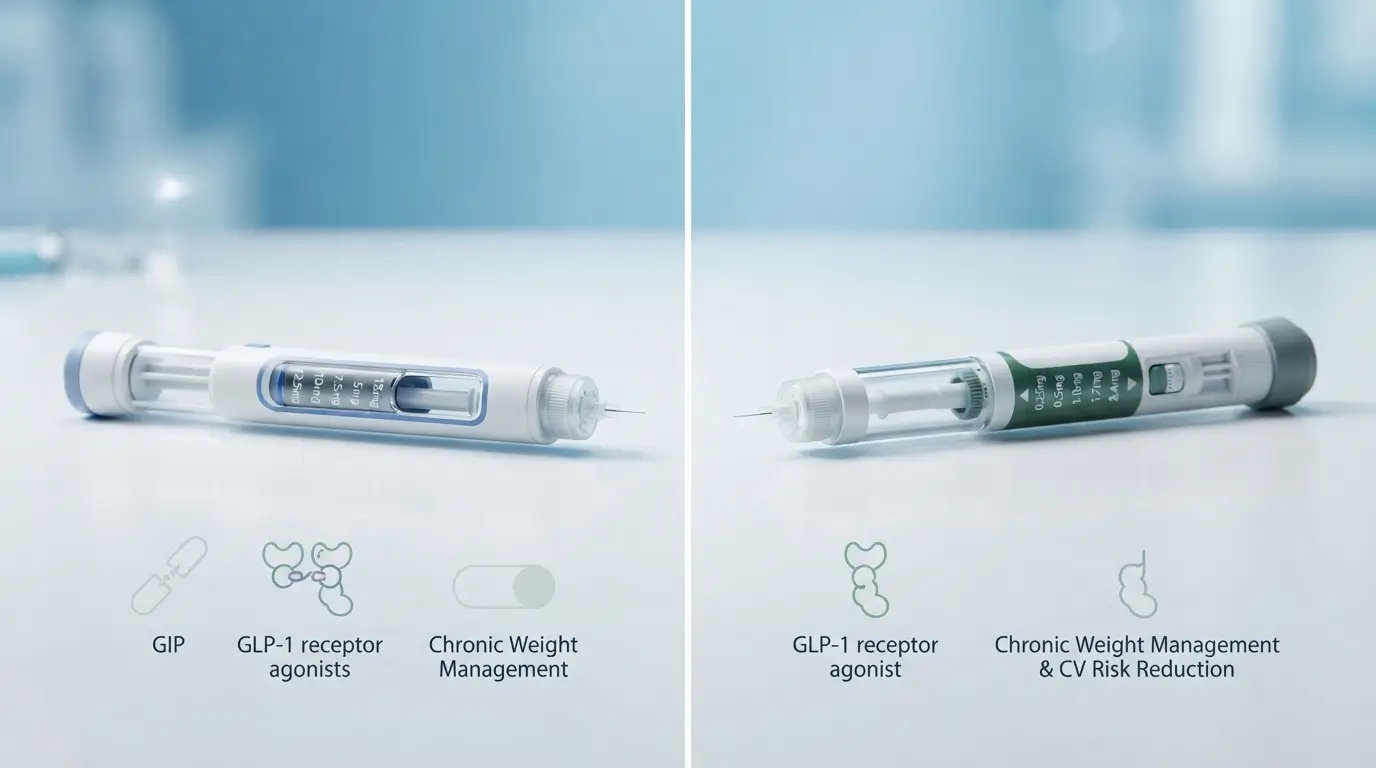
When two medicines are used for weight management, it is easy to assume they work in exactly the same way. Zepbound and Wegovy are both prescription medicines used for chronic weight management, but they contain different active ingredients and act on different hormone pathways.
That is why people often search for the difference between Zepbound and Wegovy. They want to know how the medicines differ, what conditions they are approved for, how they are taken, and what side effects and warnings matter.
The difference between Zepbound and Wegovy is not simply a matter of brand name. Zepbound contains tirzepatide, which activates both GIP and GLP-1 receptors. Wegovy contains semaglutide, a GLP-1 receptor agonist. Their approved uses also differ in important ways.
The difference between Zepbound and Wegovy can also change as regulatory approvals are updated. In 2026, for example, Wegovy has additional approved forms and indications, while Zepbound has an approved indication for moderate-to-severe obstructive sleep apnea in adults with obesity.
This guide explains the differences in simple language without treating one medicine as automatically right for everyone.
Quick Answer
The main difference between Zepbound and Wegovy is their active ingredients and how they work.
- Zepbound contains tirzepatide.
- Wegovy contains semaglutide.
- Zepbound activates GIP and GLP-1 receptors.
- Wegovy activates the GLP-1 receptor.
- Both are used with a reduced-calorie diet and increased physical activity for approved weight-management uses.
- Zepbound is also FDA-approved for moderate-to-severe obstructive sleep apnea in adults with obesity.
- Wegovy has an FDA-approved indication to reduce the risk of major cardiovascular events in certain adults with cardiovascular disease and obesity.
Both medicines are prescription treatments. They are not interchangeable simply because both can be used for weight management.
The FDA-approved prescribing information should be used for the most current dosing, contraindications, warnings, and approved uses.
Quick comparison
| Feature | Zepbound | Wegovy |
|---|---|---|
| Active ingredient | Tirzepatide | Semaglutide |
| Main drug class | GIP and GLP-1 receptor agonist | GLP-1 receptor agonist |
| Main weight-management use | Adults with obesity, or higher-weight person with a weight-related condition | Adults and certain adolescents with obesity; adults with over-weight plus a weight-related condition |
| Cardiovascular indication | Not the same approved indication as Wegovy | Reduces certain cardiovascular-event risks in eligible adults |
| Sleep apnea indication | Approved for moderate-to-severe OSA in adults with obesity | Not the same FDA-approved OSA indication |
| Brand company | Eli Lilly | Novo Nordisk |
| Common route | Injection | Injection; oral Wegovy is also now included in U.S. labeling |
| Key point | Dual GIP/GLP-1 action | GLP-1 action |
The Origin of Zepbound and Wegovy
Unlike ordinary vocabulary words, Zepbound and Wegovy are pharmaceutical brand names. Their names should not be treated like words such as emigrate or immigrate, which have well-established historical roots.
The FDA prescribing information identifies the active ingredients rather than giving a linguistic history for the brand names. Therefore, it is safer not to invent an etymology for either trade name.
Zepbound
Zepbound is a brand name for tirzepatide. The FDA approved Zepbound for chronic weight management in adults with obesity and at least one weight-related condition in November 2023.
The FDA later approved Zepbound for moderate-to-severe obstructive sleep apnea in adults with obesity in December 2024.
The active ingredient, tirzepatide, is the drug substance responsible for its pharmacological action.
Wegovy
Wegovy is a brand name for semaglutide. The FDA approved Wegovy for chronic weight management before Zepbound and later expanded its approved uses.
Wegovy is a GLP-1 receptor agonist. Current FDA labeling includes weight-management indications and an indication to reduce major cardiovascular events in certain adults with established cardiovascular disease and obesity.
As of 2026, FDA labeling also includes Wegovy injection and oral Wegovy tablets. A higher-dose Wegovy injection, called Wegovy HD, was approved in March 2026 for certain adults for weight loss and long-term weight maintenance.
Because these are brand names, there is no genuine British-versus-American spelling issue to solve. The brand names remain Zepbound and Wegovy.
How Zepbound and Wegovy Work
The medicines are related but not identical.
How Zepbound works
Zepbound contains tirzepatide. Tirzepatide activates receptors for two hormones:
- GIP
- GLP-1
These hormones are involved in appetite, food intake, and metabolic processes. The FDA explains that Zepbound activates GIP and GLP-1 receptors, which can reduce appetite and food intake.
This dual-receptor action is one of the most important scientific differences between the two medicines.
How Wegovy works
Wegovy contains semaglutide, which is a GLP-1 receptor agonist.
GLP-1 is a naturally occurring hormone involved in appetite and blood-glucose regulation. Wegovy’s action can reduce appetite and food intake and supports weight reduction when used with diet and physical activity.
So the simple distinction is:
Zepbound → GIP + GLP-1
Wegovy → GLP-1
This does not mean that the medicines have identical effects or that one is automatically better for a particular person. Individual treatment decisions depend on medical history, approved indications, risks, other medicines, and clinician guidance.
Zepbound vs Wegovy: Approved Uses
Both medicines have weight-management uses, but their FDA-approved indications are not identical.
Zepbound
Zepbound is approved, with diet and physical activity, for chronic weight management in:
- Adults with obesity.
- Higher-weight person who have at least one weight-related condition.
The FDA also approved Zepbound for moderate-to-severe obstructive sleep apnea in adults with obesity.
Wegovy
Current FDA labeling includes Wegovy for long-term weight reduction and maintenance in:
- Adults with obesity.
- Higher-weight person and at least one weight-related condition.
- Pediatric patients aged 12 and older with obesity.
Wegovy also has an approved cardiovascular indication for certain adults with established cardiovascular disease and obesity.
The exact eligibility requirements matter. A medicine being approved for a condition does not mean every person with that condition should take it.
Zepbound vs Wegovy: Side Effects and Safety
Both medicines can cause gastrointestinal side effects.
Commonly reported effects include:
- Nausea
- Diarrhea
- Vomiting
- Constipation
- Abdominal discomfort or pain
The exact side-effect profile differs between medicines and can also vary from person to person.
Both Zepbound and Wegovy carry a boxed warning about the risk of thyroid C-cell tumors seen in animal studies. Their labels state that the human relevance of this finding is unknown. Both are contraindicated in people with a personal or family history of medullary thyroid carcinoma or with multiple endocrine neoplasia syndrome type 2.
Their prescribing information also contains warnings involving issues such as pancreatitis, gallbladder disease, kidney injury, hypoglycemia in certain circumstances, and serious gastrointestinal reactions.
The FDA also updated its position on suicidal thoughts and behavior in January 2026. After reviewing available evidence, the agency requested removal of this warning from labeling for several GLP-1-related medicines, including Wegovy and Zepbound, because its review did not identify an increased risk.
Safety information can change as regulators review new evidence, so current prescribing information matters.
Zepbound vs Wegovy: Dosing and Administration
Both medicines have traditionally been associated with once-weekly injections, but their dosing schedules are not identical.
Zepbound’s FDA labeling uses a gradual dose-escalation process. The 2023 FDA approval described weekly administration with increases over several weeks before reaching maintenance doses.
Wegovy injection also uses gradual dose escalation to help patients adjust to treatment. Current labeling includes both injectable and oral Wegovy products, so the exact schedule depends on the formulation prescribed.
Because doses and formulations can change with updated approvals, it is not useful to treat one fixed schedule as universal.
Do not compare milligram amounts directly. A milligram of tirzepatide is not equivalent to a milligram of semaglutide.
Zepbound vs Wegovy: Weight Loss Results
People often search for which medicine produces more weight loss. Clinical trials have reported substantial weight reduction with both medicines, but trial populations, study designs, doses, treatment duration, and comparison groups can differ.
A direct clinical trial comparing tirzepatide and semaglutide in adults with obesity without diabetes found greater average weight reduction with tirzepatide over the study period. However, one study does not establish that every individual will have the same response. Treatment choice should also consider approved indications, tolerability, contraindications, and other health factors.
For that reason, it is better to avoid a simple statement such as “one always works better.”
The more useful question is:
Which treatment fits the person’s medical needs, risks, goals, and approved treatment options?
That decision belongs with a qualified healthcare professional.
Cardiovascular and Sleep Apnea Differences
This is an important area where the approved indications differ.
Wegovy and cardiovascular risk
The FDA approved Wegovy to reduce the risk of cardiovascular death, heart attack, and stroke in adults with established cardiovascular disease and either obesity.
This is a specific approved indication, not a general claim that Wegovy prevents heart disease in everyone who takes it.
Zepbound and obstructive sleep apnea
The FDA approved Zepbound for moderate-to-severe obstructive sleep apnea in adults with obesity. In the trials supporting that approval, Zepbound reduced apnea-hypopnea events and body weight compared with placebo.
These different indications can be important when a healthcare professional is considering treatment for a person with more than one health condition.
British English vs American English Spelling
There is no meaningful British-versus-American spelling difference for Zepbound or Wegovy.
These are pharmaceutical brand names, so you should not change their spelling based on the English variety you use.
| Term | British English | American English |
|---|---|---|
| Zepbound | Zepbound | Zepbound |
| Wegovy | Wegovy | Wegovy |
| tirzepatide | tirzepatide | tirzepatide |
| semaglutide | semaglutide | semaglutide |
| GLP-1 | GLP-1 | GLP-1 |
Other medical words in the surrounding text may have regional differences, such as tumor/tumour, but that does not change the spelling of the drug names.
Which Spelling Should You Use?
Use Zepbound and Wegovy exactly as written in both British and American English.
For medical articles, essays, emails, and patient information, capitalization also matters:
Zepbound contains tirzepatide.
Wegovy contains semaglutide.
Avoid changing the brand names to forms such as “zepbound” or “wegovy” in formal writing.
When discussing the active ingredients, use the generic names:
tirzepatide
semaglutide
This makes it clear whether you are discussing the brand or the active drug.
Common Mistakes With the Difference Between Zepbound and Wegovy
Mistake 1: Saying they contain the same medicine
They do not.
Zepbound → tirzepatide
Wegovy → semaglutide
Mistake 2: Calling both drugs GLP-1 medicines without qualification
Wegovy is a GLP-1 receptor agonist. Tirzepatide in Zepbound activates both GIP and GLP-1 receptors.
Calling both “GLP-1 drugs” in casual conversation may be understandable, but it leaves out an important pharmacological difference.
Mistake 3: Assuming their doses are interchangeable
They are not.
A 10-mg dose of one medicine cannot be treated as equivalent to a 10-mg dose of the other.
Mistake 4: Assuming FDA approvals are identical
They are not. Zepbound has an FDA-approved OSA indication for adults with obesity, while Wegovy has a specific cardiovascular-risk reduction indication for eligible adults with established cardiovascular disease and obesity.
Mistake 5: Treating brand names as generic names
Zepbound and Wegovy are brand names.
Their active ingredients are tirzepatide and semaglutide.
Mistake 6: Assuming one medicine is suitable for everyone
Weight-management medicines have contraindications, warnings, interactions, and eligibility requirements.
A comparison article can explain the differences, but it cannot determine which medicine is appropriate for an individual.
Difference Between Zepbound and Wegovy in Everyday Examples
These medicines appear in many types of writing, so knowing the correct terms helps.
In an email
My doctor and I discussed the differences between Zepbound and Wegovy before deciding what treatment options to consider.
In a news article
The FDA has approved different indications for Zepbound and Wegovy, including an obstructive sleep apnea indication for Zepbound and a cardiovascular-risk reduction indication for Wegovy.
On social media
Zepbound and Wegovy are not the same drug. Zepbound contains tirzepatide, while Wegovy contains semaglutide.
In formal writing
Zepbound contains tirzepatide, a GIP and GLP-1 receptor agonist, whereas Wegovy contains semaglutide, a GLP-1 receptor agonist.
This wording is more precise than simply calling both medicines “weight-loss injections.”
Zepbound vs Wegovy: Side-by-Side Comparison
| Category | Zepbound | Wegovy |
|---|---|---|
| Brand | Zepbound | Wegovy |
| Active ingredient | Tirzepatide | Semaglutide |
| Main receptor action | GIP + GLP-1 | GLP-1 |
| Manufacturer | Eli Lilly | Novo Nordisk |
| Weight-management use | Adults with obesity or qualifying higher-weight person | Adults with obesity or qualifying higher-weight person; certain adolescents with obesity |
| OSA indication | Yes, in adults with obesity and moderate-to-severe OSA | No equivalent FDA-approved OSA indication |
| Cardiovascular-risk indication | No equivalent Wegovy cardiovascular indication | Yes, for certain adults with established cardiovascular disease and higher-weight person/obesity |
| Administration | Injection | Injection; oral formulation also included in current U.S. labeling |
| Boxed warning | Thyroid C-cell tumors | Thyroid C-cell tumors |
| Common GI effects | Nausea, diarrhea, vomiting, constipation, abdominal symptoms | Nausea, diarrhea, vomiting, constipation, abdominal symptoms |
| Drug class | GIP/GLP-1 receptor agonist | GLP-1 receptor agonist |
FAQs
1. What is the main difference between Zepbound and Wegovy?
Zepbound contains tirzepatide and activates GIP and GLP-1 receptors. Wegovy contains semaglutide and activates the GLP-1 receptor. Their approved uses also differ.
2. Are Zepbound and Wegovy the same drug?
No. They are different prescription medicines with different active ingredients. Both are used for certain weight-management purposes.
3. Is Zepbound a GLP-1 drug?
Zepbound contains tirzepatide, which activates both GIP and GLP-1 receptors. It is therefore more precise to describe it as a GIP/GLP-1 receptor agonist.
4. Does Wegovy have uses beyond weight management?
Yes. FDA labeling includes an indication to reduce major cardiovascular events in certain adults with established cardiovascular disease and higher-weight person or obesity.
5. Is Zepbound approved for sleep apnea?
Yes. The FDA approved Zepbound for moderate-to-severe obstructive sleep apnea in adults with obesity.
6. Can someone take Zepbound and Wegovy together?
They should not be combined unless specifically directed within an appropriate medical context. The FDA labeling for Zepbound does not recommend coadministration with other GLP-1 receptor agonists, and Wegovy’s labeling likewise states that it should not be combined with other semaglutide-containing products or other GLP-1 receptor agonists.
7. Which one should a person choose?
There is no single answer for everyone. The appropriate choice depends on the person’s medical history, current conditions, other medicines, treatment goals, contraindications, and the approved indication being considered. A healthcare professional can assess these factors.
Conclusion
The difference between Zepbound and Wegovy starts with their active ingredients: Zepbound uses tirzepatide, while Wegovy uses semaglutide. Their hormone targets are also different.
Both medicines can play a role in chronic weight management, but their FDA-approved uses are not identical. Zepbound also has an approved OSA indication, while Wegovy has a cardiovascular-risk indication for eligible adults.
The safest way to compare these medicines is to look beyond weight-loss claims and consider approved uses, safety information, medical history, and current prescribing guidance before making decisions.
Keep these names clear in your emails, essays, and daily conversations, and use current medical sources when discussing treatment options with a healthcare professional.

Aamer Shahzad is the founder of Diffnexx.com, a fast-growing educational platform focused on high-intent “difference between” topics. With over 8 years of experience in English language education and analytical writing, I specialize in breaking down complex “difference between” topics into clear, structured, and easy-to-understand explanations. Diffnexx.com is your go-to resource for enhancing English skills and writing with confidence.
I specializes in building search-optimized, research-driven comparison content designed for clarity, authority, and long-term digital asset value.







