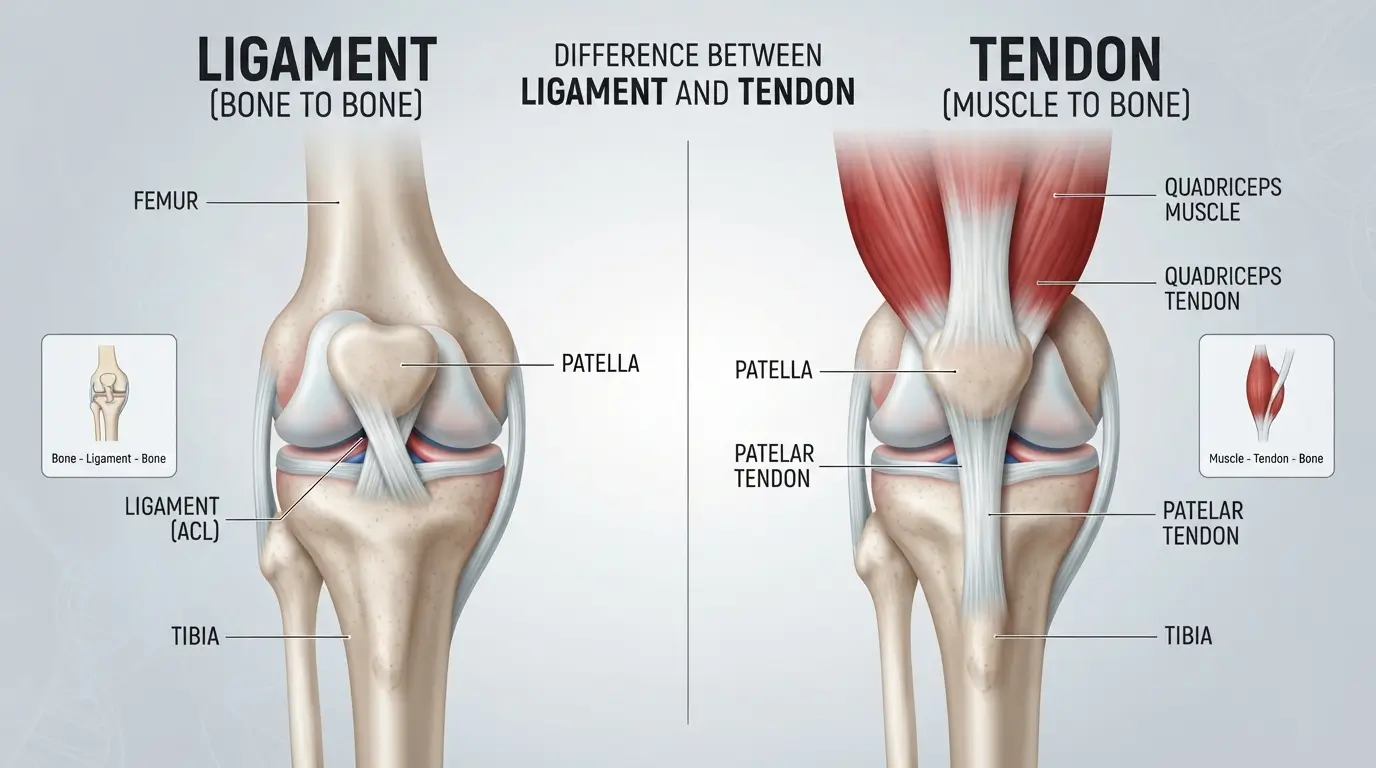
A sudden twist, a sports injury, or even a basic anatomy lesson can lead to the same question: what is the difference between ligament and tendon? These two connective tissues are often mentioned together because both help support and move the body. Yet they do different jobs.
The difference between ligament and tendon is easiest to understand by looking at what each tissue connects. A ligament connects one bone to another bone. A tendon connects a muscle to a bone.
People often search for the difference between ligament and tendon after hearing terms such as ACL tear, sprain, Achilles tendon injury, or tendonitis. The names can sound technical, but the basic idea is simple.
Understanding the difference between ligament and tendon can also help you understand medical articles, sports reports, anatomy lessons, and conversations with health professionals. This guide explains their functions, locations, injuries, pronunciation, word origins, spelling, and everyday use in clear English.
Quick Answer
The simplest answer is:
A ligament connects bone to bone. A tendon connects muscle to bone.
Both are strong connective tissues, but they serve different roles.
A ligament helps hold bones together and stabilize a joint. For example, the anterior cruciate ligament (ACL) connects bones within the knee and helps control the movement of the joint.
A tendon connects a muscle to a bone. When a muscle contracts, the tendon transfers that force to the bone, helping produce movement.
A quick memory trick is:
Ligament = bone to bone
Tendon = muscle to bone
| Feature | Ligament | Tendon |
|---|---|---|
| Connects | Bone to bone | Muscle to bone |
| Main role | Stability and joint support | Transfers muscle force |
| Example | ACL | Achilles tendon |
| Common injury term | Sprain | Strain or tendon injury |
| Tissue type | Fibrous connective tissue | Fibrous connective tissue |
This basic distinction explains most of the confusion between the two.
The Origin of “Ligament” and “Tendon”
The words ligament and tendon have different linguistic histories.
Origin of ligament
The English word ligament dates to the late 14th century. It came from Latin ligamentum, meaning a band, tie, or something used for binding. It is related to Latin ligare, meaning “to bind” or “to tie.”
The history fits the modern anatomical meaning well because ligaments help bind bones together around joints.
The word is also related to English terms such as ligature and ligation, which carry the general idea of tying or binding.
Origin of tendon
Tendon entered English in the late Middle English period. Its history goes through French or Medieval Latin and ultimately connects with Greek tenōn, meaning a tendon or sinew. The Greek term is related to a verb meaning “to stretch.”
This history is also meaningful because tendons are strong structures that transmit force between muscles and bones.
The two words therefore have different roots:
- Ligament → Latin roots connected with binding
- Tendon → Greek and Latin history connected with a tendon or something stretched
There is no spelling difference caused by British and American English. The different spellings are simply part of the established English forms of these anatomical terms.
What Is a Ligament?
A ligament is a band of fibrous connective tissue that connects bones to other bones. Its main job is to help stabilize joints and limit excessive or unwanted movement.
Ligaments are found throughout the body.
Some important examples include:
- ACL in the knee
- PCL in the knee
- MCL in the knee
- LCL in the knee
- Ankle ligaments
- Wrist ligaments
- Foot ligaments
The knee provides a clear example. Its four primary ligaments help keep the femur, tibia, and other structures properly aligned while controlling movement.
Ligaments contain large amounts of collagen along with elastic fibers. Their strength allows them to resist forces while still providing some flexibility.
What does a ligament do?
A ligament can:
- Connect bones
- Stabilize a joint
- Limit excessive movement
- Help guide joint motion
- Help keep bones properly aligned
For example, knee ligaments help prevent excessive forward, backward, or side-to-side movement.
What Is a Tendon?
A tendon is a strong connective tissue structure that connects a muscle to a bone. Its key job is to transfer the force created when a muscle contracts.
You have tendons throughout your body.
Examples include:
- Achilles tendon
- Quadriceps tendon
- Patellar tendon
- Flexor tendons in the hand
- Tendons around the shoulder
- Tendons around the elbow
The Achilles tendon is one of the best-known examples. It connects muscles in the lower leg to the heel area and helps transmit muscular force during activities such as walking and running.
What does a tendon do?
A tendon can:
- Connect muscle to bone
- Transfer muscular force
- Help move a joint
- Contribute to joint stability
When a muscle contracts, it does not pull directly on a bone by itself. The tendon transfers that force to the bone, allowing movement to occur.
Main Difference in Function
The most important functional difference is stability versus movement.
Ligaments mainly help stabilize and guide joints.
Tendons mainly help transfer force from muscles to bones.
That does not mean ligaments play no role in movement or tendons play no role in stability. Both contribute to the normal function of joints.
A simple example is the knee.
The knee’s ligaments help keep the bones aligned and control unwanted motion. Its tendons connect muscles to bones and help those muscles move the leg.
Think of the two tissues as different parts of a mechanical system:
Ligament → keeps the joint controlled
Tendon → carries muscle force to the bone
Ligament vs Tendon Injuries
The terminology used for injuries can also help you remember the difference.
Ligament injuries
An injury to a ligament is commonly called a sprain.
A sprain occurs when a ligament is stretched too far or torn. This often happens after a sudden twist, fall, collision, or awkward joint movement.
For example:
She suffered an ankle sprain.
An ankle sprain usually involves one or more ligaments around the ankle.
Knee ligament injuries can also occur during sports involving sudden changes in direction, twisting, or direct impact.
Tendon injuries
Tendons can also be overstretched, irritated, inflamed, or torn.
A common term is tendinitis, which refers to inflammation of a tendon. Other tendon problems can involve degeneration or tearing.
For example:
The runner developed an Achilles tendon injury.
Because tendon injuries involve the structures that connect muscles and bones, they can affect the way force is transferred during movement.
Easy memory rule
Sprain → think ligament
Tendon injury → think tendon
However, injury terminology can be more detailed in medical settings, so a specific diagnosis should come from a qualified healthcare professional.
Where Are Ligaments and Tendons Found?
Both structures are found around joints, which is one reason people confuse them.
Ligaments
Ligaments are especially important around joints because they connect bones and help control their movement.
Common locations include:
- Knees
- Ankles
- Wrists
- Fingers
- Shoulders
- Feet
For example, ankle ligaments connect bones of the foot with bones of the lower leg and help prevent excessive twisting or collapse of the joint.
Tendons
Tendons are also common around joints because muscles need to transmit force to bones.
They can be found in:
- Shoulders
- Elbows
- Wrists
- Hands
- Hips
- Knees
- Ankles
- Feet
This means location alone does not always tell you whether a structure is a ligament or tendon.
The key question is:
What does it connect?
British English vs American English Spelling
There is no meaningful British-American spelling difference between ligament and tendon.
Both British English and American English normally use:
- ligament
- tendon
- ligaments
- tendons
The same applies to common anatomical terms such as Achilles tendon, anterior cruciate ligament, and medial collateral ligament.
| Term | British English | American English | Difference |
|---|---|---|---|
| Ligament | ligament | ligament | None |
| Tendon | tendon | tendon | None |
| Ligaments | ligaments | ligaments | None |
| Tendons | tendons | tendons | None |
| Achilles tendon | Achilles tendon | Achilles tendon | None |
| ACL | ACL | ACL | None |
Therefore, you do not need to change either spelling for a US, UK, Commonwealth, or global audience.
Some medical words do have regional spelling differences, but ligament and tendon are not examples of that pattern.
Which Spelling Should You Use?
Use ligament and tendon in all standard English varieties.
For an American audience:
The athlete injured a knee ligament.
For a British audience:
The athlete injured a knee ligament.
The spelling remains exactly the same.
In academic, medical, or educational writing, capitalization also matters. General terms such as ligament and tendon are normally lowercase.
Specific names may include capital letters in abbreviations:
- ACL
- PCL
- MCL
- LCL
When writing for a general audience, it is helpful to give the full term first:
anterior cruciate ligament (ACL)
You can then use ACL afterward.
Pronunciation of Ligament and Tendon
The two words do not sound alike.
Ligament
Ligament is commonly pronounced:
LIG-uh-ment
In many varieties of English, the word has three syllables.
The g has the sound heard in give, not the soft sound in giant.
Tendon
Tendon is pronounced:
TEN-dun
It normally has two syllables.
The first syllable sounds like ten.
| Word | Simple pronunciation | Syllables |
|---|---|---|
| Ligament | LIG-uh-ment | 3 |
| Tendon | TEN-dun | 2 |
Neither term has a major British-American pronunciation difference that changes its meaning.
Parts of Speech: Ligament and Tendon
Both ligament and tendon are nouns.
They name anatomical structures.
Examples:
The ligament supports the joint.
The tendon connects the muscle to the bone.
Their plural forms are:
- ligament → ligaments
- tendon → tendons
You can also use them as nouns in compound medical terms:
- ligament injury
- ligament tear
- tendon injury
- tendon repair
- tendon inflammation
Related adjectives include:
- ligamentous
- tendinous
For everyday writing, however, the basic nouns ligament and tendon are much more common.
Common Mistakes with Ligament and Tendon
Mistake 1: Saying a ligament connects muscle to bone
This is the most common basic error.
Incorrect:
A ligament connects muscle to bone.
Better:
A tendon connects muscle to bone.
A ligament generally connects bone to bone.
Mistake 2: Saying tendons connect bone to bone
Incorrect:
Tendons connect the bones of the knee.
Better:
Ligaments connect bones and help stabilize the knee.
Tendons connect muscles to bones and transfer muscular force.
Mistake 3: Calling every soft-tissue injury a sprain
A sprain specifically involves a ligament.
A tendon problem should be described using the appropriate tendon-related term.
MedlinePlus defines a sprain as an injury to the ligaments around a joint.
Mistake 4: Assuming ligaments only exist in the knee
Ligaments occur throughout the body.
They are found in the ankle, foot, wrist, shoulder, and other areas as well.
Mistake 5: Assuming tendons only help movement
Movement is their main mechanical role, but tendons can also contribute to joint stability.
AAOS notes that tendons both allow joint movement and provide stability.
Mistake 6: Using “ligament” and “tendon” as synonyms
They are related connective tissues, but they are not interchangeable terms.
The structure they connect is the clearest distinction.
Ligament and Tendon in Everyday Examples
These words appear in many types of English.
In an email
Hi Daniel,
My doctor thinks I may have strained a tendon, so I am taking a break from training this week.
In news writing
The athlete suffered a ligament injury during the match and left the field for further assessment.
On social media
I finally understand the difference between a tendon and a ligament!
In formal writing
Ligaments connect bones and contribute to joint stability, whereas tendons connect muscles to bones and transfer muscular force.
In a classroom
Remember the simple rule: ligaments connect bone to bone, while tendons connect muscle to bone.
For everyday conversation
“What did you injure?”
“The doctor said it was a tendon problem, not a ligament injury.”
These examples show how the terms work as ordinary nouns in both casual and formal English.
Ligament vs Tendon: Side-by-Side Comparison
| Category | Ligament | Tendon |
|---|---|---|
| Basic definition | Fibrous connective tissue connecting bones | Fibrous connective tissue connecting muscle to bone |
| Main connection | Bone → bone | Muscle → bone |
| Main role | Joint stability and controlled movement | Transfer of muscle force |
| Common location | Around joints | Between muscles and bones |
| Example | ACL | Achilles tendon |
| Common injury | Sprain or ligament tear | Tendon injury or tendinitis |
| Main structural proteins | Collagen and elastic fibers | Primarily collagen-rich connective tissue |
| Part of speech | Noun | Noun |
| Plural | Ligaments | Tendons |
| Pronunciation | LIG-uh-ment | TEN-dun |
| British spelling | Ligament | Tendon |
| American spelling | Ligament | Tendon |
The quickest way to remember the whole comparison is:
Ligaments link bones. Tendons transfer muscle force to bones.
FAQs
1. What is the main difference between a ligament and a tendon?
A ligament connects bone to bone and helps stabilize a joint. A tendon connects muscle to bone and transfers force from the muscle to the bone.
2. Is an ACL a ligament or tendon?
The ACL, or anterior cruciate ligament, is a ligament. It connects the femur and tibia and helps stabilize the knee.
3. Is the Achilles a ligament or tendon?
The Achilles is a tendon. It connects muscles in the lower leg to the heel region and helps transfer force for movement.
4. Is a sprain a ligament injury?
Yes. A sprain is an injury in which a ligament is stretched too far or torn.
5. Which is stronger, a ligament or a tendon?
It is not useful to treat one as simply “stronger.” Their structures and mechanical roles differ, and strength varies by location and tissue. Tendons are designed to transmit muscle force, while ligaments are designed to stabilize joints.
6. Can a tendon and ligament be injured at the same time?
Yes. A single accident or sports injury can damage several structures around a joint, including ligaments, tendons, cartilage, or bone. The exact injury depends on the force and location.
7. How can I remember the difference between ligament and tendon?
Use this simple memory aid:
Ligament = bone to bone.
Tendon = muscle to bone.
Think L for ligament and link between bones, while a tendon helps transfer muscle force to bone.
Conclusion
The difference between ligament and tendon becomes simple once you remember what each structure connects. Ligaments join bones, while tendons connect muscles to bones.
Ligaments mainly help keep joints stable and control unwanted movement. Tendons transfer force from contracting muscles to bones, helping your body move.
The words also differ in common injury terms. Ligament injuries are often called sprains, while tendon problems include injuries such as tendinitis or tears.
Keep practicing these terms in emails, essays, and daily conversations. Clear anatomy vocabulary makes health and science writing easier to understand.

Anton Reyes is a contributing writer at DiffNexx.com, where he explores meaningful differences in language, culture, and everyday concepts. With a background in creative nonfiction, Anton brings clarity and balance to complex comparisons. His writing helps readers understand subtle distinctions in words and ideas, making learning both insightful and engaging.







