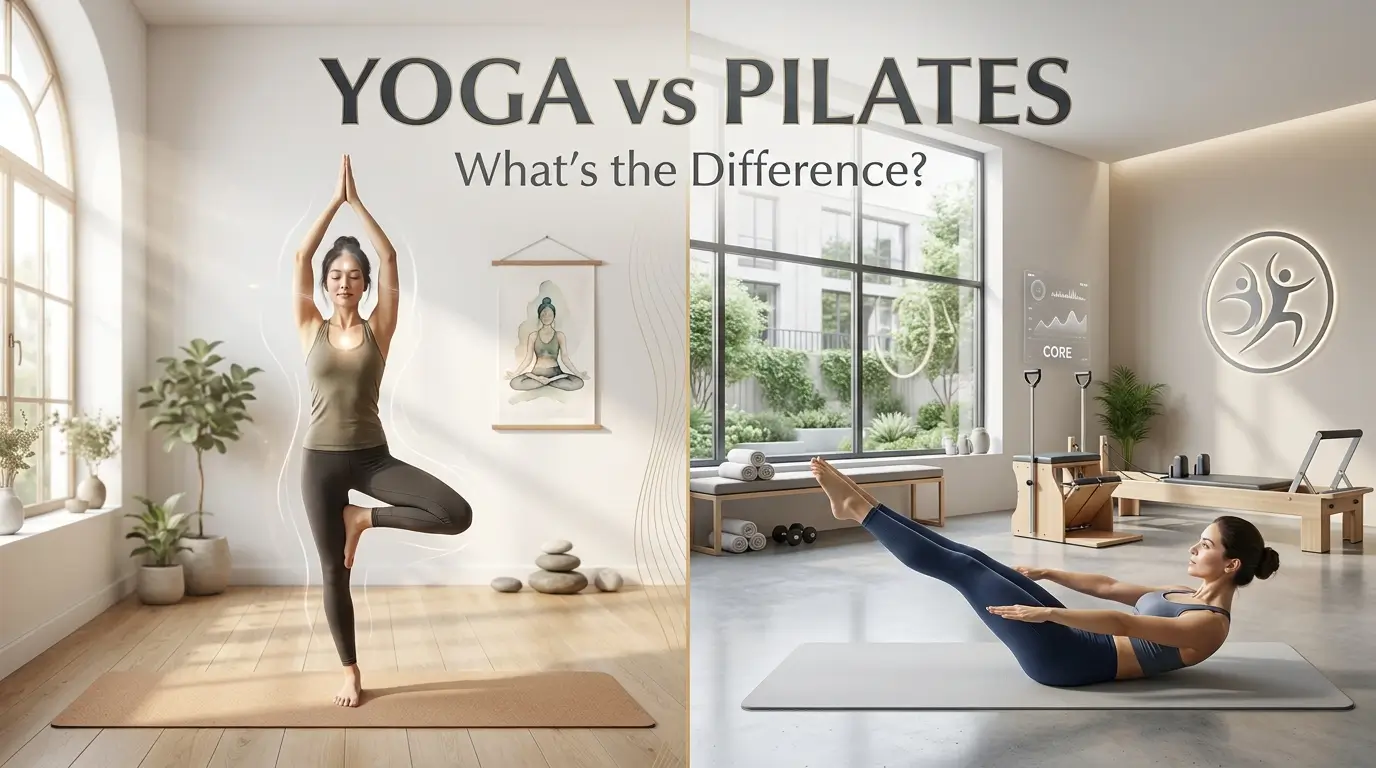
Yoga and Pilates can look similar at first. Both use controlled movements, breathing, balance, flexibility, and focused body awareness. Both can be practiced on a mat, and both are often linked with better strength and overall wellness. So, what is the real difference between yoga and pilates?
People often search for the difference between yoga and pilates because they want to choose the right activity for their goals. Some want more flexibility. Others want stronger core muscles, better balance, less stress, or a gentle way to stay active. The difference between yoga and pilates also matters because the two practices have very different histories and underlying ideas.
In simple terms, yoga is an ancient practice rooted in Indian philosophy and traditionally includes physical postures, breathing, and meditation. Pilates is a modern exercise system developed by Joseph Pilates and originally known as Contrology.
Understanding the difference between yoga and pilates can help you choose a practice that fits your needs, preferences, and fitness level without relying on myths or outdated advice.
Quick Answer
The main difference between yoga and pilates is their origin, purpose, movement style, and traditional approach.
Yoga is an ancient mind-body practice with roots in Indian philosophy. Modern yoga classes may focus heavily on physical postures, breathing, relaxation, and meditation. There are many styles, from gentle practices to physically demanding ones.
Pilates is a modern exercise system developed by Joseph Pilates. His method emphasized controlled movement, body awareness, strength, breathing, and physical control. The method was originally called Contrology.
| Feature | Yoga | Pilates |
|---|---|---|
| Origin | Ancient India | Developed by Joseph Pilates |
| Main roots | Indian philosophy and mind-body practice | Modern physical training system |
| Common focus | Flexibility, balance, breathing, awareness | Core strength, control, alignment, stability |
| Meditation | Common in many styles | Not a defining feature |
| Breathing | Important | Important |
| Equipment | Usually a mat; props may be used | Mat or specialized equipment |
| Movement | Wide range of poses and flows | Controlled, structured exercises |
| Variety | Many traditional and modern styles | Classical and contemporary approaches |
| Spiritual element | Present in some traditions and styles | Not central to the method |
Neither practice is simply “better.” The better choice depends on what you want from your movement routine.
The Origin of Yoga and Pilates
Yoga and Pilates come from very different historical backgrounds.
Where Did Yoga Come From?
Yoga is an ancient and complex practice rooted in Indian philosophy. It began as a spiritual practice and developed over a long period into different traditions and approaches. Modern yoga can include physical postures, breathing techniques, and meditation.
The word yoga comes from Sanskrit and is associated with the idea of joining, yoking, or union. The English word entered the language through the history of Sanskrit and related traditions.
It is important not to reduce yoga to stretching. Traditional yoga includes much more than physical poses. Modern classes, however, can vary greatly. Some focus mostly on physical movement, while others place greater emphasis on meditation, breathing, or spiritual practice.
Where Did Pilates Come From?
Pilates has a much more recent and clearly documented origin.
Joseph Hubertus Pilates developed his exercise system during the early 20th century. He was born in Germany in 1883 and studied different forms of physical training. During World War I, he continued developing his exercise ideas while interned in England. He later moved to the United States and opened a studio in New York in 1926.
Joseph Pilates called his method Contrology. His system emphasized controlled movement and the relationship between physical movement and mental focus.
This history explains one of the biggest differences between the two practices: yoga developed over centuries from philosophical and spiritual traditions, while Pilates began as a modern physical training method created by one identifiable person.
How Are Yoga and Pilates Pronounced?
The words are pronounced differently.
Yoga is commonly pronounced with two syllables, with the first syllable receiving the main stress.
Pilates is commonly pronounced with three syllables, with the first syllable stressed.
The word Pilates comes from the surname of Joseph Pilates, so its pronunciation follows the established English pronunciation of his name.
Both yoga and Pilates are nouns when referring to the practices.
Examples:
- “I practice yoga every morning.”
- “She started Pilates last month.”
- “Yoga helps me relax.”
- “Pilates is part of my weekly exercise routine.”
Pilates is normally capitalized because it comes from a person’s surname. Yoga is normally written in lowercase unless it begins a sentence or appears in a title.
British English vs American English Spelling
There is no meaningful British-versus-American spelling difference between yoga and Pilates.
Both British and American English use:
- yoga
- Pilates
- yoga class
- Pilates class
- yoga practice
- Pilates exercises
| Term | American English | British English | Difference |
|---|---|---|---|
| yoga | yoga | yoga | None |
| Pilates | Pilates | Pilates | None |
| yoga class | yoga class | yoga class | None |
| Pilates class | Pilates class | Pilates class | None |
| yoga mat | yoga mat | yoga mat | None |
| Pilates instructor | Pilates instructor | Pilates instructor | None |
There can be differences in broader fitness vocabulary between countries, but those differences do not change the spelling of these two practice names.
So, if you are writing for a global audience, you do not need to choose between an American and British spelling of yoga or Pilates.
What Is the Main Difference Between Yoga and Pilates?
The two practices overlap, but their traditional foundations and common class styles differ.
1. Yoga Has a Longer Historical Tradition
Yoga has ancient roots and includes philosophical, spiritual, physical, and meditative elements. Modern yoga classes may use only some of these elements.
Pilates was created in the 20th century as a structured exercise method.
This does not mean that every yoga class is spiritual or every Pilates class is purely physical. Modern instruction varies widely.
2. Pilates Places Strong Emphasis on Controlled Movement
Pilates is strongly associated with controlled, deliberate movement and body awareness. Modern Pilates descriptions commonly emphasize strength, core stability, balance, flexibility, alignment, and mental focus.
The goal is not simply to perform many repetitions. Attention to movement quality is a major part of the method.
3. Yoga Often Includes Meditation and Breathwork
Breathing techniques and meditation can be important parts of yoga. NCCIH describes modern yoga as commonly involving physical postures, breathing techniques, and meditation, although styles vary.
Pilates also uses breathing, but meditation is not a defining part of the Pilates method.
4. Pilates Often Focuses More Directly on Core Control
Many Pilates exercises require sustained control of the torso while the arms and legs move.
This can make Pilates appealing to people who want to work on trunk stability, posture, coordination, and controlled strength.
However, yoga can also build strength. Some yoga styles include demanding poses that challenge the arms, legs, abdomen, and back.
5. Yoga Has a Wider Range of Styles
Yoga includes many styles and traditions. Some are slow and restorative, while others are physically demanding.
NCCIH lists examples such as Hatha, Vinyasa, Ashtanga, Kundalini, Iyengar, Sivananda, and restorative yoga.
Pilates also has different approaches, including classical and contemporary forms, but its family of exercises comes from the system developed by Joseph Pilates.
6. Equipment Is Used Differently
Yoga can be practiced with little equipment. A mat is common, while blocks, straps, bolsters, blankets, and other props may be used depending on the style.
Pilates can also be practiced on a mat, but specialized equipment is an important part of many Pilates programs. Examples include the Reformer, Cadillac, Ladder Barrel, and other apparatus.
This means you can practice either activity at home, but equipment-based Pilates usually requires access to specialized equipment or a studio.
7. The Mental Experience Can Be Different
Yoga may place a stronger emphasis on mindfulness, breathing, relaxation, and meditation, depending on the class.
Pilates generally places mental attention on precise physical movement, control, alignment, and coordination.
Still, both can require strong concentration. The exact experience depends on the instructor and style.
Yoga vs Pilates for Flexibility
If flexibility is your main goal, yoga may be the more obvious choice because many yoga styles include sustained stretches and positions that challenge range of motion.
But Pilates can also improve flexibility while building strength and control.
The best choice depends on your starting point and how you practice. A gentle yoga class may feel very different from a challenging Pilates session, just as a dynamic yoga class can feel very different from restorative yoga.
Do not assume that one practice always produces better results. Consistent, appropriate movement matters more than choosing an activity based on a simple label.
Yoga vs Pilates for Core Strength
Pilates has a strong reputation for core-focused movement because many exercises require control of the abdomen, pelvis, spine, and surrounding muscles.
Yoga can also strengthen the core. Planks, balance poses, transitions, and other postures may challenge the trunk and supporting muscles.
If core strength is your main goal, Pilates may feel more directly focused on that area. If you want core work combined with stretching, balance, breathing, and other elements, yoga may offer a broader experience.
Yoga vs Pilates for Stress
Yoga has been studied for stress management and mental well-being. Research reviewed by NCCIH suggests yoga may help with stress and some aspects of mental and emotional well-being, although research results vary by condition and type of yoga.
Pilates can also feel calming because it requires concentration, controlled breathing, and deliberate movement. However, its primary identity is as an exercise system rather than a traditional meditation practice.
If relaxation is your main goal, look at the specific class rather than relying only on the word “yoga” or “Pilates.”
A gentle yoga class may be very relaxing, while a challenging Pilates workout may feel more like strength training.
Which Spelling Should You Use?
There is no spelling choice to make between British and American English.
Use:
Yoga
Pilates
For formal writing, keep Pilates capitalized because the name comes from Joseph Pilates.
Examples:
- “Yoga is part of my morning routine.”
- “Pilates can be practiced on a mat.”
- “She attends a Pilates class twice a week.”
- “He uses yoga breathing exercises to relax.”
Avoid unnecessary forms such as pilates in formal writing when referring to the named exercise system.
Common Mistakes with the Difference Between Yoga and Pilates
Mistake 1: Saying They Are the Same Exercise
Yoga and Pilates share some movements, but they are not the same practice.
Better: Explain that both involve controlled movement and body awareness but have different origins and methods.
Mistake 2: Calling Yoga Only Stretching
Yoga can include stretching, but it may also involve strength, balance, breathing, meditation, and other practices.
Better: Treat yoga as a broad group of practices rather than a simple stretching routine.
Mistake 3: Saying Pilates Is Only for the Core
The core is important in Pilates, but the method works with the body as a whole.
Better: Describe Pilates as a system involving controlled movement, strength, stability, flexibility, coordination, and body awareness.
Mistake 4: Assuming All Yoga Classes Are Spiritual
Yoga has philosophical and spiritual roots, but modern classes differ greatly.
Better: Consider the specific style and instructor.
Mistake 5: Assuming One Is Always Better
There is no universal winner.
Better: Choose according to your goals, preferences, fitness level, and any physical limitations.
Difference Between Yoga and Pilates in Everyday Examples
These terms appear naturally in many kinds of communication.
In an Email
I am thinking about joining a yoga or Pilates class. Which one would you recommend for a beginner?
This is a natural way to ask a trainer or fitness instructor for advice.
In Formal Writing
The difference between yoga and Pilates includes their historical origins, movement styles, and traditional approaches.
This works well in an educational article or essay.
In News or Health Writing
Yoga and Pilates are both popular forms of mind-body exercise, but their origins and methods are different.
The sentence avoids claiming that one practice is universally better.
On Social Media
Trying Pilates this week after months of yoga. The movements feel different, but both require focus!
This sounds natural in casual online writing.
In Daily Conversation
I like yoga because it helps me slow down, while Pilates gives me a stronger workout.
This expresses a personal preference without making a broad medical claim.
Comparison Table: Yoga vs Pilates
| Category | Yoga | Pilates |
|---|---|---|
| Historical origin | Ancient Indian tradition | Modern system developed by Joseph Pilates |
| Original character | Philosophical, spiritual, physical, and meditative | Physical training and movement system |
| Main modern elements | Poses, breathing, meditation, movement | Controlled exercises, breathing, alignment, strength |
| Core work | Present in many styles | Strong emphasis |
| Flexibility | Often a major focus | Developed alongside strength and control |
| Meditation | Common in some styles | Not central |
| Equipment | Usually limited or simple props | Mat and specialized apparatus |
| Class styles | Highly varied | Classical and contemporary approaches |
| Best known for | Flexibility, balance, mindfulness, mind-body practice | Core control, strength, stability, precise movement |
| Can beginners participate? | Yes, with an appropriate class | Yes, with an appropriate class |
FAQs
1. Is yoga better than Pilates?
Not necessarily. Yoga and Pilates have different approaches. Your better choice depends on your goals, preferred style, fitness level, and the type of class you enjoy.
2. Is Pilates better for the core?
Pilates places strong emphasis on controlled movement and core stability, so it may be especially appealing if core-focused training is important to you. Yoga can also strengthen the core.
3. Can yoga and Pilates improve flexibility?
Both can support flexibility. Yoga often places more direct emphasis on stretching and range of motion, while Pilates combines flexibility work with strength and movement control.
4. Can I do yoga and Pilates together?
Yes. They can complement each other. Someone might use yoga for mobility, balance, breathing, or relaxation and Pilates for controlled strength and stability.
5. Which is better for beginners?
Either can work for beginners. The most important factor is choosing an appropriately paced class and learning the movements correctly.
6. Does Pilates come from yoga?
Pilates and yoga have different historical origins. Pilates was developed by Joseph Pilates in the 20th century, while yoga has ancient roots in Indian philosophy.
7. Which is better for stress relief?
Yoga has more established research and traditional emphasis around breathing, meditation, and stress management. However, the experience depends greatly on the specific class and individual.
Conclusion
Yoga and Pilates may look similar on a mat, but their histories, goals, and methods are quite different. Knowing those differences makes your choice much easier.
Yoga comes from an ancient Indian tradition and can blend movement, breathing, meditation, and philosophy. Pilates began as a modern exercise system built around control.
Neither practice wins for everyone. The best choice depends on what you enjoy, what your body needs, and the kind of movement you can practice consistently.
Try an appropriate beginner session, notice how your body responds, and keep learning. Practice these words in emails, essays, and daily conversations as you build healthy habits.

Aamer Shahzad is the founder of Diffnexx.com, a fast-growing educational platform focused on high-intent “difference between” topics. With over 8 years of experience in English language education and analytical writing, I specialize in breaking down complex “difference between” topics into clear, structured, and easy-to-understand explanations. Diffnexx.com is your go-to resource for enhancing English skills and writing with confidence.
I specializes in building search-optimized, research-driven comparison content designed for clarity, authority, and long-term digital asset value.







