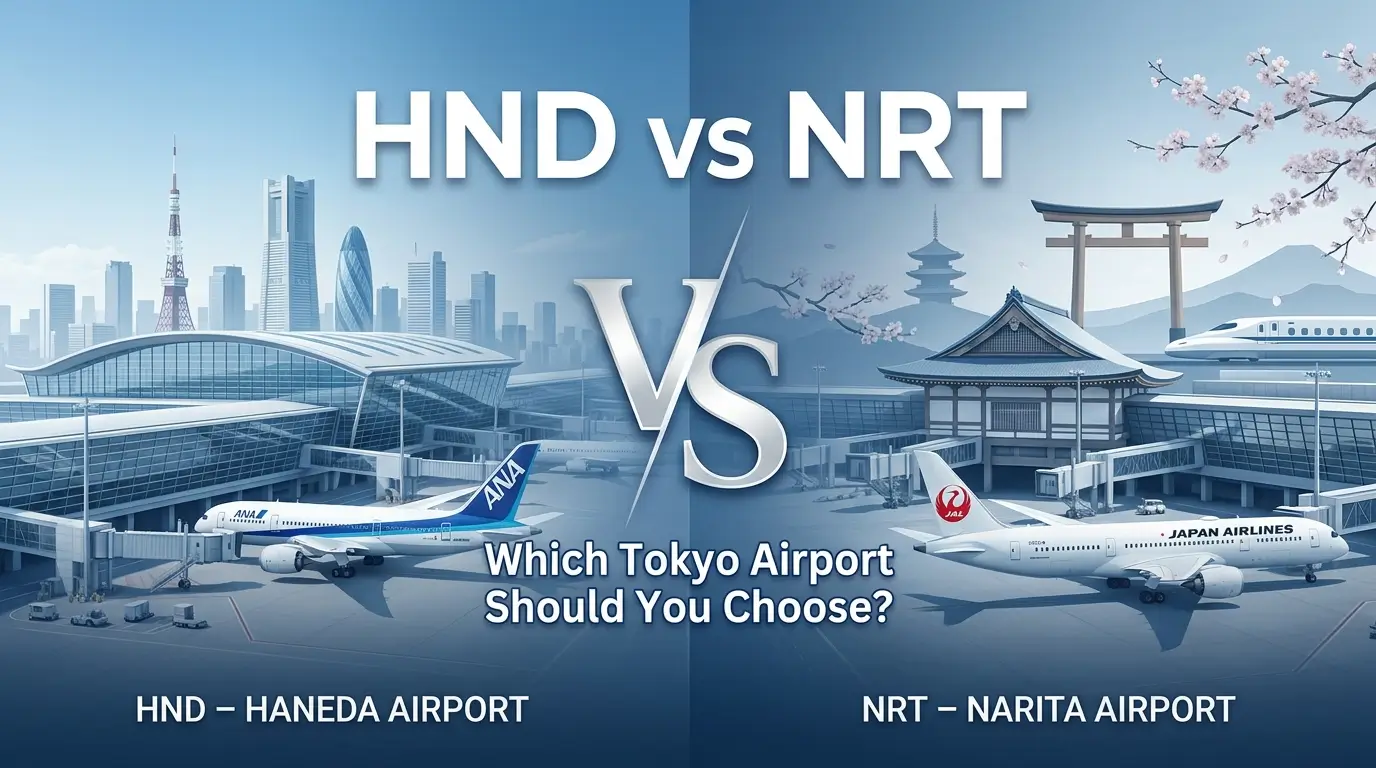
When booking a flight to Tokyo, seeing HND or NRT can cause real confusion. Both are airport codes for airports serving the Tokyo area, but they are not the same airport. Choosing between HND or NRT can affect your travel time, transportation costs, flight options, and even how easy your first day in Japan feels.
The question HND or NRT usually appears when travelers compare flight tickets, check an itinerary, or plan transportation from the airport to their hotel. HND refers to Haneda Airport, officially Tokyo International Airport, while NRT refers to Narita International Airport. Both serve international and domestic travelers, but their locations and typical flight patterns differ.
Understanding HND or NRT is especially useful if you are visiting Tokyo for the first time. A cheaper flight is not always the better choice if it takes much longer to reach your hotel. This guide explains the difference in simple terms and helps you decide which airport fits your trip.
Quick Answer
HND means Haneda Airport, while NRT means Narita International Airport. Both are Tokyo-area airports, but Haneda is much closer to central Tokyo.
Here is the simplest comparison:
| Feature | HND | NRT |
|---|---|---|
| Airport | Haneda Airport | Narita International Airport |
| Location | Tokyo | Narita, Chiba Prefecture |
| Distance from central Tokyo | Much closer | About 60 km east of central Tokyo |
| Main strength | Convenient access to Tokyo | Large international network |
| Common use | Domestic and international | International and domestic |
| Best for | Travelers who value convenience | Travelers with suitable flights or fares |
Haneda’s official IATA code is HND. Narita’s is NRT. The two codes are standardized airport identifiers used on tickets, baggage tags, flight boards, and travel websites.
For many visitors staying in central Tokyo, HND is the more convenient choice because of its location. However, NRT can be the better option when it offers a much better flight, price, airline, or schedule.
The right choice depends on your complete itinerary, not just the airport code.
The Origin of HND or NRT
Unlike ordinary English words, HND and NRT are airport codes, so their history is tied to aviation rather than English spelling.
HND identifies Haneda Airport, also known officially as Tokyo International Airport. The airport is located in Tokyo. NRT identifies Narita International Airport, which is located in Narita, Chiba Prefecture.
These three-letter identifiers are IATA airport codes. IATA codes provide a compact way for airlines, travel companies, airports, and passengers to identify airports.
The codes do not necessarily spell out the complete airport name. That is why a traveler cannot always guess an airport’s identity from its three letters.
For example:
- HND = Haneda
- NRT = Narita
- TYO = Tokyo metropolitan area/city code
Tokyo can therefore appear as TYO in some booking systems, while the actual airport is identified as HND or NRT. Official and industry references distinguish Tokyo’s two airports using these codes.
Narita also has an interesting naming history. It was formerly known as New Tokyo International Airport, before its name changed to Narita International Airport in 2004.
Pronunciation of HND and NRT
Because HND and NRT are initialisms, travelers normally say the letters individually rather than treating them as ordinary words.
- HND: say the letters H-N-D.
- NRT: say the letters N-R-T.
In spoken travel conversations, you might hear:
“My flight arrives at H-N-D.”
or:
“I’m flying into N-R-T.”
The airport names are more useful in normal conversation: Haneda and Narita.
Part of Speech
HND and NRT are initialisms used as proper identifiers. They are not normal English nouns, verbs, or adjectives.
For example:
- “My flight lands at HND.”
- “We booked a hotel near NRT.”
- “Is this flight going to Haneda or Narita?”
The codes function as labels rather than ordinary vocabulary.
British English vs American English Spelling
There is no meaningful British-versus-American spelling difference for HND or NRT.
The codes are standardized aviation identifiers, so travelers in the United States, United Kingdom, Canada, Australia, and other English-speaking regions use the same codes.
| Item | British English | American English |
|---|---|---|
| Haneda airport code | HND | HND |
| Narita airport code | NRT | NRT |
| Haneda | Haneda | Haneda |
| Narita | Narita | Narita |
| Airport | Airport | Airport |
| Code difference | None | None |
This is important because HND vs NRT is not a spelling issue. It is an airport-identification issue.
You should not change the spelling based on whether your audience uses British or American English. The correct code remains HND for Haneda and NRT for Narita.
Key Differences Between HND and NRT
1. Location
The biggest difference is location.
Haneda is in Tokyo and is much closer to central Tokyo. Narita is in Chiba Prefecture, around 60 kilometers east of central Tokyo.
That difference can matter after a long international flight.
If your hotel is in areas such as Shinjuku, Shibuya, Ginza, Tokyo Station, or Asakusa, Haneda will often provide a shorter journey.
Narita is farther away, but it still has strong rail and bus connections to Tokyo.
2. Travel Time Into Tokyo
Haneda generally wins when your priority is reaching central Tokyo quickly.
Narita has dedicated transportation options, including the Narita Express, which serves major destinations such as Tokyo, Shinagawa, Shibuya, Shinjuku, Ikebukuro, and Yokohama.
Travel time depends on your destination and transport method, so do not assume that every HND journey is automatically faster than every NRT journey.
Still, airport location gives Haneda a major convenience advantage for many central-Tokyo travelers.
3. International and Domestic Flights
Both airports handle international and domestic flights, but their flight mixes differ.
Japan’s official tourism information notes that Narita handles many international flights and some domestic services, while Haneda handles most of Tokyo’s domestic flights and an increasing number of international flights.
This means you should compare actual flight availability, rather than choosing an airport based only on reputation.
4. Transportation Options
Both airports have trains, buses, taxis, and other ground transportation options.
Narita has the Narita Express and other railway connections into the Tokyo area.
Haneda is connected to Tokyo’s transport network and can make reaching central areas especially convenient.
Your final choice should consider:
- Hotel location
- Arrival time
- Departure time
- Luggage
- Train availability
- Bus availability
- Your budget
5. Flight Price
NRT may sometimes have attractive fares, particularly for travelers comparing a wide range of international services.
But a cheaper ticket does not always mean a cheaper trip.
Suppose one flight saves you money but requires a longer transfer into Tokyo. You should compare the total travel cost, including airport transportation.
6. Convenience for First-Time Visitors
For someone visiting Tokyo for the first time, Haneda can be especially attractive because of its proximity to the city.
However, Narita is not a poor choice. It is a major international airport with established connections to central Tokyo.
The best airport is the one that works smoothly with your flight, hotel, schedule, and budget.
7. Connecting Between HND and NRT
Some travelers arrive at one airport and depart from the other.
This is possible, but you should plan carefully.
Current transportation options include direct buses and rail connections between the airports. Travel time can vary with traffic, service schedules, and the route selected.
Never treat an HND-to-NRT transfer like a simple terminal change.
If you have a self-transfer between separate tickets, allow substantial time for:
- Leaving the first airport.
- Collecting baggage if required.
- Traveling across the Tokyo area.
- Arriving at the second airport.
- Checking in again.
- Passing security and immigration where applicable.
A tight connection can create unnecessary risk.
Which Spelling Should You Use?
In this case, the better question is which airport code should you use?
Use HND when your flight is departing from or arriving at Haneda Airport.
Use NRT when your flight is departing from or arriving at Narita International Airport.
For a traveler staying in central Tokyo, HND is often the convenient choice because Haneda is located much closer to the city while for travelers whose preferred airline, route, schedule, or fare is at Narita, NRT can still be an excellent choice.
For U.S. Travelers
Do not assume that one airport is always better. Compare the complete itinerary, including the arrival time and your Tokyo hotel.
For UK and Commonwealth Travelers
The same codes apply. British English does not change HND or NRT.
For Global Travelers
Use the exact code shown on your booking. Check it carefully before leaving for the airport.
Common Mistakes
Mistake 1: Assuming They Are the Same Airport
They both serve Tokyo, but they are separate airports.
Correct: HND and NRT are different airports.
Mistake 2: Treating TYO as the Exact Airport
TYO can refer to Tokyo as an airport-city code, while HND and NRT identify the individual airports.
Better habit: Check the three-letter airport code on your actual flight.
Mistake 3: Booking Based Only on Ticket Price
A flight that is slightly cheaper may involve a less convenient airport.
Better approach: Compare airfare plus transportation and travel time.
Mistake 4: Forgetting the Hotel Location
An airport that works well for one neighborhood may be less convenient for another.
Better approach: Look at the complete route from airport to hotel.
Mistake 5: Confusing an Airport Transfer With a Terminal Transfer
HND and NRT are separate airports.
Correct: An HND-to-NRT journey requires transportation across the Tokyo area.
Mistake 6: Assuming NRT Is Inside Central Tokyo
Narita Airport is located in Narita, Chiba Prefecture, approximately 60 km east of central Tokyo.
Everyday Examples
Understanding how these codes appear in real life makes them easier to remember.
In an Email
“My flight arrives at HND at 3:00 p.m., so I’ll head to the hotel afterward.”
In a Travel Message
“Can you check whether the flight leaves from HND or NRT?”
On Social Media
“Just landed at NRT! Tokyo, here we come.”
In Formal Writing
“Passengers should verify whether their itinerary lists Haneda Airport (HND) or Narita International Airport (NRT).”
On a Flight Booking
You may see:
Tokyo (HND) — Haneda Airport
or
Tokyo (NRT) — Narita International Airport
Always read the code before booking transportation.
Comparison Table
| Category | HND — Haneda | NRT — Narita |
|---|---|---|
| Full name | Tokyo International Airport / Haneda | Narita International Airport |
| Code | HND | NRT |
| Location | Tokyo | Narita, Chiba |
| Central Tokyo access | Generally closer | Generally farther |
| International flights | Yes | Yes |
| Domestic flights | Yes | Yes |
| Rail connections | Yes | Yes |
| Best-known advantage | Convenience | Broad international service |
| Good for central Tokyo | Often excellent | Still well connected |
| Airport transfer to the other | Possible | Possible |
Neither airport is universally “better.” Your destination, airline, flight time, fare, and transportation plans should guide the decision.
Search Intent Behind “HND or NRT”
People searching HND or NRT usually have a practical travel question rather than a language question.
They may want to know:
- Which airport is closer to Tokyo?
- Which airport should they fly into?
- Is HND or NRT cheaper?
- Which airport is easier for tourists?
- How long does it take to reach Tokyo?
- Can they transfer between HND and NRT?
- Which airport is better for a particular hotel?
- Why does a Tokyo flight show two different airport codes?
The important distinction is that search interest does not necessarily tell us which airport is universally better. Travelers have different routes and priorities, so a useful comparison should focus on actual travel needs rather than unsupported claims about search popularity.
FAQs
1. Is HND or NRT better for Tokyo?
For many travelers staying in central Tokyo, HND is more convenient because Haneda is much closer to central Tokyo. However, NRT can be preferable when its flight, price, airline, or schedule better matches your trip.
2. Is HND the same as Haneda?
Yes. HND is the IATA airport code for Haneda Airport, officially Tokyo International Airport.
3. Is NRT the same as Narita?
Yes. NRT is the IATA airport code for Narita International Airport.
4. Which airport is closer to central Tokyo?
Haneda (HND) is much closer to central Tokyo. Narita (NRT) is about 60 km east of central Tokyo.
5. Can I travel from HND to NRT?
Yes. Haneda and Narita are connected by rail and bus services. Because they are separate airports, travelers should allow enough time for the transfer.
6. Does British English use different codes for HND and NRT?
No. HND and NRT are standardized airport codes, so British and American English use the same identifiers.
7. What does TYO mean compared with HND and NRT?
TYO can be used as a Tokyo airport-city code, while HND and NRT identify the two individual Tokyo-area airports.
Conclusion
HND and NRT are not two spellings of the same thing. They identify two separate airports serving the Tokyo area, each with different travel advantages.
For many visitors, HND offers easier access to central Tokyo, while NRT remains a major airport with strong international connections and useful transport links.
The smartest choice depends on your flight, hotel, arrival time, budget, and onward plans. Always check the code before you book.
Take a moment to practice HND and NRT in your travel messages and emails. Once you know the difference, Tokyo airport planning becomes much easier.

Aamer Shahzad is the founder of Diffnexx.com, a fast-growing educational platform focused on high-intent “difference between” topics. With over 8 years of experience in English language education and analytical writing, I specialize in breaking down complex “difference between” topics into clear, structured, and easy-to-understand explanations. Diffnexx.com is your go-to resource for enhancing English skills and writing with confidence.
I specializes in building search-optimized, research-driven comparison content designed for clarity, authority, and long-term digital asset value.







