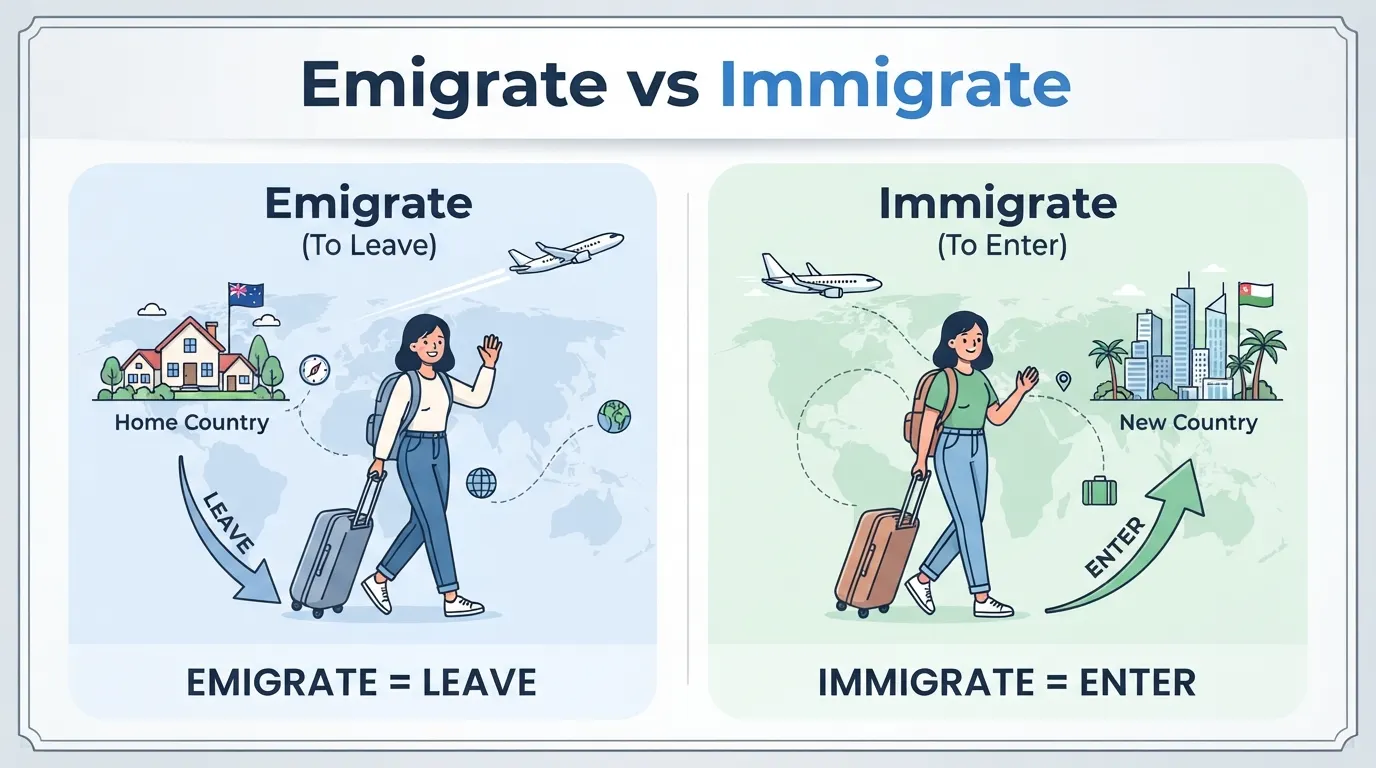
The difference between emigrate and immigrate is about direction. Emigrate means to leave your own country to live in another country, while immigrate means to move into another country to live there. In simple terms, you emigrate from a country and immigrate to a country.
For example, if Maria leaves Spain and moves permanently to Canada, she emigrates from Spain and immigrates to Canada. The physical move is the same, but the two verbs look at it from different sides.
The easiest way to remember the difference between emigrate and immigrate is: E = exit, I = into. Emigrate focuses on leaving; immigrate focuses on arriving.
Emigrate vs. Immigrate at a Glance
| Word | Meaning | Main focus | Common preposition | Example |
|---|---|---|---|---|
| Emigrate | Leave one country to live in another | Departure | from | She emigrated from India. |
| Immigrate | Move into another country to live there | Arrival | to | She immigrated to Canada. |
| Migrate | Move from one place to another | Movement in general | Varies | Many families migrated to new regions. |
Both emigrate and immigrate usually describe international relocation, especially when someone moves to another country to live there. The difference is the point of view.
What Does Emigrate Mean?
Emigrate is a verb that means to leave your own country and go to another country to live.
The focus is on the country being left.
Examples of “emigrate”
- She emigrated from Pakistan to Australia.
- His grandparents emigrated from Italy.
- They decided to emigrate from their home country.
- Many families emigrated in search of new opportunities.
The noun is emigration.
Example:
Emigration from the region increased during that period.
A person who leaves their country can be called an emigrant.
The easiest question to ask
When you see emigrate, ask:
“Where did the person leave?”
If the sentence focuses on the country the person is leaving, emigrate is usually the right choice.
What Does Immigrate Mean?
Immigrate means to move to another country to live there.
The focus is on the new country.
Examples of “immigrate”
- She immigrated to Australia.
- His parents immigrated to Canada.
- They immigrated to the United States several years ago.
- My grandparents immigrated to the country after the war.
The noun is immigration.
A person who moves to another country can be called an immigrant.
The easiest question to ask
When you see immigrate, ask:
“Where did the person go to live?”
If the sentence focuses on the destination country, immigrate is usually the better choice.
Emigrate and Immigrate Can Describe the Same Person
This is the point that causes the most confusion.
One person can emigrate and immigrate as part of the same move.
Imagine Daniel leaves Mexico and moves to Canada.
From Mexico’s point of view:
Daniel emigrated from Mexico.
From Canada’s point of view:
Daniel immigrated to Canada.
Both sentences are correct.
The words do not describe two separate journeys. They describe two perspectives on the same journey.
This is why it is useful to think about the starting point and destination:
Country left → EMIGRATE
Country entered → IMMIGRATE
Emigrate vs. Immigrate Examples
Here are some simple examples to make the distinction clear.
Example 1
Ana emigrated from Brazil.
The sentence focuses on Brazil, the country she left.
Example 2
Ana immigrated to Portugal.
The sentence focuses on Portugal, the country where she went to live.
Example 3
Ana emigrated from Brazil and immigrated to Portugal.
This sentence gives both sides of the same move.
Example 4
His family emigrated from Ireland in the 1990s.
The focus is on their departure from Ireland.
Example 5
His family immigrated to the United States in the 1990s.
The focus is on their arrival in the United States.
Emigrate From vs. Immigrate To
Prepositions make these words much easier to use correctly.
Emigrate + from
Use from when you talk about the country someone leaves.
Correct:
They emigrated from France.
Correct:
She plans to emigrate from her home country.
Immigrate + to
Use to when you talk about the country someone enters and moves to.
Correct:
They immigrated to France.
Correct:
She plans to immigrate to Canada.
A useful pattern is:
emigrate from X
immigrate to Y
For a complete journey:
emigrate from X to Y
and:
immigrate to Y from X
For example:
He emigrated from India to Germany.
He immigrated to Germany from India.
Both can be grammatically correct, but each verb highlights a different side of the move.
Can You Say “Emigrate To”?
You may sometimes see emigrate to in real English usage, especially when the destination is also mentioned. However, for learners who want the clearest standard distinction, emigrate from is the safest pattern when emphasizing departure.
For example:
She emigrated from Poland.
When the destination is the focus:
She immigrated to Canada.
This makes the contrast easy to understand and avoids the common confusion.
Can You Say “Immigrate From”?
Yes, but the meaning changes with the focus.
For example:
He immigrated from India.
This can occur when the sentence identifies where the immigrant came from. However, if you are emphasizing the country he left, emigrated from India is usually the clearer choice.
Compare:
He emigrated from India.
Focus: leaving India.
He immigrated to Canada.
Focus: moving into Canada.
He immigrated from India to Canada.
The Focus: the destination, while also giving the starting point.
The preposition alone does not always determine the verb. The intended viewpoint matters.
Emigrate vs. Immigrate vs. Migrate
Migrate is the broader word.
It means to move from one place to another. It can describe people, animals, or populations and does not always focus specifically on permanent international relocation.
For example:
Birds migrate south for the winter.
Workers migrated to cities in search of jobs.
By contrast, emigrate and immigrate are more specific.
Emigrate focuses on leaving a country.
Immigrate focuses on entering another country to live there.
So you can think of the relationship like this:
Migrate = move
Emigrate = move out of a country
Immigrate = move into another country
Emigrant vs. Immigrant
The same distinction appears in the nouns.
Emigrant
An emigrant is someone viewed from the perspective of the country they left.
The emigrants left Ireland for new opportunities.
Immigrant
An immigrant is someone viewed from the perspective of the country they entered.
The immigrants settled in Canada.
The same person can therefore be both an emigrant and an immigrant.
For example:
From Ireland’s perspective, she was an emigrant.
From Canada’s perspective, she was an immigrant.
The distinction is about viewpoint, not about two different types of people.
Emigration vs. Immigration
The noun forms follow the same pattern.
Emigration = the act or process of leaving a country to live elsewhere.
Immigration = the act or process of entering another country to live there.
For example:
The country experienced high levels of emigration.
This focuses on people leaving.
The country experienced high levels of immigration.
This focuses on people arriving.
The two processes can happen at the same time.
If people leave Country A and move to Country B, that movement is emigration from Country A and immigration to Country B.
A Simple Memory Trick
If you often confuse these words, remember:
E = Exit
Emigrate = Exit
You emigrate from a country.
I = In
Immigrate = In
You immigrate to a country.
So:
E → Exit → emigrate
I → In → immigrate
This is a memory aid, not a full explanation of the words’ history, but it is useful for everyday writing.
Pronunciation and Word Forms
Both words are verbs.
Emigrate is pronounced differently depending on accent, but the first syllable begins with an “em” sound.
Immigrate begins with an “im” sound.
Their related nouns are:
- emigrate → emigration → emigrant
- immigrate → immigration → immigrant
The words look similar because they share a historical connection to the idea of moving. Their prefixes help distinguish the direction.
What Is the Difference Between an Immigrant and an Emigrant?
An immigrant is a person who moves into a country to live there.
An emigrant is a person who leaves their country to live somewhere else.
Consider someone who moves from China to Australia.
They are:
- An emigrant from China
- An immigrant to Australia
The person does not change into a completely different kind of person. The label changes depending on which country and direction you are discussing.
Common Mistakes With Emigrate and Immigrate
Mistake 1: Treating them as synonyms
They are closely related, but they are not interchangeable.
Incorrect understanding:
“They both just mean moving to another country.”
Better:
Emigrate emphasizes leaving.
Immigrate emphasizes entering.
Mistake 2: Choosing based only on the destination
If you are talking about the country someone is entering, immigrate is usually the clearest choice.
She immigrated to Canada.
Mistake 3: Choosing based only on the starting point
If you are talking about the country someone is leaving, use emigrate.
She emigrated from India.
Mistake 4: Confusing “immigrant” with “emigrant”
Remember the viewpoint.
An immigrant has come into the destination country.
An emigrant has left the country of origin.
Mistake 5: Confusing both with “migrate”
“Migrate” is broader. It does not always carry the same focus on leaving or entering a country.
Which Word Should You Use?
Use emigrate when your sentence is about leaving.
She decided to emigrate from her home country.
Use immigrate when your sentence is about moving into a new country.
She decided to immigrate to Canada.
If you mention both places, you can make the direction very clear:
She emigrated from India and immigrated to Canada.
That sentence shows exactly why both words exist.
Frequently Asked Questions
Is it emigrate from or immigrate from?
Emigrate from is the standard pattern when you focus on the country someone leaves. Immigrate to is the standard pattern when you focus on the country someone enters.
Can the same person be an immigrant and an emigrant?
Yes. Someone who leaves India and moves to Canada can be an emigrant from India and an immigrant to Canada.
What is the easiest way to remember emigrate and immigrate?
Think E = exit and I = in. Emigrate focuses on leaving; immigrate focuses on entering.
Is immigrate the opposite of emigrate?
They are commonly treated as opposite viewpoints of international movement. Emigrate focuses on departure, while immigrate focuses on arrival.
What is the difference between migrate and immigrate?
Migrate is a broader word for moving from one place to another. Immigrate specifically focuses on moving into another country to live there.
What is the noun form of emigrate?
The noun is emigration. A person who emigrates can be called an emigrant.
What is the noun form of immigrate?
The noun is immigration. A person who immigrates can be called an immigrant.
Test Your Knowledge
1. Which sentence correctly focuses on leaving India?
A. She immigrated from India.
B. She emigrated from India.
C. She immigrated India.
D. She emigrated India to.
Correct answer: B
2. Which sentence focuses on entering Canada?
A. He emigrated Canada.
B. He emigrated from Canada.
C. He immigrated to Canada.
D. He immigrated from Canada to.
Correct answer: C
3. A person moves from Mexico to the United States. Which statement is correct?
A. The person emigrated from Mexico.
B. The person immigrated from the United States.
C. The person emigrated to the United States only.
D. The person cannot be described as an immigrant.
Correct answer: A
4. Which word has the broader meaning?
A. Immigrate
B. Emigrate
C. Migrate
D. Immigrant
Correct answer: C
5. Which sentence correctly describes both sides of the move?
A. She emigrated to Canada and immigrated from India.
B. She emigrated from India and immigrated to Canada.
C. She immigrated India and emigrated Canada.
D. She migrated from Canada and immigrated India.
Correct answer: B
6. What does “immigrant” usually emphasize?
A. The country someone enters
B. The country someone leaves
C. Temporary travel
D. Animal movement
Correct answer: A
Final Takeaway
The difference between emigrate and immigrate is mainly a matter of direction and viewpoint.
Emigrate means to leave a country to live somewhere else.
Immigrate means to move into another country to live there.
The simplest pattern is:
Emigrate from → leave
Immigrate to → enter
So, if someone moves from India to Canada, they emigrate from India and immigrate to Canada. Once you connect emigrate with exit and immigrate with entering, the difference becomes much easier to remember and use correctly.
External Sources
- Cambridge Dictionary — Emigrate
- Cambridge Dictionary — Immigrate
- ThoughtCo — The Difference Between Emigrate and Immigrate
- Dictionary.com — Emigrate Definition

Eliza Marlowe is a passionate content strategist and comparison writer at diffnexx.com. She specializes in breaking down complex “difference between” topics into clear, reader-friendly guides. With a background in linguistics and digital research, Eliza focuses on accuracy, clarity, and content that helps readers make informed decisions with confidence.







