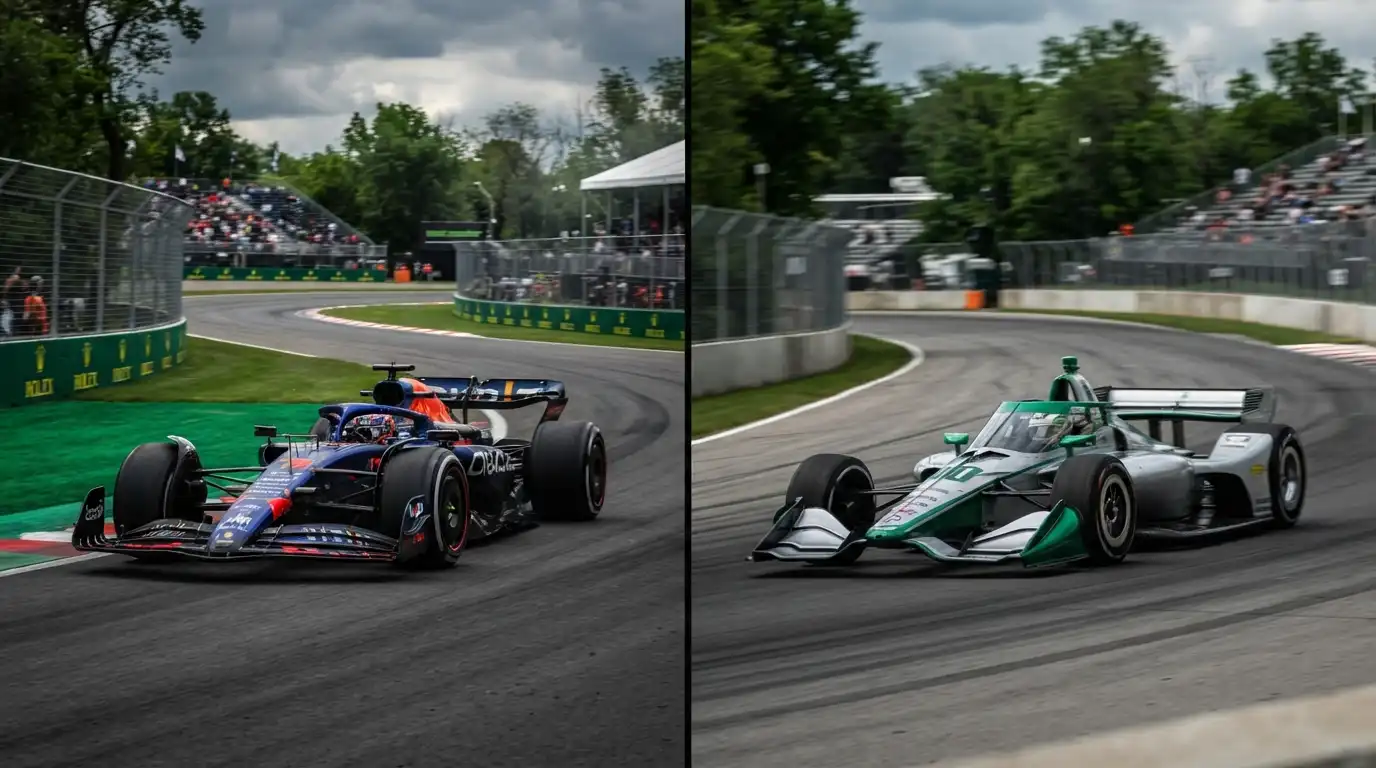
The difference between F1 and Indy goes far beyond the shape of the cars. Formula 1 and the NTT INDYCAR SERIES are both top-level open-wheel racing series, but they use different technical rules, race on different types of tracks, and create competition in different ways. The difference between F1 and Indy is especially clear when you compare car design, engines, aerodynamics, race strategy, and oval racing.
In simple terms, Formula 1 gives teams much more freedom to design and develop their own cars, while IndyCar uses a common Dallara chassis with Honda or Chevrolet power. F1 races mainly on road and street circuits around the world. IndyCar also races on road and street circuits, but it includes ovals such as Indianapolis Motor Speedway, creating a very different racing challenge.
F1 vs Indy: Quick Answer
Formula 1 (F1) is an international open-wheel championship built around constructor-designed cars and advanced technical development. Each team develops its own car within FIA regulations.
IndyCar is a North American open-wheel championship built around a more standardized technical platform. In 2026, all cars use the Dallara chassis, with Honda or Chevrolet supplying the engines. The series races on road courses, street circuits, and ovals.
The biggest differences are:
- Car design: F1 teams design their own cars; IndyCar uses a common Dallara chassis.
- Tracks: F1 mainly uses road and street circuits; IndyCar also includes several oval races.
- Engine suppliers: F1 has multiple power-unit manufacturers; IndyCar uses Honda and Chevrolet.
- Technology: F1 places a greater emphasis on team-developed technology and aerodynamics.
- Racing style: IndyCar requires drivers to handle road courses, street circuits, and high-speed ovals.
- Schedule: F1 has a global calendar; IndyCar is centered mainly in North America.
- Indianapolis 500: IndyCar includes the famous 500-mile race, which has no direct F1 equivalent.
What Is F1?
F1, short for Formula 1, is the FIA Formula One World Championship.
It is the highest-level international single-seater racing championship governed by the FIA. F1 teams compete for both the Drivers’ Championship and Constructors’ Championship.
A major feature of F1 is the constructor concept.
Teams such as Ferrari, Mercedes, McLaren, and Red Bull Racing develop their own cars within the technical regulations. The car itself is a major part of the competition.
That means F1 is not only a contest between drivers. It is also a contest between engineering teams, aerodynamic concepts, power-unit manufacturers, software, strategy groups, and development programs.
The 2026 season introduced a major new technical era. F1’s power units still use a 1.6-liter V6 internal-combustion engine, but the electrical side has become much more important, with the MGU-K capable of producing up to 350 kW. The 2026 rules also removed the MGU-H and introduced advanced sustainable fuel requirements.
What Is IndyCar?
IndyCar, officially the NTT INDYCAR SERIES, is a major American open-wheel racing championship.
Unlike F1, IndyCar does not ask every team to create its own complete car from the ground up.
The 2026 field uses Dallara chassis, while teams choose between Honda and Chevrolet engines. The series also uses Firestone tires.
The current IndyCar powertrain uses a 2.2-liter twin-turbocharged V6 engine with hybrid technology. INDYCAR says the current engines produce more than 700 horsepower, while its hybrid system captures and redeploys energy during racing.
This creates a different competitive model from F1.
Instead of spending much of the season developing a completely different chassis concept, IndyCar teams focus heavily on setup, engineering, strategy, tires, reliability, and extracting performance from a shared platform.
The Biggest Difference Between F1 and Indy: Car Design
This is one of the most important differences.
F1 uses constructor-built cars
An F1 team develops its own car.
That includes areas such as:
- Aerodynamics
- Chassis design
- Suspension concepts
- Cooling
- Bodywork
- Packaging
- Floor design
- Other performance-related systems allowed by the rules
The regulations limit what teams can do, but there is still substantial room for different engineering solutions.
This is why two F1 cars can look and behave very differently even though they compete under the same rulebook.
IndyCar uses a common chassis
IndyCar takes a different approach.
The current cars use a Dallara chassis, with Honda or Chevrolet power. This reduces the amount of freedom teams have to create completely different cars.
That does not mean every IndyCar is identical.
Teams still make many important choices involving setup, suspension, aerodynamics, tires, strategy, and how the car is prepared for each track.
The difference is that IndyCar starts from a much more standardized foundation.
Why this matters
Think of it this way:
F1:
Design the car → develop the car → optimize the car → race.
IndyCar:
Start with a common platform → develop permitted areas → optimize the setup → race.
That difference affects budgets, engineering work, competition, and the role of the team.
F1 vs IndyCar Engines
The engines are another major difference.
| Feature | Formula 1 | IndyCar |
|---|---|---|
| 2026 engine type | 1.6-liter V6 turbo hybrid | 2.2-liter twin-turbo V6 hybrid |
| Main engine suppliers | Multiple manufacturers | Honda and Chevrolet |
| Hybrid system | Major part of 2026 power unit | Integrated hybrid system |
| Team engine design | Power-unit manufacturers develop their own systems | Teams use Honda or Chevrolet power |
| Main technical focus | High efficiency, hybrid power, energy management | Power, durability, efficiency, and adaptability |
| Fuel direction | Advanced sustainable fuel | Renewable/sustainable fuel program |
F1’s 2026 power-unit rules increased the electrical contribution substantially. The MGU-K can provide up to 350 kW, while the internal-combustion engine element is capped at 400 kW under the 2026 regulations.
IndyCar’s current system is different. Its 2.2-liter twin-turbo V6 works with a hybrid system that recovers and redeploys energy. INDYCAR has also confirmed that a new 2.4-liter twin-turbo V6 hybrid powertrain is planned for the next-generation car beginning in 2028, so current and future IndyCar specifications should not be treated as the same thing.
F1 vs IndyCar: Tracks and Circuits
This is where the two series become especially different.
Formula 1
F1’s calendar is built mainly around:
- Permanent road circuits
- Temporary street circuits
- High-speed circuits
- Technical circuits
The 2026 F1 calendar contains 24 rounds across a global schedule, visiting venues in regions including Europe, Asia, North America, South America, and the Middle East.
Examples include:
- Monaco
- Silverstone
- Suzuka
- Monza
- Singapore
- Miami
- Las Vegas
F1 does not have a regular oval-racing component like IndyCar.
IndyCar
IndyCar uses a much wider mixture of circuit types.
Its 2026 schedule includes:
- Road courses
- Street circuits
- Short ovals
- Superspeedways
The official 2026 results show races at tracks such as Barber Motorsports Park, Long Beach, Indianapolis Motor Speedway, World Wide Technology Raceway, Nashville Superspeedway, Milwaukee Mile, and Laguna Seca.
This means an IndyCar driver must adapt to very different environments during one championship.
A driver may race through tight street-circuit corners one weekend and then compete at very high speed on an oval later in the season.
Why Oval Racing Changes IndyCar
Oval racing is one of the clearest answers to the question, “What is the difference between F1 and Indy?”
An oval is not simply a road circuit with fewer corners.
Drivers must manage:
- High sustained speed
- Drafting
- Traffic
- Close racing
- Tire management
- Fuel strategy
- Aerodynamic balance
- Passing opportunities
- Race restarts
- Traffic around slower cars
The Indianapolis 500 is the most famous example.
The 2026 Indianapolis 500 was run over 200 laps of the 2.5-mile Indianapolis Motor Speedway oval, totaling 500 miles.
F1 has no direct equivalent to the Indianapolis 500.
That difference affects driver preparation, car setup, engineering, race strategy, and even the type of risk a driver must manage.
Is F1 Faster Than IndyCar?
This question sounds simple, but the answer depends on what you mean by faster.
Are you asking about:
- Top speed?
- Acceleration?
- Cornering speed?
- A complete lap?
- An oval?
- A road course?
Those are different measurements.
IndyCar can reach very high speeds on oval tracks. For example, the official 2026 Indianapolis 500 results list an average race speed of more than 162 mph for the winner.
F1, meanwhile, places a major emphasis on aerodynamic performance and cornering speed on its road and street circuits.
Historical direct comparisons at shared venues have shown F1 cars can be significantly quicker over a complete road-course lap, while IndyCar can have an advantage in peak speed on certain oval configurations. Motorsport’s comparison of the two series highlights why top speed alone does not tell the whole story.
So the better answer is:
IndyCar can be extremely fast in a straight line and on ovals, while F1 is designed around very high cornering performance and aerodynamic efficiency on its circuit types.
There is no single speed number that accurately describes both series.
How Are F1 and IndyCar Races Different?
The race experience also differs.
F1 generally puts a strong focus on:
- Qualifying position
- Tire strategy
- Aerodynamic performance
- Pit-stop timing
- Energy management
- Track position
- Team development
IndyCar adds other challenges because of its mixed circuit calendar.
On ovals, drivers must deal with:
- Drafting
- Pack racing
- Traffic
- Restarts
- Different aerodynamic configurations
- Fuel and tire strategy
The Indianapolis 500 adds another layer because of its unique length and oval format.
IndyCar also continues to use race refueling, while F1 does not allow refueling during a race. This creates a major difference in pit strategy.
F1 vs IndyCar: Aerodynamics
Aerodynamics are extremely important in both series, but the goals are not identical.
F1 aerodynamics
F1 teams devote enormous engineering effort to generating aerodynamic performance.
The car must create downforce while managing drag and airflow around the car.
The 2026 F1 regulations introduced a new aerodynamic philosophy aimed at making the cars lighter and more nimble while improving overtaking opportunities.
IndyCar aerodynamics
IndyCar also relies heavily on aerodynamic setup, but its cars must work across very different track types.
An oval requires a different aerodynamic approach from a road course.
At a superspeedway, reducing drag can be extremely important because cars spend long periods at high speed.
On a road course, the car needs a different balance between downforce, braking, cornering, and straight-line speed.
That versatility is a defining part of IndyCar engineering.
F1 vs IndyCar Safety Systems
Both series have developed advanced safety systems, but their cars are designed around different racing environments.
F1 cars use the Halo, which provides additional protection around the driver’s head.
IndyCar uses an aeroscreen, which combines a windscreen-like structure with additional cockpit protection.
The different systems reflect the different demands of each championship.
IndyCar’s next-generation IR-28 car, scheduled for competition from 2028, is being developed with a lighter and more aerodynamic aeroscreen as part of its safety and performance goals.
Do F1 Drivers Race in IndyCar?
Some drivers have competed in both forms of racing, but moving between them is not simply a matter of switching cars.
An F1 driver accustomed to road courses must learn the specific demands of oval racing if they enter IndyCar.
That includes:
- Running close to other cars at high speed
- Understanding drafting
- Managing traffic
- Learning oval-specific lines
- Adapting to different aerodynamic behavior
- Managing longer race distances
The reverse is also true.
An IndyCar driver moving toward F1 would need to adapt to a championship where teams develop highly specialized cars and where performance can depend heavily on understanding an F1-specific technical package.
So experience in one series can help, but it does not automatically translate into mastery of the other.
F1 vs IndyCar: Which One Has More Technology?
Both are technologically advanced, but they use technology differently.
F1 gives teams a large role in developing the car and power unit within the regulations.
This creates intense competition in areas such as:
- Aerodynamics
- Simulation
- Vehicle dynamics
- Energy recovery
- Materials
- Data analysis
- Software
- Power-unit development
IndyCar deliberately limits some of that freedom by using a common chassis platform and a small number of engine suppliers.
That does not make IndyCar technologically simple.
Instead, the engineering challenge shifts toward extracting maximum performance from a shared platform.
This is an important distinction that generic F1 vs IndyCar comparisons sometimes miss.
F1 vs IndyCar: Season Structure
The championships also have different geographic identities.
F1 is a global championship. Its 2026 calendar has 24 rounds and spans five continents.
IndyCar’s 2026 calendar has 17 scheduled races and is concentrated primarily in the United States, with a mixture of road courses, street circuits, and ovals.
This difference affects the teams and drivers.
F1 requires a global travel schedule with races spread across many countries.
IndyCar has a more North American focus and places much greater emphasis on different circuit types within the same championship.
F1 vs IndyCar: Main Differences at a Glance
| Category | Formula 1 | IndyCar |
|---|---|---|
| Full name | FIA Formula One World Championship | NTT INDYCAR SERIES |
| Car philosophy | Constructor-designed | Common Dallara chassis |
| Chassis | Developed by each F1 team | Dallara platform |
| Engine suppliers | Multiple manufacturers | Honda and Chevrolet |
| 2026 power unit | 1.6L V6 turbo hybrid | 2.2L twin-turbo V6 hybrid |
| Circuit types | Mainly road and street | Road, street, and oval |
| Global reach | Worldwide | Mainly North America |
| 2026 schedule | 24 rounds | 17 races |
| Refueling during race | No | Yes |
| Indianapolis 500 | No | Yes |
| Oval racing | No regular oval championship races | Major part of series |
| Main engineering model | Car development and optimization | Shared-platform optimization |
| Driver challenge | Extreme road/street-circuit performance | Road, street, and oval versatility |
The exact technical and sporting details can change with future regulations, so season-specific information should always be checked against the relevant F1, FIA, and INDYCAR rules.
Common Misconceptions About F1 and IndyCar
“Indy” and “IndyCar” mean exactly the same thing
Not quite.
IndyCar refers to the racing series.
“Indy” can be used informally to refer to IndyCar, but it can also refer to Indianapolis, particularly the Indianapolis 500.
So F1 vs Indy is often shorthand for Formula 1 vs IndyCar, but the terms are not technically identical.
IndyCar cars are all completely identical
No.
They share a common chassis platform, but teams still make setup and engineering decisions that affect performance.
The engine supplier can also be Honda or Chevrolet.
F1 only races on permanent circuits
Not true.
F1 also races on temporary street circuits such as Monaco, Singapore, Miami, and Las Vegas.
IndyCar only races on ovals
This is one of the biggest misconceptions.
The 2026 IndyCar schedule includes road courses and street circuits as well as ovals.
F1 and IndyCar cars are basically the same
They may look similar because both use open-wheel, single-seat designs.
Underneath, however, their engineering philosophies are quite different.
Frequently Asked Questions
What is the main difference between F1 and IndyCar?
The biggest difference is the car and racing philosophy. F1 teams design their own cars within FIA rules, while IndyCar teams use a shared Dallara chassis and choose Honda or Chevrolet power. IndyCar also races on ovals, while F1 does not have regular oval races.
Is F1 faster than IndyCar?
It depends on the track and the type of speed being measured. IndyCars can reach very high speeds on ovals, while F1 cars are built for exceptional cornering and aerodynamic performance on road and street circuits. A top-speed comparison alone is not enough to determine which car is faster overall.
Can an F1 driver race in IndyCar?
Yes. Drivers can move between championships, but oval racing requires specific skills that are different from those used in F1. A driver moving to IndyCar must learn the demands of high-speed oval racing, traffic, drafting, and different race strategies.
Does IndyCar use the same car for every race?
The underlying chassis platform is shared, but the car is configured differently for different track types. Road courses, street circuits, and ovals require different setups and aerodynamic approaches.
Does F1 have an equivalent to the Indianapolis 500?
No. The Indianapolis 500 is a unique IndyCar event held at Indianapolis Motor Speedway. It is a 500-mile oval race and has no direct equivalent on the F1 calendar.
Why does IndyCar race on ovals but F1 does not?
The two championships evolved around different racing philosophies and technical regulations. IndyCar includes ovals as a core part of its championship, while F1 focuses on road and street circuits.
Test Your Knowledge: F1 vs IndyCar
1. Which series uses a Dallara chassis as its common current platform?
A. Formula 1
B. IndyCar
C. Both
D. Neither
Correct answer: B. IndyCar
2. Which type of track is a major part of IndyCar but not regular F1 racing?
A. Street circuits
B. Road circuits
C. Ovals
D. Temporary circuits
Correct answer: C. Ovals
3. Which two manufacturers supply engines to current IndyCar teams?
A. Ferrari and Mercedes
B. Honda and Chevrolet
C. Ford and Audi
D. Renault and Honda
Correct answer: B. Honda and Chevrolet
4. What is a major feature of the F1 constructor model?
A. Every team uses exactly the same car
B. Teams design and develop their own cars
C. Teams cannot develop aerodynamics
D. All teams use one engine manufacturer
Correct answer: B. Teams design and develop their own cars
5. Which famous 500-mile race is part of IndyCar?
A. Monaco Grand Prix
B. Italian Grand Prix
C. Indianapolis 500
D. British Grand Prix
Correct answer: C. Indianapolis 500
Conclusion
The difference between F1 and Indy comes down to more than speed or appearance. Formula 1 is built around constructor-designed cars, advanced development, global road and street circuits, and highly integrated hybrid power units. IndyCar uses a shared Dallara platform, Honda or Chevrolet power, and a much broader mix of road courses, street circuits, and ovals.
The biggest practical distinction is simple: F1 teams compete partly by designing the car, while IndyCar teams compete largely by optimizing a common platform for very different types of racing. The Indianapolis 500 and regular oval competition then give IndyCar a challenge that F1 does not have.
For a beginner, that is the easiest way to remember it: F1 emphasizes constructor development and global circuit racing; IndyCar emphasizes shared technology, driver versatility, and racing across roads, streets, and ovals.
External Sources
- Formula 1 — 2026 Regulations and Technical Changes
- FIA — 2026 Formula 1 Regulations
- INDYCAR — Cars and Technical Overview
- INDYCAR — 2026 Schedule
- INDYCAR — 2026 Indianapolis 500

Anton Reyes is a contributing writer at DiffNexx.com, where he explores meaningful differences in language, culture, and everyday concepts. With a background in creative nonfiction, Anton brings clarity and balance to complex comparisons. His writing helps readers understand subtle distinctions in words and ideas, making learning both insightful and engaging.







