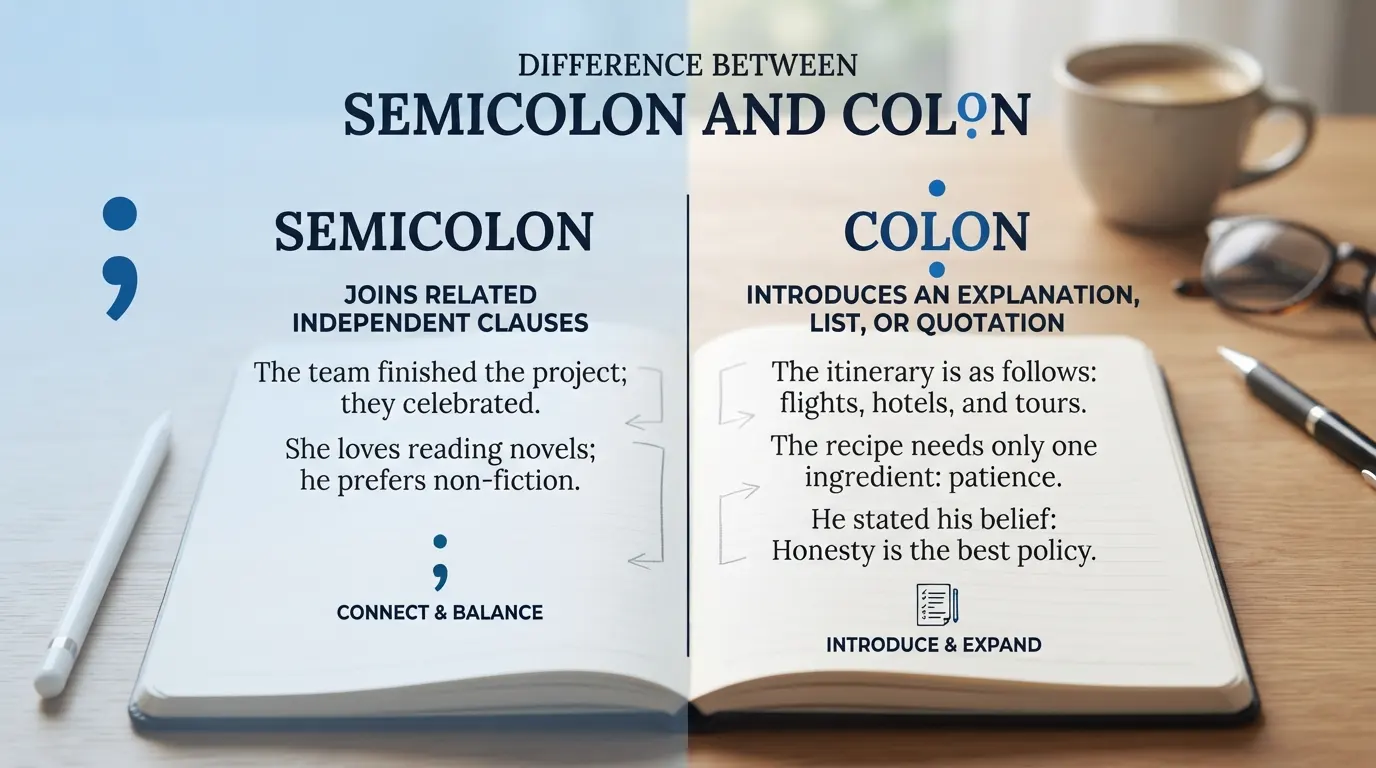
If you often pause over the difference between semicolon and colon, the easiest rule is this: a semicolon (;) connects closely related complete thoughts, while a colon (:) introduces or points to information that explains, expands, or lists something before it. For example, “The store was closed; we went home” uses a semicolon to connect two related independent clauses. “I bought three things: bread, milk, and eggs” uses a colon to introduce a list.
The difference between semicolon and colon becomes clearer when you look at what the punctuation is doing. A semicolon creates a link between two parts that could usually stand as sentences. A colon tells the reader that more detail is coming. Both marks can create a stronger break than a comma, but they do not have the same job.
This guide explains the difference between semicolon and colon with simple rules, examples, common mistakes, and a quick comparison so you can choose the right mark with confidence.
Semicolon vs. Colon: Quick Answer
Here is the simplest way to remember the difference:
- Semicolon (;): connects two closely related independent clauses.
- Colon (:): introduces a list, explanation, example, quotation, or other information that develops what came before it.
- Semicolon: usually has a complete sentence on both sides.
- Colon: normally has a complete clause before it, while what follows can be a word, phrase, list, or complete sentence depending on the construction.
Compare:
Semicolon: The rain was heavy; we stayed inside.
Both sides can stand alone:
- The rain was heavy.
- We stayed inside.
Now compare:
Colon: We stayed inside for one reason: the rain was heavy.
The words after the colon explain the reason mentioned before it.
Cambridge Dictionary gives the same basic distinction: semicolons can separate related main clauses, while colons can introduce lists and explanations.
What Is a Semicolon?
A semicolon (;) is a punctuation mark that looks like a period above a comma.
Its main grammatical job is to connect two closely related independent clauses without using a coordinating conjunction such as and, but, or so.
For example:
Maya finished her homework; she watched a movie.
Both parts are complete sentences:
Maya finished her homework.
She watched a movie.
The semicolon keeps them together because the ideas are closely connected.
When to Use a Semicolon
1. To connect two related independent clauses
Use a semicolon when two complete thoughts are closely related.
The meeting ended early; everyone left before noon.
I wanted to call you; my phone had no battery.
The road was blocked; we took another route.
The semicolon creates a stronger connection than a period while keeping the two clauses grammatically independent.
The Australian Government Style Manual describes the semicolon as a break stronger than a comma but weaker than a full stop. It recommends using it when two sentences share or develop an idea.
2. Before words such as “however” and “therefore”
A semicolon can be used before a conjunctive adverb when it connects two independent clauses.
I wanted to go; however, I was too tired.
The task looked simple; therefore, we started immediately.
She studied hard; nevertheless, the test was difficult.
The semicolon separates the two complete clauses. A comma normally follows the conjunctive adverb.
3. To separate complicated items in a list
Semicolons can make a complicated list easier to read when individual items already contain commas.
For example:
The conference attracted guests from Austin, Texas; Paris, France; and Tokyo, Japan.
Without semicolons, the commas could make it difficult to see where one item ends and the next begins.
The Style Manual recommends semicolons for complex lists when the individual items already contain commas or other punctuation.
When Not to Use a Semicolon
Do not use a semicolon simply because you want a longer pause.
Incorrect:
I went to the store; because I needed milk.
The second part is not an independent clause.
Better:
I went to the store because I needed milk.
Also avoid using a semicolon between an independent clause and a simple phrase.
Incorrect:
She packed her bag; with a notebook and a charger.
Better:
She packed her bag with a notebook and a charger.
What Is a Colon?
A colon (:) is a punctuation mark made of two vertically stacked dots.
Its main purpose is to signal that the information after it will explain, illustrate, identify, or expand on what came before it.
For example:
I need three things: a pen, paper, and a ruler.
The colon tells the reader that a list is coming.
Another example:
She had one goal: to finish the project.
The words after the colon explain the goal.
The Australian Government Style Manual describes colons as punctuation that draws attention to the text that follows and lists examples, contrasts, explanations, and lists among their uses.
When to Use a Colon
1. To introduce a list
This is one of the most common uses.
We need four ingredients: flour, sugar, eggs, and butter.
Bring these items: a notebook, a pen, and your ID.
She visited three cities: Rome, Madrid, and Lisbon.
The part before the colon should normally form a complete thought.
Watch the Lead-In
Incorrect:
I need: a pen, paper, and a ruler.
The phrase “I need” does not form a complete sentence by itself.
Better:
I need three things: a pen, paper, and a ruler.
However, style guidance can vary in special constructions, especially before displayed or bulleted lists. The important point is to avoid inserting a colon where the sentence naturally flows directly into its object. The Style Manual specifically warns against unnecessary colons after verbs or similar incomplete lead-ins.
2. To introduce an explanation
A colon can introduce information that explains the statement before it.
There was one problem: nobody had the key.
She knew the answer: the door was locked.
We had a simple goal: finish the work before Friday.
The second part develops the first.
3. To introduce an example
Some animals are nocturnal: bats are one example.
He enjoys outdoor activities: hiking is his favorite.
The colon signals that an example or specific detail is coming.
4. To introduce a quotation
A colon can introduce a quotation when the preceding material forms a suitable complete statement.
The teacher gave us one final instruction: “Read the question carefully.”
She had one message for the team: “Stay focused.”
Exact quotation punctuation can depend on the style guide and sentence structure, so follow the style required for academic, professional, or publishing work.
5. To introduce a complete explanatory sentence
A colon can also connect a complete sentence to another complete sentence when the second one explains or expands on the first.
The result was surprising: the smaller team won.
I finally understood the problem: we had used the wrong data.
This is an important point because it is where colon vs. semicolon can become confusing.
Semicolon vs. Colon: The Main Difference
The easiest distinction is the relationship between the two parts.
A semicolon says:
“These two complete thoughts are closely connected.”
A colon says:
“Here is the detail that explains or develops what I just said.”
Compare these examples:
| Feature | Semicolon (;) | Colon (:) |
|---|---|---|
| Main purpose | Connects related thoughts | Introduces or explains information |
| Common use | Two independent clauses | Lists and explanations |
| Complete clause before it | Yes, normally | Yes, normally |
| Complete clause after it | Usually yes | Not required |
| Introduces a list | Rarely | Yes |
| Introduces an explanation | No | Yes |
| Separates complex list items | Yes | No |
| Connects related independent clauses | Yes | Sometimes, when the second explains the first |
| Basic idea | Connection | Introduction |
Compare the Meaning
She was tired; she kept working.
The two ideas are closely connected. The semicolon places them side by side.
Now:
She had one reason to keep working: the deadline was near.
The second part explains the first.
That difference in relationship is more useful than simply thinking about how long the pause sounds.
The Independent-Clause Test
One of the best ways to decide whether a semicolon might work is to use the independent-clause test.
An independent clause can stand alone as a complete sentence.
Consider:
The weather changed; we went home.
Test each side:
The weather changed. ✓
We went home. ✓
Because both are complete thoughts, the semicolon works.
Now consider:
We went home; because the weather changed.
Test the second part:
Because the weather changed. ✗
That is not a complete sentence. It depends on another clause.
So the semicolon is wrong.
Correct:
We went home because the weather changed.
A Simple Three-Step Test
When you are unsure, ask:
- Can the words before the punctuation stand alone?
- Can the words after it stand alone?
- Am I connecting two ideas, or introducing an explanation/list?
If both sides are complete and closely related, a semicolon may be appropriate.
If the second part introduces a list, example, explanation, or expansion, a colon may be appropriate.
Can a Colon Connect Two Complete Sentences?
Yes, but there is an important difference.
A colon can come between two independent clauses when the second clause explains, illustrates, or expands on the first.
For example:
The decision was easy: we had no other option.
Both sides can stand alone:
The decision was easy.
We had no other option.
But the second sentence explains why the decision was easy. The colon makes that relationship clear.
A semicolon would also be grammatically possible in some contexts:
The decision was easy; we had no other option.
But the meaning and emphasis are slightly different.
The semicolon presents the two ideas as closely connected statements.
The colon makes the second idea feel like an explanation or development of the first.
Semicolon vs. Colon in Complex Lists
This is another area where writers often confuse the two marks.
Use a colon to introduce the list
I packed three items: a jacket, a flashlight, and a notebook.
The colon introduces the list.
Use semicolons to separate complicated list items
The finalists came from Denver, Colorado; Austin, Texas; and Portland, Oregon.
Here, the colon is not separating the cities. The semicolons are.
The structure is:
Introduction: item 1; item 2; item 3.
This distinction is useful:
Colon = introduces the list.
Semicolons = separate complicated items within the list.
For simple lists, commas are normally enough:
I bought apples, oranges, and bananas.
There is no need for semicolons.
Colon vs. Semicolon in Academic Writing
Both marks can appear in academic writing, but they perform different jobs.
Semicolon
The first study produced positive results; the second study found similar evidence.
The semicolon connects two related findings.
Colon
The study produced one important result: participants improved after the training.
The colon introduces the specific result.
In academic writing, punctuation should serve clarity rather than make a sentence look more formal. If two short sentences are clearer as separate sentences, a full stop may be better than a semicolon.
The Australian Style Manual similarly advises against overusing semicolons because they can make sentences harder to read.
Colon vs. Semicolon in Business Writing
The same basic rules apply in emails, reports, proposals, and workplace documents.
Semicolon example
The report is almost finished; we need to check the final figures.
The second clause gives another closely related statement.
Colon example
We have one priority: completing the report today.
The colon introduces the specific priority.
Another comparison
The client responded quickly; we can move forward.
versus:
The client gave us one instruction: move forward.
The first uses a semicolon to connect ideas.
The second uses a colon to introduce the specific instruction.
Do You Capitalize After a Semicolon?
Usually, no.
A semicolon normally does not require a capital letter after it unless the next word is a proper noun.
Correct:
The meeting ended; everyone went home.
Correct:
The meeting ended; Sarah went home.
Sarah is capitalized because it is a proper name, not because it follows a semicolon.
Do You Capitalize After a Colon?
This rule is more style-dependent.
For a normal list or phrase, lowercase is common:
I bought three things: bread, milk, and eggs.
When a colon introduces a complete sentence, capitalization may depend on the style guide.
For example, the Chicago Manual of Style’s current guidance allows an initial capital when a colon introduces a full sentence.
So you may see:
She reached one conclusion: The plan needed more work.
But other style systems may prefer:
She reached one conclusion: the plan needed more work.
Best practice: follow the style guide used by your school, employer, publisher, or publication.
Common Mistakes With Semicolons and Colons
Mistake 1: Using a semicolon before a list
Incorrect:
I bought three things; bread, milk, and eggs.
Correct:
I bought three things: bread, milk, and eggs.
The colon introduces the list.
Mistake 2: Using a colon after an incomplete lead-in
Incorrect:
My favorite foods are: pizza and pasta.
Better:
My favorite foods are pizza and pasta.
Or:
I have two favorite foods: pizza and pasta.
The second version gives the colon a complete lead-in.
Mistake 3: Using a semicolon before a dependent clause
Incorrect:
I stayed home; because I was sick.
Correct:
I stayed home because I was sick.
The phrase “because I was sick” cannot stand alone.
Mistake 4: Using a comma where a semicolon is needed
Incorrect:
The movie ended, we went home.
This creates a comma splice.
Correct:
The movie ended; we went home.
Or:
The movie ended, and we went home.
Mistake 5: Treating the two marks as interchangeable
Consider:
She had one plan; leave early.
The intended meaning is probably an explanation of the plan.
Better:
She had one plan: leave early.
The colon points forward to the specific plan.
Semicolon or Colon: A Simple Memory Trick
Try this:
Semicolon = connection
Think:
Idea; related idea.
Example:
The shop was closed; we went home.
Colon = introduction
Think:
Statement: here is the detail.
Example:
We had one option: go home.
Another quick trick:
Semicolon → “and these two ideas are connected.”
Colon → “here is what I mean.”
This is not a complete grammar rule, but it is a useful way to remember the central difference.
British vs. American Usage
There is no major British-versus-American spelling difference between semicolon and colon. The words are spelled the same in both varieties of English.
The punctuation rules are also broadly similar.
Both British and American English use:
- semicolons to connect related independent clauses
- semicolons in complicated lists
- colons to introduce lists
- colons to introduce explanations and examples
The main differences you may encounter are style-guide preferences, especially around capitalization after a colon, quotation punctuation, and how strongly a particular publication prefers minimal punctuation.
For example, Cambridge’s British English guidance describes semicolons as separators between related main clauses and colons as markers for lists, subtitles, direct speech, and explanations.
So if you are writing for a US or UK audience, you generally do not need to learn a completely different rule for choosing between these two marks.
When Should You Use a Period Instead?
Sometimes the best choice is neither a semicolon nor a colon.
If the ideas are not closely connected, use a period.
Instead of:
The meeting ended; I ordered pizza for dinner.
Write:
The meeting ended. I ordered pizza for dinner.
The ideas may both be true, but there is no strong grammatical reason to join them.
Likewise, do not add a semicolon simply to make your writing sound advanced.
Clear writing is usually better than complicated punctuation.
The Style Manual emphasizes minimal punctuation and recommends shorter, clearer sentences when a semicolon would only make a sentence longer.
Test Your Knowledge: Semicolon vs. Colon
Try these questions before checking the answers.
1. Which punctuation mark is correct?
I need three things ___ a pen, paper, and a ruler.
A. Comma
B. Semicolon
C. Colon
D. Period
Correct answer: C. Colon
The colon introduces the list.
2. Which sentence uses a semicolon correctly?
A. I bought three items; apples, oranges, and bananas.
B. I was tired; I finished the report anyway.
C. I stayed home; because it was raining.
D. My favorite color is; blue.
Correct answer: B.
Both sides of the semicolon are independent clauses.
3. Which sentence uses a colon correctly?
A. She likes: reading and hiking.
B. He likes reading: and hiking.
C. She has two hobbies: reading and hiking.
D. She has two hobbies; reading and hiking.
Correct answer: C.
The colon introduces the list of hobbies.
4. Which punctuation mark can separate complex items that already contain commas?
A. Semicolon
B. Colon
C. Apostrophe
D. Hyphen
Correct answer: A. Semicolon
For example:
Paris, France; Rome, Italy; and Madrid, Spain.
5. What is the main function of a colon?
A. To join unrelated sentences
B. To introduce or explain information
C. Replace every comma
D. To show possession
Correct answer: B.
A colon commonly signals that an explanation, example, list, or related detail follows.
Frequently Asked Questions
Is a semicolon stronger than a colon?
Not simply stronger or weaker. They perform different jobs. A semicolon commonly connects two closely related independent clauses. A colon points forward to an explanation, list, example, or expansion.
Can I use a colon instead of a semicolon?
Sometimes, but not automatically. A colon works when the second part explains, illustrates, or expands on the first. A semicolon works when two closely related independent clauses are being connected.
Can a semicolon introduce a list?
Not normally. A colon usually introduces the list, while semicolons can separate complicated items inside the list.
Does a semicolon need a complete sentence on both sides?
Usually, yes, when it connects clauses. Both sides should generally be independent clauses. One important exception is its use between complex items in a series.
Do you capitalize after a semicolon?
Normally, no. Capitalize only when the next word requires capitalization for another reason, such as being a proper noun.
Do you capitalize after a colon?
It depends on the construction and style guide. A lowercase letter is common after a colon before a phrase or list. When a colon introduces a complete sentence, some style guides recommend capitalization.
Which is easier to remember: semicolon or colon?
Use semicolon for connection and colon for introduction. If two complete thoughts are closely related, consider a semicolon. If the second part explains or lists something introduced by the first, consider a colon.
Final Takeaway
The easiest way to understand the difference between semicolon and colon is to focus on the relationship between the two parts of the sentence.
Use a semicolon (;) when you want to connect two closely related independent clauses or separate complicated items in a list.
Use a colon (:) when you want to introduce a list, explanation, example, quotation, or specific detail that develops what came before it.
Remember:
Semicolon = connects.
Colon = introduces.
Once you identify whether you are linking two complete thoughts or introducing information, choosing the right punctuation mark becomes much easier.
Recommended External Sources
For readers who want to verify punctuation rules or explore formal style guidance, these are useful references:
- Cambridge Dictionary — Punctuation: colons and semi-colons
- Australian Government Style Manual — Semicolons
- Australian Government Style Manual — Colons
- Chicago Manual of Style — Colon capitalization guidance

Aamer Shahzad is the founder of Diffnexx.com, a fast-growing educational platform focused on high-intent “difference between” topics. With over 8 years of experience in English language education and analytical writing, I specialize in breaking down complex “difference between” topics into clear, structured, and easy-to-understand explanations. Diffnexx.com is your go-to resource for enhancing English skills and writing with confidence.
I specializes in building search-optimized, research-driven comparison content designed for clarity, authority, and long-term digital asset value.







