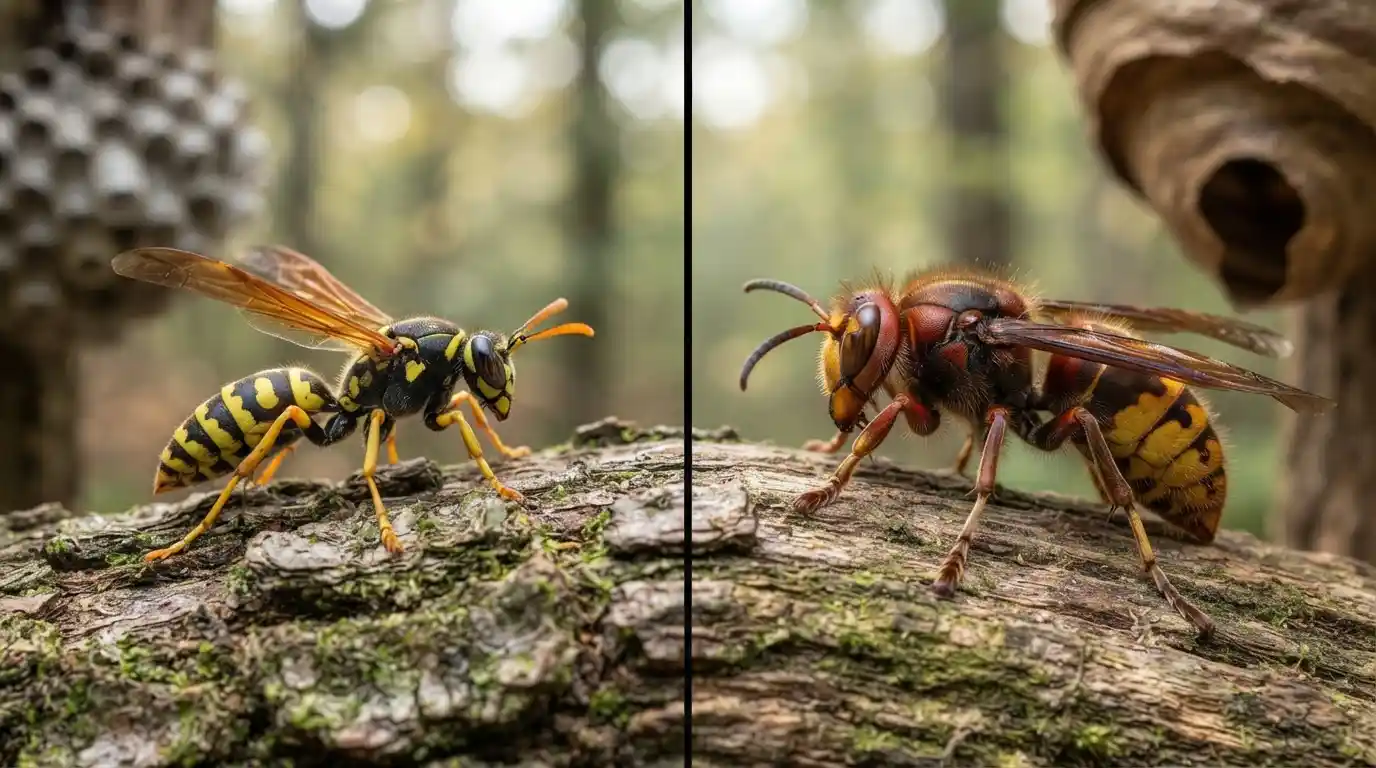
The difference between hornet and wasp starts with one simple fact: a hornet is a type of wasp, but not every wasp is a hornet. Hornets belong to a smaller group within the wasp family, and true hornets are in the genus Vespa. They are often larger and more robust than many common wasps. Wasps, however, include thousands of species with very different sizes, colors, nesting habits, and lifestyles.
When people ask about the difference between hornet and wasp, they usually want to know what they are looking at in the garden, near a house, or around food. Size, body shape, color, nest design, and behavior can help, but no single feature works for every species.
The difference between hornet and wasp also becomes confusing because common names are not always scientifically precise. For example, the insect commonly called a bald-faced hornet in North America is actually a type of aerial yellowjacket, not a true Vespa hornet.
Hornet vs. Wasp: Quick Answer
A hornet is a specialized type of wasp, while “wasp” is a much broader term.
In general:
- Hornets are usually larger and have thicker, more robust bodies.
- Wasps include both solitary and social species and can vary greatly in size and appearance.
- True hornets belong to the genus Vespa.
- Both hornets and wasps belong to the family Vespidae when referring to the familiar social wasps discussed here.
- Both can sting.
- Hornets and many social wasps build nests from plant fibers mixed with saliva.
- Both can play useful roles by hunting other insects.
- Neither group should be judged by aggression based on appearance alone.
The most important point is taxonomic: hornets are wasps, but wasps are not all hornets.
Hornet vs. Wasp: Key Differences
| Feature | Hornet | Wasp |
|---|---|---|
| Basic classification | A type of wasp | Broad group containing many species |
| True hornet genus | Vespa | Many genera |
| Typical body | Larger and more robust | Often slimmer, but varies |
| Size | Usually larger than common wasps | Can range from tiny to fairly large |
| Social behavior | True hornets are social | Can be solitary or social |
| Color | Often dark brown, black, yellow, or reddish-brown, depending on species | Extremely varied |
| Diet | Often hunts insects and also uses sugary foods | Varies by species |
| Nesting | Often enclosed or protected nests | May be underground, exposed, enclosed, or solitary |
| Sting | Can sting repeatedly | Many female wasps can sting repeatedly |
| Ecological role | Predator and part of food webs | Predators, parasites, scavengers, and pollinators |
These are broad patterns. Wasp diversity is so large that exceptions are common. The University of Maryland Extension notes that most wasps are solitary, while social wasps include yellowjackets, hornets, and paper wasps.
What Is a Wasp?
A wasp is a broad term for insects in the order Hymenoptera. Wasps include a huge range of species.
Some wasps live alone. Others form colonies.
Common examples include:
- Paper wasps
- Yellowjackets
- Potter wasps
- Mud daubers
- Cicada killers
- Social hornets
- Many parasitic wasps
This variety matters when comparing a hornet with a wasp.
There is no single body shape or lifestyle that describes every wasp.
Some wasps are small and difficult to notice. Others are large and colorful. Some build nests. Others lay eggs in soil, wood, or on other organisms.
The University of Maryland Extension notes that Maryland alone has more than 1,000 wasp species, illustrating how broad the group can be.
What Is a Hornet?
A hornet is a particular type of social wasp.
True hornets belong to the genus Vespa. The European hornet, for example, has the scientific name Vespa crabro. The Smithsonian lists it within the order Hymenoptera and family Vespidae.
Hornets tend to have a more powerful, broad-bodied appearance than many familiar wasps.
They also hunt other insects. Some species switch to sugary foods or plant materials at certain times of the year.
For example, Penn State Extension reports that European hornets hunt insects such as flies, grasshoppers, and yellowjackets. They also use sugary foods and plant sap, especially later in the year.
The Most Important Taxonomy Difference
This is where many online comparisons become misleading.
It is not scientifically accurate to think of wasps and hornets as two completely separate groups.
Instead:
Wasps → includes hornets
A useful analogy is:
Fruit → includes apples
An apple is a fruit, but not every fruit is an apple.
Likewise, a true hornet is a wasp, but most wasps are not hornets.
The Georgia Department of Agriculture uses a similar comparison and explains that hornets are a subset of wasps.
Why Do Hornets Look Bigger?
Many true hornets are larger and more robust than common social wasps such as yellowjackets and paper wasps.
The European hornet, for example, can reach about 1 to 1.5 inches in length, according to USDA APHIS.
But size alone is not a reliable identification method.
Some wasps are surprisingly large.
The cicada killer is a good example. It is a large solitary wasp that can look intimidating but has a very different lifestyle from a social hornet. Penn State Extension describes the cicada killer as a large wasp that digs individual burrows and hunts cicadas for its young.
So, seeing a large flying insect does not automatically mean you have found a hornet.
How to Tell a Hornet From a Wasp
If you need to identify one, look at several features together.
1. Body Shape
True hornets tend to have a more robust body.
Many familiar wasps have a slimmer appearance and a very narrow connection between the thorax and abdomen.
This narrow area is often called the wasp waist.
However, body shape varies among wasp groups, so it should not be used alone.
2. Size
Size can provide a useful clue.
Many true hornets are larger than common paper wasps and yellowjackets.
For example, USDA APHIS lists European hornets at about 1 to 1.5 inches long, while paper wasps may reach around 0.75 inches.
Still, large wasps exist, so size is only one clue.
3. Color
Color can help, but there is no universal “hornet color.”
European hornets often have reddish-brown and yellow markings.
Other hornets can have very different patterns.
Wasps also show enormous variation. Some are black and yellow, some are brown, some are metallic, and some have red or orange markings.
This is why identification guides often use body pattern plus size, nest type, location, and behavior rather than color alone.
Why “Bald-Faced Hornet” Causes Confusion
The name bald-faced hornet is one of the biggest sources of confusion.
Despite its common name, the bald-faced hornet is not a true hornet in the genus Vespa.
Its scientific name is Dolichovespula maculata, and it is classified among the yellowjackets. The University of Illinois Extension specifically notes that the bald-faced “hornet” is not a hornet at all in the strict taxonomic sense.
It is still a type of wasp.
This explains why two insects can both be called “hornets” in everyday speech even though only one belongs to the true hornet genus.
Bald-Faced Hornet Appearance
Bald-faced hornets are mostly black with pale white markings.
They also build distinctive enclosed paper nests.
Their nests may hang from trees, shrubs, buildings, or other elevated structures.
The University of Wisconsin–Milwaukee describes their nests as large, football-shaped paper structures that can be suspended several feet above the ground.
So if you see a large gray paper nest in a tree, the insect may be called a hornet even though it is technically a type of yellowjacket.
Hornet and Wasp Nest Differences
Nest structure can offer another clue.
Social wasps, including hornets, often make nests from plant fibers.
They chew wood or other cellulose material and mix it with saliva. This creates a paper-like building material. Penn State Extension describes paper wasps, yellowjackets, and hornets as paper-nest builders.
Hornet Nests
True hornets often build enclosed nests.
Depending on the species, the nest may be:
- In a tree cavity
- Inside a wall or other enclosed space
- In a sheltered structure
- In an elevated location
European hornets can build nests in hollow trees and building voids, and their nests may contain hundreds of workers.
Wasp Nests
Wasp nests vary much more.
Paper wasps often build exposed nests under:
- Eaves
- Roof overhangs
- Porches
- Sheltered structures
- Other protected surfaces
Yellowjackets may build nests underground or inside enclosed spaces.
Solitary wasps can use very different nesting sites.
So a nest can help with identification, but nest location alone does not prove that an insect is a hornet or a particular type of wasp.
Are Hornets More Aggressive Than Wasps?
There is no simple answer.
“Wasp” covers too many species for a blanket statement about aggression.
Behavior depends on the species, colony, season, nest location, and situation.
Social wasps usually defend their nests when they perceive a threat. The University of Maryland Extension notes that social wasps do not normally seek people out simply to sting them.
Penn State Extension also notes that yellowjackets can be especially defensive around their nests.
European hornets can defend their nests too, but Penn State reports that their sting is not automatically more painful than a honey bee sting despite their larger size.
So it is better to avoid statements such as:
“Hornets are always more aggressive.”
A safer and more accurate rule is:
Any social stinging insect can become defensive when its nest is disturbed.
Can Hornets and Wasps Sting More Than Once?
Yes.
Unlike honey bees, hornets and many wasps have smooth stingers. This means they can generally withdraw the stinger and sting again.
Penn State Extension specifically notes that European hornets can sting multiple times.
The same general principle applies to many other wasps.
This does not mean that every encounter will lead to a sting.
A wasp or hornet may simply fly away when it feels threatened.
Is a Hornet Sting Worse Than a Wasp Sting?
Not always.
Sting pain varies by species and by the person who is stung.
A larger insect does not automatically have a universally more painful or dangerous sting.
For example, Penn State Extension states that the European hornet’s sting is about as painful as a honey bee sting.
The more important safety issue is the individual’s reaction.
People with an allergy to bee or wasp venom can experience a serious allergic reaction. Multiple stings can also create greater medical risk.
If someone develops signs of a severe allergic reaction after a sting, such as trouble breathing, swelling of the throat or tongue, fainting, or widespread symptoms, seek emergency medical care immediately.
What Do Hornets and Wasps Eat?
Both groups can be important predators.
Many social wasps catch insects and feed them to their developing young.
This makes them useful predators of other insects.
Hornets can also hunt other wasps and insects.
European hornets, for example, prey on flies, grasshoppers, yellowjackets, and other insects. They may also consume sugary foods and plant sap.
Wasps have even more varied diets.
Some adults feed on nectar or other sugary substances. Some hunt insects. Some are scavengers. Parasitic wasps have completely different feeding strategies because their larvae develop on or inside hosts.
This is another reason why “what does a wasp eat?” cannot have one universal answer.
Are Hornets and Wasps Helpful?
Yes.
Although people often focus on their ability to sting, these insects can perform important ecological roles.
Predatory wasps help control populations of other insects.
They can prey on caterpillars, flies, grasshoppers, and other arthropods.
Some wasps also visit flowers and contribute to pollination.
Penn State Extension describes social wasps such as yellowjackets, hornets, and paper wasps as beneficial predators and scavengers in appropriate ecological settings.
So a wasp nest is not automatically a sign of an ecologically harmful insect.
The practical concern is usually where the nest is located and whether people or pets are likely to disturb it.
Hornet vs. Wasp vs. Yellowjacket
These three terms are often mixed together.
Hornet
A true hornet belongs to the genus Vespa.
Wasp
“Wasp” is a broad term that includes many different species and groups.
Yellowjacket
Yellowjackets are social wasps in several genera, including Vespula and Dolichovespula.
In North American everyday speech, people sometimes call certain yellowjackets “hornets.” The bald-faced hornet is a well-known example.
This difference between scientific classification and common names is one of the most useful things to understand when reading insect-identification guides.
Common Mistakes When Identifying Hornets and Wasps
Mistake 1: Assuming every large wasp is a hornet
Some solitary wasps can be quite large.
Size is useful, but it is not enough.
Mistake 2: Assuming every “hornet” is a true hornet
Common names can be misleading.
The bald-faced hornet is a famous example of a wasp with “hornet” in its common name.
Mistake 3: Thinking all wasps are aggressive
Wasps vary widely.
Some are solitary and avoid people. Social species are more likely to defend a nest.
Mistake 4: Assuming hornet nests are always in trees
Nest location varies by species.
European hornets can nest in cavities and buildings, while other social wasps may nest underground, under eaves, or in other protected areas.
Mistake 5: Judging danger from size alone
A large insect may look frightening, but size does not tell you exactly how it will behave or how a person will react to its venom.
What Should You Do If You Find a Nest?
Do not disturb a nest just to get a closer look.
If a nest is far from normal human activity, leaving it alone may be the safest option.
If a nest is close to a doorway, children’s play area, walkway, or another high-traffic location, consider getting help from a qualified pest professional.
People with known venom allergies should take extra care around stinging-insect nests.
Penn State Extension warns that removing larger colonies can expose people to many stings and recommends following appropriate safety and pesticide-label instructions when control is necessary.
If a nest is inside a wall or another enclosed building space, avoid sealing the visible entrance without understanding where the colony is located. Penn State notes that trapped European hornets may attempt to find another way out and could enter interior spaces.
Pronunciation and Word Use
Hornet
- Part of speech: noun
- Pronunciation: HOR-nit
Wasp
- Part of speech: noun
- Pronunciation: wosp in many American pronunciations
The spelling of wasp can also confuse English learners because the written w is not pronounced in standard English.
Both hornet and wasp are countable nouns:
- “I saw a hornet.”
- “There were several wasps near the nest.”
Hornet and Wasp Etymology
The word hornet is an old English word. It has Germanic roots and has been used in English for centuries to describe a large stinging insect.
Wasp is also an old Germanic word. English inherited it through earlier forms of the language, with related words appearing across Germanic languages.
The modern scientific distinction is much more precise than the everyday words themselves.
That is why common names can sometimes create confusion. Scientific names such as Vespa crabro provide a more exact way to identify a species than simply calling an insect a “hornet.”
Frequently Asked Questions
Is a hornet a wasp?
Yes. True hornets are a type of wasp. They belong to the genus Vespa. However, not every insect commonly called a “hornet” is a true hornet.
Which is bigger, a hornet or a wasp?
True hornets are generally larger and more robust than many common wasps. However, wasps vary greatly in size, and some non-hornet wasps can also be large.
Are hornets more dangerous than wasps?
Not automatically. Risk depends on the species, number of stings, location of the nest, and the person’s sensitivity to venom. A large insect should not be assumed to be more dangerous simply because it is larger.
Can a hornet sting more than once?
Yes. True hornets have smooth stingers and can sting repeatedly. Many wasps can also sting more than once.
Is a bald-faced hornet really a hornet?
Not in the strict taxonomic sense. The bald-faced hornet, Dolichovespula maculata, is a type of yellowjacket rather than a true Vespa hornet.
Do hornets and wasps make the same kind of nests?
Many social hornets and wasps make paper nests from chewed plant fibers. However, nest shape and location vary by species. Some wasps build exposed nests, while others nest underground or inside cavities.
Do hornets and wasps have useful roles?
Yes. Many species prey on other insects, helping regulate insect populations. Some wasps also contribute to pollination and decomposition or scavenging processes.
Test Your Knowledge
1. What is the most important taxonomic difference?
A. Hornets are bees
B. Hornets are a type of wasp
C. Wasps are a type of hornet
D. Hornets are butterflies
Correct answer: B. Hornets are a type of wasp
2. Which genus contains true hornets?
A. Apis
B. Vespa
C. Bombus
D. Sphecius
Correct answer: B. Vespa
3. Why can the name “bald-faced hornet” be confusing?
A. It is actually a butterfly
B. It has no wings
C. It is not a true Vespa hornet
D. It cannot sting
Correct answer: C. It is not a true Vespa hornet
4. Which feature can help distinguish many true hornets from common wasps?
A. Hornets are generally more robust
B. Hornets always have blue bodies
C. Hornets never build nests
D. Hornets cannot fly at night
Correct answer: A. Hornets are generally more robust
5. Can many hornets and wasps sting more than once?
A. No
B. Only males can
C. Yes
D. Only during winter
Correct answer: C. Yes
6. Which statement about wasps is most accurate?
A. Every wasp is social
B. Every wasp is aggressive
C. Wasps include both solitary and social species
D. All wasps are larger than hornets
Correct answer: C. Wasps include both solitary and social species
Conclusion
The easiest way to remember the difference between hornet and wasp is to think of a hornet as a specialized member of the larger wasp group. True hornets belong to the genus Vespa and are usually larger and more robust than many common wasps.
The comparison becomes less simple when common names enter the picture. The bald-faced hornet, for example, is actually a type of yellowjacket rather than a true hornet. Wasp species also vary greatly in size, color, diet, nesting behavior, and temperament.
For identification, look at several clues together: body shape, size, markings, nest structure, nesting location, and behavior. Do not rely on one feature alone.
Both hornets and wasps also have ecological value. Many hunt insects and help control other populations, while some wasps contribute to pollination and other ecosystem processes. If you find a nest near people, especially where children, pets, or someone with a venom allergy may encounter it, avoid disturbing it and consider professional assistance.
Suggested External Sources
- University of Maryland Extension — Social Wasps, Yellowjackets, Hornets, and Paper Wasps
- USDA APHIS — Northern Giant Hornet Identification
- Penn State Extension — European Hornet
- University of Illinois Extension — Bees, Wasps, and Hornets
- Smithsonian Institution — European Hornet

Anton Reyes is a contributing writer at DiffNexx.com, where he explores meaningful differences in language, culture, and everyday concepts. With a background in creative nonfiction, Anton brings clarity and balance to complex comparisons. His writing helps readers understand subtle distinctions in words and ideas, making learning both insightful and engaging.







