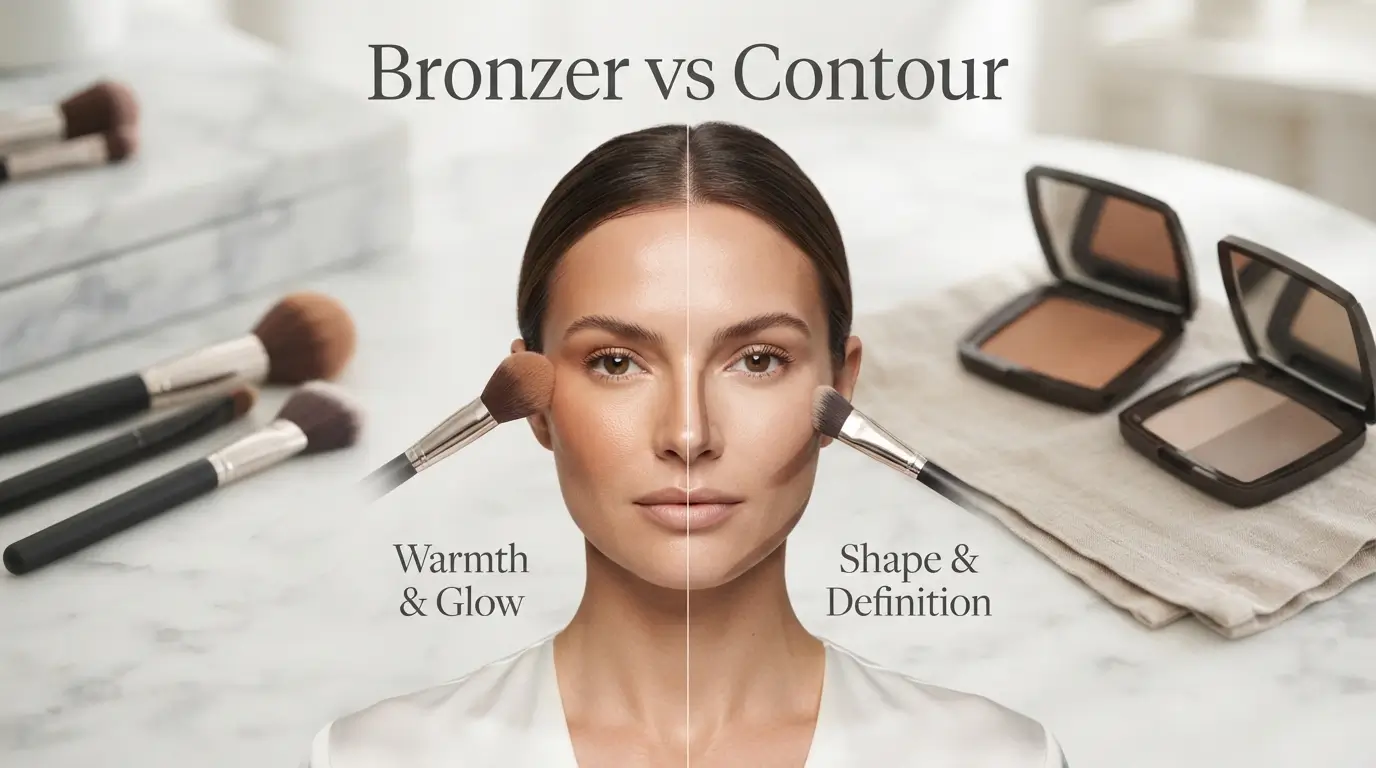
Makeup can change the way your face looks, but different products have different jobs. Two products that often cause confusion are bronzer and contour. They may both add color to the face, yet they are designed to create different effects.
The difference between bronzer and contour becomes easier to understand when you focus on the goal of each product. Bronzer is mainly used to add warmth and create a healthy, sun-kissed appearance. Contour is used to create the appearance of shadows, helping define or emphasize the natural shape of the face.
People often search for the difference between bronzer and contour because the products can look similar in a makeup bag. Both may come in powder, cream, or stick formulas, and both can be applied around areas such as the cheeks. However, their colors, placement, and purpose are not quite the same.
Understanding the difference between bronzer and contour can help you choose the right product, apply it correctly, and avoid a muddy or overly orange makeup look.
Difference Between Bronzer and Contour – Quick Answer
The simplest explanation is:
- Bronzer adds warmth and a sun-kissed effect.
- Contour creates the appearance of shadows and definition.
- Bronzer is usually warmer in tone.
- Contour is usually more neutral or cool-toned.
- Bronzer is often placed where the sun naturally hits the face.
- Contour is placed where natural shadows would appear.
Cambridge Dictionary defines bronzer as a cream or powder applied to the face or body to make the skin look brown, similar to the effect of being in the sun.
Contour, on the other hand, has a broader meaning related to the shape or outline of something. In makeup, Cambridge defines contouring as using darker and lighter areas to create the effect of changing or emphasizing the shape of the face.
A simple way to remember the difference is:
Bronzer = warmth.
Contour = shadow and shape.
For example:
Bronzer:
“She applied bronzer to give her skin a warm glow.”
Contour:
“She used contour under her cheekbones to make them look more defined.”
You can also use both products together. Bronzer can make the face look warmer, while contour can add structure.
The Origin of Bronzer and Contour
The words bronzer and contour come from different linguistic paths.
Where Does “Bronzer” Come From?
The word bronzer is connected to bronze, a word associated with the brown-golden color of the metal and, by extension, a bronzed appearance.
In modern English, bronzer is a straightforward formation from bronze with the suffix -er, creating a noun for something that produces or provides a particular effect.
In cosmetics, the meaning developed around products that give the skin a darker, warmer, bronze-like appearance.
This fits the modern dictionary meaning: bronzer is a cosmetic used to make the skin look brown or sun-kissed.
Where Does “Contour” Come From?
Contour has a much older and broader meaning. It refers to the outline, shape, or curved surface of something.
The word is used in areas such as:
- geography
- art
- design
- clothing
- anatomy
- makeup
Cambridge defines contour as the shape of an object, especially its curved surface or outer edge. It also recognizes contour as a verb meaning to use makeup to create darker and lighter areas that emphasize or alter the appearance of facial shape.
This explains why the word works so well in makeup. Contouring is essentially about visually emphasizing the contours of the face.
Why Are the Terms Different?
The terms describe different cosmetic goals.
Bronzer is named for the warm, bronzed appearance it creates.
Contour is named for the technique of emphasizing facial contours.
Neither word is simply another spelling of the other. They have different meanings and different histories.
Bronzer vs Contour: What Is the Main Difference?
The biggest difference is what you want the product to accomplish.
Bronzer is designed to make the face look warmer and more radiant.
Contour is designed to create shadows that can make certain facial features appear more defined.
Think about natural sunlight.
When sunlight touches your face, some areas become brighter and warmer. Bronzer can imitate some of that warmth.
Now imagine a soft shadow under your cheekbone or along your jaw. Contour is used to imitate or emphasize that kind of shadow.
Bronzer
Bronzer is commonly used on areas such as:
- the forehead
- cheekbones
- bridge of the nose
- temples
- jawline
The exact placement depends on the desired look and the person’s face shape.
The goal is usually not to create a sharp line. Instead, bronzer should blend smoothly into the surrounding makeup.
Contour
Contour is commonly applied to areas such as:
- beneath the cheekbones
- along the jawline
- sides of the nose
- temples
- hairline
The goal is to create the appearance of depth.
Contour can be subtle or dramatic. For everyday makeup, a soft application usually looks more natural.
Bronzer vs Contour Comparison Table
| Feature | Bronzer | Contour |
|---|---|---|
| Main purpose | Adds warmth | Creates definition |
| Visual effect | Sun-kissed glow | Shadow and structure |
| Typical tone | Warm | Neutral or cool |
| Common colors | Golden, caramel, warm brown | Taupe, neutral brown, muted brown |
| Typical placement | High points of the face | Areas where natural shadows fall |
| Finish | Matte, satin, or shimmery | Usually matte |
| Can be cream? | Yes | Yes |
| Can be powder? | Yes | Yes |
| Main goal | Make skin look warmer | Emphasize facial shape |
This table is a useful starting point, but formulas vary. Not every bronzer is strongly orange, and not every contour product is extremely cool.
Why Does Bronzer Look Warmer?
Bronzer is meant to mimic the warmth associated with sun exposure.
That is why bronzers often have undertones such as:
- golden
- honey
- caramel
- peachy brown
- warm tan
However, the best shade depends on your natural skin tone and undertone.
A bronzer that is too orange can look unnatural. A shade that is too dark can also create harsh patches.
The goal is usually a believable warmth rather than a completely different skin color.
Cambridge’s definition reflects this basic purpose by describing bronzer as a cosmetic used to make the skin appear brown, similar to the effect of being in the sun.
Why Does Contour Look More Neutral?
Contour is supposed to imitate a shadow.
Natural shadows are not usually bright orange or golden. They tend to look more muted.
That is why contour products are often:
- taupe
- neutral brown
- muted brown
- slightly cool-toned
However, “cool” does not mean that every contour product must have a gray or ashy appearance.
Your skin tone matters. A contour shade should look like a believable shadow on your particular complexion.
For example, a shade that looks cool on one person may appear neutral on another.
Can You Use Bronzer as Contour?
Yes, but the result may not be the same.
If your bronzer is relatively neutral and matte, you may be able to use it for subtle definition.
But a warm or shimmery bronzer may not work well as a contour product.
A warm bronzer can make an area look more prominent rather than creating the illusion of a recessed shadow.
For example, putting a very warm bronzer directly under your cheekbones may add color without creating the same sculpted effect as a neutral contour shade.
So, if you want strong facial definition, a dedicated contour product is usually easier to control.
Can You Use Contour as Bronzer?
Technically, you can use a contour product to add some depth, but it may not create the warm effect associated with bronzer.
A cool brown contour placed across the high points of the face can look flat, gray, or unnatural if the goal is a sun-kissed appearance.
This is why makeup artists often treat the products as separate steps.
Contour creates structure.
Bronzer adds warmth.
British English vs American English Spelling
There is no meaningful British English versus American English spelling difference between bronzer and contour.
Both varieties use:
- bronzer
- contour
- contouring
The main differences may involve pronunciation rather than spelling.
Cambridge gives these pronunciations:
- bronzer: UK /ˈbrɒn.zər/, US /ˈbrɑːn.zɚ/
- contour: UK /ˈkɒn.tɔːr/, US /ˈkɑːn.tʊr/
So there is no reason to change the spelling based on whether you are writing for a British or American audience.
Pronunciation
Bronzer: roughly BRON-zər in British English and BRON-zər with the American vowel pattern.
Contour: roughly KON-toor in British English and KON-toor with the American vowel pattern.
The vowel sounds can vary by accent, but the words are clearly distinct.
Which Product Should You Use?
The right choice depends on your goal.
Use Bronzer If You Want:
- a warmer complexion
- a sun-kissed effect
- a healthy-looking glow
- more color after applying foundation
- a softer everyday makeup look
Bronzer is especially useful when your foundation has made your complexion look more uniform and you want to bring some warmth back.
Use Contour If You Want:
- more defined cheekbones
- a sharper-looking jawline
- a more sculpted nose
- added facial dimension
- stronger definition for photos or events
Contour is about creating visual depth rather than simply adding color.
Use Both If You Want:
You do not have to choose one.
Many makeup routines use both.
A simple order might be:
- Apply base makeup.
- Add contour for structure.
- Blend it carefully.
- Add bronzer for warmth.
- Add blush and highlighter if desired.
The products can work together because they perform different jobs.
Common Mistakes With Bronzer and Contour
Mistake 1: Using an Orange Bronzer as Contour
A very warm bronzer may not look like a natural shadow.
Better: Choose a neutral or slightly cool contour shade for sculpting.
Mistake 2: Making Contour Too Dark
Heavy contour can create visible stripes instead of soft shadows.
Better: Start with a small amount and build gradually.
Mistake 3: Putting Bronzer Only Under the Cheekbones
This can make the face look more sculpted but may not create a natural sun-kissed effect.
Better: Place bronzer where sunlight would naturally warm the face.
Mistake 4: Using Shimmer for Strong Contour
Shimmer reflects light, while contour is generally intended to create the appearance of shadow.
Better: Choose a mostly matte contour product.
Mistake 5: Ignoring Your Undertone
A shade that works beautifully for one person may look orange, gray, or muddy on another.
Better: Consider whether your skin is warm, cool, neutral, or olive before choosing a shade.
Mistake 6: Applying Too Much Product
More makeup does not always mean more definition.
Better: Build color slowly and blend the edges.
Bronzer and Contour in Everyday Examples
In a Beauty Blog
“Apply bronzer to the high points of your face for a warm, natural finish.”
Here, bronzer is being used to add warmth.
In a Makeup Tutorial
“Blend the contour beneath the cheekbones to create subtle definition.”
Here, contour is being used to create the appearance of shadow.
In a Social Media Caption
“Bronzer for warmth, contour for shape.”
This is a short but useful summary of the difference.
In a Beauty Product Review
“The bronzer blends easily and gives the skin a soft golden finish.”
This focuses on warmth and finish.
In a Makeup Consultation
“Would you like more warmth, more definition, or both?”
This helps identify whether the person needs bronzer, contour, or a combination.
How to Apply Bronzer and Contour Together
You do not need a complicated routine.
Start with your normal base makeup. Then decide whether you want warmth, definition, or both.
If you want definition, apply a small amount of contour to the areas where you want to create shadow.
Blend it well so there are no obvious lines.
Next, apply bronzer to areas that would naturally receive more sunlight. Keep the application light and blend it toward the hairline and cheeks.
The final result should look balanced.
The contour gives the face dimension.
The bronzer brings warmth back into the complexion.
If you also use blush, place it where it complements the bronzer and contour rather than covering them completely.
Is Contour Always Cool-Toned?
No.
This is an important point.
Many people learn that contour must be gray or cool brown. That is too strict.
Contour should imitate a believable shadow on your skin. The best shade depends on your complexion, undertone, lighting, and the intensity of the look.
A neutral contour may work better than a very cool one for some people.
The important distinction is not simply warm versus cool. The more useful distinction is:
Does this product add warmth, or does it create the appearance of shadow?
That question is more reliable than following a fixed color rule.
Is Bronzer Always Shimmery?
No.
Bronzers are available in many finishes, including:
- matte
- satin
- soft sheen
- shimmer
A matte bronzer can provide a very natural effect.
A shimmery bronzer can add more visible glow.
If you want to create realistic facial shadows, however, a matte product is generally easier to use because it does not reflect as much light.
Search Intent and Common Usage
People searching for difference between bronzer and contour are usually trying to solve a practical makeup problem.
They may want to know:
- which product to buy
- whether they need both
- where to apply each product
- why their bronzer looks orange
- why their contour looks muddy
- whether one product can replace the other
- which product is better for everyday makeup
Search interest is not the same as product usage data. A search query tells us what people want to understand, but it does not prove that one product is universally more popular.
The basic intent is clear: users want a simple explanation of two makeup products that can appear similar but serve different purposes.
Frequently Asked Questions
1. What is the difference between bronzer and contour?
Bronzer adds warmth and creates a sun-kissed effect. Contour creates the appearance of shadows and helps emphasize facial structure.
2. Can I use bronzer instead of contour?
You can, especially for soft definition, but the result may be warmer. A neutral contour product is usually better when you want a realistic shadow effect.
3. Can I use contour instead of bronzer?
You can add depth with contour, but it may not provide the warm, glowing effect that bronzer is designed to create.
4. Which goes first, bronzer or contour?
There is no single rule for every makeup routine. Many people apply contour first for structure and then bronzer for warmth, but the best order depends on the formulas and desired finish.
5. Should contour be darker than bronzer?
Not necessarily. Contour should be dark enough to create believable depth without looking harsh. Shade and undertone are often more important than simply choosing the darkest product.
6. Is bronzer warmer than contour?
Usually, yes. Bronzers are commonly designed with warm or golden tones, while contour products are often more neutral or cool. However, formulas vary.
7. Do I need both bronzer and contour?
No. You can use either one. If you want both warmth and stronger definition, however, using the two together can create a more complete look.
Conclusion
Bronzer and contour may look similar, but they create different effects. Bronzer adds warmth, while contour creates the appearance of shadow and facial definition.
The best choice depends on your makeup goal. Choose bronzer for warmth, contour for structure, or combine both for a balanced and polished finish.
You do not need a large collection of products to create beautiful makeup. Learning what each product does can make your routine easier and more natural.
Start with small amounts, blend well, and practice where each product works best. With time, these simple techniques will feel easy and natural.

Aamer Shahzad is the founder of Diffnexx.com, a fast-growing educational platform focused on high-intent “difference between” topics. With over 8 years of experience in English language education and analytical writing, I specialize in breaking down complex “difference between” topics into clear, structured, and easy-to-understand explanations. Diffnexx.com is your go-to resource for enhancing English skills and writing with confidence.
I specializes in building search-optimized, research-driven comparison content designed for clarity, authority, and long-term digital asset value.







