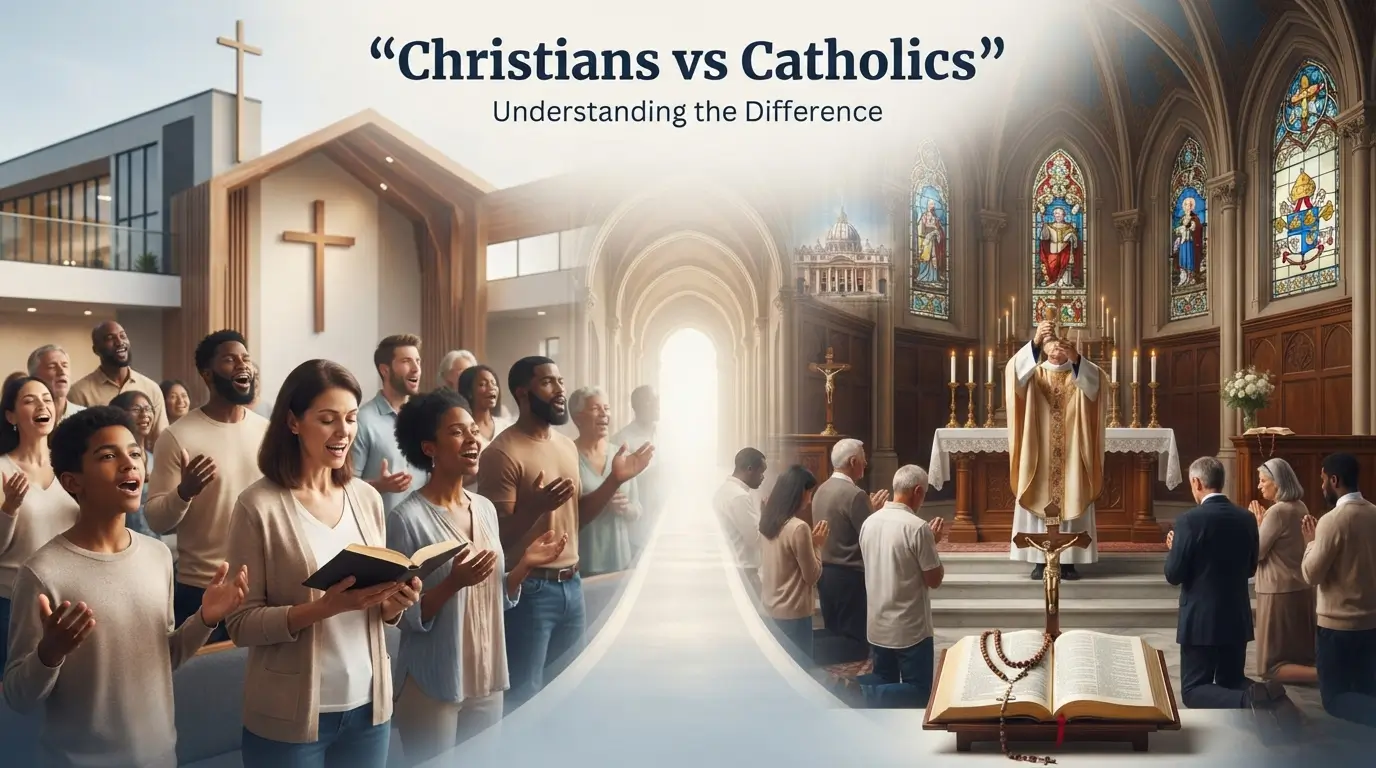
People often search for the difference between Christians and Catholics because the two terms can sound as if they describe separate religions. The relationship is actually more nuanced. Catholicism is a major tradition within Christianity, so Catholics are Christians, but not all Christians are Catholic.
The difference between Christians and Catholics becomes clearer when you look at church authority, worship, sacraments, tradition, and beliefs about the structure of the Church. Catholics share the central Christian belief in Jesus Christ, his death and resurrection, and the importance of the Bible. At the same time, Catholic teaching gives a distinctive role to Sacred Tradition, the bishops, and the Pope.
Understanding the difference between Christians and Catholics can also help when reading religious texts, talking about faith, or comparing Christian denominations. The terms are not simple opposites. One is a broad religious identity, while the other usually refers to a specific Christian tradition.
This guide explains the difference between Christians and Catholics in simple language without treating either group as a single, completely uniform community.
Christians and Catholics – Quick Answer
The simplest answer is this:
Christianity is the broad religion centered on Jesus Christ, while Catholicism is one major tradition within Christianity.
A Catholic is therefore a Christian. Other Christians may belong to Protestant, Eastern Orthodox, Asian Orthodox, Anglican, or other Christian traditions.
The word Christian can be used broadly for people who identify with Christianity. The word Catholic usually refers specifically to members of the Catholic Church.
For example:
- A Catholic Christian attends a Catholic parish.
- A Baptist Christian is Christian but not Catholic.
- An Eastern Orthodox Christian is Christian but not Catholic.
- A Methodist Christian is Christian but not Catholic.
The main differences usually involve church authority, tradition, sacraments, leadership, and certain doctrines.
Catholic teaching describes the Church as apostolic and emphasizes bishops in succession from the apostles, with the Pope as the Bishop of Rome and successor of Peter.
It is also important to avoid saying that “Christians believe X while Catholics believe Y” in every case. Catholics are Christians, and many beliefs are shared across Christianity.
Quick comparison
| Topic | Christians broadly | Catholics |
|---|---|---|
| Religion | Christianity | Christianity |
| Identity | Broad category | Specific Christian tradition |
| Jesus Christ | Central to Christian faith | Central to Catholic faith |
| Bible | Important across Christianity | Sacred Scripture is authoritative |
| Tradition | Varies by denomination | Sacred Tradition has an important role |
| Pope | Not recognized as universal head by most non-Catholic Christians | Pope is the Bishop of Rome and universal pastor |
| Sacraments | Number and meaning vary | Seven sacraments |
| Church structure | Varies widely | Bishops, priests, deacons, and Pope |
| Mary | Importance varies | Honored in a distinctive way |
| Saints | Practices vary | Saints are honored and asked to intercede |
The Origin of Christians and Catholics
The terms Christian and Catholic have different histories.
Christian comes from the Greek Christianos, meaning a follower of Christ. The word is connected with Christos, the Greek form of “Christ,” meaning “anointed one.”
In the New Testament, followers of Jesus are referred to as Christians. The term therefore developed as a name for people associated with Jesus Christ and his movement.
Catholic, meanwhile, comes from the Greek katholikos, commonly understood as meaning “universal” or “according to the whole.” The term became associated with the universal Church.
Historically, the Christian movement developed into many traditions and communities. Over time, differences arose over theology, church authority, worship, and other matters.
One major turning point in Western Christianity was the Protestant Reformation in the 16th century. Protestant churches developed separately from the Roman Catholic Church, although the broader Christian tradition is much older than the Reformation.
This history explains why Christian and Catholic should not be treated as two completely separate religions. Catholicism developed within the historical Christian tradition, while Christianity eventually came to include numerous distinct churches and denominations.
Are Christians and Catholics Pronounced Differently?
Yes.
Christian is commonly pronounced:
KRIS-chun
It has two main syllables.
Catholic is commonly pronounced:
KATH-uh-lik
It has three syllables in ordinary English pronunciation.
The words are not homophones, so pronunciation is usually not the source of confusion. The bigger problem is the relationship between the two terms.
A useful memory trick is:
Christian = the broad category. Catholic = one tradition within that category.
This is similar to saying that a person can be both a Christian and a Catholic at the same time.
British English vs American English Spelling
There is no major British-versus-American spelling difference between Christian and Catholic.
Both British and American English normally use:
- Christian
- Christians
- Catholic
- Catholics
- Christianity
- Catholicism
The pronunciation of some words can vary slightly by accent, but there is no standard British spelling that contrasts with an American spelling for these terms.
Comparison table
| Word | British English | American English |
|---|---|---|
| Christian | Christian | Christian |
| Christians | Christians | Christians |
| Catholic | Catholic | Catholic |
| Catholics | Catholics | Catholics |
| Christianity | Christianity | Christianity |
| Catholicism | Catholicism | Catholicism |
So, if you are writing for a British, American, Canadian, Australian, or other international English audience, you normally do not need to change these spellings.
Which Spelling Should You Use?
Use Christian when you are discussing Christianity broadly.
Use Catholic when you specifically mean the Catholic tradition or Catholic Church.
For example:
Correct:
Catholics are Christians.
Also correct:
Catholic Christians celebrate the Eucharist as a central part of their worship.
But avoid:
Christians and Catholics are two completely different religions.
That statement creates a false distinction because Catholicism is part of Christianity.
If your article is about Christianity as a whole, Christian is usually the broader and more accurate term.
If your article focuses on the Catholic Church, Catholic doctrine, Catholic worship, or Catholic history, use Catholic.
Major Differences Between Christianity and Catholicism
Because Christianity includes many denominations, the most useful comparison is between Catholic Christianity and non-Catholic Christian traditions, especially Protestant traditions.
1. Church authority
One of the most important differences concerns authority.
Catholic teaching gives an important role to Sacred Scripture and Sacred Tradition, interpreted by the Church’s teaching authority, known as the Magisterium. The Catholic Catechism describes Scripture and Tradition as closely connected sources in the transmission of Christian revelation.
Many Protestant traditions place a stronger emphasis on Scripture as the highest or final authority for doctrine, although Protestant churches differ among themselves.
This means there is no single “Christian” position outside Catholicism. Different denominations approach authority in different ways.
2. The Pope
The Pope is a major distinguishing feature of Catholic Christianity.
Catholics recognize the Pope as the Bishop of Rome and successor of Saint Peter. Catholic teaching gives the Pope a unique role in the governance and unity of the Catholic Church.
Most Protestant and Orthodox Christians do not recognize the Pope as their universal church leader.
This is one of the clearest practical differences between Catholicism and many other Christian traditions.
3. The sacraments
Catholicism recognizes seven sacraments:
- Baptism
- Confirmation
- Eucharist
- Penance
- Anointing of the Sick
- Holy Orders
- Matrimony
The Catholic Catechism explicitly identifies these seven sacraments and explains their roles in Christian life.
Other Christian traditions may recognize fewer sacraments or use different terminology. For example, many Protestant churches emphasize Baptism and Communion as the two ordinances or sacraments directly instituted by Christ, although practices vary by denomination.
4. Mary
Catholics give Mary, the mother of Jesus, a distinctive place in Christian devotion.
Catholic teaching honors Mary as the Mother of God and gives her an important role in Catholic prayer and theology.
Other Christians also respect Mary as the mother of Jesus, but they may not accept Catholic teachings and devotional practices concerning her.
The difference is therefore not whether Christians recognize Mary at all. It is largely about how Mary is understood and honored.
5. Saints
Catholic Christianity has a formal tradition of honoring saints and asking for their intercession.
Other Christian traditions vary. Some honor historical Christian figures but do not practice prayers asking saints to intercede.
Catholic teaching connects the communion of saints with the wider life of the Church.
6. Worship
Catholic worship is centered on the Mass, with the Eucharist occupying a central place.
Catholic teaching describes the Eucharist as uniquely central among the sacraments.
Other Christian churches may have very different worship styles. Some use highly structured liturgies, while others emphasize sermons, contemporary music, prayer, or informal gatherings.
There is no single Christian worship style.
Common Mistakes With Christians and Catholics
Mistake 1: Treating Christians and Catholics as opposites
Incorrect idea:
Christians believe in Jesus, while Catholics believe in Jesus differently.
Better:
Catholics are Christians, but Christianity includes many traditions besides Catholicism.
Mistake 2: Assuming every Christian denomination has the same beliefs
Christianity contains many traditions. Catholics, Protestants, Orthodox Christians, and other Christian communities can differ in theology and practice.
Mistake 3: Calling Catholicism a non-Christian religion
Catholicism is a Christian tradition.
Mistake 4: Using “Christian” when you specifically mean “Protestant”
If you mean Protestants, say Protestants.
If you mean all Christians except Catholics, say non-Catholic Christians.
This is much more precise.
Mistake 5: Assuming all Catholics practice their faith in exactly the same way
Catholic doctrine has official teachings, but individual Catholics can differ in personal practice, devotion, and cultural traditions.
Christians and Catholics in Everyday Examples
In an email
“I am researching Christian traditions, including Catholic and Protestant beliefs.”
This is broad and accurate.
In academic writing
“Catholicism is one of the major traditions within Christianity.”
This makes the relationship between the terms clear.
In a news article
“Christian communities around the world include Catholics, Protestants, and Orthodox Christians.”
This avoids treating Catholicism as separate from Christianity.
In social media
“I used to think Christians and Catholics were completely separate groups. Learning about Christian denominations helped me understand the difference.”
This is natural in informal writing.
In conversation
“Are you Christian?”
“Yes, I’m Catholic.”
This exchange is perfectly logical. The second answer gives a more specific description of the person’s Christian tradition.
Christianity vs Catholicism: Comparison Table
| Feature | Christianity | Catholicism |
|---|---|---|
| Meaning | Broad religion centered on Jesus Christ | Major tradition within Christianity |
| Followers | Christians | Catholics |
| Jesus | Central to faith | Central to faith |
| Scripture | Important | Sacred Scripture is authoritative |
| Tradition | Depends on denomination | Sacred Tradition has an important role |
| Pope | Varies; most non-Catholics do not accept him as universal head | Recognized as Pope and Bishop of Rome |
| Sacraments | Varies by tradition | Seven |
| Eucharist/Communion | Understanding varies | Central sacrament |
| Mary | Importance varies | Highly honored |
| Saints | Practices vary | Saints are honored and their intercession is sought |
| Church leadership | Varies greatly | Pope, bishops, priests, and deacons |
| Worship | Varies widely | Mass is central |
What About Protestant and Orthodox Christians?
It is useful to remember that Catholicism is not the only alternative to “Christianity.”
Protestant Christianity includes many traditions, such as:
- Lutheran
- Anglican
- Baptist
- Methodist
- Presbyterian
- Reformed
- Pentecostal
- Evangelical
Eastern Orthodox Christianity is another major Christian tradition, with its own theology, liturgy, and church structure.
Therefore, a simple three-part picture is often more helpful:
Christianity → Catholic, Orthodox, Protestant, and other Christian traditions
The exact classification can become more complex because Christianity contains many churches and communities with different histories and beliefs.
Search Intent and Usage Patterns
People searching for “difference between Christians and Catholics” may have several different goals.
Some want a basic definition. They may simply wonder whether Catholics are Christians.
Others may want to compare beliefs about the Bible, Mary, saints, salvation, sacraments, or church leadership.
Students may also search the phrase while preparing an assignment about Christian denominations or church history.
The search phrase itself does not prove that people hold a particular religious belief. Search interest and actual religious identity are different things.
The safest approach is to explain the relationship clearly: Catholics are Christians, while Christianity is the broader category.
FAQs
1. Are Catholics Christians?
Yes. Catholics are Christians. Catholicism is one major tradition within Christianity.
2. What is the main difference between Christians and Catholics?
The wording is slightly misleading because Catholics are Christians. The more useful comparison is between Catholic Christianity and other Christian traditions.
3. Do Catholics believe in Jesus?
Yes. Jesus Christ is central to Catholic faith and worship.
4. Is Catholicism a separate religion from Christianity?
No. Catholicism is a Christian tradition. Christianity includes Catholicism along with many other traditions.
5. Do all Christians believe the same things as Catholics?
No. Christianity includes many denominations and traditions, and beliefs can differ on church authority, sacraments, worship, and other doctrines.
6. Do Catholics follow the Bible?
Yes. The Bible is Sacred Scripture in Catholic Christianity. Catholic teaching also gives an important role to Sacred Tradition and the Church’s teaching authority.
7. Why do Catholics have a Pope?
The Catholic Church teaches that the Pope is the Bishop of Rome and successor of Saint Peter, with a unique role in the unity and governance of the Catholic Church.
Conclusion
Christianity is the broad faith centered on Jesus Christ, while Catholicism is one major Christian tradition. Knowing this makes the basic relationship much clearer.
The biggest differences appear in church authority, the role of tradition, the Pope, sacraments, worship, and devotion to Mary and the saints.
At the same time, Catholic Christians share the central Christian focus on Jesus. Other Christian traditions may differ in important ways, but they remain part of Christianity.
Learning these terms carefully helps you speak and write about religion with greater accuracy and respect. Keep practicing them in everyday conversations and writing.

Anton Reyes is a contributing writer at DiffNexx.com, where he explores meaningful differences in language, culture, and everyday concepts. With a background in creative nonfiction, Anton brings clarity and balance to complex comparisons. His writing helps readers understand subtle distinctions in words and ideas, making learning both insightful and engaging.







