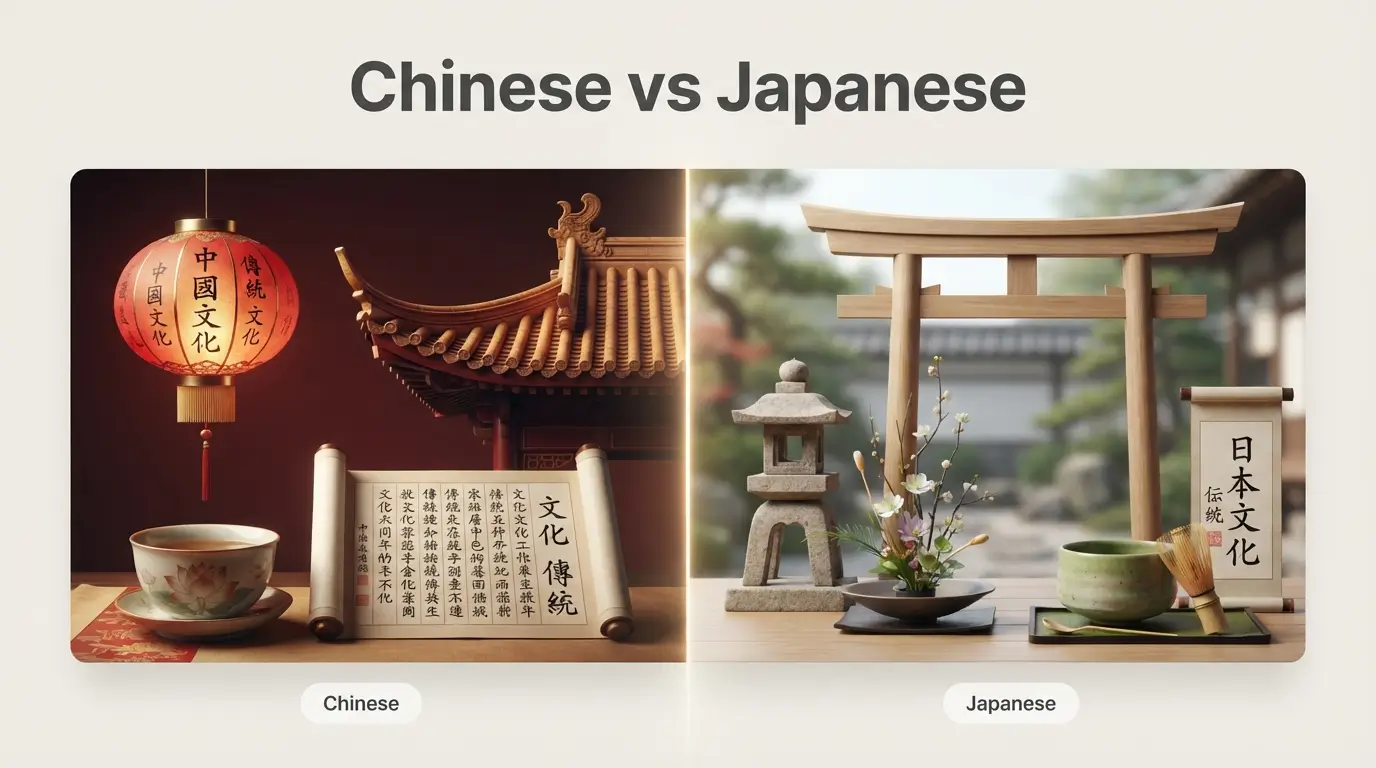
At first glance, Chinese and Japanese can look surprisingly similar. Both are East Asian languages, both have strong historical links, and Japanese writing uses many Chinese characters. This is why people often search for the difference between Chinese and Japanese when they see similar characters, hear unfamiliar words, or try to understand the two cultures.
The difference between Chinese and Japanese is much larger than their shared writing history suggests. Chinese and Japanese are different languages with different grammar, pronunciation, sentence structure, and sound systems. Japanese uses Chinese-derived characters called kanji, but it also uses two native syllabaries, hiragana and katakana. Chinese writing uses Chinese characters, commonly called hanzi.
The difference between Chinese and Japanese also appears in culture, naming systems, food, social customs, and history. However, it is important not to treat either China or Japan as culturally uniform. Both have regional and historical diversity.
This guide explains the major differences in simple terms so you can tell the languages apart, understand their writing systems, and avoid common mistakes.
Difference Between Chinese and Japanese – Quick Answer
The easiest answer is:
Chinese and Japanese are different languages, but Japanese adopted Chinese characters as part of its writing system.
Chinese belongs to the Sinitic branch of the Sino-Tibetan language family. Japanese belongs to the Japonic language family. Their relationship is therefore not the same as the relationship between two closely related languages such as Spanish and Italian.
Japanese borrowed a large amount of vocabulary and writing influence from Chinese over many centuries. However, Japanese developed its own grammar and pronunciation system.
Quick comparison
| Feature | Chinese | Japanese |
|---|---|---|
| Main language family | Sino-Tibetan | Japonic |
| Writing | Chinese characters | Kanji + hiragana + katakana |
| Word order | Generally Subject-Verb-Object | Generally Subject-Object-Verb |
| Tones | Mandarin uses lexical tones | Japanese uses pitch accent rather than Mandarin-style tones |
| Grammar | Relatively little grammatical inflection | Uses particles and verb/adjective inflections |
| Chinese characters | Native writing system | Borrowed and adapted as kanji |
| Pronunciation | Very different from Japanese | Very different from Chinese |
| Basic writing appearance | Mostly characters | Mix of kanji and kana |
| Politeness system | Varies by Chinese language | Highly developed honorific system |
Oxford Academic notes that Japanese may look similar to Chinese in writing but differs greatly in its phonological system, grammatical categories, and syntax.
The Origin of Chinese and Japanese
The historical connection between Chinese and Japanese is mainly connected to writing, literature, religion, government, and cultural exchange, rather than a simple shared linguistic origin.
Chinese civilization developed a long-established writing tradition based on Chinese characters. Japan later adopted Chinese characters and elements of Chinese literary culture.
Chinese characters became part of Japanese writing, but Japanese speakers adapted them to their own language. Over time, this led to the development of kanji, hiragana, and katakana.
The history is complex because Japanese did not simply become a form of Chinese. The Japanese language continued to have its own grammar and native vocabulary.
Japan’s use of Chinese characters also created multiple readings for many kanji. Some readings are based on Chinese-derived pronunciations, while others represent native Japanese words.
For example, the character 水 is associated with water. In Japanese, it can be read mizu as a native Japanese word and sui in certain Chinese-derived compounds.
This is one reason Japanese can look familiar to someone who knows Chinese while sounding completely different when spoken.
Historical sources also show that Japan’s adoption of Chinese writing involved adaptation rather than simple copying.
Are Chinese and Japanese Pronounced the Same?
No. Chinese and Japanese pronunciation systems are substantially different.
One of the biggest differences is that Mandarin Chinese is tonal. In Mandarin, changing the tone can change the meaning of a syllable. The British Council describes Mandarin as having four basic tones plus a neutral tone.
Japanese does not use tones in the same way. Standard Japanese has a pitch-accent system, where differences in high and low pitch can distinguish words or grammatical patterns.
This means a Mandarin speaker and a Japanese speaker may pronounce characters that look identical in very different ways.
For example:
| Character | Mandarin | Japanese |
|---|---|---|
| 山 | shān | yama / san |
| 水 | shuǐ | mizu / sui |
| 人 | rén | hito / jin / nin |
| 学 | xué | gaku |
These are simplified examples, and the Japanese reading depends on the word and context.
The visual similarity does not mean the spoken languages are mutually understandable.
Chinese vs Japanese Writing Systems
This is perhaps the most noticeable difference.
Chinese writing
Modern Chinese is primarily written with Chinese characters.
For example:
你好
This means “hello” in Mandarin and is commonly pronounced nǐ hǎo.
There are two major standardized character forms in modern use:
- Simplified Chinese
- Traditional Chinese
Simplified characters are widely used in mainland China and Singapore, while traditional characters are widely used in Taiwan and Hong Kong.
Japanese writing
Japanese uses three major writing components:
- Kanji
- Hiragana
- Katakana
For example:
私は日本語を勉強します。
This sentence contains kanji and hiragana.
Japanese uses kanji for many content words, while hiragana is used for grammatical endings, particles, and many native words. Katakana is often used for foreign words, names, emphasis, and certain specialized terms.
The British Council also notes that Japanese uses Chinese-derived characters alongside two kana systems, while the grammar and pronunciation remain different from Chinese.
Why Do Chinese and Japanese Characters Look Similar?
The reason is historical borrowing.
Japan adopted Chinese characters and adapted them to represent Japanese words. As a result, modern Japanese contains many characters that originated in the Chinese writing tradition.
However, similar appearance does not guarantee identical meaning or pronunciation.
Some characters have closely related meanings in both languages. Others have developed different meanings or uses.
This can create a false impression that Chinese and Japanese are almost the same written language.
They are not.
Japanese writing is a combination of kanji and kana, while Chinese relies much more heavily on characters.
Grammar: Chinese vs Japanese
Grammar provides one of the clearest differences.
Chinese sentence structure
Mandarin Chinese generally follows:
Subject + Verb + Object
For example:
I eat rice.
A simplified Mandarin structure is:
我吃饭。
The order is broadly similar to English.
Japanese sentence structure
Japanese generally follows:
Subject + Object + Verb
For example, a simplified Japanese sentence might follow the pattern:
I rice eat.
Japanese also uses particles to show grammatical relationships.
For instance, は can mark a topic, while を commonly marks a direct object.
This means Japanese sentence structure can look very different from Chinese even when the subject matter is identical.
Comparison
| Feature | Chinese | Japanese |
|---|---|---|
| Typical basic order | Subject–Verb–Object | Subject–Object–Verb |
| Particles | Limited compared with Japanese | Central to grammar |
| Verb position | Usually before object | Usually after object |
| Grammatical endings | Relatively limited | Extensive verb/adjective inflection |
| Topic marking | Exists | Very prominent |
Vocabulary: Shared History, Different Languages
Chinese has influenced Japanese vocabulary for centuries.
Japanese has many words called Sino-Japanese vocabulary, often known as kango. These words were built from Chinese characters and are an important part of Japanese vocabulary.
This creates another source of confusion.
Two words may use the same or similar characters but have different pronunciations.
For example:
中国
In Mandarin Chinese, it is pronounced approximately Zhōngguó.
In Japanese, it is Chūgoku.
The written characters are the same, but the pronunciation is different.
Some meanings also differ depending on the language.
Therefore, learning Chinese characters can help someone recognize certain Japanese words, but it does not automatically mean they can understand Japanese.
Chinese and Japanese Culture
Language is only one part of the comparison.
China and Japan have long and complex histories, and both have developed distinct cultural traditions.
Food
Chinese cuisine includes many regional traditions, such as Sichuan, Cantonese, Shandong, Jiangsu, and others.
Japanese cuisine includes traditions such as sushi, sashimi, tempura, ramen, soba, udon, and many regional dishes.
Some foods and cooking techniques have historical connections across East Asia, but they developed in different cultural settings.
Writing and literature
Chinese literary traditions had a major influence on Japan, especially in earlier periods.
Japan later developed distinctive literary forms and works of its own, including The Tale of Genji, haiku, and modern Japanese literature.
Religion and philosophy
Both societies have been influenced by traditions such as Buddhism and forms of Confucian thought, but those traditions developed differently in each country.
Shinto is especially associated with Japan, while China’s religious landscape includes a complex mixture of Buddhism, Daoism, Confucian traditions, folk practices, and other beliefs.
These broad descriptions should not be treated as a complete picture of either country’s modern population.
Chinese vs Japanese Names
Names can also cause confusion.
Chinese names are commonly written with the family name first in Chinese contexts.
For example:
Li Wei
Here, Li may be the family name and Wei the given name.
Japanese names also traditionally place the family name before the given name in Japanese contexts.
For example:
Yamada Taro
Here, Yamada is the family name.
However, romanized names may appear in different orders depending on publication standards, international settings, or personal preference.
Therefore, name order alone is not always enough to determine whether someone is Chinese or Japanese.
British English vs American English Spelling
There is no meaningful British-versus-American spelling difference for the terms Chinese and Japanese.
Both varieties normally use:
- Chinese
- Japan
- Japanese
- China
- Chinese language
- Japanese language
The main differences you may encounter involve romanization systems, not British versus American English spelling.
For Chinese, Hanyu Pinyin is the standard romanization system used for Mandarin in many international contexts.
For Japanese, rōmaji systems represent Japanese using the Latin alphabet.
Comparison table
| Term | British English | American English |
|---|---|---|
| Chinese | Chinese | Chinese |
| Japanese | Japanese | Japanese |
| China | China | China |
| Japan | Japan | Japan |
| Mandarin | Mandarin | Mandarin |
| Tokyo | Tokyo | Tokyo |
So there is no reason to change these spellings based on whether your audience uses British or American English.
Which Spelling Should You Use?
Use Chinese when referring to China, Chinese people, Chinese language varieties, or Chinese culture.
Use Japanese when referring to Japan, Japanese people, Japanese language, or Japanese culture.
Be precise when discussing language.
For example:
Mandarin Chinese is a major Chinese language variety.
is more precise than saying:
Mandarin is the Chinese language.
Likewise:
Japanese uses kanji alongside hiragana and katakana.
is more accurate than saying:
Japanese is written in Chinese.
The latter is incorrect because Japanese has its own language and writing system.
Common Mistakes With Chinese and Japanese
Mistake 1: Thinking Japanese is a form of Chinese
Incorrect:
Japanese is basically Chinese written differently.
Correct:
Japanese is a separate language that historically adopted Chinese characters and borrowed substantial vocabulary from Chinese.
Mistake 2: Assuming the characters are pronounced the same
A Chinese character can have a completely different pronunciation in Japanese.
Mistake 3: Calling all Chinese people “Mandarin speakers”
China has many language varieties. Mandarin is extremely important, but it is not the only Chinese language variety.
Mistake 4: Assuming Japanese uses only Chinese characters
Japanese uses kanji, hiragana, and katakana.
Mistake 5: Assuming similar characters always have identical meanings
Some characters and compounds have similar meanings, but others differ in use or meaning.
Mistake 6: Using “Chinese” to describe Japanese culture
China and Japan have distinct national histories and cultural traditions. Shared historical influence does not make them culturally identical.
Chinese and Japanese in Everyday Examples
In an email
“Could you clarify whether this document is translated from Chinese or Japanese?”
This is useful when working with multilingual documents.
In academic writing
“Japanese writing incorporates Chinese characters but follows Japanese grammatical and phonological rules.”
This clearly separates the writing system from the language itself.
In a news article
“The Japanese government announced a new policy, while Chinese officials issued a separate response.”
The nationality terms should not be treated as interchangeable.
On social media
“I can recognize some kanji because I studied Chinese characters, but Japanese grammar is still very different.”
This is a natural way to describe the relationship.
Chinese vs Japanese: Complete Comparison Table
| Category | Chinese | Japanese |
|---|---|---|
| Country most associated with language | China | Japan |
| Language family | Sino-Tibetan | Japonic |
| Writing system | Chinese characters | Kanji, hiragana, katakana |
| Mandarin tones | Four basic tones + neutral tone | Not a Mandarin-style tonal system |
| Pitch accent | Not the same as Japanese pitch accent | Present in standard Japanese |
| Basic word order | Usually SVO | Usually SOV |
| Chinese characters | Native writing system | Historically borrowed and adapted |
| Grammar | Relatively analytic | Uses particles and inflections |
| Honorific system | Varies among Chinese varieties | Highly developed |
| Major writing distinction | Simplified/traditional characters | Kanji + kana |
| Common romanization | Pinyin for Mandarin | Rōmaji systems |
| Relationship | Source of major historical influence on Japanese | Borrowed writing and vocabulary from Chinese |
FAQs About the Difference Between Chinese and Japanese
1. Are Chinese and Japanese the same language?
No. They are different languages with different grammar, pronunciation, and linguistic histories.
2. Can Chinese speakers understand Japanese?
Not automatically. A Chinese speaker may recognize some Japanese characters, but spoken Japanese is not generally understandable to a Mandarin speaker without study.
3. Why does Japanese look like Chinese?
Japanese adopted Chinese characters as part of its writing system. Those characters became kanji and are still used in modern Japanese.
4. Is Japanese derived from Chinese?
No. Japanese is not simply a descendant of Chinese. It developed as a separate language, although Chinese had a major influence on its vocabulary and writing.
5. Which is easier to learn, Chinese or Japanese?
There is no universal answer. A learner’s native language, previous experience, goals, and exposure all matter. Chinese may present major challenges with tones and characters, while Japanese involves kanji, kana, particles, and several levels of politeness.
6. Does Japanese use Chinese characters?
Yes. Japanese uses kanji, which originated from Chinese characters and were adapted for Japanese.
7. Are Chinese and Japanese characters identical?
Some characters are identical or very similar, but not all are. Modern Chinese and Japanese also use different character forms in some cases, and the characters can have different meanings or readings.
Conclusion
Chinese and Japanese share a fascinating historical connection, but they are not the same language. Their grammar, pronunciation, and writing systems developed along different paths.
The strongest link is writing. Japan adopted Chinese characters and transformed them into part of a broader Japanese writing system that also includes hiragana and katakana.
Learning this difference helps you avoid common mistakes and makes both languages easier to understand. Similar characters do not mean identical language or culture.
If you are studying either language, keep comparing real examples. A little practice with characters, sounds, and sentence structure can quickly sharpen your understanding.

Aamer Shahzad is the founder of Diffnexx.com, a fast-growing educational platform focused on high-intent “difference between” topics. With over 8 years of experience in English language education and analytical writing, I specialize in breaking down complex “difference between” topics into clear, structured, and easy-to-understand explanations. Diffnexx.com is your go-to resource for enhancing English skills and writing with confidence.
I specializes in building search-optimized, research-driven comparison content designed for clarity, authority, and long-term digital asset value.







