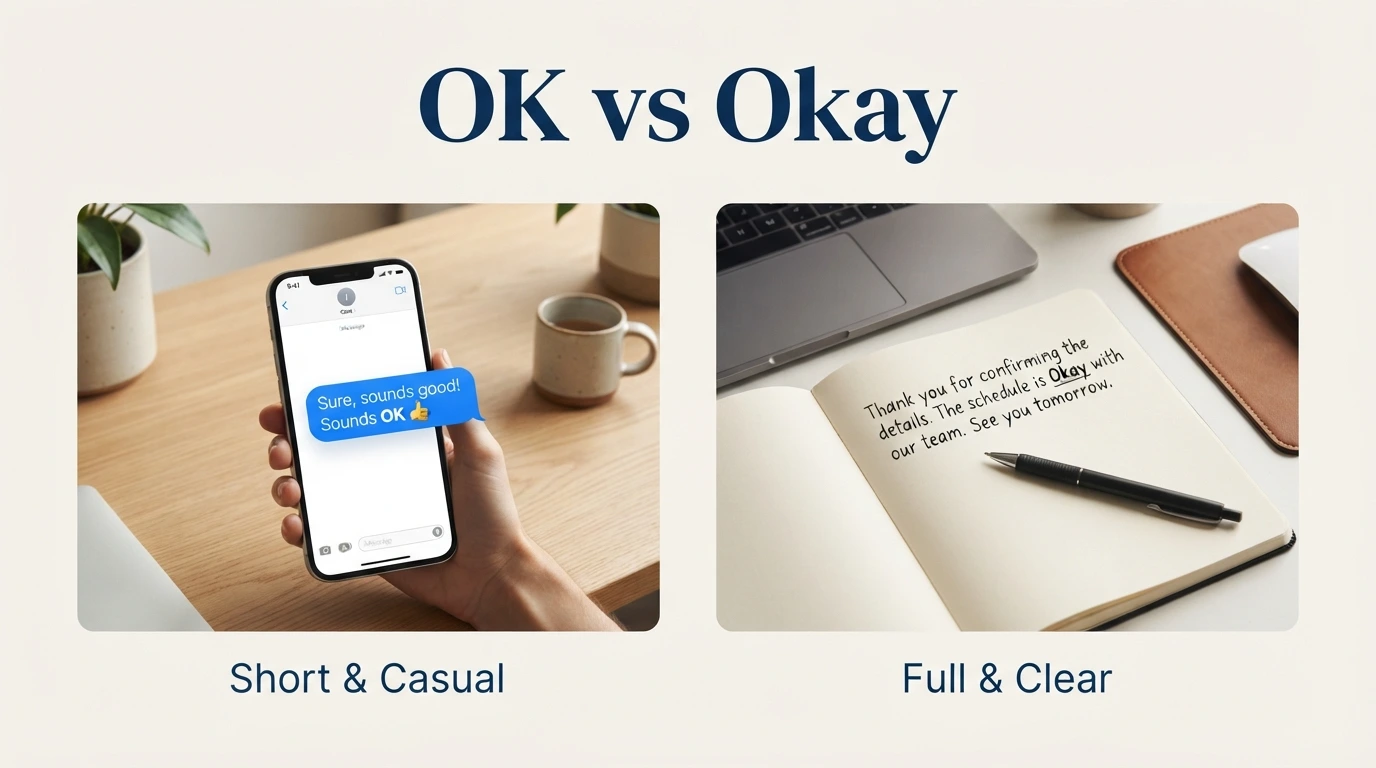
Words do not always need to be difficult to cause confusion. OK and okay are a perfect example. They usually mean the same thing, yet many English learners wonder which form is correct, whether one is more formal, and if there is a real difference between them.
The difference between ok and okay is mainly a matter of spelling, style, and context rather than meaning. Both forms can express agreement, acceptance, approval, or a satisfactory condition. For example, “Are you okay?” and “Are you OK?” communicate the same basic question.
People often search for the difference between ok and okay because they see both forms in text messages, emails, books, news articles, and everyday conversations. The difference between ok and okay can also matter when choosing a style for professional or academic writing.
Learning the difference between ok and okay helps you avoid unnecessary uncertainty. This guide explains where the two forms came from, how they work grammatically, whether British and American English prefer one form, common mistakes, and the best choice for different situations.
Difference Between OK and Okay – Quick Answer
The short answer is simple: OK and okay generally have the same meaning and are pronounced the same way.
Both can mean:
- satisfactory
- acceptable
- all right
- agreed
- permitted
- not harmful or problematic
Examples:
The plan is OK.
The plan is okay.
Both sentences mean that the plan is acceptable or satisfactory.
You can also use both forms to ask about someone’s condition:
Are you OK?
Are you okay?
Again, the meaning is essentially the same.
The main difference is form and style.
Okay is the fully spelled-out form and often looks more natural in ordinary prose. OK is a shorter form that is extremely common in signs, messages, headlines, labels, instructions, and informal communication.
| Form | Meaning | Common use |
|---|---|---|
| OK | All right, acceptable, agreed | Short writing, messages, signs |
| okay | All right, acceptable, agreed | General prose and conversation |
| OK? | Is that acceptable? | Questions and messages |
| okay? | Is that acceptable? | General writing and speech |
Neither spelling is automatically wrong.
The Origin of OK and Okay
The history of OK is unusual because it began as a playful abbreviation rather than as a traditional word shortened in the normal way.
The form OK became popular in the United States during the 19th century. It is widely associated with a humorous abbreviation based on the deliberately misspelled phrase “oll korrect,” meaning “all correct.”
The abbreviation appeared in American newspaper culture during the 1830s, when playful misspellings and humorous abbreviations were fashionable. OK later became much more widely used and eventually developed into an ordinary English word.
The exact history of its spread has been studied by linguists and historians, and the “oll korrect” explanation is the well-supported origin for the abbreviation.
How Did “Okay” Develop?
Okay is a later spelling of OK. It represents the abbreviation as a pronounceable word.
In other words:
OK → okay
The spelling okay became established as a written form that corresponds more closely to how the word sounds when spoken.
This explains why the two forms are pronounced alike despite looking different.
The history does not suggest that okay and OK began as two completely different words with separate meanings. They are closely connected forms of the same word.
Is “OK” an Acronym?
Not in the modern sense people sometimes assume.
A common misunderstanding is that OK originally stood for phrases such as “zero killed,” “Old Kinderhook,” or other proposed expressions. Some of these theories have appeared over time, but the historical evidence for the humorous “oll korrect” explanation is much stronger.
Old Kinderhook did play a role in the later popularity of the expression because it was associated with Martin Van Buren’s 1840 presidential campaign, but it was not the original creation of OK.
Pronunciation of OK and Okay
OK and okay have the same standard pronunciation.
They are usually pronounced:
oh-KAY
The first syllable sounds like the letter O, followed by the sound represented by the letter K.
Examples:
Are you okay?
Are you OK?
Both are pronounced:
oh-KAY
This makes OK and okay different from many word pairs that create pronunciation problems. There is normally no meaningful pronunciation difference between these two spellings.
Part of Speech
OK and okay are flexible words. They can function in several grammatical roles.
Adjective
They can describe something satisfactory or acceptable.
The food was okay.
The food was OK.
Adverb
They can describe an action done satisfactorily.
She did okay on the test.
Verb
They can mean to approve or authorize something.
The manager OK’d the request.
The spelling okay can also appear as a verb:
The manager okayed the request.
Noun
They can refer to approval or permission.
We need your OK before we continue.
Interjection
They can be used as a response.
Okay, let’s begin.
This flexibility is one reason the word appears so often in everyday English.
British English vs American English Spelling
Unlike pairs such as colour/color or centre/center, OK and okay do not represent a major British-versus-American spelling difference.
Both British and American English use OK and okay.
The difference is mainly one of style, context, and personal or editorial preference.
| Situation | British English | American English |
|---|---|---|
| General prose | okay / OK | okay / OK |
| Text messages | OK / okay | OK / okay |
| Formal documents | OK / okay, depending on style | OK / okay, depending on style |
| Signs and labels | OK | OK |
| Pronunciation | oh-KAY | oh-KAY |
| Meaning | Essentially the same | Essentially the same |
There is no reliable rule saying that British English must use okay while American English must use OK.
Both varieties recognize both forms.
What About “O.K.”?
You may also encounter the older-looking form O.K.
For example:
The proposal was O.K.
This punctuation was once more common, but modern English generally favors OK without periods.
So, for contemporary writing, OK is usually the cleaner choice.
Which Spelling Should You Use?
The best choice depends on your audience and the type of writing.
Use “Okay” for Natural General Prose
If you are writing an article, essay, personal message, or general piece of prose, okay is often a smooth choice.
Example:
It is okay to ask questions.
The full spelling looks natural and easy to read.
Use “OK” for Short Responses
OK works especially well when you want a brief response.
OK, I’ll call you later.
It is also common in:
- text messages
- chats
- buttons
- signs
- labels
- short instructions
Use Your Publication’s Style Guide
Professional organizations may have their own preferences.
If a company, university, newspaper, or publisher specifies OK, use OK consistently.
If it prefers okay, use okay.
Consistency matters more than choosing one as universally “correct.”
For International English
Both forms are widely understood.
If you want a simple, fully spelled-out form in general educational writing, okay is a safe choice.
If space is limited or the tone is brief, OK is equally clear.
Common Mistakes with OK and Okay
Mistake 1: Thinking One Form Is Incorrect
Both OK and okay are established English forms.
Incorrect assumption:
Only okay is correct.
Better:
Both OK and okay are standard forms.
Mistake 2: Assuming They Have Different Meanings
In most everyday contexts, there is no major difference in meaning.
The movie was OK.
The movie was okay.
Both can mean that the movie was satisfactory, although context and tone can affect how strongly the statement feels.
Mistake 3: Using “Okay” and “OK” Randomly in Formal Branding
A company or publication may choose one form as part of its style.
If you are writing professionally, check the organization’s preferred style instead of switching between forms without reason.
Mistake 4: Confusing “OK” With “O.K.”
O.K. is understandable, but OK is the more common modern form.
For most current writing, use:
OK
rather than:
O.K.
Mistake 5: Overusing “Okay” in Formal Writing
Although okay is a standard word, it can sometimes sound conversational.
For formal writing, consider a more precise word when appropriate:
- acceptable
- satisfactory
- approved
- adequate
- permitted
For example:
The proposal is acceptable.
may be more precise than:
The proposal is okay.
The right choice depends on your intended tone.
Difference Between OK and Okay in Everyday Examples
In Emails
Both forms can work in casual emails.
Okay, I’ll send the document this afternoon.
Or:
OK, I’ll send the document this afternoon.
In a highly formal email, you may want to replace either with a more specific response:
I confirm that the proposed schedule is acceptable.
In Text Messages
OK is especially common because it is short.
OK, see you at 7.
But okay is also completely natural:
Okay, see you at 7.
The choice may depend on tone. In some contexts, OK can feel brief or firm, while okay can feel slightly more conversational. This is a matter of perceived tone, not a fixed dictionary difference.
In News Writing
Both can appear in news writing, but professional news style may favor more precise wording when the context calls for it.
Instead of:
The plan is OK.
A news report might say:
Officials approved the plan.
However, when quoting a person or reporting ordinary speech, OK or okay can be appropriate.
In Social Media
Both forms are common:
Okay, this is amazing!
OK, I did not expect that.
Social media allows greater flexibility, so either spelling can fit naturally.
In Formal Writing
Formal writing often benefits from more precise vocabulary.
Instead of:
The results are okay.
You might write:
The results are satisfactory.
Instead of:
Is this okay?
you could write:
Is this acceptable?
Still, okay itself is not grammatically incorrect in formal writing. The issue is usually tone and precision, not correctness.
OK vs Okay Comparison Table
| Feature | OK | Okay |
|---|---|---|
| Meaning | All right, acceptable, agreed | All right, acceptable, agreed |
| Pronunciation | Oh-KAY | Oh-KAY |
| Origin | Historical abbreviation | Spelled-out form of OK |
| Formality | Neutral, context-dependent | Neutral, context-dependent |
| Common in texting | Very common | Very common |
| Common in prose | Common | Very common |
| British English | Used | Used |
| American English | Used | Used |
| Can be a verb | Yes | Yes |
| Can be an adjective | Yes | Yes |
| Can be an interjection | Yes | Yes |
| Main difference | Shorter form | Full written form |
Tone: Can OK and Okay Feel Different?
Although their dictionary meanings are generally the same, the two forms can sometimes create slightly different visual or emotional impressions.
Consider:
OK.
This may look short and final.
Now compare:
Okay.
This can look a little more conversational.
However, punctuation and context often have a greater effect on tone than spelling alone.
Compare:
OK!
Okay!
Both may sound friendly and enthusiastic.
Compare:
OK.
Okay.
Both could sound neutral, brief, or even slightly cold depending on the conversation.
Therefore, do not treat the difference in tone as a strict grammar rule.
Is “OK” Formal or Informal?
OK is not simply an informal word.
It is widely established in standard English and appears in many types of writing. However, it is often less precise than alternatives such as acceptable, approved, or satisfactory.
For example, in a business report:
The equipment is OK.
might be acceptable in a casual internal note, but:
The equipment is in satisfactory condition.
sounds more precise.
The choice depends on what you need to communicate.
Google Search Intent and Usage Patterns
People searching for difference between ok and okay usually want a practical answer. They may have noticed both forms and want to know whether one is grammatically correct.
Common search intentions include:
- checking whether OK and okay mean the same thing
- learning which spelling is correct
- choosing the best form for formal writing
- understanding American and British usage
- checking punctuation
- improving English vocabulary
- understanding the origin of OK
Search interest does not automatically tell us how frequently people use each spelling in everyday language. Without verified live search data, specific search-volume figures or percentage comparisons should not be presented as facts.
The most useful conclusion is that both forms are established, while okay is the fully spelled-out version and OK is the shorter form.
FAQs
1. Is OK or okay correct?
Both are correct and widely accepted. OK is the shorter form, while okay is the fully spelled-out form.
2. Is there a difference between OK and okay?
There is usually no difference in basic meaning. Both can mean satisfactory, acceptable, agreed, or all right.
3. Are OK and okay pronounced differently?
No. They are normally pronounced the same way: oh-KAY.
4. Is okay more formal than OK?
Not necessarily. Okay may look more natural in continuous prose, while OK is shorter and common in many contexts. Neither is automatically more formal.
5. Do British and American English use different spellings?
No major regional spelling difference exists. Both British and American English use OK and okay.
6. Can OK be used as a verb?
Yes. For example: The manager OK’d the request. The spelling okayed is also possible.
7. Should I use OK or okay in an essay?
Either can be grammatically correct, but academic writing often benefits from more precise words such as acceptable, satisfactory, or approved, depending on the meaning.
Conclusion
The difference between OK and okay is much smaller than it may first appear. Both forms express approval, agreement, or a satisfactory condition in most everyday situations.
OK is the shorter form, while okay is the fully spelled-out version. Neither belongs only to British or American English, and both remain widely understood.
When writing, choose the form that fits your tone, audience, and style guide. In formal work, consider a more precise word when it improves clarity and meaning.
The more you see these forms in real English, the easier the choice becomes. Keep practicing them in emails, essays, and daily conversations to build confidence.

Aamer Shahzad is the founder of Diffnexx.com, a fast-growing educational platform focused on high-intent “difference between” topics. With over 8 years of experience in English language education and analytical writing, I specialize in breaking down complex “difference between” topics into clear, structured, and easy-to-understand explanations. Diffnexx.com is your go-to resource for enhancing English skills and writing with confidence.
I specializes in building search-optimized, research-driven comparison content designed for clarity, authority, and long-term digital asset value.







