Words can look simple until they appear in a contract, real estate listing, application, or business email. Pending and contingent are two such words. Both describe situations that are not fully settled, but they do not mean the same thing.
The difference between pending and contingent is mainly about what keeps something from being final. Pending usually means an action, decision, or process is still waiting to be completed. Contingent means an outcome depends on a particular condition being satisfied.
Understanding the difference between pending and contingent is especially useful in real estate. A property marked “pending” is generally further along in the transaction than one marked “contingent,” although exact listing definitions can vary. Outside real estate, the same basic distinction applies.
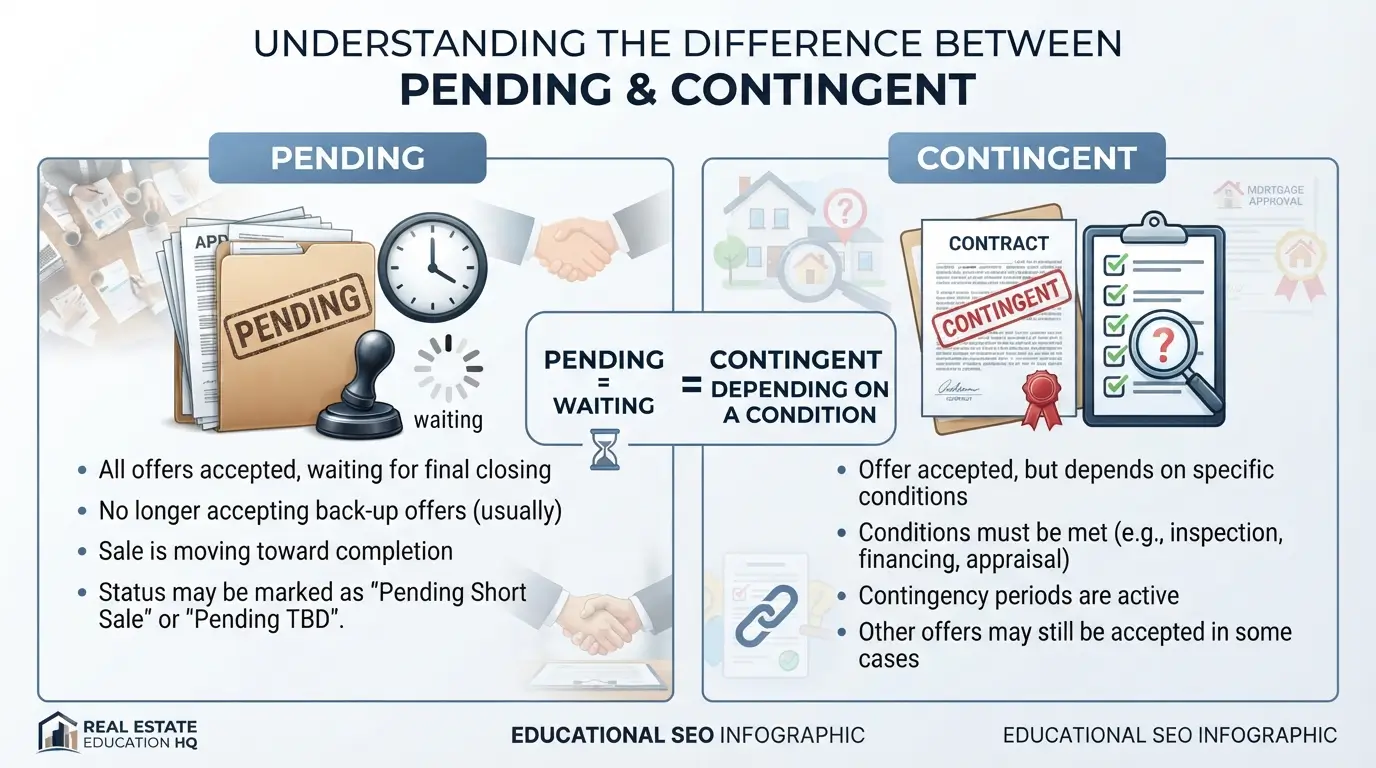
If you are searching for the difference between pending and contingent, you may want to know which word belongs in a sentence, what each status means, or whether the two terms can describe the same situation. The good news is that the core rule is easy: pending means waiting; contingent means depending.
Difference Between Pending and Contingent – Quick Answer
The simplest way to understand the difference between pending and contingent is:
- Pending = waiting for something to be completed, decided, or resolved.
- Contingent = dependent on a condition, event, or requirement.
Consider these two sentences:
The application is pending.
The application has not received its final result yet.
The application is contingent on additional documents.
The application depends on those documents being provided or accepted.
The two words can describe an unresolved situation, but they focus on different things.
What does pending mean?
Pending describes something that is still awaiting action or a final outcome.
Examples include:
- Pending approval
- Pending payment
- Pending review
- Pending investigation
- Pending decision
- Pending transaction
For example:
Your refund is pending.
This means the refund has not yet been completed.
What does contingent mean?
Contingent means dependent on something else.
For example:
The agreement is contingent on final approval.
The agreement depends on approval.
Another example:
The purchase is contingent upon financing.
The purchase depends on financing being obtained.
An easy memory trick
Remember these two words as:
Pending = waiting
Contingent = depending
This simple distinction will help you choose the correct word in most everyday situations.
The Origin of Pending and Contingent
Pending and contingent come from different Latin roots, and their histories help explain their modern meanings.
Origin of pending
Pending is related to the Latin verb pendere, meaning “to hang” or “to weigh.” The idea of something hanging eventually developed into a figurative sense of something being undecided or unresolved.
This meaning is still visible in modern expressions such as:
pending approval
pending investigation
pending decision
Something that is pending is, in a sense, still “hanging” while people wait for the next action or result.
The English word developed through Latin and French influence rather than being created as a modern business term.
Origin of contingent
Contingent comes from Latin contingere, a verb associated with ideas such as touching, happening, or befalling. It entered English through French and Latin-derived usage.
Its modern sense developed around the idea that an event or result depends on circumstances.
For example:
The deal is contingent on financing.
The deal may happen, but its progress or completion depends on financing.
Why do the meanings differ?
The words developed from different ideas.
Pending is linked to something being unresolved or “hanging.”
Contingent is linked to something occurring depending on circumstances.
Their histories therefore fit their modern meanings quite well:
Pending → an unresolved matter
Contingent → a conditional matter
Neither word is a spelling variation of the other. They are separate words with different histories and functions.
Pronunciation of Pending and Contingent
The pronunciation of these words is different, so they are not normally confused because they sound alike.
Pending
Pending is pronounced approximately:
PEN-ding
IPA:
/ˈpɛndɪŋ/
The main stress is on the first syllable.
Contingent
Contingent is commonly pronounced:
kun-TIN-jənt
IPA:
/kənˈtɪndʒənt/
The main stress falls on the second syllable.
Pronunciation comparison
| Word | Simple pronunciation | Stress |
|---|---|---|
| pending | PEN-ding | First syllable |
| contingent | kun-TIN-jənt | Second syllable |
A useful point is that contingent can also be a noun with a different meaning and the same spelling. For example:
A contingent of soldiers arrived.
Here, contingent means a group or body of people.
In the phrase:
The payment is contingent on approval.
it is an adjective meaning dependent on a condition.
Part of Speech: Pending vs Contingent
Both words are commonly used as adjectives, but their sentence patterns are different.
Pending as an adjective
When pending is an adjective, it describes something that has not yet been settled.
Examples:
The case is pending.
We have a pending request.
The payment remains pending.
It frequently comes before a noun:
pending application
pending sale
pending approval
Pending as a preposition
In formal English, pending can also work as a preposition meaning while waiting for something to happen or until something is decided.
For example:
Pending further review, the decision will remain unchanged.
This use is more formal and appears often in legal, administrative, and professional writing.
Contingent as an adjective
Contingent is an adjective when it means dependent on something.
The most common structures are:
contingent on
contingent upon
For example:
The offer is contingent on financing.
The contract is contingent upon approval.
Contingent as a noun
Contingent can also be a noun.
For example:
A large contingent of employees attended the conference.
Here, it means a group of people.
This meaning is completely different from:
The agreement is contingent on approval.
Understanding the part of speech helps prevent confusion.
British English vs American English Spelling
There is no genuine British-American spelling difference between pending and contingent.
Both varieties use:
pending
and:
contingent
The main differences you may encounter are related to context, legal systems, business practices, or real estate terminology rather than spelling.
| Term | British English | American English | Spelling Difference |
|---|---|---|---|
| pending | pending | pending | None |
| contingent | contingent | contingent | None |
| pending approval | pending approval | pending approval | None |
| contingent on | contingent on | contingent on | None |
| contingent upon | contingent upon | contingent upon | None |
So you should not change the spelling based on whether your reader is American, British, Canadian, Australian, or from another English-speaking region.
The important issue is choosing the correct word for the meaning you intend.
A note about real estate terminology
Real estate is where regional differences can become more noticeable.
A listing service or local market may use specific definitions for pending, contingent, under contract, and similar statuses. These terms should not be assumed to have identical legal or practical meanings everywhere.
Therefore, when discussing a particular property market, always consider the definitions used by the relevant local listing service.
Which Spelling Should You Use?
There is no spelling decision to make between British and American English.
Use:
pending
when you mean something is awaiting completion, action, or a decision.
Use:
contingent
when you mean something depends on a condition.
For example:
The application is pending.
But:
Approval is contingent on receiving the required documents.
For UK and Commonwealth readers, these spellings are correct.
The same spellings are correct for US readers, .
For international writing, these forms are also standard and widely understood.
The key is to focus on meaning rather than regional spelling.
Common Mistakes with Pending and Contingent
1. Treating pending and contingent as exact synonyms
They can both describe something unfinished, but they explain different aspects of that situation.
Compare:
The application is pending.
The application is still being processed or awaiting a result.
The application is contingent on a background check.
The outcome depends on a specific condition.
2. Saying “pending on”
A common error is:
The decision is pending on approval.
Usually, if you mean that something depends on approval, use:
The decision is contingent on approval.
Or, if you mean the decision has not happened yet:
The decision is pending.
The expressions pending and contingent on have different grammatical patterns.
3. Using contingent without identifying the condition
This sentence can be vague:
The agreement is contingent.
A reader may naturally ask:
Contingent on what?
A clearer sentence is:
The agreement is contingent on final approval.
4. Thinking pending means rejected
It does not.
If an application is pending, a final decision has not necessarily been made.
Compare:
Application pending
with:
Application denied
They communicate very different statuses.
5. Thinking contingent means canceled
It does not.
A contingent agreement may proceed if its condition is satisfied.
For example:
The purchase is contingent on financing.
The purchase is not necessarily canceled. It depends on whether financing is obtained.
6. Confusing “contingent” with “continuous”
These words have completely different meanings.
Contingent means dependent on a condition.
Continuous means continuing without interruption.
7. Using pending for a simple future event
Something scheduled for the future is not automatically pending.
For example:
The meeting is scheduled for Monday.
This is better than:
The meeting is pending.
Pending usually suggests that something is awaiting an action or outcome.
Difference Between Pending and Contingent in Everyday Examples
These words appear in many professional and everyday situations.
In emails
A customer service email might say:
Your refund is currently pending.
This tells the customer that the refund has not yet been completed.
Another email could say:
Your refund is contingent on the return being approved.
Now the message identifies a condition that must be satisfied.
In business
A business might report:
The merger remains pending.
This means the transaction has not reached its final stage.
A related statement might say:
The merger is contingent on regulatory approval.
Here, regulatory approval is a condition.
Both words can therefore appear in the same business discussion.
In legal writing
Legal documents frequently distinguish between unresolved matters and conditional obligations.
For example:
The case remains pending.
The case has not reached its final resolution.
Another statement could read:
The agreement is contingent upon the parties meeting the stated requirements.
The agreement depends on those requirements.
Legal documents can give these words more specific meanings depending on the surrounding provisions, so context always matters.
In real estate
This is one of the most important areas for understanding the distinction.
A property described as contingent generally has an accepted offer, but one or more conditions remain to be satisfied.
Possible contingencies can involve:
- Financing
- Inspection
- Appraisal
- Sale of another property
- Title matters
- Other contractual requirements
A property described as pending generally indicates that the transaction has progressed further, but the exact status depends on the local market and listing system.
Therefore, a buyer should not rely on the word alone. They should check the listing details or ask the agent what the status specifically means.
In employment
Consider:
Your application is pending review.
The employer has not completed the review.
Now compare:
Your employment offer is contingent on a background check.
The offer depends on a condition.
In insurance
You might see:
The claim is pending.
The claim is still being processed.
Or:
Payment is contingent on receipt of the required documentation.
The payment depends on receiving the documents.
Pending vs Contingent: Comparison Table
| Feature | Pending | Contingent |
|---|---|---|
| Core meaning | Awaiting an outcome | Depending on a condition |
| Main idea | Waiting | Depending |
| Typical question | What is still unresolved? | What does this depend on? |
| Common pattern | pending approval | contingent on approval |
| Status | Not yet completed or decided | Conditional |
| Requires a condition? | No | Usually yes |
| Example | The payment is pending. | Payment is contingent on verification. |
| Common contexts | Applications, cases, payments | Contracts, offers, agreements |
| Main part of speech | Adjective | Adjective |
| Other grammatical use | Can be a preposition | Can also be a noun |
| British spelling | pending | contingent |
| American spelling | pending | contingent |
Can Something Be Both Pending and Contingent?
Yes. This is an important point.
Something can be pending because it has not been finalized and contingent because its final outcome depends on a condition.
For example:
The property transaction is pending and contingent on financing.
Here, pending describes the current status. The transaction is not finished.
Contingent on financing explains the condition affecting the transaction.
Another example is:
The application is pending, with final approval contingent on verification.
The application is still being processed, while approval depends on verification.
This shows why the two words should not always be treated as alternatives. Sometimes they provide two different pieces of information about the same matter.
Pending vs Contingent in Real Estate
The distinction is especially important when reading property listings.
A contingent property generally has an accepted offer, but the buyer and seller still have one or more conditions to satisfy.
For example, the buyer may need to:
- Secure a mortgage
- Complete an inspection
- Receive an acceptable appraisal
- Sell an existing property
- Satisfy another contractual requirement
A pending property generally indicates that the sale is further along and is moving toward completion.
However, there is an important warning: real estate status labels are not universal legal definitions. Different listing services and markets can use them differently.
Therefore, if you are deciding whether you can still make an offer on a property, do not rely only on the label. Ask the listing agent about the actual transaction status.
Pending vs Contingent in Contracts
Contracts often use contingent when an obligation depends on a specified event.
For example:
Payment is contingent on successful completion of the project.
The payment depends on project completion.
A contract may also contain a pending matter:
The application remains pending.
This describes the current status rather than creating a condition.
A useful way to read such language is to ask two questions:
What is waiting?
If the answer is a decision, approval, payment, or process, pending may be appropriate.
What does the outcome depend on?
If the answer is a condition or event, contingent may be appropriate.
This approach makes dense professional language easier to understand.
Pending vs Contingent: Which Is More Final?
Neither word automatically establishes a universal legal level of finality.
In ordinary usage, however, pending often describes something that is still waiting for completion or resolution.
Contingent describes something whose outcome depends on a condition.
In some real estate markets, pending may indicate a transaction is further along than contingent. But this should not be treated as a universal rule for every listing service.
For contracts, legal cases, applications, and business transactions, the surrounding language is more important than the word alone.
Always read the condition or status that follows.
Search Intent and Usage of “Difference Between Pending and Contingent”
People searching for difference between pending and contingent usually want practical clarity rather than a long dictionary definition.
Common reasons for this search include:
- Understanding real estate listings
- Reading a contract
- Checking an application status
- Understanding an insurance claim
- Writing a professional email
- Interpreting business terminology
- Choosing the correct word in a sentence
Search interest should not be presented as actual word frequency. Without reliable live Google Trends data, specific search-volume figures, percentages, or rankings should not be invented.
The useful language pattern is much simpler: pending focuses on an unresolved status, while contingent focuses on dependence on a condition.
FAQs
1. What is the main difference between pending and contingent?
Pending means something is waiting for completion, review, approval, or a final decision. Contingent means something depends on a condition or event.
2. Does pending mean approved?
No. Pending only means the matter has not reached its final outcome. It can later be approved, denied, completed, or changed.
3. Does contingent mean canceled?
No. Contingent means conditional. If the required condition is satisfied, the transaction or agreement may continue.
4. Can something be both pending and contingent?
Yes. Something can be unresolved while also depending on a condition. For example, an application can be pending while final approval is contingent on document verification.
5. What does contingent mean in real estate?
It generally means an accepted offer exists but one or more conditions still need to be satisfied. Exact definitions vary by market and listing service.
6. What does pending mean in real estate?
It generally means a property is under contract and the transaction is moving toward completion. The exact meaning depends on the local listing system.
7. Which word should I use: pending or contingent?
Use pending when something is waiting for an outcome. Use contingent when the outcome depends on a stated condition.
Conclusion
The difference between pending and contingent is easy to remember: pending means waiting, while contingent means depending. That simple rule works in most everyday contexts.
Use pending for applications, payments, cases, decisions, and processes that are not finished. Use contingent when a result depends on a condition or event.
The two words can sometimes describe the same matter from different angles. Pending shows its status, while contingent explains what may affect its outcome.
With a little practice, these terms become easy to use. Try them in emails, essays, contracts, and daily conversations to make your writing clearer and more precise.

Eliza Marlowe is a passionate content strategist and comparison writer at diffnexx.com. She specializes in breaking down complex “difference between” topics into clear, reader-friendly guides. With a background in linguistics and digital research, Eliza focuses on accuracy, clarity, and content that helps readers make informed decisions with confidence.







