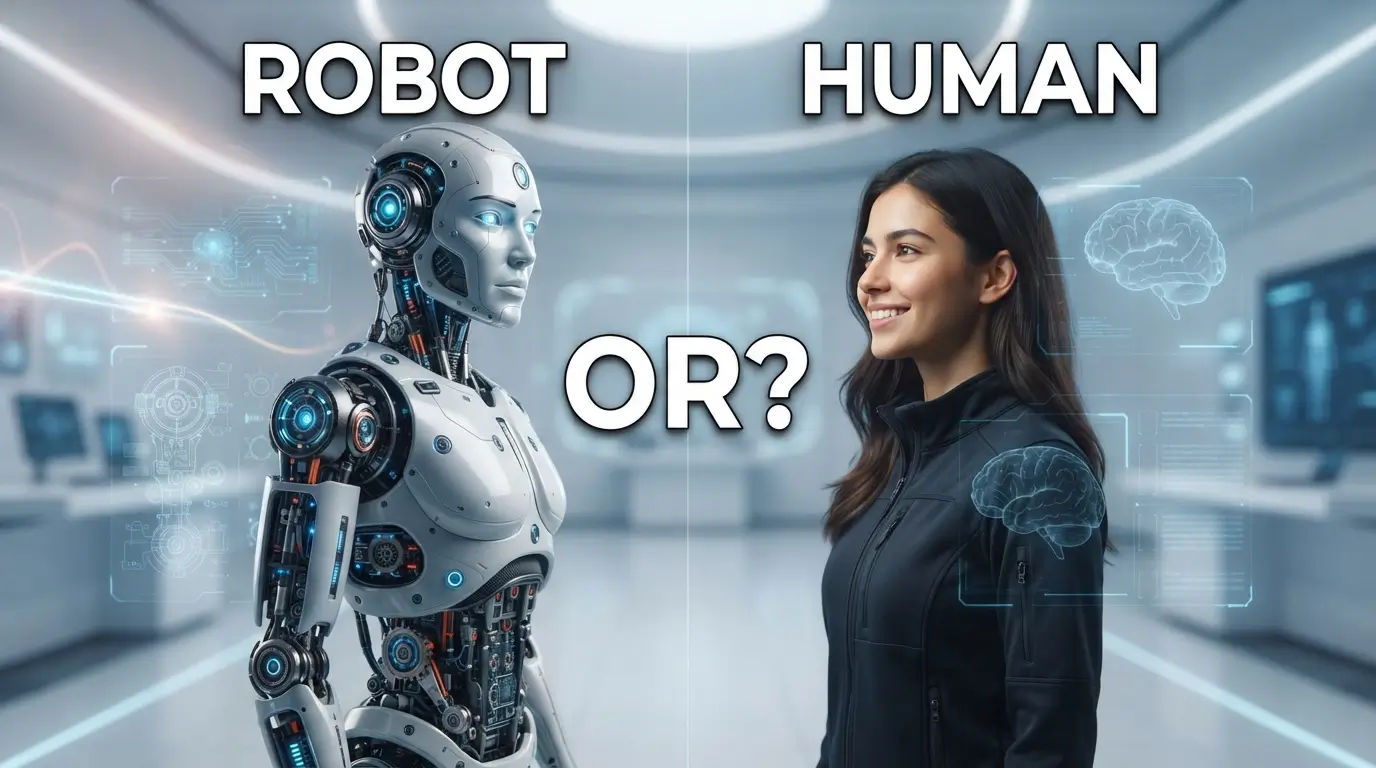
Have you ever looked at a message, image, video, or online interaction and wondered, “Is this robot or human?” That question is becoming more common as technology gets better at producing text, speech, images, and realistic digital behavior.
The phrase robot or human can refer to more than physical machines. A person may use it when comparing a human worker with an automated system, checking whether a website interaction involves a real person or a bot, or discussing how artificial intelligence differs from human thinking.
A robot is a machine designed to perform tasks automatically or with some degree of control. A human is a person belonging to the species Homo sapiens. The two are fundamentally different, even though modern robots can imitate some human actions.
The comparison becomes especially interesting when discussing communication, intelligence, emotions, decision-making, physical abilities, and artificial intelligence. Knowing the differences can help you understand what robots can do today and where human abilities remain distinct.
Robot or Human – Quick Answer
The simplest answer is that a robot is a machine, while a human is a living person.
A robot can be programmed or controlled to perform specific tasks. It may move, process information, recognize objects, or respond to commands.
A human is a living organism with a biological body, nervous system, brain, emotions, and consciousness.
For example:
The robot sorted the packages.
Here, robot is a noun referring to a machine.
The human operator checked the system.
Here, human is a noun referring to a person.
The words can also work as adjectives:
robot technology
human intelligence
Robot
A robot is generally a machine that can carry out physical or digital tasks automatically or semi-autonomously.
Examples include:
- Factory robots
- Surgical robots
- Warehouse robots
- Exploration robots
- Domestic robots
- Software bots
Not every automated program is technically a robot. The term often suggests a system capable of performing tasks through programmed or controlled actions.
Human
Human refers to a person or something relating to people.
Examples:
human behavior
human intelligence
human communication
a human worker
Humans can learn, adapt, create, communicate, and make decisions without following a fixed program in the way a conventional machine does.
The Origin of Robot or Human
The words robot and human have very different histories.
The origin of robot
The word robot has a relatively well-documented modern origin.
It comes from the Czech word robota, meaning forced labor, compulsory work, or drudgery. The word entered international use through the Czech playwright Karel Čapek’s 1920 play R.U.R. (Rossum’s Universal Robots).
Interestingly, Čapek’s brother Josef Čapek is widely credited with suggesting the word robot for the play.
In R.U.R., robots are artificial workers created to perform labor. The original meaning therefore had a strong connection with work and labor rather than the mechanical machines we picture today.
Over time, English adopted robot as a general term for machines capable of carrying out tasks automatically.
The origin of human
Human has a much older history.
English human comes through Old French and Latin. It is related to Latin humanus, meaning human, of individuals, or humane.
The word is connected with homo, Latin for human being or person.
English has used forms related to human for centuries. Its meaning has remained closely connected to people and the qualities associated with humanity.
Why are robot and human so different?
Their meanings developed from completely different concepts.
Robot developed from an idea of labor and artificial workers.
Human comes from an ancient Latin word connected with people and humanity.
Neither word is a spelling variation of the other. They simply describe two fundamentally different categories.
Pronunciation of Robot or Human
The words are pronounced differently.
Robot is commonly pronounced:
ROH-bot in American English
In British English, the first vowel can differ slightly, but the basic two-syllable structure remains.
Human is commonly pronounced:
HYOO-mən
In some accents, the first sound may be closer to YOO-mən.
Both words have two syllables in ordinary pronunciation.
Simple pronunciation guide
| Word | Simple pronunciation |
|---|---|
| robot | ROH-bot |
| human | HYOO-mən |
The pronunciation is not usually a source of confusion. The greater confusion comes from the meaning of the two words, especially when discussing artificial intelligence and machines that imitate human behavior.
Part of Speech: Robot vs Human
Both robot and human can function as nouns and adjectives.
Robot as a noun
The most common use is as a noun.
The robot cleaned the floor.
Engineers tested the robot.
The plural is:
robots
For example:
The factory uses several robots.
Robot as an adjective
Robot can also modify another noun.
robot arm
robot vacuum
robot technology
English often uses nouns before other nouns to create compound terms.
Human as a noun
Human can refer to a person.
Every human needs food and water.
The system requires a human to approve the request.
The plural is:
humans
Human as an adjective
This is extremely common.
human behavior
human rights
human language
human intelligence
human error
The adjective human means relating to people or characteristic of people.
British English vs American English Spelling
There is no meaningful British-American spelling difference between robot and human.
Both British and American English spell the words in the same way:
- robot
- robots
- human
- humans
The pronunciation may vary slightly because of regional accents, but there is no standard British spelling such as robbot or an American alternative spelling.
| Word | British English | American English | Difference |
|---|---|---|---|
| robot | robot | robot | None |
| robots | robots | robots | None |
| human | human | human | None |
| humans | humans | humans | None |
This makes robot or human different from word pairs such as colour/color, where British and American spelling conventions genuinely differ.
For this topic, the main issue is meaning and usage, not regional spelling.
Which Spelling Should You Use?
You do not need to choose between different regional spellings.
Use:
robot
and:
human
in both British and American English.
If your audience is international, these spellings are also widely recognized.
The bigger choice is how you use the words in context.
For example, in technical writing:
The robot completed the inspection.
In a discussion about AI:
The system generated a response that sounded human.
In a workplace setting:
A human employee reviewed the automated decision.
Clear context is more important than regional spelling.
Common Mistakes with Robot or Human
Mistake 1: Assuming every bot is a robot
A bot can be software rather than a physical machine.
For example:
The chatbot answered my question.
This does not necessarily mean there is a physical robot somewhere.
A robot generally refers to a machine, while a bot can refer to software that performs automated tasks.
Mistake 2: Using “human” only for physical appearance
Human can refer to much more than the body.
Examples include:
human intelligence
human language
human judgment
human creativity
Mistake 3: Treating robots as humans
A robot may imitate human conversation or movement, but imitation does not automatically make it human.
For example:
The robot sounded human.
This means its voice or communication resembled that of a person.
It does not mean the robot became a human.
Mistake 4: Writing “humans being” instead of “human beings”
The correct expression is:
human beings
Not:
humans being
For example:
Human beings can adapt to changing environments.
Mistake 5: Assuming “robotic” and “robot” mean exactly the same thing
Robot is usually a noun.
Robotic is an adjective.
Compare:
The robot moved quickly.
The movement looked robotic.
Mistake 6: Confusing “human” with “humane”
These words are related but have different meanings.
Human means relating to people.
Humane means showing kindness, compassion, or concern for living beings.
For example:
Human behavior can be complex.
The shelter uses humane treatment of animals.
Robot or Human in Everyday Examples
The phrase robot or human is useful in many modern contexts.
In emails
A company might tell customers:
Your request will first be reviewed by an automated system and then by a human agent.
Here, human agent means a real person rather than an automated system.
In customer service
Many websites use chatbots for basic questions.
A customer might ask:
Am I talking to a robot or a human?
A company may respond:
You are currently chatting with an automated assistant.
Or:
A human representative will join the conversation shortly.
In social media
The phrase can appear in casual posts:
Can you tell if this photo is AI-generated or made by a human?
Or:
Robot or human? Guess who made this artwork.
These uses connect the phrase with modern AI-generated content.
In news writing
A news report may discuss robots working alongside people:
Robots are being introduced into warehouses to assist human workers.
Here, robots and human workers have clearly different roles.
In education
Teachers may compare human learning with machine learning:
Human learners can use experience and context in ways that differ from machine-learning systems.
This type of comparison is common in discussions about artificial intelligence.
In formal writing
A formal report might say:
The automated system flagged the transaction, but a human reviewer made the final decision.
This wording clearly separates automated processing from human judgment.
Robot or Human: Key Differences
Although robots can become highly advanced, they remain different from humans in fundamental ways.
| Feature | Robot | Human |
|---|---|---|
| Nature | Machine | Living organism |
| Body | Mechanical/electronic | Biological |
| Energy | Electricity, batteries, or other power sources | Food and biological processes |
| Learning | Programming, training, sensors, algorithms | Biological learning and experience |
| Emotions | Can simulate emotional responses | Experiences human emotions |
| Reproduction | Manufactured or assembled | Biological reproduction |
| Communication | Programmed or learned systems | Natural human language and communication |
| Adaptability | Depends on design and system capabilities | Broad biological and cognitive adaptability |
| Maintenance | Requires technical maintenance | Biological body repairs itself to a degree |
| Consciousness | Not established as a property of robots | Humans are conscious beings |
| Creativity | Can generate novel outputs | Human creativity involves thought, experience, and intention |
| Physical limits | Determined by engineering | Determined by biology |
One important point is that robot capabilities vary enormously. A basic industrial robot and an advanced research robot should not be treated as equivalent.
Likewise, human abilities vary from person to person.
Can a Robot Think Like a Human?
This depends on what we mean by think.
Modern AI systems can process information, identify patterns, generate text, solve certain problems, recognize images, and perform other tasks that can look intelligent.
However, performing an intelligent-looking task does not automatically establish human-like consciousness or subjective experience.
A robot can be designed to respond to:
“How are you?”
It may answer:
“I’m doing well.”
But that response alone does not prove that the machine experiences feelings in the human sense.
This distinction is important when discussing artificial intelligence. Behavior that resembles human behavior is not automatically evidence of human experience.
Robot or Human: What About Artificial Intelligence?
AI has made the boundary seem less obvious in some situations.
A chatbot can produce natural language. A voice system can sound conversational. An image generator can create realistic pictures. A humanoid robot can imitate human movement.
These technologies can make a machine seem surprisingly human-like.
Still, human-like output and being human are different concepts.
A useful distinction is:
Human: a biological person.
Robot: a machine designed to perform tasks.
AI: a computational system capable of performing tasks that normally require forms of intelligence.
These categories can overlap in a system. For example, a robot may use AI, but AI itself does not have to be a physical robot.
Is “Robot or Human” a Grammar Question?
Not usually.
Unlike word pairs such as content or contents or days or day’s, robot or human is mainly a conceptual comparison.
The words are spelled differently, pronounced differently, and have distinct meanings.
People may search the phrase because they want to compare:
- Human workers and robots
- AI and people
- Chatbots and human agents
- Human creativity and machine generation
- Automated systems and manual work
- Humanoid robots and people
So the phrase works best as a Differences & Comparisons topic rather than a traditional spelling or grammar problem.
FAQs
1. What is the difference between a robot and a human?
A robot is a machine designed to perform tasks, while a human is a living biological person with a human body and nervous system.
2. Is a robot a living thing?
A conventional robot is not considered a living organism. It is a manufactured machine that operates through mechanical, electronic, and computational systems.
3. Can robots replace humans?
Robots can replace or automate some tasks, especially repetitive, dangerous, or highly controlled work. Whether they can replace humans completely depends on the task and technology involved.
4. Is AI the same as a robot?
No. AI refers to computational systems that perform tasks associated with intelligence. A robot is a physical machine. A robot may use AI, but AI does not have to exist inside a physical robot.
5. Can a robot have human emotions?
A robot can be designed to recognize, imitate, or respond to emotional signals. That does not by itself prove that the robot experiences emotions as humans do.
6. Is “robotic” an adjective?
Yes. Robotic is an adjective related to robots or behavior that resembles a robot.
For example:
The machine has a robotic arm.
Or:
His movements looked robotic.
7. Are robot and human opposites?
Not technically. They describe different categories. A robot is a type of machine, while a human is a type of living organism. In some comparisons, however, they are presented as contrasting categories.
Conclusion
The phrase robot or human captures a question that feels more relevant as technology becomes more lifelike. Robots can imitate many human actions, but they remain machines.
The words themselves are simple: robot refers to an automated machine, while human refers to a person. Neither has a special British or American spelling.
The most useful lesson is to separate human-like behavior from being human. A machine can copy a voice, movement, or response without becoming a person.
As technology changes, knowing this difference helps us speak and write with greater clarity. Keep practicing these terms in everyday conversations and modern technology discussions.

Eliza Marlowe is a passionate content strategist and comparison writer at diffnexx.com. She specializes in breaking down complex “difference between” topics into clear, reader-friendly guides. With a background in linguistics and digital research, Eliza focuses on accuracy, clarity, and content that helps readers make informed decisions with confidence.







