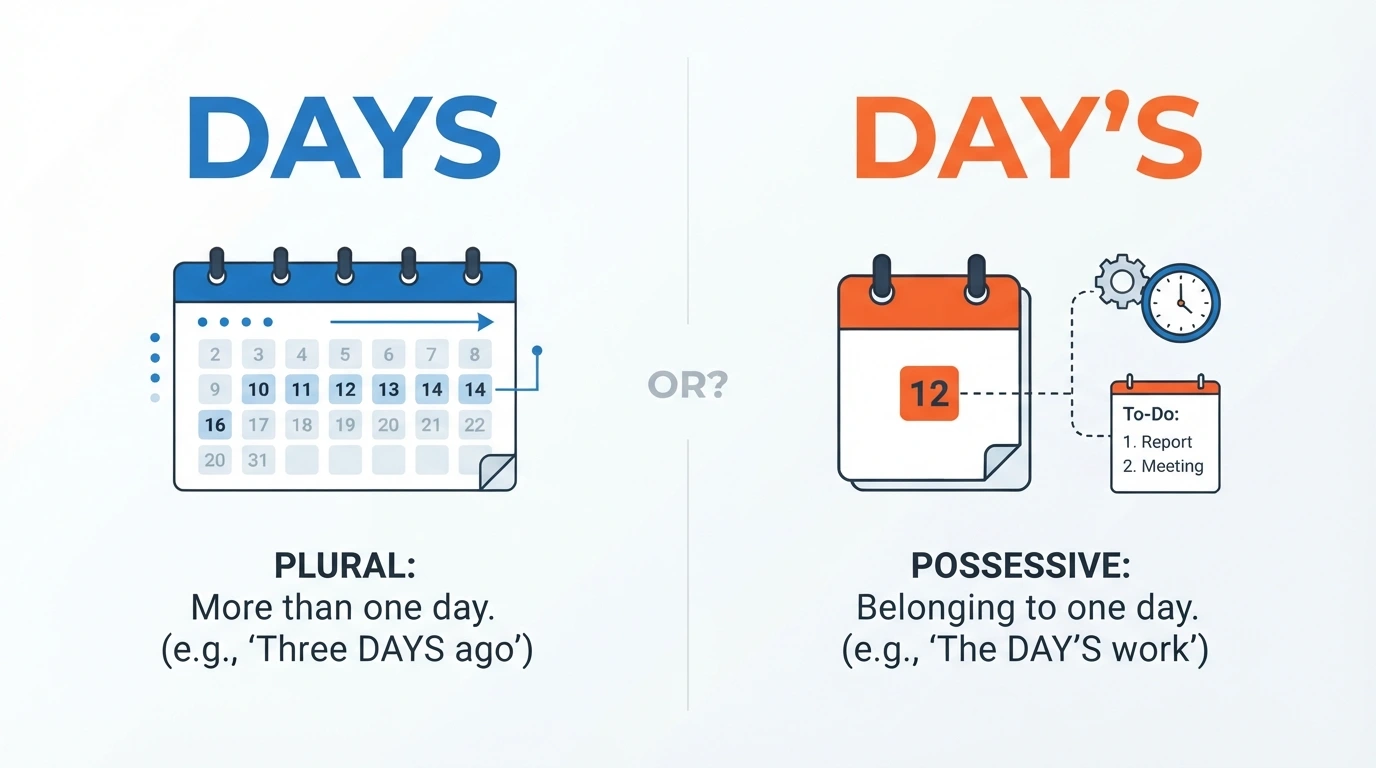
Have you ever wondered whether you should write days or day’s? The difference looks tiny, but the apostrophe changes the grammar and meaning. This is why the choice can be confusing in emails, essays, reports, and everyday writing.
The word days is simply the plural of day. Use it when you mean more than one day, such as “I stayed for three days.” The form day’s is different. It is the singular possessive form of day, so it normally describes something connected with one day, as in “a day’s work.”
There is also a third form that should not be ignored: days’. This is the plural possessive form. It is used when something is connected with more than one day, such as “three days’ work.”
Knowing these three forms makes the rule much easier. You do not need to memorize dozens of examples. You only need to identify whether you mean a simple plural, one day’s connection, or several days’ connection.
Days or Day’s – Quick Answer
Use days when you mean two or more days.
Example:
We will stay for five days.
Use day’s when one day is possessive or connected with another noun.
Example:
It was a day’s journey.
Use days’ when several days are possessive.
Example:
It was three days’ journey.
The easiest rule is:
Days = more than one day.
Day’s = one day’s something.
Days’ = several days’ something.
Days
The term Days is the regular plural form of day.
Examples:
- I will return in two days.
- She stayed there for several days.
- We have three days left.
- The repairs took five days.
There is no apostrophe because this is only a plural.
Day’s
Day’s is the singular possessive form.
Examples:
- a day’s work
- a day’s journey
- a day’s rest
- a day’s pay
- a day’s notice
The apostrophe comes before the s because the noun is singular.
Days’
Days’ is the plural possessive form.
Examples:
- two days’ work
- three days’ notice
- five days’ travel
- several days’ preparation
The apostrophe comes after the s because days is already plural.
Cambridge’s apostrophe guidance follows this general pattern: singular nouns normally take ‘s, while plural nouns ending in s normally take an apostrophe after the s.
The Origin of Days or Day’s
The forms day, days, day’s, and days’ all come from the same basic English noun.
The word day has a very old history. Oxford traces it to Old English dæg, from a Germanic source. It is related to words in other Germanic languages, including Dutch dag and German Tag.
The basic idea behind the word has remained stable. In modern English, day can mean a period of 24 hours, the period when there is daylight, or a particular period in someone’s life or in history.
The plural days follows a common English pattern. A regular noun often becomes plural by adding -s:
one day → two days
The apostrophe does not form the plural. This is one of the most important points to remember.
Why does “day’s” have an apostrophe?
The form day’s shows a possessive relationship involving one day.
For example:
a day’s work
This means work associated with one day.
Likewise:
a day’s journey
means a journey lasting or associated with one day.
The apostrophe tells the reader that day is connected to the noun that follows it.
Why does “days’” have the apostrophe after the s?
When the noun is plural and already ends in s, the possessive apostrophe normally comes after the s.
So the pattern is:
day → day’s
but:
days → days’
For example:
one day’s work
three days’ work
The first phrase involves one day. The second involves three days.
Cambridge gives examples such as 15 years’ research to illustrate this general plural possessive pattern.
The important point is that days, day’s, and days’ are not different spellings of the same grammatical form. They perform different jobs.
British English vs American English Spelling
There is no meaningful British-American spelling difference between days, day’s, and days’.
Both British English and American English use all three forms in the same basic way.
| Form | British English | American English | Function |
|---|---|---|---|
| day | ✓ | ✓ | Singular noun |
| days | ✓ | ✓ | Plural noun |
| day’s | ✓ | ✓ | Singular possessive |
| days’ | ✓ | ✓ | Plural possessive |
| a day’s work | ✓ | ✓ | One day’s work |
| three days’ work | ✓ | ✓ | Several days’ work |
For example, a British writer and an American writer would both write:
I will be away for five days.
They would also both write:
I need a day’s rest.
And:
We need three days’ notice.
The spelling does not change according to the country.
Some differences do exist between British and American English in other areas of spelling and usage, but days, day’s, and days’ are not examples of a British-American spelling difference.
Therefore, if you are writing for a global audience, you do not need to choose a different form based on whether your readers are American, British, Canadian, Australian, or from another English-speaking background.
The key issue is grammar, not regional spelling.
Which Spelling Should You Use?
The correct form depends on the meaning of your sentence.
Use “days” for a simple plural
Use days when you are talking about more than one day without showing possession.
Examples:
I will call you in three days.
We spent seven days in Paris.
The project lasted several days.
She has been away for ten days.
You can usually test this by putting a number before the word.
If your sentence means:
two days
three days
several days
then days is probably the correct form.
Use “day’s” for one day
Use day’s when one day is connected to another noun.
Examples:
a day’s work
a day’s journey
a day’s rest
a day’s pay
a day’s notice
Consider:
I need a day’s rest.
This means that one day of rest is needed.
The noun is singular, so the possessive form is day’s.
Use “days’” for several days
Use days’ when more than one day is connected to another noun.
Examples:
two days’ work
three days’ notice
four days’ travel
several days’ preparation
For example:
We need three days’ notice before the meeting.
The notice period is three days, so days’ is correct.
A simple question can solve the problem
Ask yourself:
Am I simply talking about more than one day?
If yes:
days
Am I talking about something connected with one day?
If yes:
day’s
Am I talking about something connected with several days?
If yes:
days’
This quick test works in most everyday situations.
Common Mistakes with Days or Day’s
1. Using “day’s” as the plural
Incorrect:
I will be there for five day’s.
Correct:
I will be there for five days.
Why? Because days is simply the plural of day. No possession is involved.
2. Using “days” in a possessive phrase
Incorrect:
We need three days notice.
Correct:
We need three days’ notice.
The phrase refers to notice connected with three days.
3. Using “day’s” after a plural number
Incorrect:
It will take two day’s work.
Correct:
It will take two days’ work.
The word two tells us that day must be plural.
Therefore:
two days
and the possessive form is:
two days’
4. Using “days’” after “a”
Incorrect:
I need a days’ rest.
Correct:
I need a day’s rest.
The word a refers to one day, so the singular possessive form is needed.
5. Adding an apostrophe just because a word is plural
Incorrect:
We have several day’s left.
Correct:
We have several days left.
Plural words do not automatically need apostrophes.
Compare:
two books
three cars
five days
No apostrophe is required.
An apostrophe is used when there is a possessive relationship or, in some cases, a contraction.
6. Confusing “days’” with “days of”
Both of these structures can be correct:
three days’ work
three days of work
They use different grammar.
The first uses a possessive construction.
The second uses an of phrase.
Both can communicate a similar idea, depending on context.
Days or Day’s in Everyday Examples
These forms appear in many types of writing, including emails, business documents, news reports, social media posts, and academic work.
In emails
Suppose you are asking for extra time:
I need a day’s extension to complete the report.
Here, day’s is correct because the extension is for one day.
If you need several days:
I need three days’ extension to complete the report.
However, a more natural version in many contexts would be:
I need an extension of three days to complete the report.
You can also simply use the plural:
I will send the report in three days.
In business writing
Business English often uses days’ in phrases involving deadlines and notice periods.
Please provide five days’ notice before making changes.
The company requires three days’ notice.
Here, days’ indicates a relationship between several days and the following noun.
But:
The company will respond within five days.
uses days because there is no possessive construction.
In news writing
News writing may use:
The storm caused several days of disruption.
There is no apostrophe because the sentence uses the of structure.
You may also encounter:
The storm caused several days’ disruption.
Here, the writer uses a possessive construction.
Both forms can be grammatical, although the of construction may sound more natural in some contexts.
In social media
Short social media messages often use the simple plural:
Only two days left!
Three days until the event!
I have been waiting for days!
No apostrophe is needed in these examples.
A possessive example would be:
Two days’ hard work finally paid off.
Here, days’ connects the two-day period with the hard work.
Another example is:
A day’s break can make a big difference.
Here, day’s means one day of break.
In academic writing
Academic writing often includes phrases such as:
The study required several days of observation.
The researchers conducted three days’ testing.
The results were reviewed after two days.
The correct form depends on the sentence structure.
In travel writing
You might write:
We spent five days in Rome.
This uses the simple plural.
You could also write:
After two days’ travel, we reached our destination.
This uses the plural possessive form.
Or:
It was a day’s journey from the village.
This uses the singular possessive form.
Days, Day’s, and Days’ Comparison Table
| Form | Grammar | Meaning | Example |
|---|---|---|---|
| day | Singular noun | One day | I need one day. |
| days | Plural noun | More than one day | I need three days. |
| day’s | Singular possessive | Connected with one day | A day’s work is enough. |
| days’ | Plural possessive | Connected with several days | Three days’ work is enough. |
Look at these four sentences:
I need one day.
I need three days.
I need a day’s rest.
I need three days’ rest.
The first two simply tell us how many days are involved.
The last two connect the day or days with rest.
This is the central difference.
Pronunciation of Days and Day’s
There is an interesting problem with days and day’s: they normally sound the same.
The word day is pronounced /deɪ/, roughly like “day.”
The plural days is pronounced /deɪz/, roughly like “dayz.”
The possessive day’s is also pronounced /deɪz/.
So:
days
and:
day’s
usually sound identical.
The form days’ also normally ends with the same /z/ sound.
The apostrophe does not add another syllable.
This means you cannot always identify the correct spelling just by listening.
For example:
I need three days.
and:
I need three days’ notice.
The words days and days’ sound the same. The surrounding words make the grammatical role clear.
This is why the problem is more common in writing than in speech.
There is another pronunciation of content or other words that can change with meaning, but day’s itself does not create a different pronunciation from days.
7 FAQs About Days or Day’s
1. Is “days” the plural of “day”?
Yes. Days is the standard plural form of day.
For example:
one day
two days
ten days
No apostrophe is required.
2. When should I use “day’s”?
Use day’s when one day is possessive or connected with another noun.
Examples include:
a day’s work
a day’s journey
a day’s rest
The apostrophe comes before the s because day is singular.
3. When should I use “days’”?
Use days’ when several days are possessive or connected with another noun.
Examples include:
two days’ work
three days’ notice
five days’ travel
The apostrophe comes after the s because days is plural.
4. Is “three day’s” correct?
No. If you mean three ordinary days, write:
three days
If you mean something connected with three days, write:
three days’ work
The number three makes the noun plural.
5. Is “a days’ work” correct?
No. The correct phrase is:
a day’s work
The word a refers to one day, so the singular possessive form day’s is required.
6. Do “days” and “day’s” sound the same?
Yes. In normal pronunciation, both are usually pronounced /deɪz/.
The difference is mainly visible in writing.
7. Are the rules different in British and American English?
No. British and American English use days, day’s, and days’ according to the same basic grammatical rules.
The choice depends on whether you need a plural, singular possessive, or plural possessive form.
Conclusion
The difference between days, day’s, and days’ is small, but the rule is easy once you focus on number and possession. Use days for a simple plural.
Use day’s when one day is connected to something, and use days’ when several days are connected to something. The apostrophe simply shows the grammatical relationship.
These forms appear in emails, essays, reports, schedules, and everyday conversations. Learning them helps your writing look clearer, more accurate, and more professional.
Do not worry if the apostrophe feels confusing at first. Practice these forms in your emails, essays, and daily conversations, and the correct choice will soon become natural. English is full of similarly confusing word pairs — for another example, see our guide to tailor vs tailer.

Anton Reyes is a contributing writer at DiffNexx.com, where he explores meaningful differences in language, culture, and everyday concepts. With a background in creative nonfiction, Anton brings clarity and balance to complex comparisons. His writing helps readers understand subtle distinctions in words and ideas, making learning both insightful and engaging.







