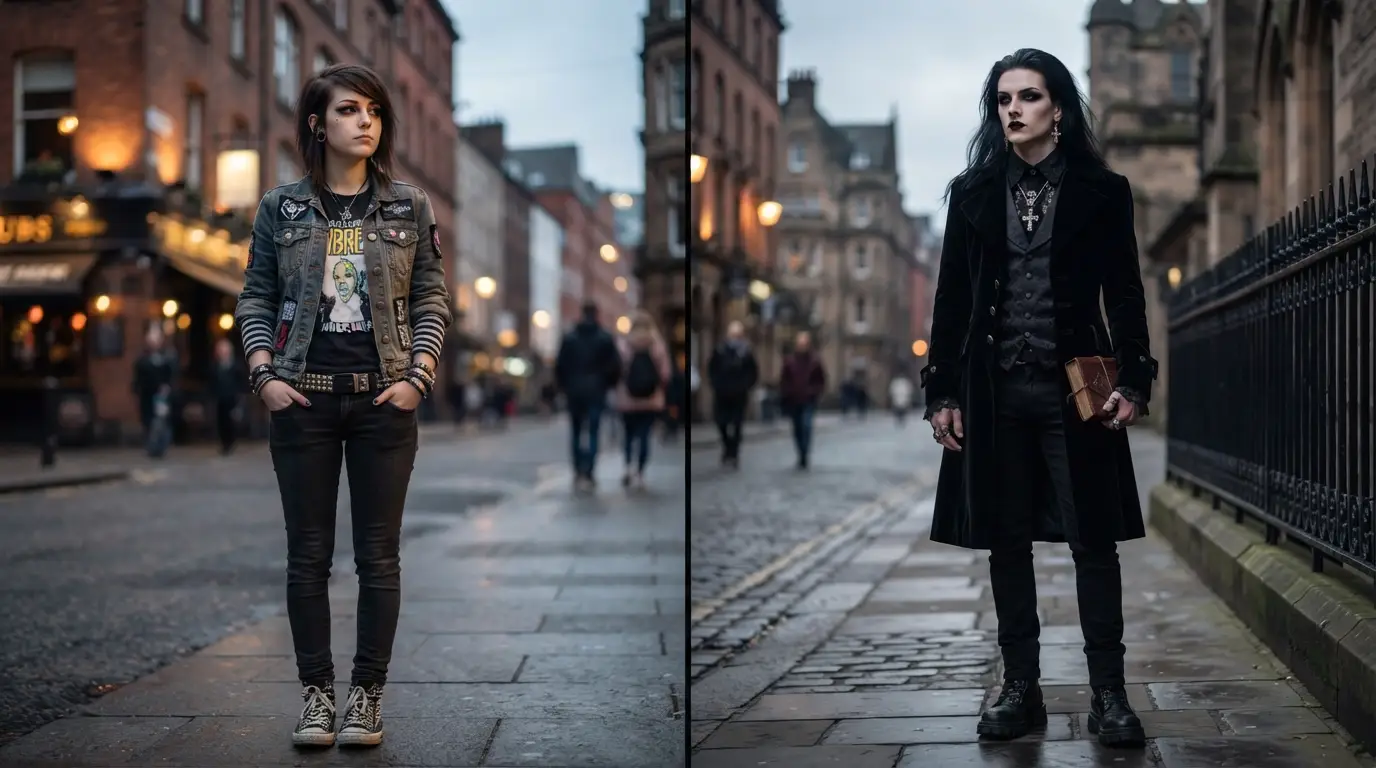
If you are trying to understand the difference between emo and goth, start with their roots. Emo grew from the hardcore punk scene in Washington, D.C., during the mid-1980s. It became known for personal, emotionally direct lyrics and expressive music.
Goth developed from late-1970s and early-1980s post-punk, especially in the United Kingdom. Its music and culture became linked with dark, atmospheric sounds, romanticism, mortality, and dramatic visual styles.
The difference between emo and goth is not simply that one wears more black than the other. Both can include dark clothing, dyed hair, makeup, and alternative music. The deeper difference lies in their musical history, artistic themes, fashion traditions, and subcultural roots.
Quick Answer
Emo is a music-rooted subculture that grew from hardcore punk and emphasizes emotional expression, personal experiences, vulnerability, and confessional lyrics.
Goth grew from post-punk and goth rock and is associated with dark, atmospheric music, romanticism, mortality, mystery, and dramatic aesthetics.
In simple terms:
- Emo: personal feelings and emotional expression
- Goth: dark atmosphere, romanticism, mystery, and the macabre
- Emo roots: 1980s Washington, D.C. hardcore punk
- Goth roots: late-1970s and early-1980s British post-punk
- Emo fashion: often band shirts, fitted clothing, dark colors, dyed hair, and expressive accessories
- Goth fashion: often black clothing, dramatic makeup, boots, lace, leather, velvet, and other dark or historical influences
However, these are broad patterns, not strict rules. A person can enjoy both scenes or dress in ways that overlap.
What Is Emo?
Emo began as a style of music connected to hardcore punk. The term is commonly linked to “emotional hardcore” or “emocore.” Early emo developed in Washington, D.C., in the mid-1980s.
Bands such as Rites of Spring and Embrace are important to the early history of the genre. AllMusic describes emo as an artistic outgrowth of hardcore punk with deeply personal lyrics and expressive vocals.
Over time, emo changed.
The sound moved through different forms of underground rock, alternative rock, post-hardcore, indie rock, and emo-pop. This means that the word emo can refer to different musical periods.
The mainstream image many people associate with emo comes largely from the late 1990s and 2000s. Bands such as Jimmy Eat World, Fall Out Boy, My Chemical Romance, Paramore, and Dashboard Confessional helped bring related sounds and aesthetics to a much wider audience.
What Does Emo Mean Today?
Today, “emo” can describe:
- A music genre
- A fan or member of an emo scene
- A fashion style
- An aesthetic influenced by emo culture
- A broader idea of emotionally expressive alternative culture
Oxford defines emo as both a style of rock music and a person who follows its music and associated fashion.
So, calling someone “emo” does not automatically mean that the person is sad, depressed, or emotionally unstable. Those are stereotypes, not reliable definitions of the subculture.
What Is Goth?
Goth developed from the darker side of the post-punk movement in the late 1970s and early 1980s.
Bauhaus, Siouxsie and the Banshees, The Cure, and The Sisters of Mercy are among the artists strongly associated with goth rock and its development.
Bauhaus’s 1979 song “Bela Lugosi’s Dead” is often treated as an important early goth-rock landmark. AllMusic describes goth rock as an offshoot of post-punk that developed a distinctive dark and atmospheric sound.
Goth music often explores subjects such as:
- Mortality
- Romance
- Alienation
- Mystery
- Religion and symbolism
- The supernatural
- Dark romanticism
- Melancholy
But goth is more than a music genre.
It also developed into a wider subculture involving fashion, clubs, art, literature, photography, and other forms of creative expression.
Oxford defines goth as both a style of rock music and a person associated with that music and its black-clothing aesthetic.
Emo vs. Goth: Key Differences at a Glance
| Feature | Emo | Goth |
|---|---|---|
| Main roots | Hardcore punk | Post-punk |
| Early development | Mid-1980s | Late 1970s–early 1980s |
| Major early location | Washington, D.C. | United Kingdom |
| Musical focus | Emotional and personal expression | Dark, atmospheric and dramatic sound |
| Common themes | Relationships, vulnerability, identity, emotional conflict | Mortality, romance, mystery, alienation, the supernatural |
| Fashion | Band shirts, fitted clothing, dark colors, dyed hair | Black clothing, dramatic makeup, lace, leather, boots, historical influences |
| Visual mood | Personal, youthful, expressive | Dark, theatrical, romantic, mysterious |
| Cultural roots | Punk and hardcore | Post-punk and goth rock |
| Mainstream association | Especially strong in the 2000s | Especially strong in the 1980s |
| Can they overlap? | Yes | Yes |
The table gives the broad picture, but it should not be treated as a strict checklist. Both scenes have changed over time.
Music Is the Biggest Difference Between Emo and Goth
If you want to tell emo and goth apart, music is often more useful than clothing.
Emo Music
Early emo came from hardcore punk but placed greater emphasis on emotional and personal expression.
Its lyrics can focus on:
- Relationships
- Heartbreak
- Identity
- Personal conflict
- Vulnerability
- Anxiety
- Introspection
Its sound has never been completely fixed. Some emo is raw and experimental, while later emo-pop can sound much closer to melodic alternative rock or pop-punk.
Goth Music
Goth rock developed from post-punk.
Its sound often uses:
- Deep or prominent bass
- Atmospheric guitars
- Reverb
- Dramatic vocals
- Repetitive or hypnotic rhythms
- Dark or haunting textures
The themes can include death, romance, religion, mystery, supernatural ideas, and existential questions.
This is why two people may both wear black while belonging to very different musical cultures.
Emo vs. Goth Fashion
Fashion creates much of the confusion.
Both styles can use:
- Black clothing
- Dark makeup
- Dyed hair
- Piercings
- Band merchandise
- Boots
- Alternative accessories
Yet the overall visual language can differ.
Typical Emo Style
Emo fashion is often associated with:
- Band T-shirts
- Skinny or fitted jeans
- Hoodies
- Canvas or casual sneakers
- Studded belts
- Wristbands
- Dyed or heavily styled hair
- Dark eyeliner
The famous side-swept hairstyle became especially associated with the 2000s emo image.
But this is not a universal emo uniform. Modern emo fashion can look very different from the style associated with the early 2000s.
Typical Goth Style
Goth fashion often uses:
- Black dresses or shirts
- Leather
- Lace
- Velvet
- Boots
- Dark makeup
- Silver jewelry
- Dramatic silhouettes
- Historical or romantic influences
Goth fashion also has many branches.
For example, romantic goth, trad goth, deathrock, and cyber-influenced styles can look quite different from one another.
That variety is one reason clothing alone cannot reliably identify someone’s subculture.
Are Emo and Goth the Same Thing?
No.
They overlap, but they are distinct subcultures with different musical histories.
Emo began within hardcore punk and developed around emotional expression. Goth developed from post-punk and became associated with a darker musical and artistic tradition.
The confusion is understandable because both can involve:
- Alternative music
- Dark clothing
- Strong emotions
- Individual expression
- Unconventional fashion
- Black eyeliner
- Dyed hair
- A rejection of mainstream style
But shared features do not make the two cultures identical.
Can Someone Be Both Emo and Goth?
Yes.
People do not always fit into one cultural box.
Someone might listen to emo bands and goth bands, wear a mixture of both styles, or participate in both communities.
There is also musical crossover. Some artists use dark or gothic imagery while drawing from emo, alternative rock, post-punk, metal, electronic music, or other genres.
For example, My Chemical Romance has often been associated with emo, but its visual style can include dark and theatrical elements that overlap with goth aesthetics. AllMusic notes that some emo-pop acts, including My Chemical Romance, developed a distinctly dark or neo-gothic edge.
This shows why a simple “black clothes = goth” or “side-swept hair = emo” rule does not work.
Does Being Emo or Goth Describe a Personality?
Not necessarily.
This is one of the most important points that many simple comparisons miss.
People often use words such as “emo” or “goth” as if they describe someone’s entire personality. That can create stereotypes.
For example, being emo does not automatically mean someone is unhappy.
Likewise, being goth does not mean someone is obsessed with death or the occult.
Music and fashion can provide a way to explore difficult subjects without reflecting a person’s actual mental state.
A goth fan may simply enjoy dark music, fashion, literature, or visual art. An emo fan may enjoy emotionally direct songwriting without being personally distressed.
It is better to treat these labels as cultural and artistic identities, not psychological diagnoses.
Is Goth Older Than Emo?
Yes.
Goth developed earlier.
Goth rock emerged from the late-1970s and early-1980s post-punk environment. Bauhaus’s 1979 “Bela Lugosi’s Dead” is widely recognized as an important early goth-rock recording.
Emo emerged later from the hardcore punk scene in Washington, D.C., during the mid-1980s. Rites of Spring and Embrace are central names in its early history.
So, although the two scenes share some punk ancestry, they did not begin at the same time or in the same musical community.
What Is the Difference Between Emo and Goth in Their Themes?
The simplest distinction is personal emotional expression versus broader dark and atmospheric themes, although this is only a general guide.
Emo often turns inward.
Its songs may examine a relationship, personal identity, loneliness, conflict, or emotional vulnerability.
Goth often creates a wider atmosphere.
Its music and art may explore romance, death, mystery, religion, supernatural ideas, alienation, or the beauty of darkness.
There is still plenty of overlap.
Goth music can be intensely personal, while emo can use dark imagery. The themes should therefore be understood as tendencies rather than rules.
Common Mistakes About Emo and Goth
Mistake 1: Thinking all black clothing is goth
Black clothing is strongly associated with goth fashion, but many alternative styles use black.
Clothing alone is not enough to identify someone’s subculture.
Mistake 2: Thinking emo means “sad person”
The term comes from a music tradition centered on emotional expression. It does not mean that every emo fan is unhappy.
Mistake 3: Assuming goth and metal are the same
Goth and metal can overlap, but goth rock developed from post-punk. They are not simply two names for the same genre.
Mistake 4: Using modern emo fashion to describe all emo history
The famous 2000s emo look is only one stage in a much longer musical history.
Early emo looked and sounded different from later emo-pop.
Mistake 5: Treating “emo” and “goth” as personality tests
Music taste, clothing, and cultural identity are not reliable ways to judge someone’s personality.
Pronunciation and Word Use
Emo
- Part of speech: noun or adjective
- British pronunciation: /ˈiːməʊ/
- American pronunciation: /ˈiːmoʊ/
Oxford and Cambridge both list emo as a noun, while Cambridge also gives adjective usage.
Goth
- Part of speech: noun or adjective
- British pronunciation: /ɡɒθ/
- American pronunciation: /ɡɑːθ/
Oxford lists goth as a noun for both the music style and a person associated with it. It also uses goth as an adjective.
Emo and Goth Etymology
The word emo is a shortened form connected with terms such as emotional hardcore and emocore. Collins traces the American English use to “emotional hardcore.”
The word goth has a much older linguistic history. The modern subcultural term is connected to Gothic, while the word itself ultimately relates to the historical Goths, a Germanic people. Oxford and Collins both document this older etymological history.
The modern music meaning developed much later and should not be confused with the ancient Germanic people.
British vs. American Usage
The meanings are broadly similar in British and American English.
The clearest difference is pronunciation.
Emo:
- British: /ˈiːməʊ/
- American: /ˈiːmoʊ/
Goth:
- British: /ɡɒθ/
- American: /ɡɑːθ/
The cultural terms themselves are widely understood in both varieties of English.
Frequently Asked Questions
Is emo darker than goth?
Not necessarily. Emo and goth use different forms of dark or emotional expression. Emo often focuses on personal feelings and relationships, while goth commonly uses dark, atmospheric, romantic, supernatural, or mortality-related themes.
Is My Chemical Romance emo or goth?
My Chemical Romance is commonly associated with emo and emo-pop, but its music and visual style also use dark and theatrical elements. The overlap is one reason the two labels are sometimes confused.
Can you be goth and emo at the same time?
Yes. A person can enjoy both musical scenes and combine elements of both styles.
Is goth a type of emo?
No. Goth and emo developed from different musical traditions. Goth grew from post-punk, while emo developed from hardcore punk.
Do emo and goth people wear black?
Both can. Black clothing is strongly associated with goth fashion and is also common in emo fashion, but clothing alone does not define either subculture.
Which came first, emo or goth?
Goth came first. Goth rock developed in the late 1970s and early 1980s, while emo emerged from the Washington, D.C. hardcore scene in the mid-1980s.
What is the easiest way to tell emo and goth apart?
Start with music and cultural roots, not clothing. Emo comes from hardcore punk and emphasizes emotionally direct expression. Goth comes from post-punk and has a strong tradition of dark, atmospheric music and aesthetics.
Test Your Knowledge
1. Where did early emo develop?
A. Manchester
B. Washington, D.C.
C. Los Angeles
D. Berlin
Correct answer: B. Washington, D.C.
2. Goth rock developed mainly from which musical movement?
A. Country
B. Disco
C. Post-punk
D. Jazz
Correct answer: C. Post-punk
3. Which theme is commonly associated with emo music?
A. Personal relationships and emotional vulnerability
B. Agricultural history
C. Sports competition
D. Classical mythology only
Correct answer: A. Personal relationships and emotional vulnerability
4. Which statement about goth fashion is most accurate?
A. It always requires Victorian clothing
B. Only uses white clothing
C. It often includes dark clothing and dramatic makeup
D. It cannot include modern styles
Correct answer: C. It often includes dark clothing and dramatic makeup
5. Can someone enjoy both emo and goth music?
A. No
B. Only musicians can
C. Yes
D. Only in the United States
Correct answer: C. Yes
6. Which is a common mistake?
A. Checking musical history
B. Recognizing that both scenes have changed
C. Assuming black clothing alone identifies a subculture
D. Comparing their musical roots
Correct answer: C. Assuming black clothing alone identifies a subculture
Conclusion
The difference between emo and goth is mainly a difference in musical history, cultural roots, and artistic expression. Emo developed from 1980s hardcore punk and became known for emotionally direct, personal songwriting. Goth emerged from British post-punk and developed a distinctive world of dark, atmospheric music, romanticism, mystery, and dramatic aesthetics.
Their fashion can overlap, which explains much of the confusion. Both may include black clothing, eyeliner, dyed hair, alternative accessories, and a strong interest in self-expression. But neither style can be identified reliably from one outfit or hairstyle.
The easiest way to understand the distinction is to look beyond appearance. Emo is rooted in emotional hardcore and personal expression, while goth is rooted in post-punk and a darker atmospheric tradition. At the same time, people can enjoy both, and both cultures have changed significantly over the decades.
Suggested External Sources
- Oxford Learner’s Dictionaries: Definitions and pronunciation for emo and goth. Oxford Learner’s Dictionaries – emo
- Cambridge Dictionary: Definitions and British/American pronunciations. Cambridge Dictionary – emo
- AllMusic: Historical background on emo and goth rock as music genres. AllMusic – Emo
- AllMusic: Overview of goth rock’s post-punk roots and musical development. AllMusic – Goth Rock

Aamer Shahzad is the founder of Diffnexx.com, a fast-growing educational platform focused on high-intent “difference between” topics. With over 8 years of experience in English language education and analytical writing, I specialize in breaking down complex “difference between” topics into clear, structured, and easy-to-understand explanations. Diffnexx.com is your go-to resource for enhancing English skills and writing with confidence.
I specializes in building search-optimized, research-driven comparison content designed for clarity, authority, and long-term digital asset value.







