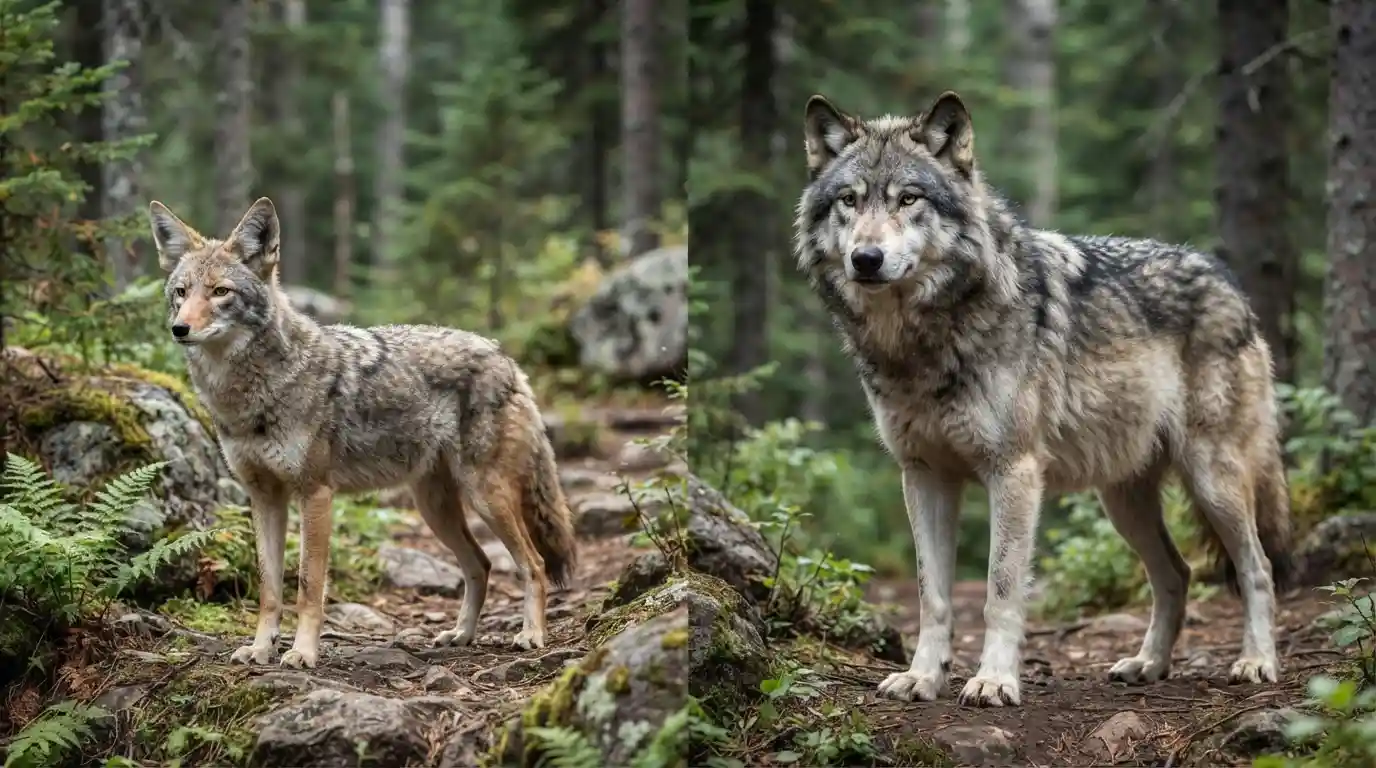
The main difference between coyote and wolf is size and build. A wolf is much larger, heavier, and more powerfully built than a coyote. Coyotes have narrower muzzles, larger ears compared with their heads, and a slimmer body. Wolves have broader heads, thicker muzzles, larger paws, and heavier bodies.
The difference between coyote and wolf also appears in their behavior. Coyotes often hunt alone, in pairs, or in small family groups and can live in many habitats, including areas close to people. Wolves are highly social and usually live in packs that cooperate to hunt large prey and defend territory.
If you see one from a distance, size is often the quickest clue. But body shape, tail position, ears, muzzle, movement, tracks, and sound can help confirm what you are seeing.
Coyote vs. Wolf at a Glance
| Feature | Coyote | Wolf |
|---|---|---|
| Scientific name | Canis latrans | Canis lupus |
| Overall size | Smaller and lighter | Much larger and heavier |
| Body shape | Slim and narrow | Broad and powerful |
| Muzzle | Narrow and pointed | Broad and blocky |
| Ears | Large and pointed | Smaller relative to the head |
| Tail | Long, bushy, usually held low | Bushy, generally carried more level |
| Social behavior | Often alone, in pairs, or family groups | Usually lives in packs |
| Typical prey | Small mammals, birds, reptiles, carrion, and more | Often medium and large hoofed mammals |
| Vocalizations | Howls, yips, barks, and other high-pitched sounds | Long, deeper howls with fewer yipping sounds |
| Habitat | Highly adaptable, including urban areas | Often associated with larger wild territories |
| Tracks | Smaller and narrower | Larger and broader |
The exact size and appearance can vary by region, so identification works best when several clues agree.
What Is a Coyote?
A coyote is a medium-sized wild canine native to North and Central America. Its scientific name is Canis latrans. Coyotes belong to the same genus as wolves and domestic dogs.
Coyotes have adapted extremely well to different environments. They can live in deserts, grasslands, forests, wetlands, agricultural areas, suburbs, and cities. Their flexible diet and behavior help them survive in places where other large predators may struggle.
A typical coyote has a slender body, pointed ears, a narrow muzzle, and a long bushy tail. Its coat often appears gray, tan, brown, or reddish, with lighter fur underneath.
What Is a Wolf?
A wolf is a large wild canine. The gray wolf, Canis lupus, is the largest wild member of the dog family, Canidae. Gray wolves occur across parts of North America, Europe, and Asia.
Wolves have long legs, large feet, powerful jaws, broad heads, and strong bodies. Their coats can vary greatly, including white, gray, brown, and black.
Wolves are also strongly social animals. Packs work together to hunt, raise young, defend territory, and use food resources. Pack size varies with location and prey availability.
7 Major Differences Between Coyotes and Wolves
1. Size and Weight
Size is usually the easiest way to separate a coyote from a wolf.
Coyotes are much smaller. National Park Service information commonly describes coyotes as roughly knee-high, with many adults around 30 pounds, although their size varies by region.
Gray wolves are much larger. The U.S. Fish and Wildlife Service gives an adult gray wolf weight range of about 40 to 175 pounds, depending on sex and geographic location.
This creates a major visual difference:
- Coyote: medium-sized, light, and slender
- Wolf: large, heavy, and muscular
However, size alone is not always enough. A large northern coyote can look surprisingly wolf-like, especially in winter when its coat becomes thicker.
2. Body Shape
Coyotes have a more delicate, narrow build.
Their legs look long compared with their body, and their chest is relatively narrow. Their overall shape often resembles a lean medium-sized dog.
Wolves look more substantial. They have broader heads, larger paws, thicker necks, and heavier bodies.
This means a coyote can look “leggy,” while a wolf often looks solid and powerful.
3. Ears and Muzzle
The head provides another useful identification clue.
Coyotes have large, pointed ears that stand out from their relatively narrow heads. Their muzzles are also thin and tapered.
Wolves have smaller-looking ears because their heads are much larger. Their muzzles are wider and more block-shaped.
A simple rule is:
Large ears + narrow muzzle = more coyote-like.
Broad head + thick muzzle = more wolf-like.
It is still better to use this clue with body size and other features.
4. Tail Position
Tail carriage can help when you have a clear view of the animal moving.
Coyotes have long, bushy tails and commonly carry them low while moving or running.
Wolves generally have bushy tails too, but they tend to carry them more level with the body.
The tail should not be used alone, because posture can change with movement, alertness, and terrain.
5. Social Behavior
This is one of the biggest ecological differences.
Coyotes often live alone or as pairs. They can also form family groups, especially when raising pups. Their social behavior can change with local conditions.
Wolves are much more strongly associated with packs. A wolf pack is a social family group that can cooperate in hunting, raising young, defending territory, and protecting food resources.
This does not mean every coyote is alone or every wolf is surrounded by a pack. A lone wolf can travel by itself, and coyotes can form groups.
6. Diet and Hunting Style
Coyotes are flexible feeders.
They commonly eat rodents, rabbits, birds, reptiles, insects, carrion, and other available foods. They may also consume plant material such as berries.
Wolves are more strongly adapted to hunting larger prey. In North America, their prey can include elk, moose, deer, caribou, muskox, and bison, although wolves also eat smaller animals when available.
The difference is closely tied to body size and social structure. A pack of large wolves can cooperate to pursue prey that would be difficult for a single coyote to handle.
7. Howling and Other Sounds
Both animals make vocal sounds, so hearing a howl does not automatically tell you which animal is nearby.
Coyote vocalizations can include howls, yips, barks, and rapid changes in pitch. Their calls often sound more varied and higher-pitched.
Wolf howls are usually deeper, longer, and more sustained. The National Park Service notes that wolf howls are generally not interrupted by the short yaps and barks commonly heard in coyote vocalizations.
So, as a general guide:
- Coyote: higher, more varied, yipping or barking sounds
- Wolf: deeper, longer, more sustained howls
Coyote Tracks vs. Wolf Tracks
Tracks can provide a useful clue when the animal is no longer visible.
Coyote tracks are generally smaller and more narrow. Wolf tracks are much larger because wolves have larger bodies and feet. National Park Service material gives wolf tracks at roughly 4.5–5 inches long in one regional example, while coyote tracks are considerably smaller.
The challenge is that domestic dogs can produce tracks that overlap with both.
For that reason, do not identify a wolf from one footprint alone. Look at:
- Track size
- Shape
- Toe arrangement
- Claw marks
- Spacing between tracks
- The animal’s walking pattern
- Other signs around the trail
A series of tracks can tell you more than one isolated print.
Where Do Coyotes and Wolves Live?
Coyotes have an unusually broad habitat range.
They occur throughout much of North and Central America and can survive in deserts, forests, grasslands, wetlands, agricultural areas, and developed landscapes. Their tolerance of human activity has helped them expand into many environments.
Wolves also occupy many habitat types, including forests, mountains, tundra, taiga, grasslands, and some desert environments. However, they generally need enough space and prey to support their larger bodies and social groups.
This leads to a useful practical clue:
An animal living near a city or suburb is much more likely to be a coyote than a wolf.
That does not mean wolves can never appear near developed areas. It simply reflects the much greater adaptability of coyotes to human-modified landscapes.
Can a Coyote Be Mistaken for a Wolf?
Yes.
Distance, poor lighting, thick winter fur, and lack of a size reference can make identification difficult. The National Park Service specifically notes that distinguishing coyotes from wolves can be difficult when the sighting is brief, distant, or poorly lit.
A large northern coyote can also look much bigger than a typical coyote. Some coyotes in northern regions can approach the size of a large dog.
Another source of confusion is a wolf-dog hybrid. Such animals may have physical features that resemble either wild wolves or large dogs.
For reliable identification, combine several features instead of relying on one.
Are Coyotes and Wolves Related?
Yes. Both belong to the dog family, Canidae, and both are members of the genus Canis.
Their scientific names are:
- Coyote — Canis latrans
- Gray wolf — Canis lupus
They share many basic traits because they are closely related canids. Both have strong senses of smell and hearing, sharp teeth, four legs, bushy tails, and adaptations for traveling and hunting across large areas.
But they are separate species with important differences in size, ecology, behavior, and social structure.
Coyote and Wolf Pronunciation
Coyote has more than one common English pronunciation. Oxford lists both a three-syllable form and a shorter two-syllable form.
Wolf is pronounced with a short vowel sound and has the plural form wolves.
Both words are nouns when they name the animals.
The Origin of the Words “Coyote” and “Wolf”
The word coyote entered English through Mexican Spanish from the Nahuatl word coyotl. Oxford dates the English word to the mid-18th century.
The word wolf has a much older English history. Oxford traces it to Old English wulf and Germanic origins.
Interestingly, the coyote has also been called a “prairie wolf.” That older name reflects its wolf-like appearance, but a coyote is not simply a small wolf. It is a distinct species.
Common Mistakes When Identifying a Coyote or Wolf
Mistake 1: Assuming every howling animal is a wolf
Coyotes howl too. Their calls can be especially noticeable at night and may include yips and barks.
Mistake 2: Using color as the main clue
Wolf coats can range from white to gray, brown, and black. Coyotes also show several coat colors. Color alone is therefore unreliable.
Mistake 3: Assuming a large canine must be a wolf
Large dogs, wolf-like dogs, wolf-dog hybrids, and large northern coyotes can all cause confusion.
Look at the full body, head shape, ears, tail, movement, and setting.
Mistake 4: Identifying a species from one track
A single paw print without a size reference can be misleading. A trail containing several prints gives much better information.
Mistake 5: Thinking coyotes never form groups
Coyotes are often solitary or live in pairs, but they can form family groups and, in some circumstances, larger groups.
Are Coyotes and Wolves the Same Animal?
No. Coyotes and wolves are closely related wild canids, but they are different species.
A wolf is generally much larger, with a broader head, thicker muzzle, larger paws, and a more powerful body. Coyotes are smaller, slimmer, and more adaptable to different habitats, including areas near people.
Their lifestyles also differ. Wolves are strongly social pack animals, while coyotes show more flexible social behavior.
Which Is More Adaptable?
Coyotes are especially well known for their adaptability.
They have expanded across a wide range of North and Central American habitats and can survive in both remote wilderness and highly developed areas. Their flexible diet is one reason they have been successful in so many environments.
Wolves are also adaptable animals, but their larger bodies, prey needs, and social lifestyle create different ecological requirements.
Frequently Asked Questions
Is a coyote just a small wolf?
No. A coyote is a separate species, Canis latrans. It is closely related to wolves but has its own physical traits, behavior, habitat use, and evolutionary history.
Which is bigger, a coyote or a wolf?
A wolf is much bigger. Gray wolves can weigh from about 40 to 175 pounds depending on sex and geographic location, while coyotes are generally far lighter.
How can you tell a coyote from a wolf?
Start with size. Then check the muzzle, ears, body shape, paws, tail position, and movement. Coyotes tend to be smaller and slimmer with larger ears and narrower muzzles. Wolves have broader heads and heavier bodies.
Do coyotes live in packs like wolves?
Coyotes can form family groups and sometimes larger groups, but they are often seen alone or in pairs. Wolves are much more strongly associated with organized packs.
Do coyotes and wolves eat the same food?
They overlap in some foods, but their typical prey differs. Coyotes often take smaller animals such as rodents and rabbits, while wolves commonly hunt larger hoofed mammals such as deer, elk, and moose.
Do coyotes howl like wolves?
Yes, both howl, but their calls often sound different. Coyote vocalizations tend to be higher and more varied, with yips and barks mixed into the calls. Wolf howls are usually deeper and more sustained.
Conclusion
The easiest difference between coyote and wolf is their overall size and build. Wolves are much larger, heavier, and broader, while coyotes are smaller, slimmer, and more lightly built.
Their faces also provide useful clues. Coyotes usually have large ears and narrow, pointed muzzles. Wolves have smaller-looking ears, broader heads, and thicker muzzles. Their behavior differs too: wolves usually live and hunt in packs, while coyotes often travel alone, in pairs, or in family groups.
If you are trying to identify one in the wild, avoid relying on a single feature. Combine size, body shape, head structure, tail position, tracks, sounds, and habitat. That approach gives you a much better chance of telling a coyote from a wolf accurately.
Recommended External Sources
For readers who want authoritative wildlife information, these are useful sources:
- National Park Service — Distinguishing Coyotes and Wolves
- National Park Service — Wolf Ecology
- U.S. Fish & Wildlife Service — Gray Wolf
- U.S. Fish & Wildlife Service — Coyote
- Oxford Learner’s Dictionaries — Coyote

Eliza Marlowe is a passionate content strategist and comparison writer at diffnexx.com. She specializes in breaking down complex “difference between” topics into clear, reader-friendly guides. With a background in linguistics and digital research, Eliza focuses on accuracy, clarity, and content that helps readers make informed decisions with confidence.







