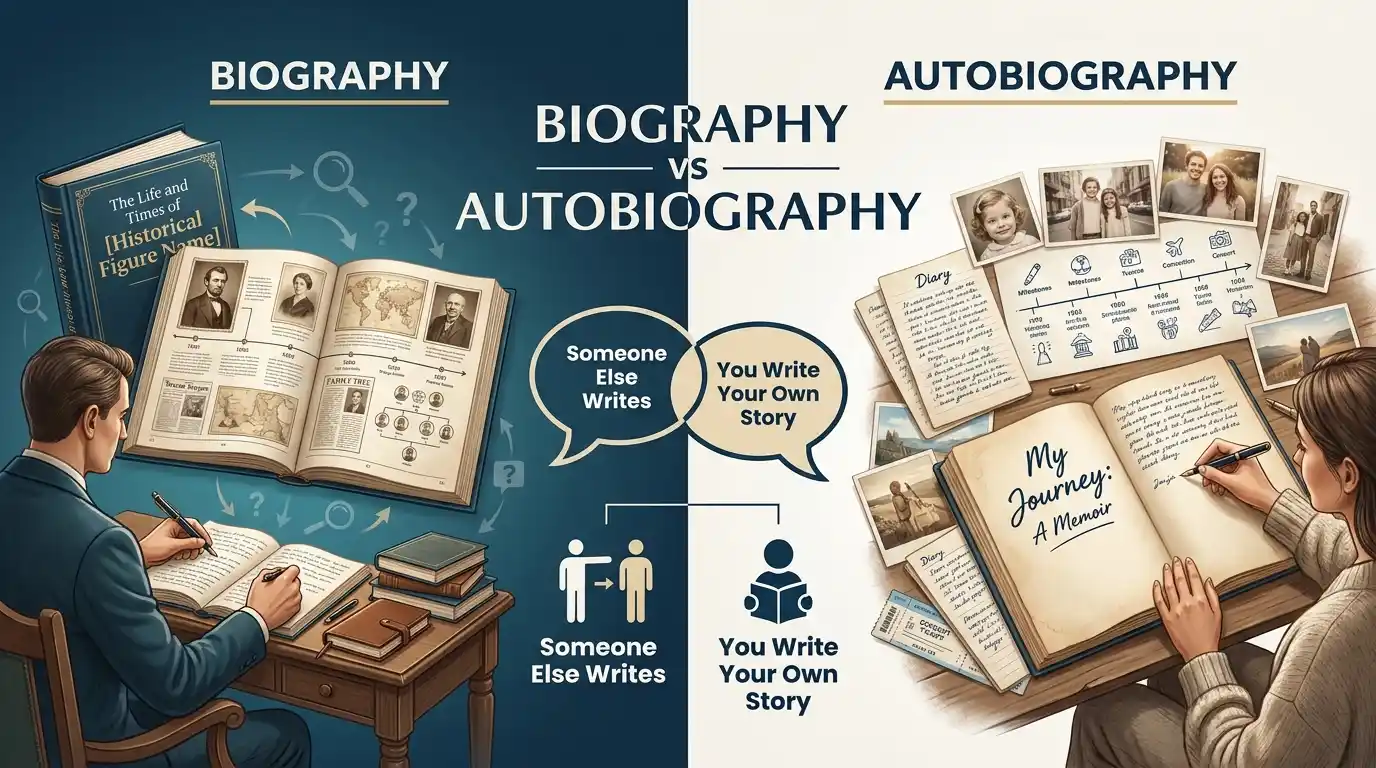
A person’s life can become a story, but who tells that story changes the way readers understand it. This is the main idea behind the difference between biography and autobiography. Both forms tell the story of a person’s life, yet they come from different points of view.
People often search for the difference between biography and autobiography because the two genres can look very similar. Both may cover childhood, education, career, relationships, achievements, struggles, and major life events. The biggest difference is the author. A biography is written by someone other than the person whose life is being described. An autobiography is written by the person about their own life.
Understanding the difference between biography and autobiography is useful for students, readers, writers, and anyone studying nonfiction. It helps you identify the author’s perspective, understand possible limits of the account, and choose the right term when discussing a book.
This guide explains the difference between biography and autobiography with simple definitions, history, examples, common mistakes, spelling guidance, and practical writing advice.
Quick Answer
The main difference is who writes the life story.
A biography is a nonfiction account of someone’s life written by another person.
An autobiography is a nonfiction account of someone’s own life written by that person.
For example:
A historian writes a book about the life of a famous scientist. That book is a biography.
If the scientist writes a book about their own life, it is an autobiography.
The easiest way to remember the difference is:
- Biography = someone else writes your life story.
- Autobiography = you write your own life story.
Both forms can include facts, memories, major events, personal experiences, and reflections. However, their perspectives are different.
| Feature | Biography | Autobiography |
|---|---|---|
| Subject | Another person’s life | The author’s own life |
| Writer | Someone other than the subject | The subject of the book |
| Point of view | Usually third person | Usually first person |
| Main source | Research, records, interviews, documents | Personal memories and records |
| Personal insight | Based on research and available evidence | Direct access to the author’s experiences |
| Common pronouns | He, she, they | I, me, my |
| Purpose | Explain and document another person’s life | Tell one’s own life story |
The Origin of Biography and Autobiography
The words biography and autobiography have Greek roots.
Origin of Biography
Biography comes from Greek elements related to bios, meaning “life,” and graphia, meaning “writing” or “a written account.”
The word entered English through French and Latin forms and developed into its modern meaning: a written account of a person’s life.
The basic idea is therefore connected with writing about a life.
A biography does not have to cover every moment of someone’s existence. A writer may focus on a person’s childhood, career, public achievements, relationships, ideas, or historical importance.
Origin of Autobiography
Autobiography combines several Greek-derived elements:
- auto- = self
- bio- = life
- -graphy = writing or description
The literal idea is therefore writing about one’s own life.
The word became established in English in the late 18th century. The genre itself, however, has much older roots because people have been recording their own experiences and lives for centuries.
Why the Words Look So Similar
The words share bio and graphy because both describe written accounts of lives.
The difference comes from the prefix:
- auto- points to the self.
- biography has no auto- prefix, so the word does not specifically say that the subject wrote it.
This makes the vocabulary easier to remember.
Pronunciation
The words are not pronounced exactly alike.
- Biography: usually pronounced with four syllables, with the main stress near the second syllable.
- Autobiography: usually pronounced with six syllables, with the main stress on the main biography portion.
A useful memory trick is to notice the extra auto- at the beginning of autobiography. It signals that the person is writing about themselves.
Parts of Speech
Both biography and autobiography are countable nouns.
Examples:
- “I read a biography of the scientist.”
- “She published an autobiography.”
- “The library has several biographies.”
- “His autobiography became popular.”
Their related adjectives are:
- biographical — related to a biography
- autobiographical — related to an autobiography or based on the author’s own life
For example:
“The film contains several autobiographical details.”
Biography vs Autobiography: The Main Differences
1. The Author Is Different
This is the clearest distinction.
A biography has a different writer and subject.
An autobiography has the same person as both writer and subject.
For example:
A journalist writes about a musician’s life.
That is a biography.
If the musician writes the story personally, it becomes an autobiography.
2. The Point of View Is Usually Different
Biographies are normally written in the third person.
Example:
“Maria grew up in a small coastal town.”
Autobiographies are normally written in the first person.
Example:
“I grew up in a small coastal town.”
This is a useful clue when identifying the genre, although point of view alone is not always enough.
3. The Sources Are Different
A biographer may use many sources, including:
- Letters
- Diaries
- Interviews
- Newspaper reports
- Public records
- Photographs
- Earlier publications
- Personal documents
An autobiographer can also use records and documents, but they have direct access to their own memories and experiences.
4. The Emotional Perspective Can Differ
An autobiography can give readers direct access to how the author remembers an event.
For example:
“I was terrified when I received the diagnosis.”
A biographer might describe the same event from outside:
“The diagnosis deeply affected her.”
The autobiographical version provides the subject’s own voice. The biographical version provides another person’s interpretation.
5. The Author’s Bias Can Take Different Forms
Neither genre is automatically completely objective.
A biographer may have opinions about the subject. Their selection of evidence and interpretation can shape the story.
An autobiographer may also have personal biases because they are describing their own experiences.
Memory can change over time, and people may remember the same event differently. For this reason, both genres should be read thoughtfully.
6. The Scope Can Be Different
A biography may cover a person’s entire life from childhood to old age. It may also focus on only one period.
An autobiography can do the same.
Some autobiographical works focus strongly on childhood, career, hardship, identity, travel, or a particular period rather than providing a complete record of every year.
7. The Purpose Can Be Different
A biography may aim to help readers understand why a person became historically, culturally, scientifically, or politically important.
An autobiography may place more emphasis on personal experience, reflection, memory, and the author’s own interpretation of events.
The two purposes can overlap, but the author’s position remains the key distinction.
British English vs American English Spelling
There is no meaningful British-American spelling difference between biography and autobiography.
Both British and American English use:
- biography
- autobiography
- biographical
- autobiographical
The words come from Greek-derived vocabulary that entered English through historical borrowing, and neither developed a standard British-American spelling variation.
| Word | British English | American English |
|---|---|---|
| Biography | biography | biography |
| Autobiography | autobiography | autobiography |
| Biographical | biographical | biographical |
| Autobiographical | autobiographical | autobiographical |
There may be accent differences in pronunciation, but there is no major regional spelling distinction to learn.
Which Spelling Should You Use?
Use biography and autobiography in both American and British English.
For US readers:
“I bought a biography of the president.”
For UK readers:
“I bought an autobiography of the athlete.”
The spelling stays the same.
The important issue is choosing the correct word based on the author.
Ask:
Did the person write about their own life?
If yes, autobiography is usually correct.
Did another person write about that person’s life?
If yes, biography is usually correct.
Common Mistakes with Biography and Autobiography
Mistake 1: Calling Every Life Story an Autobiography
A book about someone’s life is not automatically an autobiography.
If another writer tells the story, it is generally a biography.
Incorrect:
“The historian wrote an autobiography of the king.”
Better:
“The historian wrote a biography of the king.”
Mistake 2: Assuming a First-Person Book Is Always an Autobiography
First-person narration is a strong clue, but the term depends on the work’s relationship to the author’s life.
A fictional first-person novel is not an autobiography simply because the narrator says “I.”
Mistake 3: Confusing Autobiography with Memoir
A memoir is closely related to autobiography, but the terms are not always identical.
An autobiography often presents a broader account of the author’s life. A memoir commonly focuses on particular experiences, periods, relationships, or themes.
The boundaries can overlap, and publishers and authors may use the labels differently.
Mistake 4: Spelling “Autobiography” Incorrectly
Because the word is long, writers sometimes omit letters or mix up the order.
Remember its structure:
auto + bio + graphy
Thinking of these three parts makes the spelling easier.
Mistake 5: Using “Biography” as a Verb
Biography is normally a noun.
You would not normally say:
“I biography the actor.”
Instead, say:
“I wrote a biography of the actor.”
The related verb biograph exists in English but is uncommon in everyday writing. It is usually better to use a clearer phrase such as write a biography.
Mistake 6: Assuming Either Genre Is Completely Objective
Both forms involve selection.
A biographer chooses which events and sources to include. An autobiographer chooses which memories and experiences to share.
Neither should automatically be treated as a perfect record of every fact.
Biography and Autobiography in Everyday Examples
In Emails
You might write:
“Could you recommend a good biography of the scientist?”
Or:
“I am reading an autobiography for my literature assignment.”
In an academic email, using the correct genre name makes your request clear.
In News Writing
News articles often describe newly released books:
“The author has published an autobiography about her childhood and career.”
A review of a book written by another person might say:
“The new biography examines the leader’s early political career.”
In Social Media
People often use short forms:
“Just finished this amazing biography!”
Or:
“His autobiography completely changed how I saw his career.”
These uses are casual but grammatically correct.
In Formal Writing
Students may write:
“The biography uses letters and historical records to reconstruct the author’s subject’s early life.”
An essay discussing an autobiography might say:
“The first-person narration gives readers direct access to the author’s memories.”
In Book Reviews
A useful distinction is:
“The biography presents the subject through external research, while the autobiography presents the author’s own account.”
This clearly explains why the two books may tell similar events in different ways.
Biography vs Autobiography: A Simple Decision Guide
Use this quick test when you are unsure.
| Question | If the answer is yes | Choose |
|---|---|---|
| Did someone write about another person’s life? | The writer and subject are different | Biography |
| Did a person write about their own life? | The writer and subject are the same | Autobiography |
| Does the book focus on selected memories? | It may be a personal life account | Memoir may also fit |
| Is the story fictional? | It is not automatically either genre | Check the work’s form |
| Does the author use “I”? | It suggests first-person narration | Check whether it is nonfiction |
The simplest rule remains:
Biography = someone writes about another person’s life.
Autobiography = someone writes about their own life.
Why the Difference Matters
Knowing the difference helps readers understand where a life story comes from.
A biography may offer distance. The writer can compare sources, question claims, and place events within a larger historical setting.
An autobiography can offer intimacy. The author can describe private thoughts, emotions, memories, and experiences from their own perspective.
Neither approach is automatically better. They simply give readers different windows into a person’s life.
For students, this distinction also matters in book reports and exams. If a question asks you to identify the genre, first look at the relationship between the author and the subject.
Frequently Asked Questions
1. What is the main difference between biography and autobiography?
A biography is written by someone about another person’s life. An autobiography is written by a person about their own life.
2. Is an autobiography written in first person?
Usually, yes. Because the author is describing their own life, autobiographies commonly use first-person pronouns such as I, me, and my.
3. Is a biography always written in third person?
Usually, yes. A traditional biography normally refers to the subject as he, she, or they. However, writing styles can vary.
4. Is a memoir the same as an autobiography?
Not exactly. An autobiography often covers a broader portion of a person’s life, while a memoir usually focuses on selected experiences, periods, or themes. The categories can overlap.
5. Can someone else write an autobiography for a person?
If another person writes the complete book on behalf of the subject, the classification can become more complex. A book may involve collaboration or a credited co-writer, but an autobiography is fundamentally presented as the subject’s own life account.
6. Are biography and autobiography spelled differently in British and American English?
No. Both varieties use biography and autobiography with the same spelling.
7. How can I remember the difference?
Look at the prefix auto-. It means “self.” Therefore, an autobiography is a life story written by the person whose life it describes.
Conclusion
The difference between biography and autobiography becomes simple once you focus on the writer. A biography tells another person’s life, while an autobiography tells the author’s own life.
Both genres can reveal important facts, emotions, struggles, and achievements, but they offer different viewpoints. One comes from an outside researcher; the other comes from the subject’s own voice.
Knowing this difference also helps you read with care. Every life story reflects choices about memory, evidence, events, and meaning, whether the writer is the subject or someone else.
Practice these terms in essays, emails, and daily conversations. Once the “auto” clue becomes familiar, choosing the right word will feel natural and easy.

Aamer Shahzad is the founder of Diffnexx.com, a fast-growing educational platform focused on high-intent “difference between” topics. With over 8 years of experience in English language education and analytical writing, I specialize in breaking down complex “difference between” topics into clear, structured, and easy-to-understand explanations. Diffnexx.com is your go-to resource for enhancing English skills and writing with confidence.
I specializes in building search-optimized, research-driven comparison content designed for clarity, authority, and long-term digital asset value.







