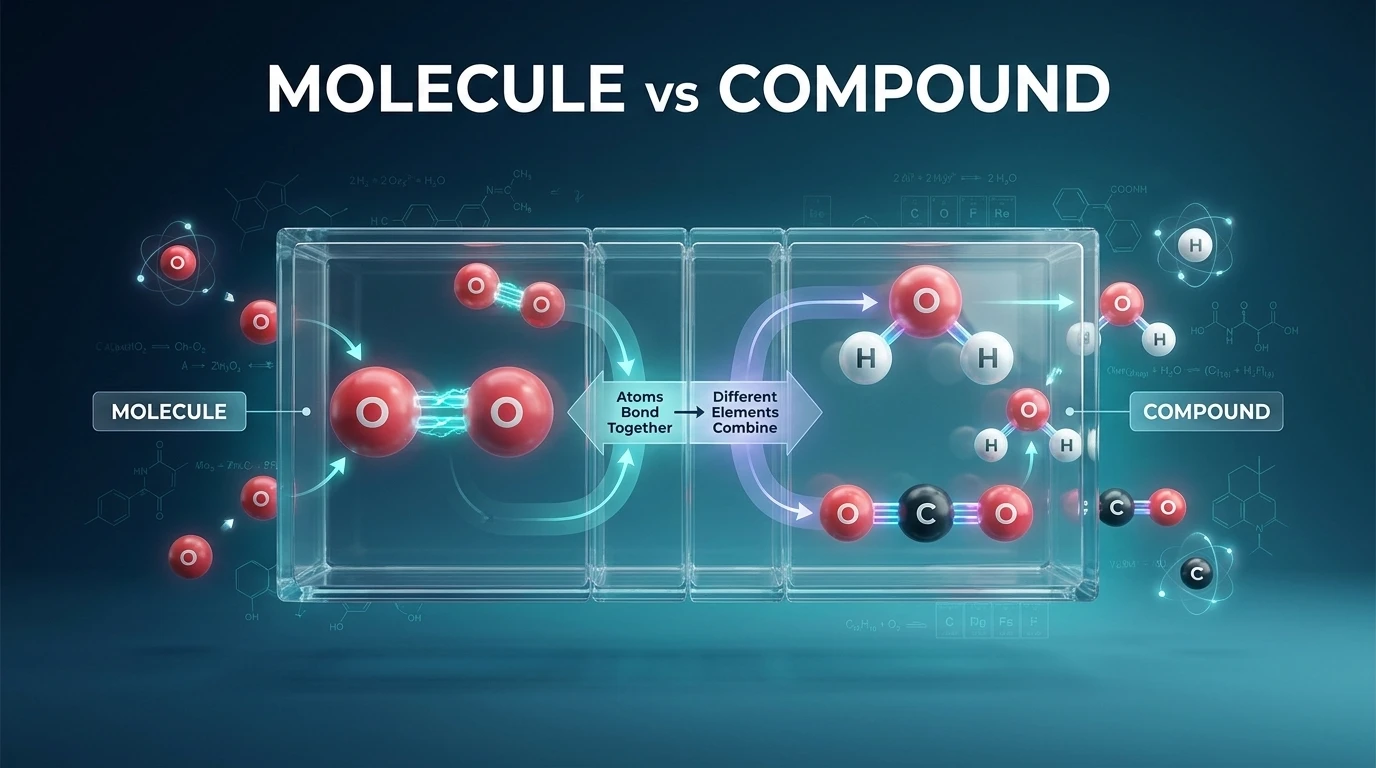
Chemistry becomes much easier when you know what its basic words really mean. Two terms that often cause confusion are molecule and compound. They are closely related, but they do not describe exactly the same thing. Understanding the difference between molecule and compound can help you read chemical formulas, follow science lessons, and avoid common mistakes in chemistry.
People often search for the difference between molecule and compound because examples such as water, oxygen, carbon dioxide, and salt seem to blur the line. Water is both a molecule and a compound, while oxygen exists as molecules but is not a compound. Sodium chloride is a compound, but it does not consist of separate molecules in the same way water does.
The difference between molecule and compound becomes clear when you focus on what each word describes. A molecule is a discrete group of atoms held together by chemical interactions. A compound is a chemical substance made from two or more different elements in a fixed composition.
Once you understand this simple distinction, many chemistry examples become much easier to classify.
Quick Answer
A molecule is a discrete group of two or more atoms that behaves as a single unit. The atoms may be from the same element or from different elements.
A compound is a pure chemical substance made from atoms of two or more different elements in a definite proportion.
This creates an important relationship:
Some molecules are compounds, but not every molecule is a compound.
For example:
- O₂ is a molecule because it contains two oxygen atoms bonded together. It is not a compound because it contains only one element.
- H₂O is a molecule and a compound because it contains hydrogen and oxygen atoms.
- CO₂ is a molecule and a compound because it contains carbon and oxygen.
- NaCl is a compound, but solid sodium chloride is an ionic lattice rather than a collection of separate NaCl molecules.
A useful way to remember the difference is:
Molecule describes a bonded particle or unit. Compound describes a substance containing different elements chemically combined.
IUPAC defines a molecule as an electrically neutral entity consisting of more than one atom. Chemistry texts also distinguish molecular compounds from ionic compounds, showing why the two terms should not be treated as synonyms.
The Origin of Molecule and Compound
The words molecule and compound have different histories, and their origins help explain why they developed into different scientific terms.
Origin of “Molecule”
Molecule entered English in the late 18th century through French molécule, from Modern Latin molecula. The Latin word was a diminutive form related to moles, meaning a mass or large body. Early uses referred broadly to an extremely small particle.
The scientific meaning became more precise over time as scientists developed better ideas about atoms and chemical structure. Amedeo Avogadro used molecule in its modern scientific sense in 1811, helping establish the idea of molecules as distinct particles associated with substances.
Today, the word has a much more exact chemical meaning. IUPAC describes a molecule as an electrically neutral entity made of more than one atom.
Origin of “Compound”
Compound has a different history. The word comes from forms related to Old French and Latin componere, meaning “to put together” or “to combine.” The Latin parts carry the basic idea of bringing things together.
That basic meaning fits chemistry well. A compound results when different chemical elements become part of the same chemical substance through chemical bonding.
The everyday word compound has several meanings in English, including a fenced area or a substance made by combining things. Chemistry uses the word in a specific technical sense.
So, while their histories are different, both words developed meanings connected with the structure or combination of matter.
Molecule vs Compound: The Main Difference
The easiest way to understand the distinction is to ask two different questions.
Question 1: What is the individual bonded unit?
If the answer is a discrete group of atoms behaving as one unit, you are talking about a molecule.
Question 2: What kind of substance is present?
If the substance contains two or more different chemical elements combined in a fixed composition, you are talking about a compound.
Consider these examples:
| Substance or particle | Molecule? | Compound? | Why? |
|---|---|---|---|
| O₂ | Yes | No | Two oxygen atoms, one element |
| N₂ | Yes | No | Two nitrogen atoms, one element |
| H₂O | Yes | Yes | Hydrogen and oxygen are combined |
| CO₂ | Yes | Yes | Carbon and oxygen are combined |
| CH₄ | Yes | Yes | Carbon and hydrogen are combined |
| NaCl | No, in the usual solid-state description | Yes | Ionic compound made of Na⁺ and Cl⁻ |
| He | No | No | Individual helium atoms |
This table reveals the key idea: molecule and compound are not competing categories. A substance can fit both descriptions, one description, or neither.
Why Water Is Both a Molecule and a Compound
Water is one of the clearest examples.
A water molecule has the formula H₂O. Each individual molecule contains two hydrogen atoms and one oxygen atom. The atoms are connected by covalent bonds and form a discrete molecular unit.
Water is also a compound because it contains two different elements: hydrogen and oxygen.
Therefore:
H₂O = molecule + compound
This is why saying “a molecule and a compound are the same thing” is inaccurate. Water happens to belong to both categories.
Carbon dioxide works in the same way:
CO₂ = molecule + compound
Its molecules contain one carbon atom and two oxygen atoms.
Why Oxygen Is a Molecule but Not a Compound
Oxygen provides the opposite example.
The oxygen gas commonly found in Earth’s atmosphere is primarily O₂. Each O₂ unit contains two oxygen atoms.
That makes O₂ a molecule.
However, it is not a compound because both atoms belong to the same chemical element.
A compound must contain atoms from at least two different elements.
So:
O₂ = molecule, but not a compound
The same reasoning applies to N₂, H₂, and other elemental substances that exist as discrete molecules.
Why Sodium Chloride Is a Compound but Not a Molecular Substance
Sodium chloride, NaCl, is especially useful because it shows why the terms cannot be used interchangeably.
Sodium chloride is an ionic compound. Its structure consists of positively charged sodium ions and negatively charged chloride ions arranged in an extended crystal lattice.
It is common in introductory chemistry to write NaCl as its formula, but that does not mean a piece of solid table salt is made of individual NaCl molecules.
Instead, the formula represents the simplest ratio of sodium ions to chloride ions in the ionic solid.
Chemistry resources distinguish ionic compounds from molecular compounds for exactly this reason. Molecular compounds contain discrete molecules, while ionic compounds contain ions arranged in a structure held together by electrostatic attraction.
Parts of Speech and Correct Usage
Both molecule and compound are primarily countable nouns in chemistry.
Molecule
You can say:
- “A water molecule contains two hydrogen atoms.”
- “The scientist studied the molecules in the sample.”
- “Oxygen exists as a diatomic molecule.”
Related words include:
- molecular
- molecularly
- intermolecular
Compound
You can say:
- “Water is a chemical compound.”
- “The laboratory tested several compounds.”
- “Sodium chloride is an ionic compound.”
Related words include:
- compound
- compounded
- chemical compound
- molecular compound
Do not treat molecule and compound as interchangeable nouns. The correct word depends on whether you are describing a discrete atomic unit or a chemical substance made from different elements.
Pronunciation of Molecule and Compound
These words are pronounced differently, so pronunciation usually does not cause the same kind of confusion as words such as affect and effect.
Molecule has several syllables and normally carries stress near the first syllable.
Compound can be pronounced differently depending on its grammatical role. As a noun or adjective, the stress normally falls on the first syllable. As a verb, English commonly shifts the stress toward the second syllable.
For chemistry writing, the noun compound is the form you will use most often.
A simple memory tip is:
- molecule → think about a bonded atomic unit
- compound → think about different elements combined
British English vs American English Spelling
There is no meaningful British-American spelling difference between molecule and compound.
Both British English and American English use:
- molecule
- molecules
- molecular
- compound
- compounds
- molecular compound
| Term | British English | American English |
|---|---|---|
| Molecule | molecule | molecule |
| Plural | molecules | molecules |
| Molecular | molecular | molecular |
| Compound | compound | compound |
| Plural | compounds | compounds |
| Molecular compound | molecular compound | molecular compound |
Unlike words such as colour/color or centre/center, these chemistry terms do not change spelling between the two major varieties of English.
The scientific terminology is also broadly shared because chemistry uses internationally standardized naming systems and conventions.
Which Spelling Should You Use?
Since there is no British-American spelling difference, choose molecule or compound based on the scientific meaning, not your location.
If You Write for a U.S. Audience
Use the standard forms molecule, molecular, and compound.
For example:
“A carbon dioxide molecule contains one carbon atom and two oxygen atoms.”
If You Write for a UK or Commonwealth Audience
Use exactly the same spellings.
For example:
“Sodium chloride is an ionic compound.”
There is no need to change these words to a British spelling.
If You Write for a Global Audience
Use the internationally recognized chemistry terms and define them clearly when the audience is new to chemistry.
The bigger issue is not spelling. It is scientific accuracy. Calling every compound a molecule can create more confusion than any spelling issue.
Common Mistakes with Molecule and Compound
1. Saying every molecule is a compound
Incorrect: “O₂ is a compound.”
Correct: “O₂ is a molecule of an element.”
O₂ contains only oxygen, so it does not meet the basic definition of a compound.
2. Saying every compound contains molecules
This is also incorrect.
Ionic compounds such as sodium chloride have extended ionic structures rather than discrete molecules in the ordinary solid-state description.
3. Calling NaCl a molecule
Students often write:
“One NaCl molecule contains one sodium atom and one chlorine atom.”
For solid sodium chloride, this is not the best description. NaCl is an ionic compound, and its formula represents the ratio of ions in the lattice.
4. Thinking “compound” means any mixture
A mixture is not automatically a compound.
Air, for example, contains several substances mixed together. A compound has a definite chemical composition and involves chemical combination of its constituent elements.
5. Assuming different elements always form molecules
Different elements can form molecular compounds, but they can also form ionic compounds and other extended structures.
6. Confusing molecular formula and empirical formula
A molecular formula can show the actual number of atoms in one molecule of a molecular substance. An empirical formula gives the simplest whole-number ratio of elements.
For example, molecular formulas are especially useful for substances such as H₂O and CO₂. Ionic compounds such as NaCl are represented by formula units or composition ratios rather than discrete molecules.
Difference Between Molecule and Compound in Everyday Examples
The distinction appears in many common substances.
In an Email
A science teacher might write:
“Please explain why oxygen is a molecule but not a compound.”
Here, molecule describes the structure of O₂, while compound describes a different category.
In News Writing
A science article might say:
“Researchers identified a new compound with unusual chemical properties.”
Here, compound refers to a chemical substance under investigation.
On Social Media
A student might post:
“I finally understand why water is both a molecule and a compound!”
That statement is scientifically reasonable because H₂O fits both descriptions.
In Formal Academic Writing
A chemistry report might say:
“The compound contains two elements and forms discrete molecules.”
This sentence uses both terms correctly. The first describes the substance’s composition, while the second describes the form of its individual units.
A Simple Rule to Remember
When you see a chemical formula, ask:
Are the atoms from one element or multiple elements?
Then ask:
Does the substance exist as separate bonded molecular units?
If it contains multiple elements and exists as discrete molecules, it can be both a compound and a molecule.
If it contains only one element but forms discrete bonded units, it can be a molecule without being a compound.
But it contains multiple elements and forms an ionic or extended structure rather than discrete molecules, it can be a compound without being molecular.
This three-part test makes many beginner chemistry questions much easier.
FAQs
Is every molecule a compound?
No. A molecule can contain atoms of only one element. O₂ is a molecule, but it is not a compound because it contains only oxygen.
Is every compound a molecule?
No. Ionic compounds such as sodium chloride are compounds but do not consist of separate molecules in the usual solid-state description.
Is water a molecule or a compound?
Water is both. An H₂O molecule is a discrete group of hydrogen and oxygen atoms, while water as a pure substance is a compound because it contains two different elements in a fixed composition.
Is oxygen a molecule or a compound?
Oxygen gas is commonly O₂, so it is a molecule. It is not a compound because both atoms are oxygen atoms.
Is carbon dioxide a molecule or a compound?
Carbon dioxide is both a molecule and a compound. Each CO₂ molecule contains carbon and oxygen, and the substance has a definite chemical composition.
Is salt a molecule?
Common table salt, sodium chloride, is an ionic compound. In its solid form, it has an extended ionic lattice rather than separate NaCl molecules.
What is the easiest way to remember the difference?
Think unit versus substance. A molecule describes a discrete bonded unit of atoms. A compound describes a substance made from two or more different elements in a fixed chemical composition.
Conclusion
The difference between molecule and compound becomes simple once you separate structure from composition. A molecule is a discrete bonded unit, while a compound contains different elements in a definite chemical combination.
Water shows how the ideas can overlap: H₂O is both a molecule and a compound. Oxygen shows the contrast because O₂ is molecular but contains only one element.
Sodium chloride gives another useful lesson. It is a compound, but its solid structure is ionic rather than a collection of separate molecules.
With a little practice, these terms become natural. Try using them in your emails, essays, and daily conversations to build lasting chemistry confidence.

Anton Reyes is a contributing writer at DiffNexx.com, where he explores meaningful differences in language, culture, and everyday concepts. With a background in creative nonfiction, Anton brings clarity and balance to complex comparisons. His writing helps readers understand subtle distinctions in words and ideas, making learning both insightful and engaging.







